

Exam Anxiety on a GCSE Maths Resit
Exam anxiety on a GCSE Maths resit can feel overwhelming. Build a practical revision routine, manage exam-day nerves and practise with purpose.
A GCSE Maths resit can sit awkwardly beside the rest of your life. You may be starting a college course, an apprenticeship or work while returning to a qualification you hoped was already behind you. That combination can make exam anxiety on a GCSE Maths resit feel especially heavy.
The practical answer is not to wait until you feel completely confident. Build familiarity in small, deliberate steps: identify weak topics, practise them, complete timed questions and review every error. Anxiety may still appear, but the paper will contain fewer surprises.
Your practical resit checklist
- Separate what you know from what you need to relearn.
- Revise in short, regular sessions rather than occasional marathons.
- Practise without notes once a method becomes familiar.
- Introduce timed work gradually.
- Review mistakes using mark schemes and video solutions.
- Speak to your college early if anxiety is affecting daily life or exam access.
- Use the MathsGenie GCSE revision resources to keep your work focused.
Why resit anxiety can feel different
A post-16 student is not simply repeating Year 11. Your timetable, responsibilities and feelings about the qualification may all have changed.
Perhaps you narrowly missed the grade you needed. That can create the thought that every future attempt must go perfectly. Perhaps maths has become tied to entry requirements for a course or job. The paper then feels like more than a paper.
There can also be frustration. Revisiting fractions or algebra while progressing in other subjects may feel like moving backwards. It is not. You are returning with more experience and a clearer target. The purpose is not to prove that the previous result was wrong. It is to prepare for the next opportunity.
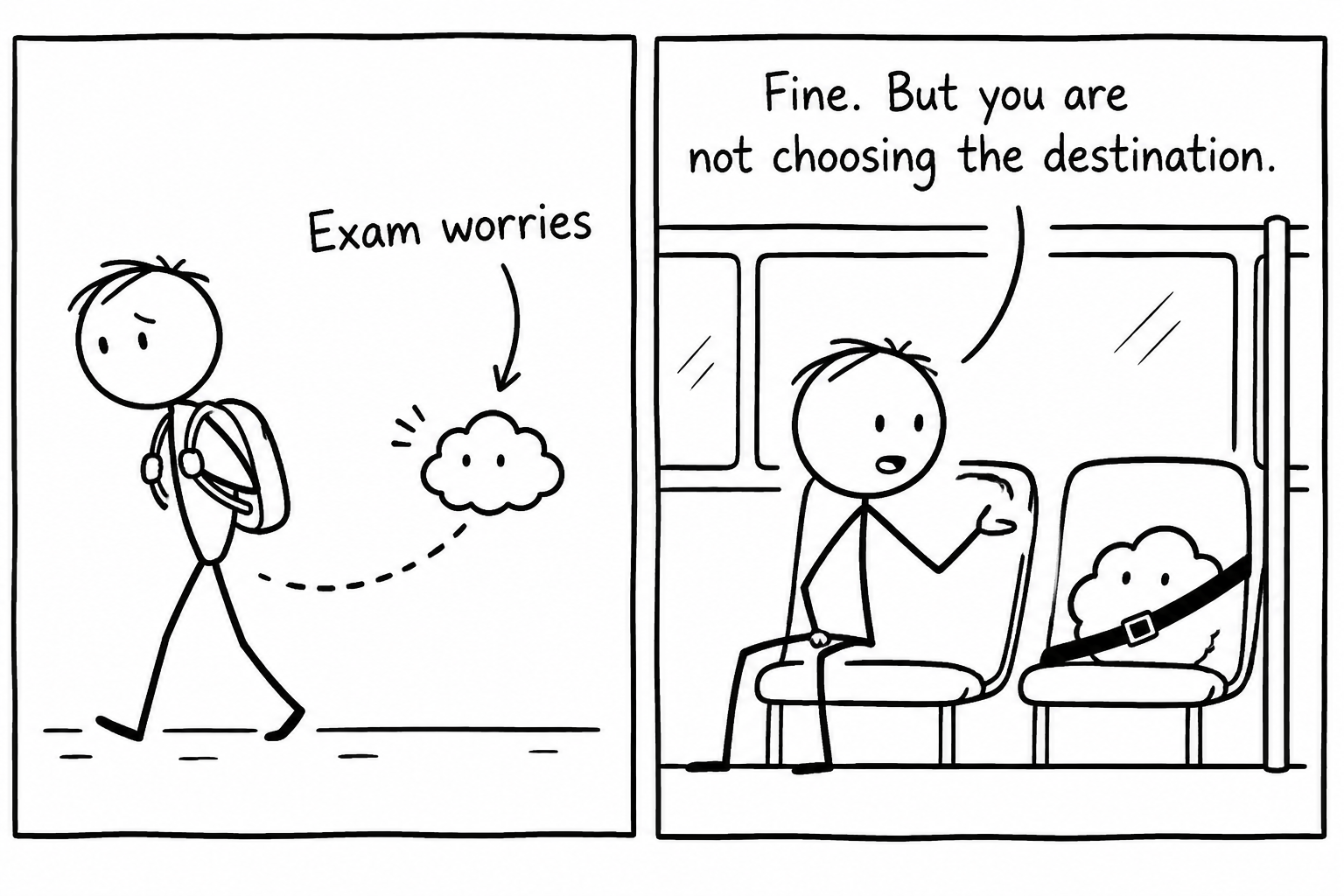 A post-16 student allows an exam-worry cloud onto the bus but refuses to let it choose the destination
Turn a large fear into specific topics
Anxiety likes vague statements: “I cannot do maths” or “I always fail exams.” Revision improves when those statements become precise.
Replace “algebra is impossible” with questions such as:
- Can I solve a linear equation?
- Can I expand and factorise a single bracket?
- Can I substitute into a formula?
- Do I lose marks when negative numbers are involved?
A precise weakness has a next action. Begin with a relevant revision lesson, answer practice questions, mark the work and record what needs another attempt. MathsGenie organises GCSE topics by grade, helping you concentrate on material that matches your tier and current working level.
Keep the error record simple. Label each mistake as one of the following:
| Type of mistake | Useful response |
|---|---|
| Knowledge gap | Revisit the lesson and copy the method accurately. |
| Method error | Complete several similar questions without notes. |
| Misread question | Underline the value or instruction that was missed. |
| Arithmetic slip | Slow down and show an extra line of working. |
| Time pressure | Practise a short timed section before another full paper. |
This changes mistakes from evidence against you into instructions for your next session.
Build confidence before adding pressure
Going straight from topic revision to a full timed paper can be discouraging. It combines mathematical recall, concentration, timing and exam nerves in one demanding task.
Use a gradual sequence instead:
Start with supported practice
Review a revision lesson, then answer questions while the method is still fresh. At this stage, accuracy matters more than speed.
Remove the support
Return to similar questions a day or two later without notes. This checks whether you can retrieve the method rather than merely recognise it.
Add manageable time limits
Complete a short group of questions under timed conditions. A timer should give you information, not punish you. If the time limit causes your accuracy to collapse, shorten the task and build up again.
Attempt complete papers
Use MathsGenie GCSE past papers once individual topics feel more secure. Sit somewhere quiet, use the permitted equipment and follow the paper time. Afterwards, use the available mark scheme rather than judging the attempt by how stressful it felt.
Use the November resit as a defined project
For eligible post-16 students, GCSE Mathematics may be available in the November exam series. Exact entries, dates and arrangements depend on the examination series and your centre, so confirm them with your college or exam officer rather than relying on an old online timetable.
A November resit can arrive quickly after the summer result. That makes prioritisation important. Start with topics that appear frequently in your own marked work, not with whichever page happens to come next in a textbook.
Your weekly plan might contain three types of session:
- one topic lesson followed by practice;
- one mixed set completed without notes;
- one timed section followed by careful marking.
The MathsGenie revision planner can help turn that intention into scheduled work. A modest plan you repeatedly follow is more valuable than an ambitious plan abandoned after three days.
What to do when anxiety rises in the exam
The first difficult question can create the impression that the entire paper will be difficult. Pause before accepting that conclusion.
Place both feet on the floor and let your breathing settle. Read the question again, looking only for facts you have been given and what you are being asked to find. Write down a relevant formula, diagram or first step if you know one.
If you remain stuck, leave space and move on. Returning later is an exam technique, not an admission of defeat. Another question may restore your rhythm and trigger the method you could not initially recall.
Show your working throughout. Correct intermediate steps may earn marks even when the final answer is wrong. They also make checking easier because you can see where your reasoning changed.
Ask for support before the paper
If anxiety is affecting sleep, attendance, revision or your ability to enter the exam room, tell someone early. This might be your maths teacher, tutor, college wellbeing team, SENCo, GP or another trusted professional.
Exam access arrangements are not automatically granted because a student feels nervous. They are based on individual needs and formal rules, and they must normally reflect the support used in your usual learning or assessment environment. Your centre is responsible for considering evidence and making any application. Early conversation gives staff time to explain what may be appropriate.
If you feel unable to cope or unsafe, seek urgent support from a trusted adult, health professional or emergency service rather than treating it as a revision problem.
Common mistakes when preparing for a resit
Only practising comfortable topics. Familiar questions feel reassuring, but improvement usually sits in the topics you currently avoid.
Marking by final answers alone. Use mark schemes to see whether your method was valid and where marks were lost.
Completing paper after paper without review. One paper analysed carefully can teach more than several papers completed and forgotten.
Treating one low mark as a prediction. A practice result is a snapshot. Its purpose is to reveal what to work on next.
Leaving full papers until the final week. Timed practice becomes less threatening when it is introduced gradually and repeated.
Make the next paper more familiar
A resit does not ask you to become fearless. It asks you to keep preparing even when confidence varies.
Choose one weak area today. Review the method, complete practice questions and mark them honestly. Then use MathsGenie’s free lessons, practice questions, past papers, mark schemes and video solutions to decide what comes next.
When you are ready to combine topics, build a targeted practice paper in Mock Exam Builder. Select the areas that need attention and turn a vague worry into a paper you can complete, mark and learn from.















