

Edexcel Higher Maths Grade Boundaries Explained
Edexcel higher maths grade boundaries explained, including available grades, combined paper marks and how to use past boundaries in your revision.
A grade boundary can feel like a finish line that keeps moving. You complete a past paper, count your marks and then wonder whether the result means a grade 666, 777 or something else entirely.
The important answer is simple: Edexcel higher maths grade boundaries show the minimum total mark needed for each grade in a particular exam series. Your marks from all three papers are added together out of 240240240. Pearson then applies the published overall boundaries to that combined mark.
Boundaries change between exam series, so an old boundary is useful for interpreting an old paper, but it cannot predict precisely what will be required in your exam.
Edexcel higher tier at a glance
Here is the essential checklist for Edexcel GCSE Maths higher:
- You take three papers: 111H, 222H and 333H.
- Each paper is worth 808080 marks.
- Your three marks combine to give a total out of 240240240.
- Paper 111 is non-calculator; Papers 222 and 333 allow a calculator.
- Grades 444-999 are the standard higher tier grades.
- A grade 333 may be awarded below the grade 444 boundary.
- There is no separate grade for each paper.
- Boundaries are set for each exam series after the papers have been taken and marked.
This structure matters because one difficult paper does not decide your result. All three contribute equally to the final total.
How Edexcel higher maths grade boundaries work
Suppose your paper marks are 525252, 616161 and 575757. Your overall mark is:
52+61+57=17052+61+57=17052+61+57=170Pearson compares the total of 170170170 with the overall higher tier boundaries for that exam series. You do not need to reach a particular boundary on every individual paper.
That creates an important form of flexibility. A disappointing Paper 111 can be recovered through stronger performances on Papers 222 and 333. Equally, an excellent first paper is valuable, but it does not make the remaining papers irrelevant.
Grade boundaries are minimum marks. If a grade 777 boundary were 137137137, for example, then 137137137 would earn a grade 777, provided the mark remained below the grade 888 boundary. A mark of 136136136 would fall into the grade below. Every mark matters near a boundary, including marks earned for correct working.
Which grades are available on Edexcel GCSE Maths higher?
The higher tier is designed to award grades 444-999. It also includes a grade 333 boundary, sometimes described as a safety-net grade for candidates who narrowly miss grade 444.
| Result | What it means on higher tier |
|---|---|
| Grade 999 | The highest GCSE grade |
| Grades 777-888 | Strong performance across higher content |
| Grades 444-666 | Available through the normal higher tier boundaries |
| Grade 333 | May be awarded below the grade 444 boundary |
| U | The mark has not reached the lowest published boundary |
Grades 111 and 222 are not normally reported for higher tier Mathematics. This is one reason tier decisions should be made carefully with your teacher. Higher tier gives access to grades above 555, but foundation tier offers grades 111-555 and may be more suitable for some students.
Past boundaries are illustrations, not predictions
The June 201920192019 Edexcel GCSE Mathematics higher boundaries provide a useful dated example. The qualification had a maximum of 240240240 marks.
| Grade | Minimum total mark in June 201920192019 |
|---|---|
| 999 | 198198198 |
| 888 | 167167167 |
| 777 | 137137137 |
| 666 | 108108108 |
| 555 | 808080 |
| 444 | 525252 |
| 333 | 383838 |
These figures reveal something students sometimes find surprising. A GCSE grade is not based on a fixed percentage such as 70%70\%70% or 80%80\%80%. In this series, the grade 777 boundary was:
137240×100≈57.1%\frac{137}{240}\times 100\approx57.1\%240137×100≈57.1%That does not mean a grade 777 always requires about 57%57\%57%. It means that this proportion corresponded to the published grade 777 boundary for this specific qualification, tier and exam series.
Boundaries can rise or fall because exam papers vary in difficulty. Awarding aims to keep the standard represented by a grade comparable, rather than forcing every cohort through an identical raw-mark threshold. Always match a past paper to the official boundary document from the same series.
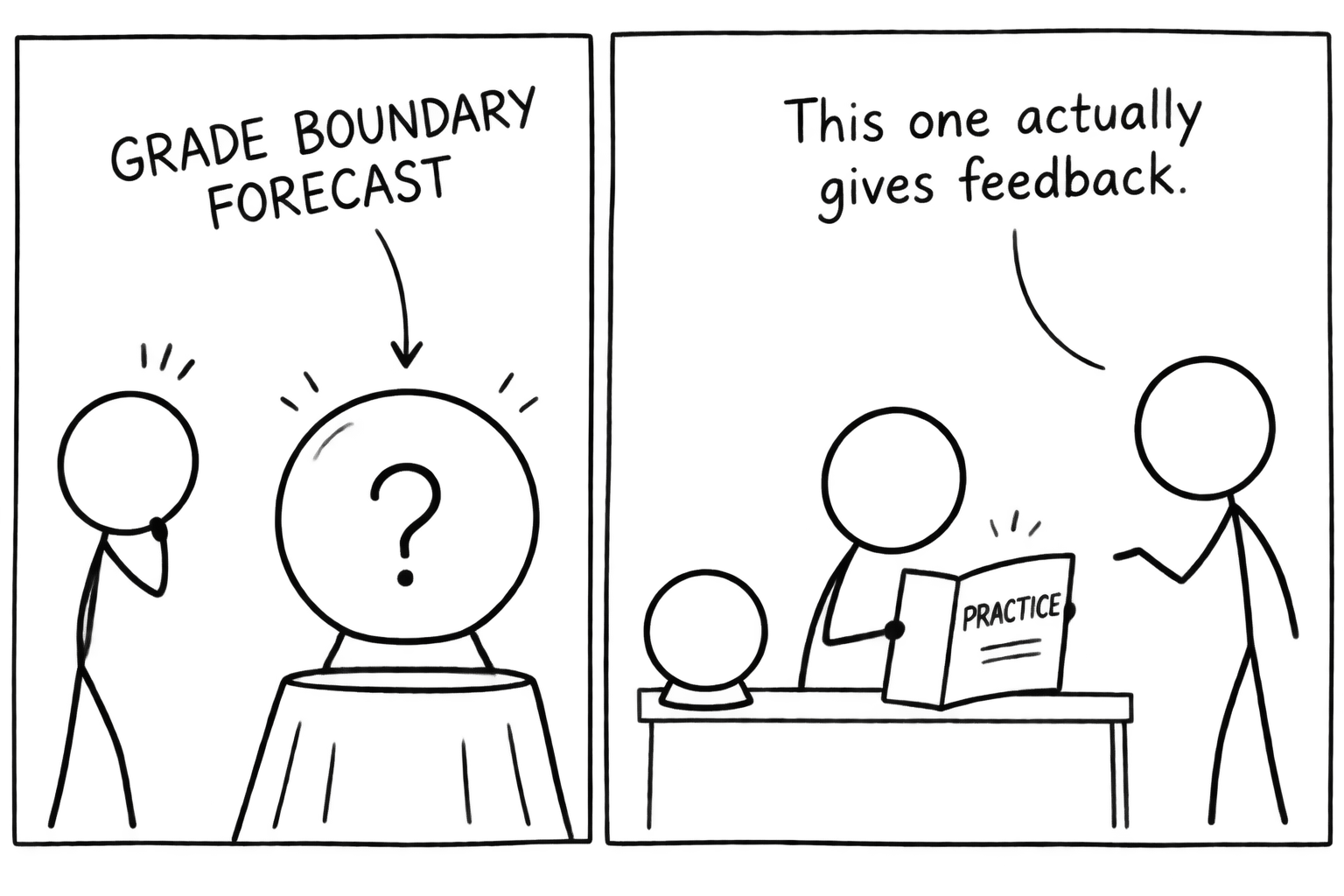 A student discovers that practice gives better feedback than a grade-boundary crystal ball
What boundaries should change about your revision
Boundaries are useful for measuring performance, but they do not tell you what to revise next. A total mark says where you finished. Your incorrect and incomplete answers explain why.
After completing an Edexcel GCSE Maths past paper, mark it carefully and sort lost marks into three groups:
- topics you did not understand;
- methods you knew but could not recall;
- avoidable errors involving arithmetic, notation or reading the question.
Then return to the Maths Genie GCSE revision lessons. Each lesson brings together explanations, videos and practice questions, so you can repair the precise gaps exposed by the paper rather than revising everything equally.
Focus on topics that move marks most
The most useful topic is not automatically the hardest chapter in the textbook. It is the topic where a manageable improvement can recover marks repeatedly.
For one student, that might mean strengthening fractions, decimals and percentages. For another, it could mean revisiting solving equations, ratio or quadratic equations.
Look through several marked papers. If the same weakness appears more than once, it deserves priority. Complete a lesson, answer the practice questions without notes, check the mark scheme and then use a mini test or another paper to see whether the improvement holds.
Predicted papers can add fresh exam-style practice near the examination, while video solutions help you compare your method with a complete solution. A revision planner can turn the diagnosis into a realistic weekly routine. The aim is not to guess a boundary. It is to make your total less dependent on where that boundary eventually falls.
Setting a sensible target mark
Do not treat a historic boundary as a target to hit exactly. If your chosen grade once required 137137137 marks, planning to score precisely 137137137 leaves no room for a harder paper, an unfamiliar question or an ordinary mistake.
Instead, build a margin above the relevant boundaries from several comparable past series. This is a revision target, not a forecast or guarantee. Track both your total and your topic-level errors.
For example, improving by only 444 marks on each paper changes the combined score by:
3×4=123\times4=123×4=12Twelve marks can represent several corrected slips, a better algebra method and one more complete multi-step answer. Progress often looks small on a single question and substantial when the papers are combined.
Common grade-boundary mistakes
Dividing the overall boundary by three
Dividing a boundary by 333 can suggest an average, but it does not create an official paper-level requirement. Your marks may be uneven across the three papers.
Using a boundary from the wrong series
A June boundary should not be used as though it were the official boundary for a different November or June paper. Check the year, series, qualification code and tier.
Assuming boundaries are fixed percentages
There is no permanent percentage for each grade. Raw-mark boundaries are set separately for each series.
Ignoring method marks
A wrong final answer does not always mean zero marks. Clear algebra, substitutions and intermediate steps may earn credit under the mark scheme. Avoid rounding too early, and show enough working for your reasoning to be followed.
Revising the boundary rather than the syllabus
Knowing last year's grade 777 mark cannot earn this year's marks. Topic knowledge, accurate methods and timed practice can.
Turn the number into a plan
A grade boundary is a measuring tool, not a verdict. It converts your combined mark into a grade after the assessment. Before the assessment, the more useful question is quieter and more practical: where can the next few marks come from?
Start with a timed paper, mark it honestly and identify the recurring losses. Then use Maths Genie lessons by GCSE grade to work on the topics that move marks most. Follow the explanation, complete the practice questions, check the mark scheme and return to exam conditions. That cycle is how a boundary stops feeling mysterious and starts becoming manageable.















