

Edexcel Further Maths A Boundary Explained
Edexcel Further Maths A boundary guide, with dated marks, optional-paper totals and a practical way to set your A Level revision target.
A grade boundary can feel like a finish line that moves whenever you look away. You complete a paper, total your marks and then ask the question that brought you here: what is the Edexcel Further Maths A boundary?
There is no single permanent mark. Pearson sets new grade boundaries after each examination series, and the required total depends on your combination of optional papers. In June 2025, for example, the published A boundaries varied by route because different option combinations had different subject-level boundaries.
The practical answer is simple: identify your exact paper combination, use the official boundary for that route and build a safety margin into your revision target.
The answer at a glance
- Edexcel A Level Further Mathematics has a maximum total of 300300300 raw marks.
- You sit four papers, each worth 757575 marks.
- Papers 111 and 222 are compulsory Core Pure Mathematics papers.
- Papers 333 and 444 depend on your school's chosen optional route.
- The A boundary is based on your total subject mark, not a requirement to achieve an A on every paper.
- Boundaries change between examination series and can differ between optional-paper combinations.
- Notional paper boundaries are useful for reviewing performance, but they are not separate grades awarded for individual papers.
Always confirm the final figure using Pearson's boundary document for your examination series. A boundary from a previous year is evidence for planning, not a promise about the next paper.
How the Edexcel Further Maths total works
A student checking the mark needed for an A must first know which papers they are taking. Everyone sits the two Core Pure papers:
75+75=150 75+75=150 75+75=150Two optional papers provide the other 150150150 marks:
75+75=150 75+75=150 75+75=150The complete qualification is therefore marked out of:
150+150=300 150+150=300 150+150=300Optional routes can include Further Pure Mathematics, Further Statistics, Further Mechanics and Decision Mathematics papers. Your school or college normally decides the route it teaches, so check your timetable, entry information or teacher's guidance rather than assuming that another student's boundary applies to you.
This matters because Pearson publishes subject boundaries for permitted paper combinations. Two students can both be taking Edexcel Further Mathematics in the same summer but need slightly different totals for an A if their option combinations differ.
Why optional papers affect the A boundary
A reasonable first instinct is to add together four paper-level A boundaries. That is not the correct way to determine the qualification grade.
Pearson awards the final grade from the subject total for the specific combination of papers entered. The board also publishes notional component boundaries, which show an indicative standard on each paper. Pearson explains that these are useful when considering performance in a linear qualification, but individual components do not receive separate certificated grades.
The distinction is important:
- Subject boundary: determines your final A Level grade.
- Notional component boundary: helps you interpret performance on one paper.
Suppose your four marks are 585858, 515151, 464646 and 606060. Your total is:
58+51+46+60=215 58+51+46+60=215 58+51+46+60=215You would compare 215215215 with the official subject-level A boundary for your exact option route, not with four independently added notional boundaries. A weaker result on one paper can be balanced by stronger marks elsewhere because the final judgement uses the combined total.
What the June 2025 figures illustrate
Dated boundaries are most useful when they teach scale rather than certainty. Pearson's June 2025 notional component document gives the following A marks for the individual Further Mathematics papers:
| June 2025 paper | Maximum mark | Notional A boundary |
|---|---|---|
| Paper 111 | 757575 | 535353 |
| Paper 222 | 757575 | 616161 |
| Paper 3A3A3A | 757575 | 575757 |
| Paper 3B3B3B | 757575 | 515151 |
| Paper 3C3C3C | 757575 | 686868 |
| Paper 3D3D3D | 757575 | 464646 |
| Paper 4A4A4A | 757575 | 626262 |
| Paper 4B4B4B | 757575 | 505050 |
| Paper 4C4C4C | 757575 | 515151 |
| Paper 4D4D4D | 757575 | 525252 |
These figures show why optional papers cannot be treated as interchangeable. In that series, the notional A standard ranged from 464646 to 686868 across the optional components. That does not mean one option was inherently easier. Boundaries respond to the demand of the actual paper and the evidence available to the awarding process.
It also shows why a percentage remembered from social media is rarely enough. You need the year, qualification code, option route and official subject boundary.
How to calculate your position against the boundary
Once you have completed a timed past paper set, mark it carefully using the official mark schemes. Then add the four raw marks:
T=P1+P2+P3+P4 T=P_1+P_2+P_3+P_4 T=P1+P2+P3+P4If the published A boundary for your route is BBB, your margin is:
M=T−B M=T-B M=T−BWhen M>0M>0M>0, the total is above that historical boundary. When M<0M<0M<0, the shortfall is ∣M∣|M|∣M∣ marks.
For example, imagine that a relevant historical route had an A boundary of 215215215 and your total was 207207207. The gap would be:
207−215=−8 207-215=-8 207−215=−8The useful conclusion is not simply, "I missed an A." It is that eight additional marks across four papers would have crossed that particular historical line. That is an average improvement of:
84=2 \frac{8}{4}=2 48=2marks per paper. Seen this way, a boundary becomes a diagnostic tool rather than a verdict.
Set a target above the published mark
Aiming for the exact boundary is fragile. Marking errors, an unfamiliar proof or a difficult mechanics question can remove a few marks quickly. A safer plan is to target a modest buffer above the recent boundaries for your route.
Do not turn that buffer into a prediction. Future boundaries cannot be known before papers have been sat and awarded. Instead, use several relevant past series to establish a working range, then revise towards its upper end.
A sensible process is:
- complete all four papers from the same examination series;
- use the correct mark schemes and apply them strictly;
- compare your total with the matching option-route boundary;
- record lost marks by topic and by cause;
- repeat the process under timed conditions.
The cause matters. A missing theorem, an algebra slip and unfinished working may each cost three marks, but they require different remedies.
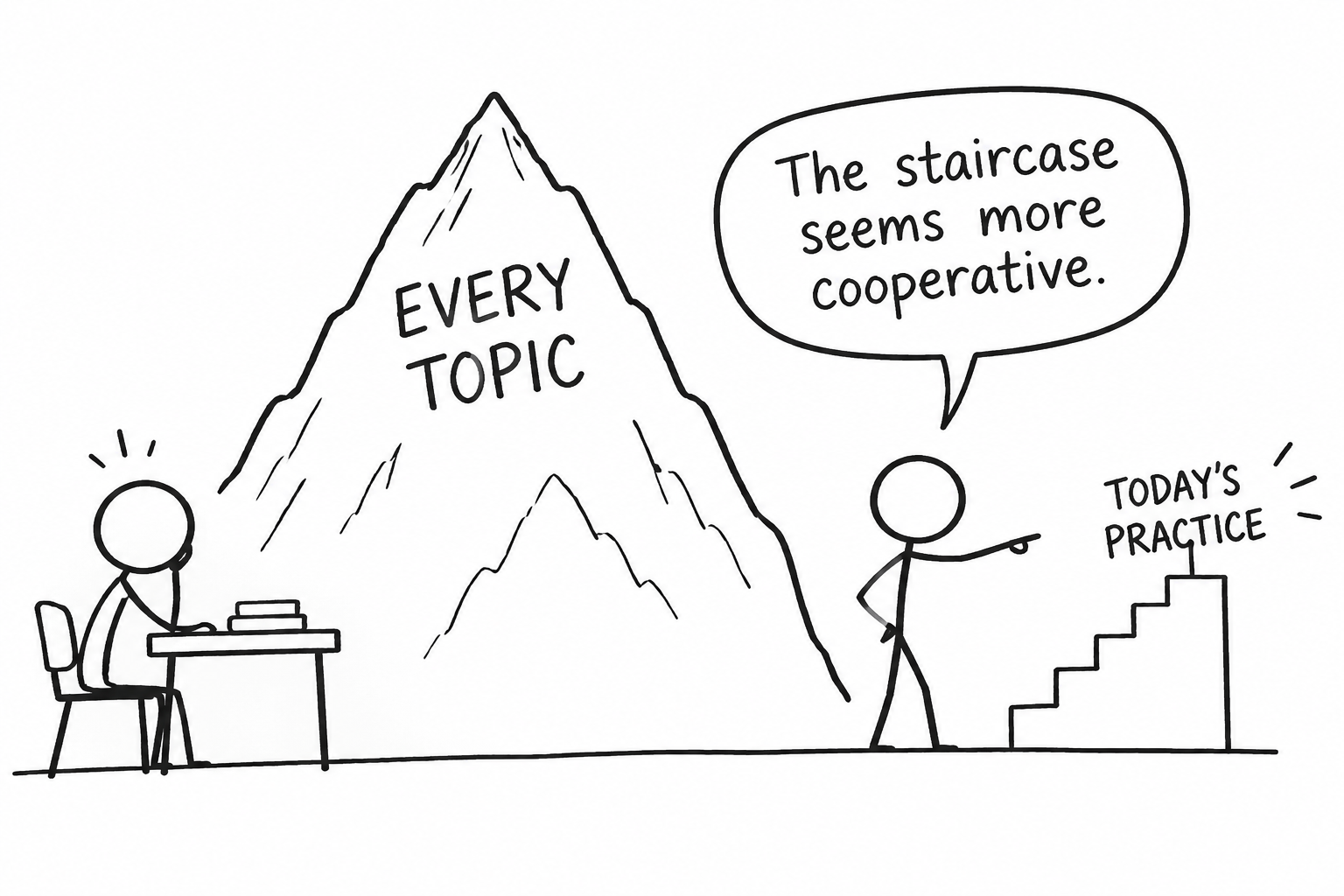 XKCD-style comic showing a student choosing today's practice staircase instead of the mountain of every topic
Revise the topics that move marks most
Students often respond to a disappointing total by trying to revise everything. That feels thorough, but it can hide the small group of topics repeatedly costing marks.
Use your marked papers to create three lists:
- topics where you cannot begin the question;
- topics where your method is sound but the algebra fails;
- topics where time pressure causes incomplete solutions.
Start with recurring high-value weaknesses. Core Pure Mathematics appears across two compulsory papers, so weaknesses in areas such as complex numbers, matrices, proof, series, differential equations and further calculus deserve particular attention. Your two option papers then need their own focused practice.
Maths Genie is built for this kind of targeted improvement. Use the A Level Maths revision hub to revisit essential methods, then move from revision lessons to practice questions and timed paper work. Past papers, mark schemes and video solutions help you compare your reasoning with the expected method rather than merely checking the final answer.
The goal is not to consume more revision. It is to convert repeated errors into reliable marks.
Common mistakes when checking grade boundaries
Using the wrong qualification
Check that the document refers to Pearson Edexcel A Level Further Mathematics and qualification code 9FM09FM09FM0. AS Further Mathematics, International A Level and A Level Mathematics have different structures and boundaries.
Looking at the wrong optional route
A boundary attached to another combination of Papers 333 and 444 may not apply to your entry. Match every paper code carefully.
Adding notional paper boundaries
Notional component figures help explain individual paper performance. The official subject-level boundary for your route determines the final qualification grade.
Treating an old boundary as a forecast
Edexcel Further Maths grade boundaries change because examination papers and awarding evidence change. A dated boundary is a benchmark, not a guaranteed target for a future series.
Marking past papers generously
Method marks depend on visible, valid reasoning. Use the mark scheme closely and study video solutions where your approach differs. An inflated practice score provides comfort, but an accurate score provides direction.
Turn the boundary into a revision decision
The Edexcel Further Maths A boundary is not one timeless number. It is a route-specific total, published after each examination series, for a qualification marked out of 300300300.
Find your exact options. Check the official subject boundary. Total all four papers and measure the gap. Then stop staring at the number and ask the more useful question: which topics can move that total next?
Start with Maths Genie's A Level lessons, concentrating on the topics that repeatedly lose you marks. Follow each lesson with practice questions, mark your work honestly, and return to timed papers. A grade is built one recovered method mark at a time.















