

Edexcel A-Level Maths E Boundary Explained
Edexcel A-Level maths E boundary marks explained, with recent examples, paper totals and practical advice for turning revision into extra marks.
A Year 13 student opens a grade-boundary document for a simple reason: they want one number. Instead, they find subject codes, several columns and enough tables to make the answer feel harder than an integration question.
Here is the direct answer. The Edexcel A-Level maths E boundary is the minimum total mark required across all three papers. It is not fixed before the exams and changes each year. For the June 2025 series, Pearson set the E boundary for Edexcel A-Level Mathematics at 717171 out of 300300300. In June 2024, it was 565656 out of 300300300.
Those figures are useful reference points, not predictions. Your own exam series will have its own boundary.
The answer at a glance
- Edexcel A-Level Mathematics has the qualification code 9MA0.
- There are three papers, each worth 100100100 marks.
- Your marks are added to give a total out of 300300300.
- The E boundary applies to that combined total.
- The boundary changes after each exam series to reflect the demand of the papers.
- In June 2025, an E required 717171 marks in total.
- In June 2024, an E required 565656 marks in total.
- Nobody can know the exact boundary for a future series before Pearson publishes it.
You can use the Edexcel A-Level Maths grade calculator to combine practice-paper marks and compare them with boundaries from previous years.
How the three paper marks combine
The calculation itself is reassuringly simple. Edexcel A-Level Mathematics consists of two pure mathematics papers and one statistics and mechanics paper. Each paper has a maximum of 100100100 marks, so:
100+100+100=300100+100+100=300100+100+100=300Your qualification total is therefore:
overall mark=Paper 1+Paper 2+Paper 3\text{overall mark}=\text{Paper 1}+\text{Paper 2}+\text{Paper 3}overall mark=Paper 1+Paper 2+Paper 3Suppose a student receives these marks in a set of mocks:
| Paper | Mark |
|---|---|
| Pure Mathematics 1 | 222222 |
| Pure Mathematics 2 | 252525 |
| Statistics and Mechanics | 202020 |
| Total | 676767 |
The total is:
22+25+20=6722+25+20=6722+25+20=67Against the June 2024 boundary, 676767 would have exceeded the E threshold of 565656. Against the June 2025 boundary, it would have been below the E threshold of 717171. That single comparison explains why dated boundaries must always be labelled clearly.
You do not ordinarily need to reach a separate E boundary on every paper. It is the combined subject total that determines the qualification grade. A difficult Paper 1 can be balanced by stronger performances elsewhere.
Recent Edexcel A-Level grade boundaries for an E
Pearson defines a grade boundary as the minimum mark needed to achieve that grade. The published overall boundaries for qualification code 9MA0 included:
| Exam series | Maximum mark | Minimum mark for an E | Approximate percentage |
|---|---|---|---|
| June 2024 | 300300300 | 565656 | 18.7%18.7\%18.7% |
| June 2025 | 300300300 | 717171 | 23.7%23.7\%23.7% |
The percentages are calculated by dividing the boundary by 300300300:
56300×100≈18.7%\frac{56}{300}\times100\approx18.7\%30056×100≈18.7%and
71300×100≈23.7%\frac{71}{300}\times100\approx23.7\%30071×100≈23.7%This does not mean that an E is always around a particular percentage. It means that these were the minimum marks for two specific exam series. The movement from 565656 to 717171 also shows why treating last year's mark as a promise can be risky.
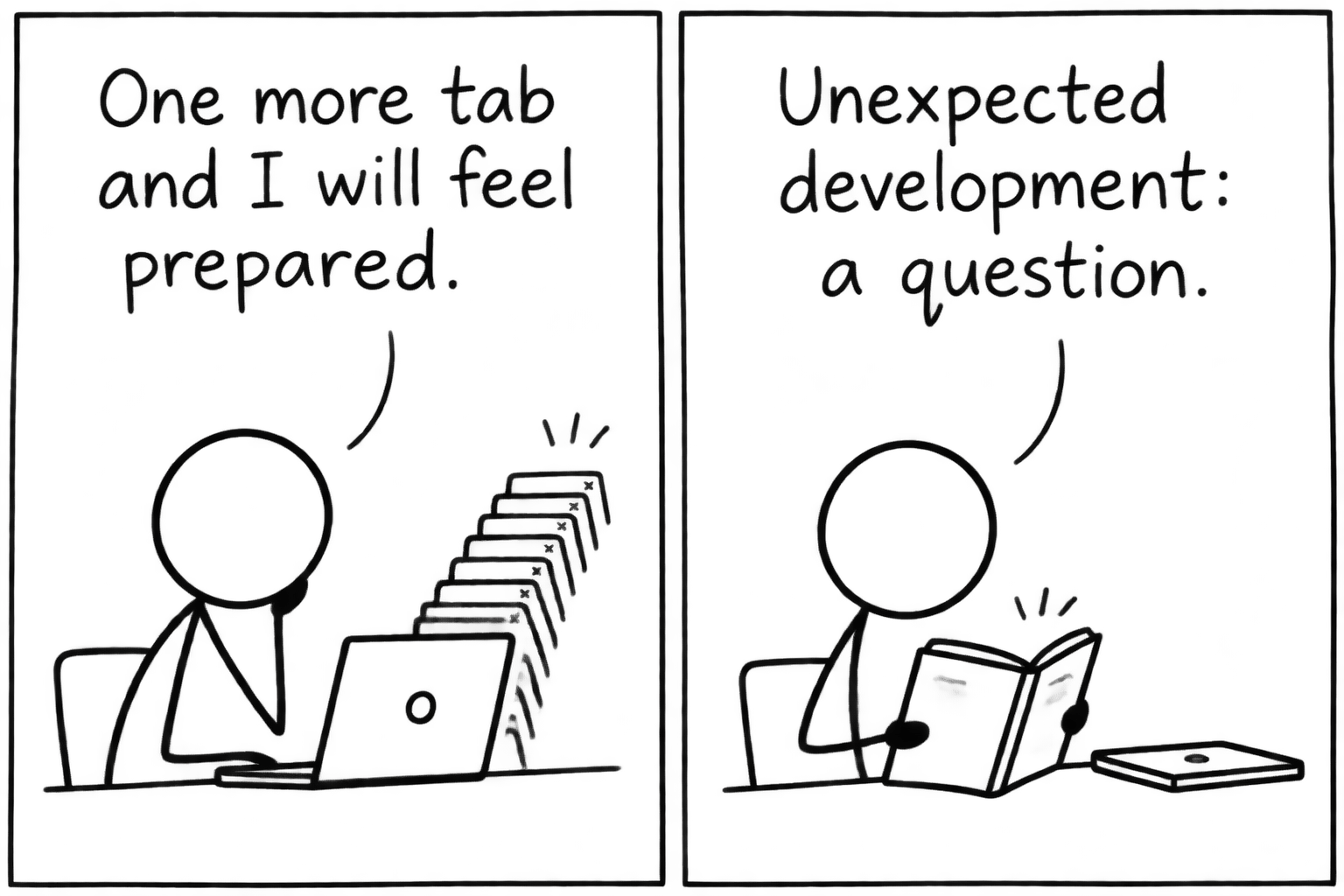 A Year 13 student discovers that attempting a revision question is more useful than opening another grade-boundary tab
Why the Edexcel A-Level maths E boundary changes
Grade boundaries are set after students have sat the papers and marking has taken place. They are intended to keep the standard represented by a grade comparable when the demand of the assessment varies.
If a paper proves more demanding, fewer raw marks may be needed to demonstrate the standard associated with a grade. If it is more accessible, the boundary may be higher. This is why a higher boundary does not automatically mean that standards became harsher, or that students suddenly became much better at maths.
The important distinction is between raw marks and grade standards. Raw marks count successful work on that year's questions. Grade boundaries translate those marks into grades while accounting for variation between exam series.
For a student checking the likely mark for an E, the sensible approach is to use several dated boundaries as context. Do not take the lowest previous boundary and build your plan around it. A safer target includes a buffer above the historical figures you are considering.
What mark should you aim for?
An E boundary tells you where a past threshold stood. It should not become your revision ceiling.
For example, after scoring 676767 in a mock, a student might ask whether that is enough. The honest answer is that it would have been enough in some series and not in June 2025. The more useful question is: where can the next ten or fifteen marks come from?
That shift matters. Boundaries are outside your control; method marks, topic knowledge and exam decisions are not.
Start by completing full papers under timed conditions. Record the mark for each paper, then diagnose the lost marks rather than merely writing down the total. Separate them into categories such as:
- a topic you did not understand;
- a method you knew but could not start;
- algebraic or arithmetic slips;
- incomplete reasoning;
- poor use of the calculator;
- questions left because time ran out.
Maths Genie provides Edexcel A-Level Maths past papers alongside mark schemes and video solutions. These let you check not only whether an answer was wrong, but where your method stopped earning marks.
The topics most likely to move your total
When the immediate goal is to secure more marks, the best topic is not always the hardest chapter in the textbook. It is often a recurring area where you can make reliable progress.
Use the A-Level Maths revision page to revisit lessons and practise questions at the right level. Prioritise gaps revealed by actual papers, particularly core skills that feed into several questions:
- algebraic manipulation and solving equations;
- differentiation and integration;
- trigonometry;
- exponentials and logarithms;
- vectors;
- statistical distributions and hypothesis testing;
- forces, kinematics and moments.
A small algebra weakness rarely stays in one corner of an A-Level paper. It appears inside calculus, trigonometry and mechanics. Repairing it can improve several topics at once.
After revising a lesson, complete questions without the video open. Then return to a past-paper question that previously caused difficulty. Revision has worked when you can make the decision yourself, not merely when the explanation feels familiar.
Common mistakes when checking an E boundary
Looking at the wrong qualification
Check that the document says Pearson Edexcel A-Level Mathematics and uses the code 9MA0. AS Mathematics, Further Mathematics and International A Level have different assessments and boundaries.
Treating a past boundary as a forecast
The June 2025 figure of 717171 is verified historical information. It does not reveal the boundary for a later exam series.
Dividing the total equally between papers
An overall E boundary of 717171 does not require precisely:
713≈23.7\frac{71}{3}\approx23.7371≈23.7marks on each paper. One paper can compensate for another because the three raw marks are combined.
Using notional paper boundaries as separate requirements
Pearson may publish notional component boundaries to illustrate performance on individual papers. The overall qualification grade comes from the combined total, so these component figures are not independent hurdles that must all be cleared.
Revising only enough to match the boundary
A boundary is a minimum established after an exam. Working towards exactly one historical threshold leaves no protection against a tougher personal paper, avoidable errors or a higher boundary.
Turn the boundary into a plan
The student who began by looking for one number now has a better answer. In recent published series, the Edexcel A-Level maths E boundary has moved, and the final grade has depended on the total across three 100100100-mark papers.
Knowing that can reduce uncertainty. It cannot add marks by itself.
Take your latest three paper scores, combine them, and identify the questions where improvement is most realistic. Then use Maths Genie A-Level lessons on the topics that can move your marks most. Follow each lesson with practice questions, check the mark scheme, and use video solutions to understand the decisions you missed.
The boundary will eventually be set by Pearson. The work that places you safely above it can start now.















