

Edexcel A-Level Maths A Boundary Explained
Edexcel A-Level maths A boundary explained with past marks, paper totals and practical advice for setting a realistic revision target above an A.
A Year 13 student opens three marked papers, adds the scores and pauses. The total looks respectable, but one question matters: is it an A?
The short answer is that the Edexcel A-Level maths A boundary changes each exam series. For illustration, it was 196196196 out of 300300300 in June 2023 and 205205205 out of 300300300 in June 2024. You cannot know the boundary for your own series before Pearson completes the awarding process, so past figures are guides rather than promises.
What you can do is understand how the total works, compare like with like and build enough margin that a small movement in the boundary does not decide your result.
The boundary checklist
Before turning one mock result into a predicted grade, check that:
- you have completed all three papers under realistic conditions;
- each paper has been marked out of 100100100;
- you have added raw marks, not percentages or estimated grades;
- you are using the Edexcel Mathematics specification code 9MA09MA09MA0;
- you are comparing your total with a boundary from the correct exam series;
- you have treated any future boundary as unknown.
MathsGenie's Edexcel A-Level Maths grade calculator makes this comparison easier once you have three paper marks.
What mark do you need for an A in Edexcel A-Level Maths?
There is no permanent Edexcel A-Level maths A boundary. Pearson sets a new minimum mark for each exam series after considering how the papers performed.
These published summer boundaries show how the required mark can move:
| Exam series | A boundary | Total available | Approximate percentage |
|---|---|---|---|
| June 2023 | 196196196 | 300300300 | 65.3%65.3\%65.3% |
| June 2024 | 205205205 | 300300300 | 68.3%68.3\%68.3% |
The calculations are:
196300×100=65.3%, approximately\frac{196}{300}\times 100=65.3\%\text{, approximately}300196×100=65.3%, approximatelyand
205300×100=68.3%, approximately.\frac{205}{300}\times 100=68.3\%\text{, approximately}.300205×100=68.3%, approximately.An A therefore required 999 more marks in 2024 than in 2023. That does not create a reliable pattern for the next series. Two years of data cannot tell you precisely where a future boundary will land.
It is more useful to say, “Recent past boundaries show the level I should prepare to exceed,” than, “This year's boundary will be the same.”
How the three paper totals combine
Edexcel A-Level Mathematics has a total of 300300300 raw marks across three papers. Your overall total is found by simple addition:
T=P1+P2+P3,T=P_1+P_2+P_3,T=P1+P2+P3,where P1P_1P1, P2P_2P2 and P3P_3P3 are the marks from the three papers.
Suppose the Year 13 student has these mock results:
| Paper | Mark |
|---|---|
| Paper 1 | 686868 out of 100100100 |
| Paper 2 | 616161 out of 100100100 |
| Paper 3 | 727272 out of 100100100 |
The combined mark is:
68+61+72=201.68+61+72=201.68+61+72=201.That total would have reached the June 2023 A boundary of 196196196, sitting 555 marks above it. It would not have reached the June 2024 A boundary of 205205205, falling 444 marks short.
This is why one paper does not determine the final grade. A difficult first paper can be recovered through the remaining papers, while an excellent pure maths result cannot make mechanics and statistics irrelevant. The grade comes from the combined raw mark.
You can recreate this process with authentic questions using the Edexcel A-Level Maths past papers, then mark each attempt carefully with the supplied mark scheme.
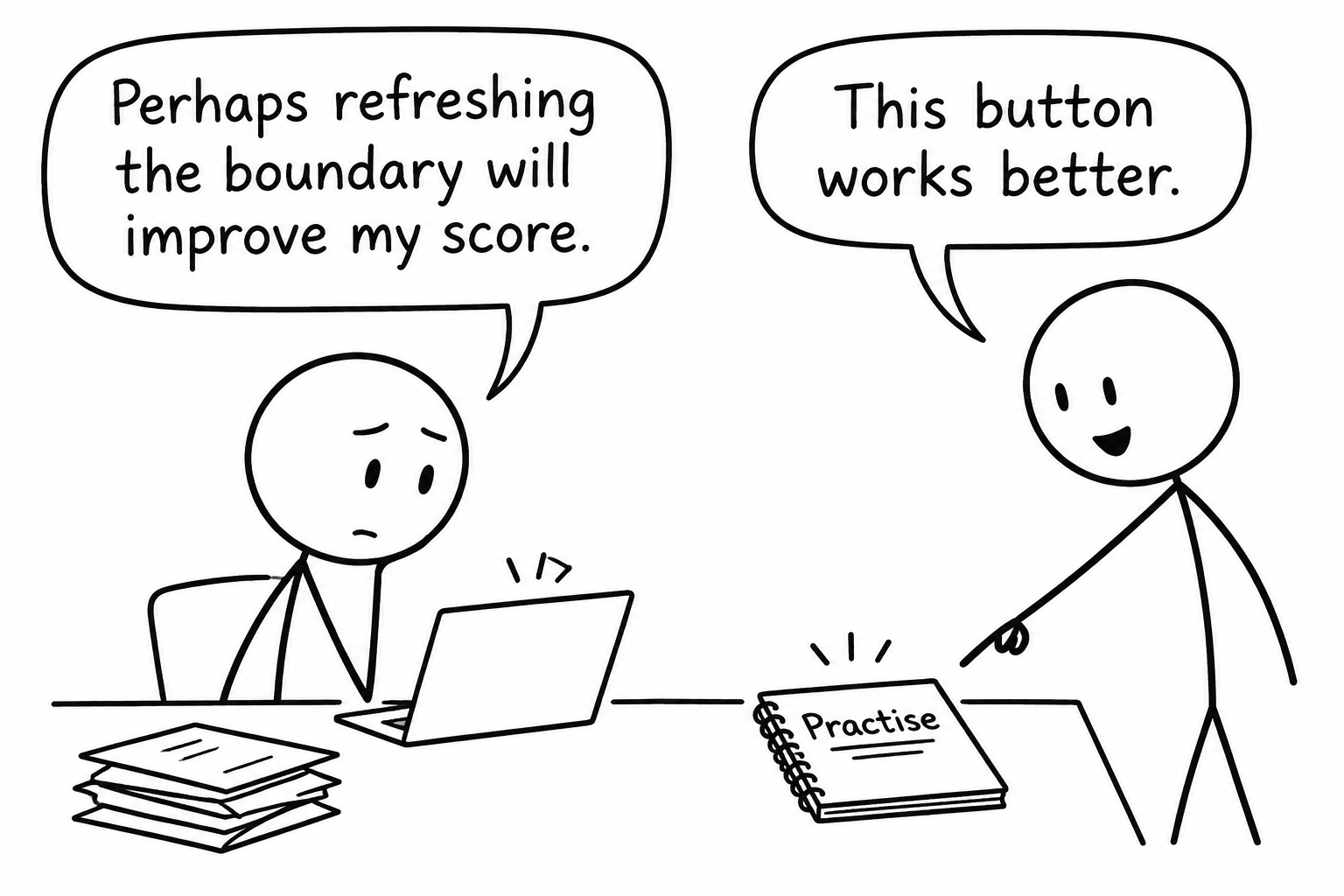 A student discovers that practising works better than refreshing grade boundaries
Why Edexcel A-Level grade boundaries change
Grade boundaries are designed to account for differences in demand between exam series. Ofqual explains the basic principle clearly: if a paper is harder, the boundary can be lower. If it is more accessible, the boundary can be higher.
That protects students from being advantaged or disadvantaged simply because one year's papers felt different from another's. A boundary is set after the papers have been taken and marked; it is not a target Pearson must preserve from the previous year.
Several things therefore do not prove that a boundary will rise or fall:
- reactions on social media after an exam;
- a particularly unpleasant question;
- how one class found the paper;
- a boundary prediction based only on last year.
Students naturally search for certainty when an exam feels uncertain. But repeatedly checking predictions cannot recover marks. Reviewing the question that went wrong can.
Set a target above the A boundary
If the aim is an A, targeting the exact previous boundary leaves little room for variation, marking errors or a topic that appears in an awkward form.
A calmer approach is to set a working target above recent boundaries. For example, aiming for 215215215 out of 300300300 means an average of:
2153=71.7\frac{215}{3}=71.73215=71.7marks per paper, approximately. You do not need exactly the same result on each paper. A possible combination is:
73+69+73=215.73+69+73=215.73+69+73=215.This is a revision target, not a predicted official boundary. Its purpose is to create breathing room and turn a vague ambition into marks you can track.
Find the topics that move marks most
The most valuable next step is not necessarily revising your favourite chapter. It is identifying repeated losses that can realistically be repaired.
Start with a full paper from the Edexcel A-Level Maths paper collection. Mark it strictly and label each lost mark:
- knowledge gap;
- incorrect method;
- algebra or arithmetic error;
- incomplete reasoning;
- poor time management.
Then use the Edexcel A-Level Maths question bank to practise the weak topic in isolation. The bank contains exam-style questions sorted by topic with mark schemes, which makes it easier to distinguish a one-off mistake from a genuine pattern.
For focused written practice, work through the Edexcel A-Level Maths topic worksheets. Maths Genie lessons, questions and solutions are particularly useful for high-impact weaknesses such as algebraic manipulation, trigonometry, differentiation, integration, statistics and mechanics. The best topic to choose is the one your marked work identifies, not the one that merely feels productive.
After focused revision, return to a complete timed paper. Topic practice builds the skill; full papers test whether you can recognise and use it under exam conditions.
Common mistakes when checking an A-Level maths A
Treating a percentage as a fixed rule
An A is not automatically awarded at a standard percentage such as 70%70\%70%. Use the published raw-mark boundary for the relevant qualification and series.
Averaging paper percentages unnecessarily
Each paper is out of 100100100, so simply add the three raw marks. Complicated conversions invite mistakes.
Comparing one paper with an overall boundary
The published subject boundary applies to the total out of 300300300, not an isolated paper score.
Using legacy Edexcel papers as direct grade evidence
Older papers can provide useful practice, but a different specification or assessment structure should not be treated as a direct grade comparison. Use current-specification 9MA09MA09MA0 papers when estimating your present level.
Revising the boundary instead of the subject
Knowing that 205205205 was an A in June 2024 is useful once. Checking it repeatedly adds nothing. Finding another 555 marks through better working, stronger algebra or more accurate interpretation can change the outcome.
Turn the number into a revision plan
The Edexcel A-Level maths A boundary is best understood as a moving threshold, not a promise. Past figures give context: 196196196 out of 300300300 in June 2023 and 205205205 in June 2024. Your three papers combine into one raw total, and only the boundary published for your exam series determines the final grade.
So add your marks, measure the gap and give yourself a margin. Then move from the number to the work that changes it. Start with Maths Genie's free A-Level Maths revision hub, choose the lessons for the topics costing you the most marks, and test the improvement with another timed paper.















