GCSE Astronomy Class Sets Matter, But How Much?
GCSE astronomy class sets matter less than your preparation. Learn how setting affects support, why it does not cap grades, and what to do next in revision.
There is a particular kind of worry that appears when students compare timetables. Someone else is in a higher set, their class seems further ahead, and suddenly the conclusion feels obvious: they must have the better chance.
But do GCSE astronomy class sets matter to your final result? The short answer is that a set can influence your classroom experience, including pace, support and expectations, but it does not place a fixed ceiling on your grade. Your exam is marked from the answers you produce, not the label on your class.
That does not mean effort is the only factor. Teaching, time, resources and confidence matter too. The useful question is not whether your set is destiny. It is whether you are getting the knowledge, mathematical fluency and exam practice needed to answer the specification.
The quick answer
Keep these points in mind:
- A class or set is an organisational decision made by your school, not a national judgement about your potential.
- GCSE Astronomy is not divided into foundation and higher tiers in the way GCSE Maths is.
- Students following the same specification are assessed against the same qualification requirements.
- A set may affect teaching pace, classroom support and how quickly content is introduced.
- Your result depends on what you can recall, apply and communicate under exam conditions.
- If mathematical skills are slowing you down, targeted revision can close specific gaps.
The most accurate conclusion is that sets can affect the route, but they do not predetermine the destination.
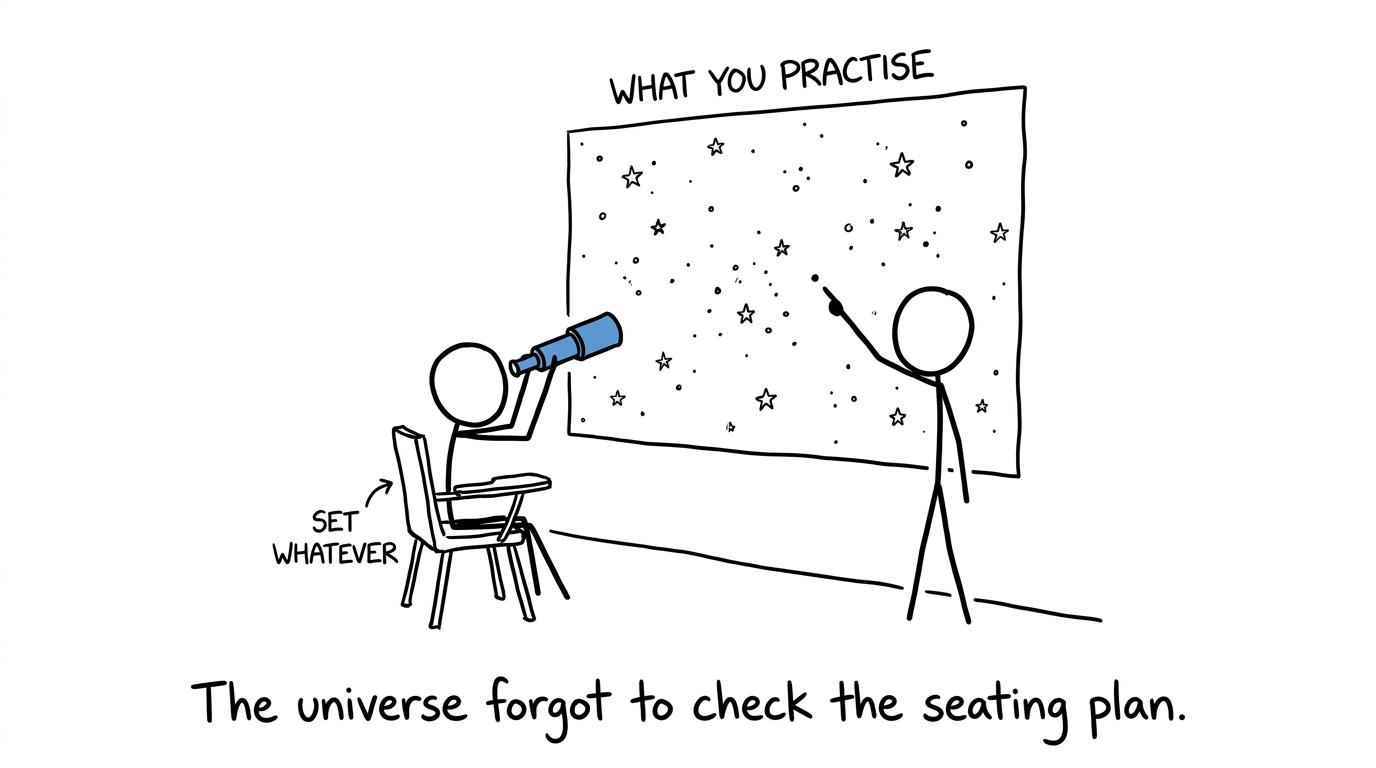 A student discovers that the universe has not checked the classroom seating plan
What a GCSE Astronomy set actually means
There is no national system that assigns every Astronomy student to a particular set. Schools decide how to organise classes according to factors such as pupil numbers, timetabling, prior attainment, available teachers and the way the course is delivered.
Some schools may teach Astronomy as a separate GCSE option. Others may run it outside the normal timetable or connect it closely with science. In some cases, students asking about their “Astronomy set” are really concerned about their set in Maths or Science and whether that placement predicts their ability to succeed in Astronomy.
It does not.
A set is usually based on evidence available at a particular moment. That evidence may include previous assessments, classroom work or teacher judgement. It can help a school pitch lessons appropriately, but it cannot measure every quality involved in future exam performance. It cannot know how consistently you will revise, which misconceptions you will correct or how much more confident you may become.
This distinction matters because a useful teaching arrangement can easily become an identity. “I am in a lower set” quietly turns into “I am a lower-attaining student.” The first statement describes a timetable. The second makes an unsupported prediction.
Why Astronomy is different from tiered GCSE Maths
GCSE Maths has foundation and higher tiers. Foundation tier normally gives access to grades 111 to 555, while higher tier gives access to grades 444 to 999, with an allowed grade 333 in certain circumstances under awarding rules. Entry tier therefore has a direct relationship with the grades available.
The current Pearson Edexcel GCSE Astronomy qualification is not organised into foundation and higher tiers. Students following the qualification are assessed through the same specification rather than being entered for separate tiered Astronomy papers.
That means being taught in a group described informally as a higher or lower set does not create an official Astronomy grade cap. If you demonstrate the required knowledge and skills in the assessment, the name of your class is not part of the marking process.
Do not transfer the rules of GCSE Maths automatically to another qualification. Terms such as “higher set” and “higher tier” sound similar, but they are not interchangeable. One describes school grouping; the other describes an official exam entry route.
How class sets can still influence results
Saying that sets do not determine grades is not the same as saying they have no effect. Context matters.
Lesson pace and depth
One class may move through familiar ideas quickly, while another spends longer securing foundations. Faster is not automatically better. A lesson only helps if students understand enough to retain and apply it.
However, you should know whether your class is on schedule to cover the full specification. If you are unsure, ask your teacher which topics remain and when they are expected to be taught. That is a practical question, not a complaint about your set.
Expectations and classroom culture
Expectations can shape behaviour. A class regularly asked to justify answers and connect ideas may become more comfortable with demanding questions. Equally, a student in any set can build those habits independently by using mark schemes, correcting errors and attempting questions that require more than recall.
Peer behaviour may affect concentration, but it does not remove your agency. Protecting a regular revision period outside lessons can give you consistency when the classroom atmosphere cannot.
Access to feedback
Effective feedback shows you what was missing and what to change next time. If you receive a mark but do not understand the lost marks, ask for clarification. The important question is not simply, “What grade did I get?” It is, “Which piece of knowledge or reasoning would improve this answer?”
That turns feedback into an instruction rather than a verdict.
Mathematical confidence
Astronomy involves scientific ideas, observations and mathematical reasoning. Students may encounter scales, units, angles, graphs, proportional relationships and calculations involving very large quantities.
A student who understands the astronomy but hesitates over the calculation can lose marks unnecessarily. This is where MathsGenie's free GCSE Maths revision resources can support the mathematical side of the course.
Useful areas include standard form revision, trigonometry lessons and questions, bearings practice and graphs revision. These resources do not replace Astronomy teaching. They strengthen tools that can make Astronomy questions more manageable.
Effort matters, but effective effort matters more
“Just work harder” is comforting because it sounds simple. It is also incomplete.
Hours alone do not guarantee progress. Reading notes repeatedly may feel productive while leaving recall weak. Completing questions without checking the mark scheme can preserve the same misunderstanding. Avoiding difficult topics keeps revision comfortable but narrow.
Effective effort has a feedback loop:
- identify a specific weakness;
- review the relevant lesson;
- answer questions without copying a method;
- mark the answers carefully;
- record why marks were lost;
- return to the topic after a gap.
This process makes effort measurable. Instead of deciding that you are “bad at calculations”, you may discover that the real problem is converting units, rearranging a formula or reading a graph scale. A vague worry has become a task.
MathsGenie's topic pages combine explanations, practice questions, answers and video support, while GCSE past papers help you practise selecting methods when the topic is not announced in advance. That shift from isolated practice to mixed exam practice is essential as assessments approach.
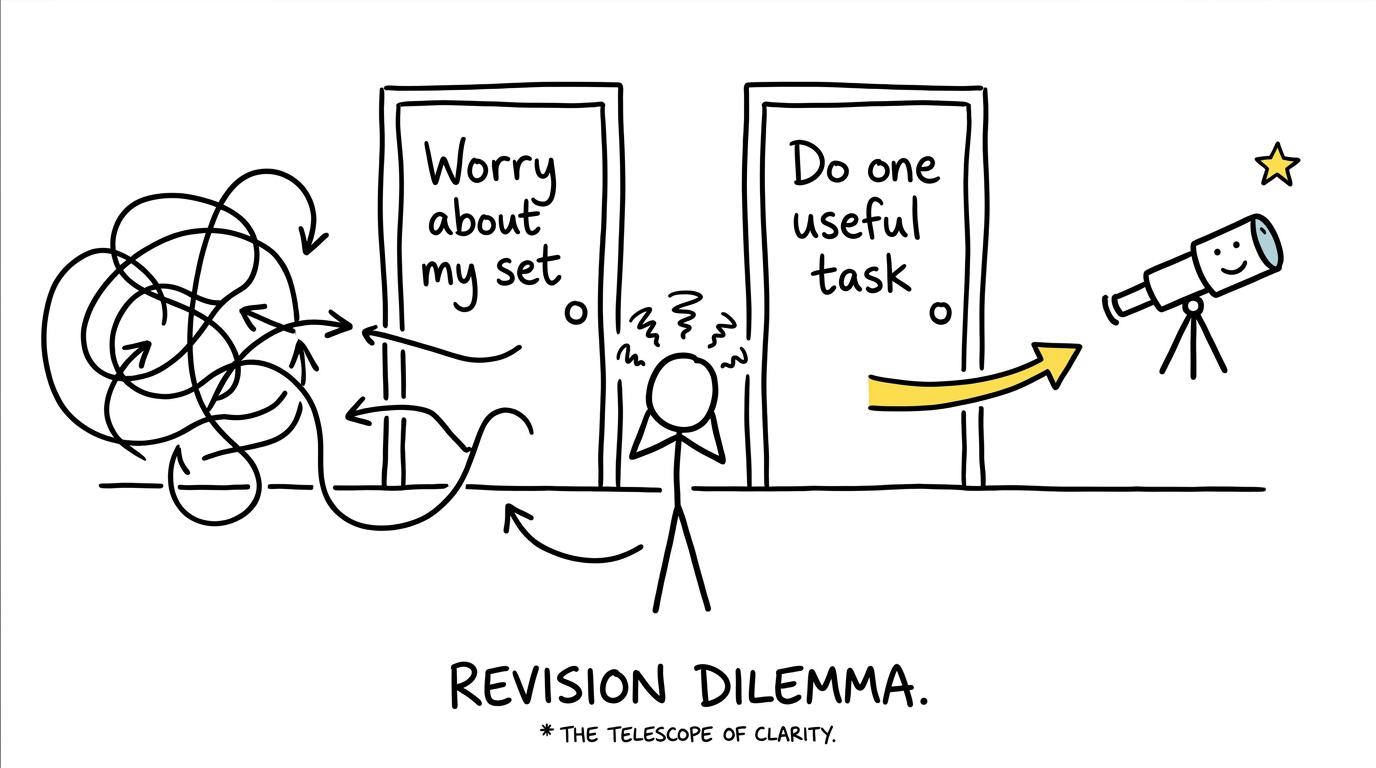 A student chooses between worrying about a set and completing one useful revision task
What to do if you think your set is holding you back
Begin with evidence rather than comparison. Another class being on a different chapter does not necessarily mean yours is behind; teachers often arrange specifications in different orders.
Check the specification coverage
Use your course specification or teacher's checklist to divide topics into three groups: secure, developing and not yet covered. This shows whether you have a genuine content gap or simply feel less confident than somebody else.
Speak to your teacher precisely
Avoid opening with “I am in the wrong set.” Explain the academic issue instead:
- you are consistently completing classwork accurately and need more challenge;
- a particular topic has not made sense;
- you want to know what evidence is needed for a set review;
- you are concerned about completing the specification;
- you need guidance on suitable exam questions.
Schools have their own procedures, and changing set may not always be possible. Even so, a specific conversation can lead to extension work, additional support or a clearer revision plan.
Strengthen the maths underneath the astronomy
Choose topics according to need rather than grade labels. If interpreting axes is difficult, revise graphs. If directions and angles cause trouble, practise bearings and trigonometry. If large and small quantities look confusing, revisit standard form.
Students considering later mathematical study can also explore the A Level Maths revision hub, but GCSE preparation should remain the priority until the foundations are secure.
Practise under realistic conditions
Topic questions teach a skill. Full papers test whether you can recognise when that skill is needed. Both have a purpose.
As the exam approaches, combine targeted work with timed papers and appropriate MathsGenie predicted papers. Predicted papers are practice resources, not forecasts of exact exam questions, so they should sit alongside past papers and complete specification coverage.
Common mistakes when judging the importance of sets
Treating a set as a permanent ability label
Placement can reflect past performance, but past performance is not a maximum. Knowledge and exam technique can change substantially through specific practice and feedback.
Assuming another class has an automatic advantage
A faster class may have covered more content, but coverage is not mastery. Compare your work with the specification and mark scheme, not with corridor conversations.
Confusing set placement with exam tier
GCSE Astronomy does not use the foundation and higher tier structure of GCSE Maths. A school's class label does not itself restrict the Astronomy grade available.
Revising only comfortable topics
Confidence can be misleading. Students often repeat questions they can already answer because success feels reassuring. Improvement usually comes from spending some revision time at the boundary of understanding.
Ignoring method and communication
Knowing a fact is not always enough. Examiners award marks according to the requirements of the question and mark scheme. Practise using accurate terminology, showing necessary reasoning and giving units where required.
Believing resources can replace correction
Videos, notes and questions are valuable, but improvement happens when you respond to errors. A completed paper is only the beginning; the marked and corrected paper is the revision.
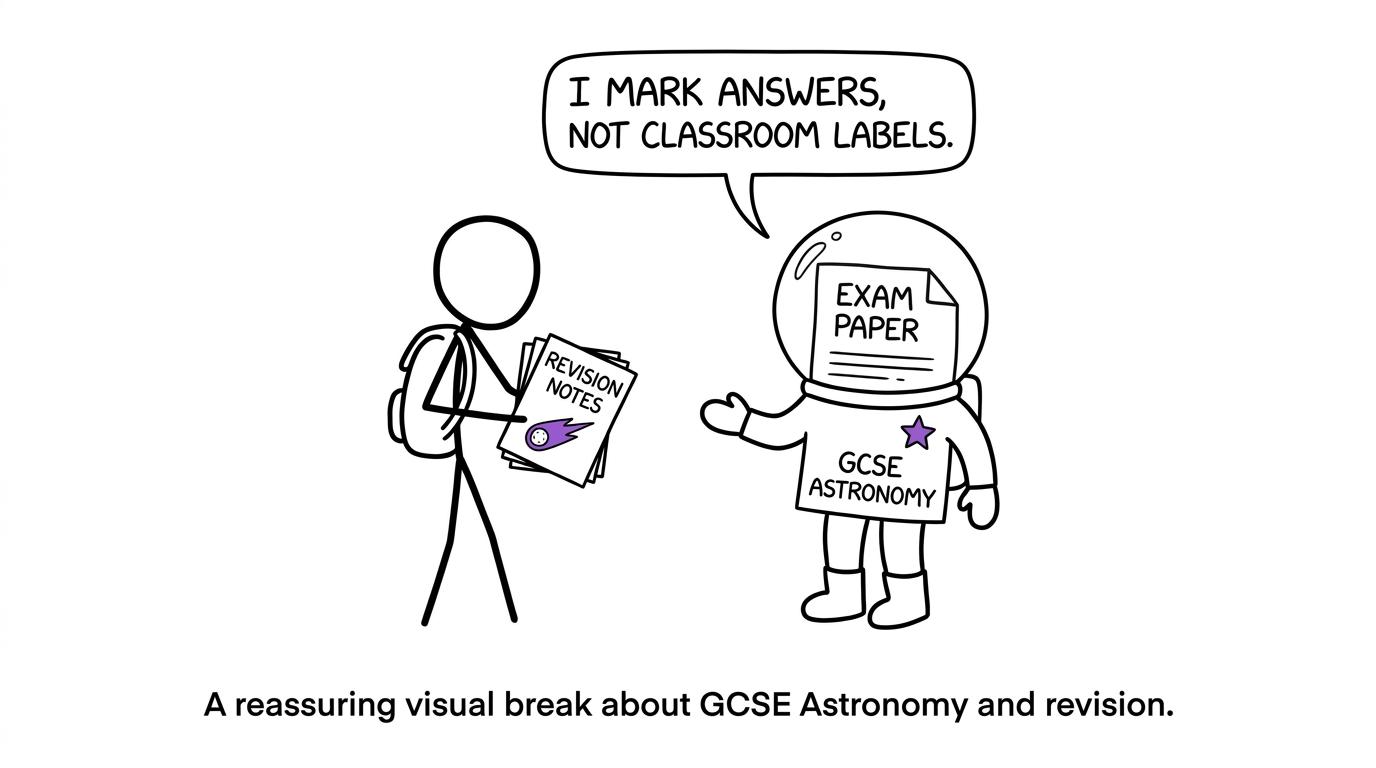 An astronaut exam paper explains that it marks answers rather than classroom labels
Your set is context, not a conclusion
Class sets can matter indirectly. They may change lesson pace, the amount of scaffolding you receive and the atmosphere in which you learn. It would be unrealistic to pretend those differences never affect students.
But the set itself is not awarded a GCSE grade. You are.
Focus on the parts of the outcome you can influence: complete specification coverage, secure mathematical foundations, active recall, regular practice and honest correction. If your classroom experience is not giving you something you need, speak to your teacher early and describe the gap clearly.
Then build a revision routine that works beyond the classroom. Start with a focused MathsGenie GCSE revision lesson, complete the practice questions, use the video solution when you are stuck, and finish by testing yourself with past or predicted papers. Your timetable may tell you where you sit during lessons. It does not get to decide how far you can go.