

Common Mistakes with BIDMAS in GCSE Maths
Common mistakes with BIDMAS in GCSE Maths explained with clear worked examples, corrections and exam-style practice to help you avoid lost marks.
A student can know every operation in a calculation and still lose the mark. The problem is often not multiplication, subtraction or powers. It is deciding what to do first.
The most common mistakes with BIDMAS in GCSE Maths come from treating the letters as a strict queue. They are not. Multiplication and division have equal priority, as do addition and subtraction. When operations have equal priority, work from left to right.
This guide follows the errors a student might find while checking a practice paper. For each one, you will see what went wrong, why it happened and how to correct it.
The BIDMAS checklist
BIDMAS gives the order of operations:
- B: Brackets
- I: Indices, including powers and roots
- D and M: Division and multiplication, working from left to right
- A and S: Addition and subtraction, working from left to right
Before calculating, scan the whole expression. Mark the brackets and indices, then identify multiplication or division. Leave addition and subtraction until the relevant earlier operations are complete.
The crucial detail is that division does not automatically come before multiplication just because DDD appears first in BIDMAS. The same applies to addition and subtraction.
Mistake: working from left to right immediately
Suppose the student sees:
7+3×4 7 + 3 \times 4 7+3×4They work from the left:
7+3=10 7 + 3 = 10 7+3=10 10×4=40 10 \times 4 = 40 10×4=40This happens because reading naturally moves from left to right. BIDMAS, however, says multiplication must be completed before addition.
The correct method is:
7+3×4 7 + 3 \times 4 7+3×4 =7+12 = 7 + 12 =7+12 =19 = 19 =19Only work from left to right when the operations have equal priority. Here, multiplication has higher priority than addition, so the answer is 191919, not 404040.
Mistake: always dividing before multiplying
Now consider:
24×2÷6 24 \times 2 \div 6 24×2÷6A student may divide 222 by 666 first because division appears before multiplication in the word BIDMAS. That interpretation is incorrect.
Multiplication and division have equal priority. Work from left to right:
24×2÷6 24 \times 2 \div 6 24×2÷6 =48÷6 = 48 \div 6 =48÷6 =8 = 8 =8A useful way to remember this is to think of BIDMAS in four levels rather than six separate steps:
Brackets→Indices→Multiplication or division→Addition or subtraction \text{Brackets} \rightarrow \text{Indices} \rightarrow \text{Multiplication or division} \rightarrow \text{Addition or subtraction} Brackets→Indices→Multiplication or division→Addition or subtractionAt either paired level, move from left to right.
Mistake: always adding before subtracting
The same misunderstanding appears with:
15−6+2 15 - 6 + 2 15−6+2If the student completes the addition first, they might write:
15−(6+2)=7 15 - (6 + 2) = 7 15−(6+2)=7But there are no brackets telling us to combine 666 and 222. Addition and subtraction have equal priority, so the calculation proceeds from left to right:
15−6+2 15 - 6 + 2 15−6+2 =9+2 = 9 + 2 =9+2 =11 = 11 =11Do not add brackets in your head. Use only the grouping shown in the question.
You now have the central method: complete higher-priority operations first, then move left to right within equal-priority pairs. Use the Maths Genie GCSE lessons and Question Bank to practise applying that method until the scan becomes automatic.
Mistake: ignoring a power
Indices are easy to overlook when they are small. Take:
5+23×4 5 + 2^3 \times 4 5+23×4A student might multiply 222 by 444 before dealing with the power. BIDMAS places indices before multiplication, so begin with:
23=2×2×2=8 2^3 = 2 \times 2 \times 2 = 8 23=2×2×2=8Then continue:
5+23×4 5 + 2^3 \times 4 5+23×4 =5+8×4 = 5 + 8 \times 4 =5+8×4 =5+32 = 5 + 32 =5+32 =37 = 37 =37Remember that 232^323 means three factors of 222. It does not mean 2×32 \times 32×3.
Mistake: mishandling a negative number and a square
The placement of brackets can change an answer completely:
(−3)2=(−3)×(−3)=9 (-3)^2 = (-3) \times (-3) = 9 (−3)2=(−3)×(−3)=9Here the entire negative number is squared. Compare that with:
−32=−(32)=−9 -3^2 = -(3^2) = -9 −32=−(32)=−9Without brackets around −3-3−3, the index applies to 333 before the negative sign is applied. When negative numbers and powers appear together, copy the brackets carefully rather than relying on memory.
For more practice with signs, use the Maths Genie negative numbers lesson.
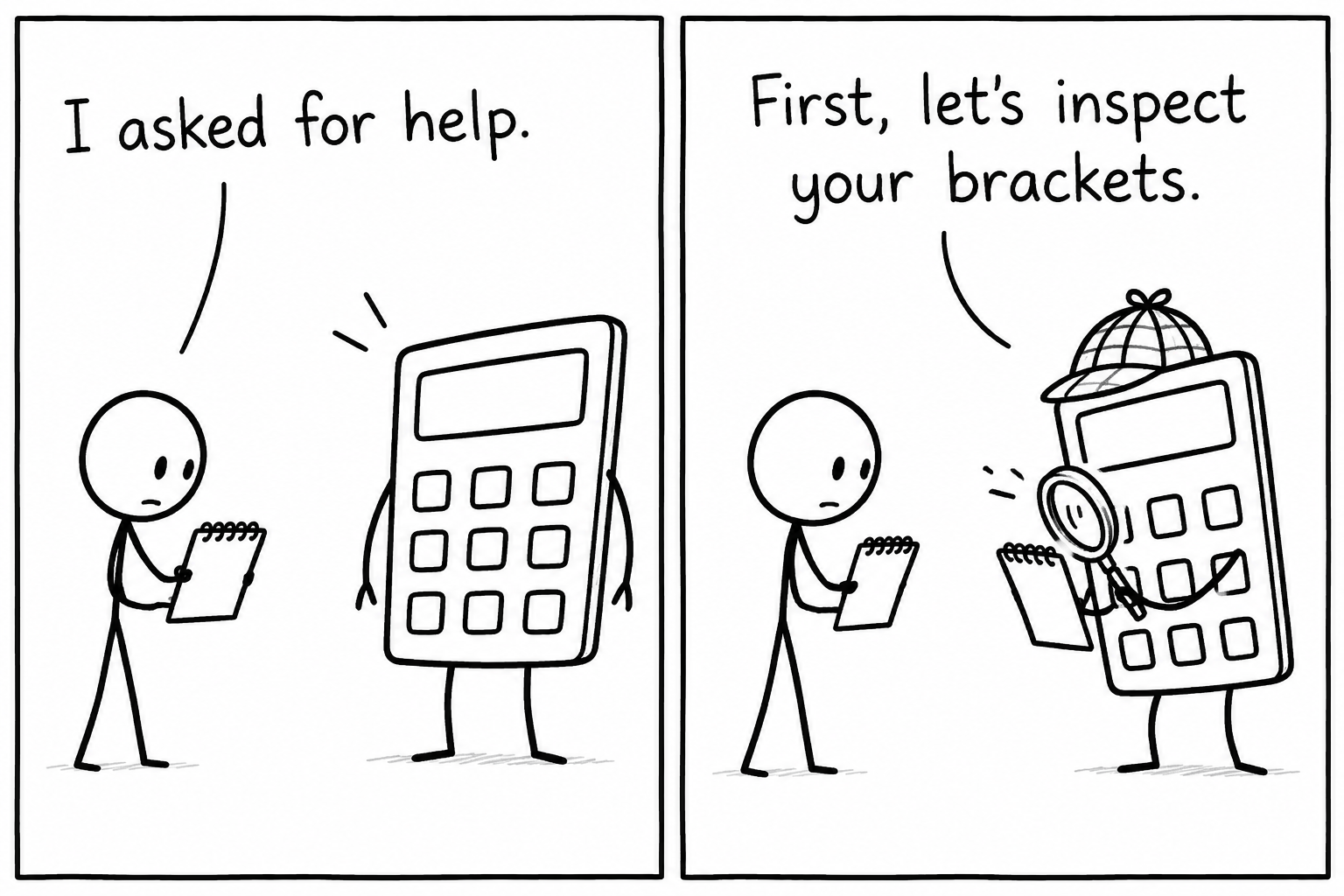 A stick-figure student asks a detective calculator for help checking brackets
Mistake: removing brackets incorrectly
Consider:
4(7−2)+3 4(7 - 2) + 3 4(7−2)+3The bracket comes first:
7−2=5 7 - 2 = 5 7−2=5The expression becomes:
4×5+3 4 \times 5 + 3 4×5+3Now multiply before adding:
20+3=23 20 + 3 = 23 20+3=23A common error is to calculate 4×74 \times 74×7 but forget that the 444 also relates to the bracketed expression. Evaluating the bracket first avoids that issue in this example.
Nested brackets need the same calm approach. Start with the innermost pair:
3[10−(6−2)] 3[10 - (6 - 2)] 3[10−(6−2)] =3[10−4] = 3[10 - 4] =3[10−4] =3×6 = 3 \times 6 =3×6 =18 = 18 =18Do not try to complete every stage mentally. One correctly rewritten line is often quicker than recovering from a hidden error.
Mistake: entering the calculation badly on a calculator
A calculator follows the expression you enter, not the expression you intended. Suppose you need to evaluate:
18+63×2 \frac{18 + 6}{3 \times 2} 3×218+6The numerator and denominator are separate grouped expressions:
18+6=24 18 + 6 = 24 18+6=24 3×2=6 3 \times 2 = 6 3×2=6Therefore:
18+63×2=246=4 \frac{18 + 6}{3 \times 2} = \frac{24}{6} = 4 3×218+6=624=4Typing an ungrouped string may represent a different calculation. Use the fraction key where available, or brackets around the numerator and denominator. Then check that the calculator display matches the printed question.
A reliable method for BIDMAS GCSE questions
Use this routine whenever an expression contains several operations:
- Copy the expression accurately.
- Complete the innermost brackets first.
- Evaluate powers and roots.
- Complete multiplication and division from left to right.
- Complete addition and subtraction from left to right.
- Rewrite the full expression after each stage.
- Estimate whether the final answer is sensible.
The rewritten lines matter. They expose the exact point where an error occurred and make your method easier to follow.
Exam-style BIDMAS practice
Try these without looking at the answers:
- 8+4×58 + 4 \times 58+4×5
- 36÷6×336 \div 6 \times 336÷6×3
- 20−7+420 - 7 + 420−7+4
- 2(9−5)+322(9 - 5) + 3^22(9−5)+32
- (−4)2−3×5(-4)^2 - 3 \times 5(−4)2−3×5
- 24÷(3+1)×224 \div (3 + 1) \times 224÷(3+1)×2
Answers:
- 282828
- 181818
- 171717
- 171717
- 111
- 121212
If an answer differs, do not simply replace it. Identify whether the error involved priority, left-to-right order, brackets, indices or negative signs. Naming the error makes it easier to avoid next time.
Common mistakes to check before moving on
Most BIDMAS mistakes fall into a short list:
- calculating strictly from left to right when the operations have different priorities
- assuming division must precede multiplication
- assuming addition must precede subtraction
- overlooking an index or treating ana^nan as a×na \times na×n
- confusing (−a)2(-a)^2(−a)2 with −a2-a^2−a2
- changing or inventing brackets
- skipping several stages in one line
- entering fractions or grouped expressions incorrectly on a calculator
The encouraging part is that these are not separate mysteries. They are usually variations of one habit: beginning before scanning the complete expression.
Turn BIDMAS knowledge into reliable marks
The student in this story did not need a new trick. They needed to slow down, mark the structure and practise the exact errors that kept recurring. Knowing BIDMAS is only the first step; following it consistently under exam pressure is what protects the marks.
Use the Maths Genie GCSE lessons to review the method, then open the Maths Genie Question Bank and practise BIDMAS questions with every line of working shown. Start a BIDMAS lesson and Question Bank practice set now.















