Common Mistakes with Standard Form in GCSE Maths
Common mistakes with standard form in GCSE maths explained through worked examples, clear checks and exam-style practice to help you avoid losing marks.
You can understand powers of ten and still lose marks through one misplaced decimal point. The most common mistakes with standard form in GCSE maths are choosing the wrong power, leaving the first number outside its allowed range, and using multiplication rules when adding.
The fix is to check two things separately: does your answer have the right value, and is it written in standard form? Those are different questions.
Imagine a student reviewing a marked worksheet. Instead of writing “careless” beside every correction, they identify the exact rule that went wrong. Follow that approach below: each mistake becomes something you can recognise, repair and check next time.
Your standard form checklist
For positive numbers, standard form means writing
a×10n,1≤a<10,a \times 10^n, \qquad 1 \leq a < 10,a×10n,1≤a<10,where nnn is an integer. The number aaa is called the coefficient.
Before moving on from an answer, check:
- Coefficient: is it at least 111 but less than 101010?
- Power: does its sign match the size of the original number?
- Operation: have you used the correct rule for the calculation?
- Size: is your answer approximately what you expected?
For a positive number greater than or equal to 101010, the power is positive. For a positive number smaller than 111, it is negative. Numbers from 111 up to, but not including, 101010 use the power 000.
Common mistakes with standard form in GCSE maths
Leaving the coefficient too large
Our imagined student writes:
72 000=72×103.72\,000 = 72 \times 10^3.72000=72×103.Why it happens: the value is correct, so the answer feels finished. But 727272 is too large to be the coefficient in standard form.
Correct method: first choose the coefficient, then find the power needed to recover the original number.
72 000=7.2×104.72\,000 = 7.2 \times 10^4.72000=7.2×10⁴.The coefficient became ten times smaller, so the power-of-ten factor must become ten times larger.
This also matters after calculations. An intermediate answer can be numerically correct without being in standard form. Check the final line, not just the working.
Choosing the wrong sign for a small number
The next answer reads:
0.00063=6.3×104.0.00063 = 6.3 \times 10^4.0.00063=6.3×10⁴.Why it happens: the student counts decimal places correctly but forgets what the power means. Multiplying by 10410^4104 makes 6.36.36.3 much larger, not smaller.
Correct method: establish the coefficient, then think about the multiplier needed.
0.00063=6.3×0.0001=6.3×10−4.0.00063 = 6.3 \times 0.0001 = 6.3 \times 10^{-4}.0.00063=6.3×0.0001=6.3×10−4.A negative power does not make the answer negative. It gives a small positive power-of-ten factor:
10−4=1104.10^{-4} = \frac{1}{10^4}.10−4=1041.If that distinction feels uncertain, MathsGenie's indices revision lesson explains the underlying rules.
Counting zeros instead of decimal-place movements
Another correction involves converting back:
4.08×10−3=0.000408.4.08 \times 10^{-3} = 0.000408.4.08×10−3=0.000408.Why it happens: counting zeros is unreliable because the digits already present affect how many zeros appear.
Correct method: multiplying by 10−310^{-3}10−3 means dividing by 100010001000. Move the decimal point three places left:
4.08→0.408→0.0408→0.00408.4.08 \rightarrow 0.408 \rightarrow 0.0408 \rightarrow 0.00408.4.08→0.408→0.0408→0.00408.Therefore,
4.08×10−3=0.00408.4.08 \times 10^{-3} = 0.00408.4.08×10−3=0.00408.Keep the zero between 444 and 888. It belongs to the number and cannot be discarded. Counting movements rather than visible zeros gives you a method that works consistently.
Once you can check the coefficient and power separately, use the Lessons and Question Bank on MathsGenie's standard form topic page to practise applying those checks without prompts.
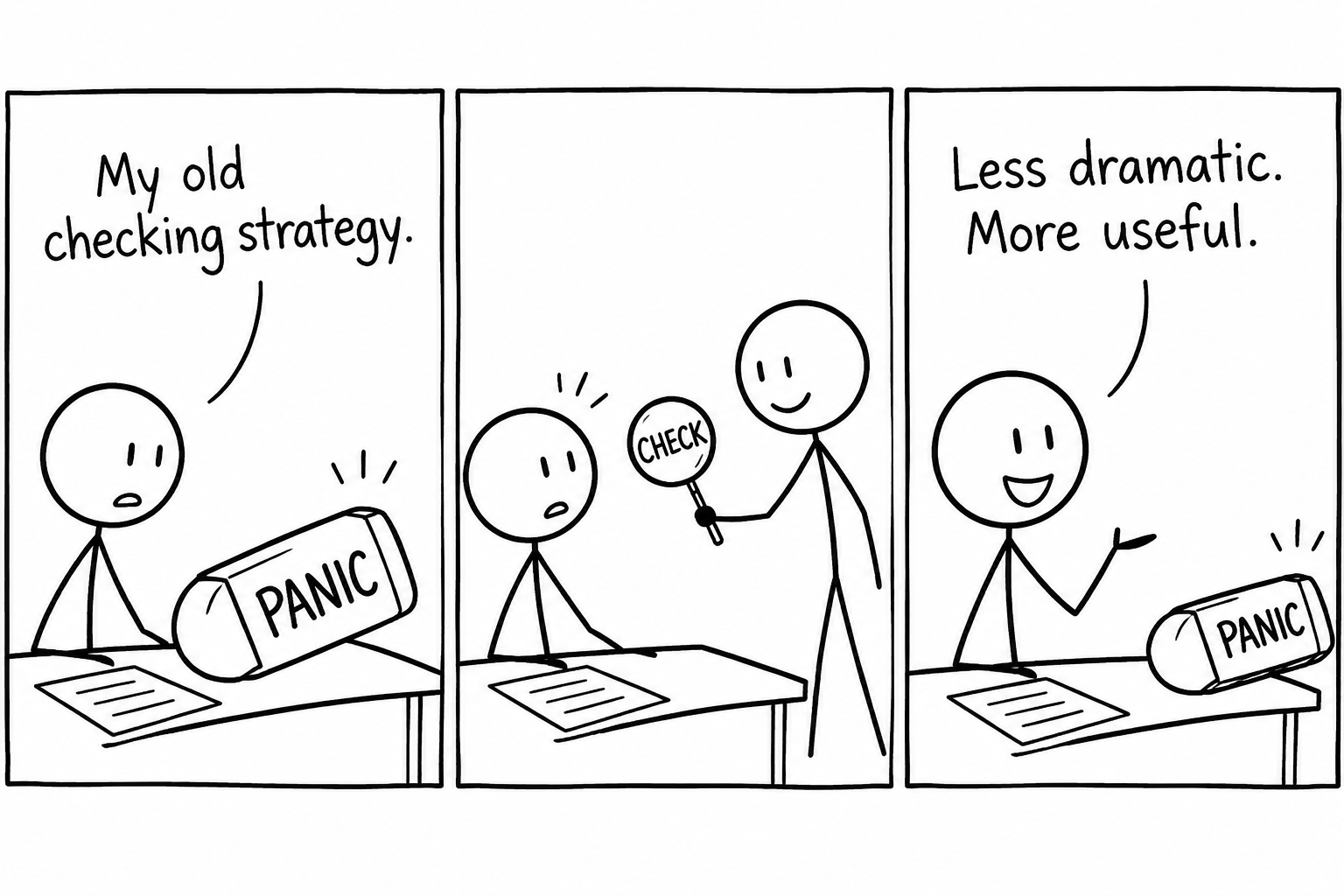 Stick-figure comic about replacing a dramatic revision strategy with a calmer checking habit
Multiplying correctly but stopping too soon
The student calculates:
(6×10⁴)(3×10⁻²)=18×102.(6 \times 10^4)(3 \times 10^{-2}) = 18 \times 10^2.(6×10⁴)(3×10⁻²)=18×102.Why it happens: both calculation steps are correct, so the student stops before checking the required format.
Correct method: multiply the coefficients and add the powers:
6×3=18,4+(−2)=2.6 \times 3 = 18, \qquad 4 + (-2) = 2.6×3=18,4+(−2)=2.Then rewrite the result in standard form:
18×102=1.8×103.18 \times 10^2 = 1.8 \times 10^3.18×102=1.8×10³.For division, divide the coefficients and subtract the powers. Take particular care when subtracting a negative:
8×1032×10−2=4×10³−(−2)=4×10⁵.\frac{8 \times 10^3}{2 \times 10^{-2}} = 4 \times 10^{3-(-2)} = 4 \times 10^5.2×10−28×103=4×10³−(−2)=4×10⁵.MathsGenie's explanation of calculations with numbers in standard form reinforces this distinction between the coefficients and powers.
Adding powers when adding numbers
Here is a different kind of error:
(3×10⁵)+(2×10⁴)=5×10⁹.(3 \times 10^5) + (2 \times 10^4) = 5 \times 10^9.(3×10⁵)+(2×10⁴)=5×10⁹.Why it happens: a familiar multiplication rule gets applied to an addition question. Index laws depend on the operation; they are not interchangeable shortcuts.
Correct method: make the powers equal before combining the coefficients.
2×104=0.2×105.2 \times 10^4 = 0.2 \times 10^5.2×104=0.2×10⁵.Now add:
(3×10⁵)+(0.2×10⁵)=3.2×10⁵.(3 \times 10^5) + (0.2 \times 10^5) = 3.2 \times 10^5.(3×10⁵)+(0.2×10⁵)=3.2×10⁵.You could also convert both numbers into ordinary notation first. For subtraction, use the same matching-powers approach. An intermediate coefficient such as 0.20.20.2 is acceptable during working; the final answer must satisfy the standard form rule.
Misreading a calculator display
A calculator may use an exponent indicator such as E when displaying a number in scientific notation. The exact appearance depends on the model.
Why it happens: the display looks different from the notation used on paper, so the student copies it without interpreting it.
If the display represents 7.2×10−57.2 \times 10^{-5}7.2×10⁻⁵, write that expression when standard form is requested. Do not drop the negative sign or treat the exponent indicator as a variable.
Before entering a calculation, predict its approximate size. After entering it, compare the display with that prediction. This catches many input mistakes that pressing the same buttons again would miss.
Exam-style practice: test the repairs
Try these without looking at the answers. Show working for the calculations and give every answer in standard form.
- Write 580 000580\,000580000 in standard form.
- Write 0.0000920.0000920.000092 in standard form.
- Calculate (4×10³)(6×10⁻⁵)(4 \times 10^3)(6 \times 10^{-5})(4×10³)(6×10⁻⁵).
- Calculate (7×10⁶)+(5×10⁵)(7 \times 10^6) + (5 \times 10^5)(7×10⁶)+(5×10⁵).
Answers and checks
The first answer is 5.8×1055.8 \times 10^55.8×10⁵. Check that multiplying 5.85.85.8 by 100 000100\,000100000 recovers the original number.
The second is 9.2×10−59.2 \times 10^{-5}9.2×10⁻⁵. The original number is positive and smaller than 111, so a negative power makes sense.
For multiplication:
(4×10³)(6×10⁻⁵)=24×10−2=2.4×10⁻¹.(4 \times 10^3)(6 \times 10^{-5}) = 24 \times 10^{-2} = 2.4 \times 10^{-1}.(4×10³)(6×10⁻⁵)=24×10−2=2.4×10⁻¹.For addition:
(7×10⁶)+(0.5×10⁶)=7.5×10⁶.(7 \times 10^6) + (0.5 \times 10^6) = 7.5 \times 10^6.(7×10⁶)+(0.5×10⁶)=7.5×10⁶.For further exam-style material, the standard form exam booklet provides questions with answers. When checking, label the cause of each error rather than simply copying the correction.
Turn corrections into reliable habits
Our imagined student's useful discovery is not that they need to “be more careful”. It is that each mistake has a specific check: coefficient, power, operation or size. Knowing those checks is the start; remembering them independently takes practice.
Your turn: start with MathsGenie's standard form Lessons and Question Bank, and apply all four checks to each answer.