

Common Mistakes With Solving Linear Equations in GCSE Maths
Common mistakes with solving linear equations in GCSE Maths: fix sign errors, brackets and fractions with worked examples and focused exam-style practice.
Common mistakes with solving linear equations in GCSE Maths
Common mistakes with solving linear equations in GCSE Maths usually come from changing only one side, losing a negative sign or using an inverse operation incorrectly. The fix is to write one balanced step at a time, keep signs attached to their terms and check your answer in the original equation.
Imagine a student looking back through a marked exercise. They understand what solving means, yet several answers are wrong. Another explanation of the whole topic might not help. Finding the exact line where their working changed the equation probably will.
This guide follows that process: spot the mistake, understand why it happens and replace it with a method you can repeat.
Your equation-solving checklist
Solving a linear equation means finding the value of the unknown that makes both sides equal. Each valid step must preserve that equality.
Before starting, use this checklist:
- Simplify each side where necessary, expanding brackets carefully.
- Use the same operation on both sides.
- Collect the unknown terms on one side when needed.
- Undo addition or subtraction, then multiplication or division.
- Substitute your answer into the original equation.
There is no compulsory direction for collecting terms. Choose the route you can explain clearly. If one-step equations still feel uncertain, revisit the solving one-step equations lesson before combining several operations.
Common mistakes and the correct methods
Changing one side but not the other
Our imagined student begins with:
3x+5=203x + 5 = 203x+5=20They subtract the constant on the left but leave the right unchanged:
3x=20(incorrect)3x = 20 \quad \text{(incorrect)}3x=20(incorrect)This happens when solving becomes a task of removing unwanted symbols. But the equals sign describes a relationship, not an instruction to tidy the left-hand side.
Subtract the same amount from both sides:
3x+5−5=20−53x + 5 - 5 = 20 - 53x+5−5=20−5 3x=153x = 153x=15Then divide both sides:
x=5x = 5x=5Repair habit: write the operation on both sides until balancing becomes reliable. A slightly longer correct solution is more useful than a short, uncertain one.
Using the wrong inverse operation
Consider:
4x−7=134x - 7 = 134x−7=13A mistaken first step is:
4x=13−7(incorrect)4x = 13 - 7 \quad \text{(incorrect)}4x=13−7(incorrect)The student notices subtraction and repeats it. Instead, ask which operation undoes the subtraction already attached to the unknown term.
Add the same amount to both sides:
4x−7+7=13+74x - 7 + 7 = 13 + 74x−7+7=13+7 4x=204x = 204x=20 x=5x = 5x=5“Move it across and change the sign” can become a fragile shortcut. Understanding the balancing operation explains why the shortcut works and helps prevent sign errors.
Multiplying only the first term inside brackets
Now the student reaches:
3(x−4)=183(x - 4) = 183(x−4)=18Their expansion reads:
3x−4=18(incorrect)3x - 4 = 18 \quad \text{(incorrect)}3x−4=18(incorrect)The multiplier applies to every term inside the bracket, not just the first:
3x−12=183x - 12 = 183x−12=18 3x=303x = 303x=30 x=10x = 10x=10Here, dividing both sides before expanding is also valid:
x−4=6x - 4 = 6x−4=6 x=10x = 10x=10Repair habit: inspect the structure before calculating. When a whole bracket is multiplied by a number, dividing first may reduce the amount of working.
Losing a negative sign outside a bracket
A minus sign is easy to overlook because it occupies so little space. Its effect is not small.
For:
10−2(x+1)=410 - 2(x + 1) = 410−2(x+1)=4the incorrect expansion is:
10−2x+2=4(incorrect)10 - 2x + 2 = 4 \quad \text{(incorrect)}10−2x+2=4(incorrect)The multiplier is negative, so both terms inside the bracket must be multiplied by it:
10−2x−2=410 - 2x - 2 = 410−2x−2=4 8−2x=48 - 2x = 48−2x=4Subtract from both sides:
−2x=−4-2x = -4−2x=−4Divide by the negative coefficient:
x=2x = 2x=2Our student now has something specific to change: carry the sign with the multiplier. For more support, read MathsGenie's guidance on solving linear equations without negative sign errors.
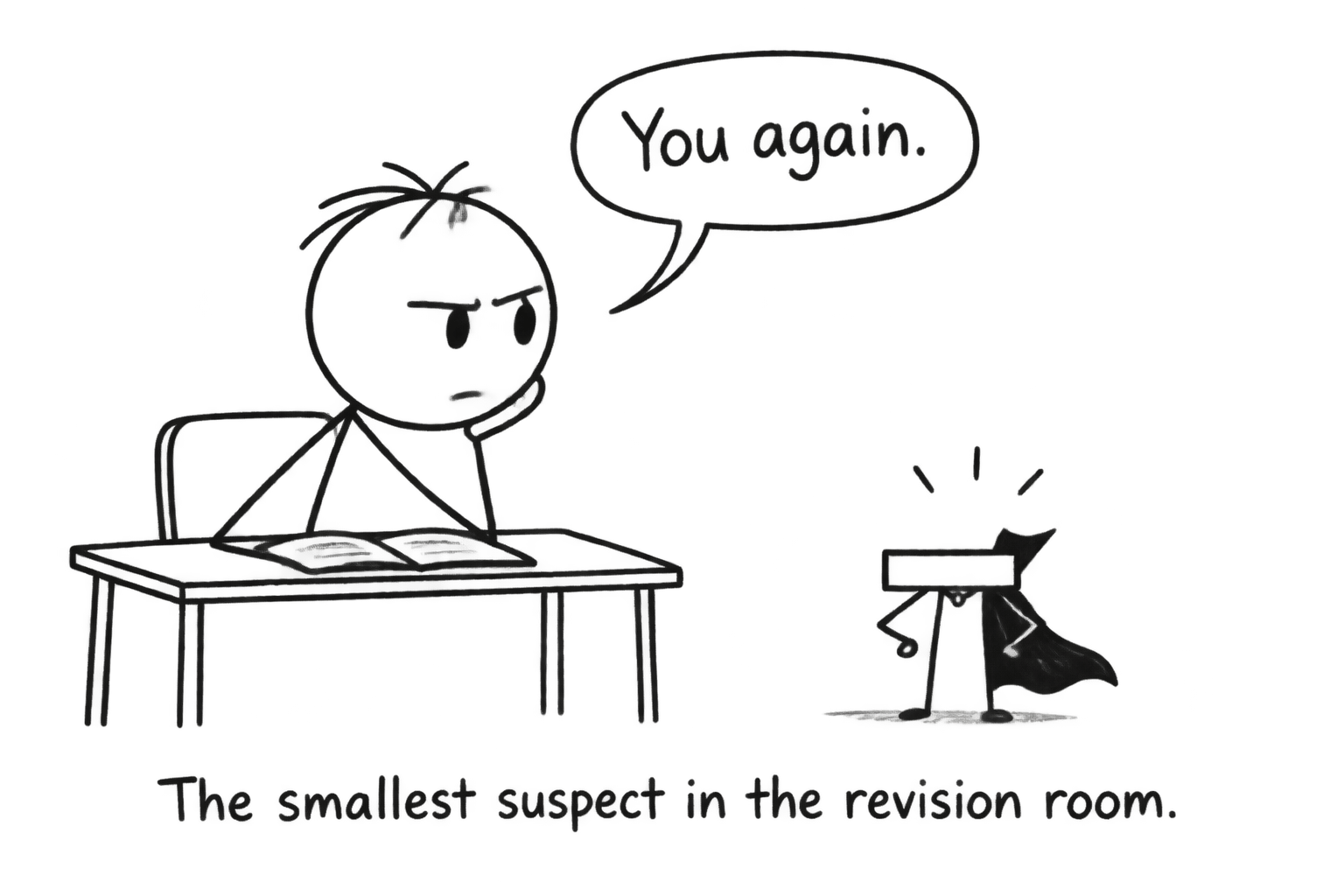 A stick-figure student recognises a tiny minus sign dressed as a theatrical villain
Combining terms from opposite sides without balancing
When the unknown appears on both sides, students sometimes combine terms as though the equals sign were not there.
Take:
5x+3=2x+185x + 3 = 2x + 185x+3=2x+18A mistaken line might be:
7x+3=18(incorrect)7x + 3 = 18 \quad \text{(incorrect)}7x+3=18(incorrect)You cannot simply add the unknown terms together across the equals sign. Subtract the same unknown term from both sides instead:
5x−2x+3=2x−2x+185x - 2x + 3 = 2x - 2x + 185x−2x+3=2x−2x+18 3x+3=183x + 3 = 183x+3=18 3x=153x = 153x=15 x=5x = 5x=5Repair habit: keep the equals signs aligned vertically. Each new line should show an equation equivalent to the previous one.
Dividing only part of an expression
Fractions can tempt students to split an expression incorrectly.
For:
x+63=5\frac{x + 6}{3} = 53x+6=5this rewrite is wrong:
x+2=5(incorrect)x + 2 = 5 \quad \text{(incorrect)}x+2=5(incorrect)The fraction bar groups the entire numerator. Both terms are being divided, not just the constant.
Multiply both sides by the denominator:
x+6=15x + 6 = 15x+6=15 x=9x = 9x=9A related mistake occurs when dividing an equation containing several terms: every term on each side must be included in the division.
Repair habit: read the fraction aloud as “the whole numerator divided by the denominator”. That wording makes the grouping harder to miss.
You can rehearse this same routine with MathsGenie's solving equations lesson and its Question Bank practice.
Check the answer, not just the working
A neat solution can still contain an arithmetic slip. Substitution gives you an independent check.
Return to the original equation with unknowns on both sides and substitute the answer:
5(5)+3=285(5) + 3 = 285(5)+3=28 2(5)+18=282(5) + 18 = 282(5)+18=28Both sides match, so the value satisfies the equation.
Check against the original question, not a later line. If your first expansion was wrong, checking only that expansion could confirm the wrong answer.
Our imagined student's improvement is not suddenly becoming faster. It is knowing where to look when something fails.
Exam-style practice: find your weakest step
Solve these without looking back at the examples. Write the balancing operations clearly and check each answer by substitution.
- Inverse operations: 6x−5=196x - 5 = 196x−5=19.
- Brackets: 4(x−3)=204(x - 3) = 204(x−3)=20.
- Negative multiplier: 15−3(x+1)=615 - 3(x + 1) = 615−3(x+1)=6.
- Unknowns on both sides: 7x+2=3x+227x + 2 = 3x + 227x+2=3x+22.
- Fraction: x−45=3\frac{x - 4}{5} = 35x−4=3.
The answers, in order, are x=4x = 4x=4, x=8x = 8x=8, x=2x = 2x=2, x=5x = 5x=5 and x=19x = 19x=19.
For each incorrect answer, identify the first invalid line. Label the cause: balancing, inverse operation, expansion, negative sign or division. Then correct that line and complete the solution again without copying.
The solving equations exam booklet provides further practice. Use worked solutions and mark schemes to compare the method, not simply the final value. Visible working makes your reasoning easier to follow and helps you diagnose errors afterwards.
Turn corrections into reliable working
Your goal is not to memorise every possible equation. It is to recognise the operation in front of you and preserve equality at each step. Knowing that principle matters; applying it consistently takes focused practice.
Start with your weakest step in MathsGenie's Lessons, then practise the same skill in the Question Bank.















