Common Mistakes with Quadratic Sequences in GCSE Maths
Common mistakes with quadratic sequences in GCSE Maths explained through worked examples, reliable checks and focused exam-style practice questions.

A quadratic sequence question can feel strangely unforgiving. You calculate the differences, recognise the pattern and write an expression that looks convincing. Then the mark scheme disagrees.
The common mistakes with quadratic sequences in GCSE Maths usually come from a handful of small errors: stopping at the first differences, forgetting to halve the second difference, or finding the n2n^2n2 term but not the complete nth term. The solution is a method that separates the process into steps and checks the result against the original sequence.
Imagine a student reviewing a question that cost them marks. Rather than deciding they are simply “bad at sequences”, they investigate where the method changed direction. That is what we will do here. Each mistake has a cause, a correction and a worked example.
The quadratic sequences checklist
For a sequence with nth term an2+bn+can^2+bn+can2+bn+c:
- Calculate the first differences.
- Calculate the second differences.
- Check that the second differences are constant.
- Use 2a2a2a as the constant second difference, so divide it by 222 to find aaa.
- Write the values of an2an^2an2 underneath the sequence.
- Subtract these values from the original terms.
- Find the linear nth term of the remaining sequence.
- Combine the two expressions.
- Substitute at least one value of nnn to check your answer.
You can see the full method alongside videos and practice on the Maths Genie GCSE revision lessons.
Mistake: stopping after the first differences
Consider the sequence:
3, 8, 15, 24, 35 3,\ 8,\ 15,\ 24,\ 35 3, 8, 15, 24, 35Its first differences are:
5, 7, 9, 11 5,\ 7,\ 9,\ 11 5, 7, 9, 11A common error is to see that these differences increase by 222 and then treat 222 as the coefficient of n2n^2n2. But the changing first differences do not directly give the quadratic coefficient. You need the second differences:
2, 2, 2 2,\ 2,\ 2 2, 2, 2A constant second difference confirms that the sequence is quadratic. For an nth term beginning with an2an^2an2, the second difference is 2a2a2a. Therefore:
2a=2 2a=2 2a=2 a=1 a=1 a=1The nth term begins with n2n^2n2, not 2n22n^22n2.
Mistake: forgetting to divide the second difference by two
This is one of the most frequent quadratic sequences mistakes because the constant second difference feels like the obvious number to use.
Take:
2, 9, 20, 35, 54 2,\ 9,\ 20,\ 35,\ 54 2, 9, 20, 35, 54The first differences are:
7, 11, 15, 19 7,\ 11,\ 15,\ 19 7, 11, 15, 19The second differences are:
4, 4, 4 4,\ 4,\ 4 4, 4, 4Since the second difference equals 2a2a2a:
2a=4 2a=4 2a=4 a=2 a=2 a=2The quadratic part is therefore 2n22n^22n2. Writing 4n24n^24n2 would make the sequence grow much too quickly.
There is a useful reason behind the rule. The sequence generated by n2n^2n2 has a constant second difference of 222. Multiplying n2n^2n2 by aaa multiplies that second difference by aaa, producing 2a2a2a.
Mistake: finding only the quadratic part
Finding aaa is an important step, but it is not usually the final answer. Return to:
2, 9, 20, 35, 54 2,\ 9,\ 20,\ 35,\ 54 2, 9, 20, 35, 54We found that its nth term begins with 2n22n^22n2. The first five values of 2n22n^22n2 are:
2, 8, 18, 32, 50 2,\ 8,\ 18,\ 32,\ 50 2, 8, 18, 32, 50Subtract these from the original terms:
2−2=09−8=120−18=235−32=354−50=4\begin{aligned} 2-2&=0\\ 9-8&=1\\ 20-18&=2\\ 35-32&=3\\ 54-50&=4 \end{aligned}2−29−820−1835−3254−50=0=1=2=3=4The remaining sequence is:
0, 1, 2, 3, 4 0,\ 1,\ 2,\ 3,\ 4 0, 1, 2, 3, 4Its nth term is n−1n-1n−1, because substituting n=1n=1n=1 gives 000. Combine both parts:
2n2+n−1 2n^2+n-1 2n2+n−1Now check the third term:
2(3)2+3−1=18+2=20 2(3)^2+3-1=18+2=20 2(3)2+3−1=18+2=20That matches the original sequence.
Once this subtraction method feels clear, the Maths Genie Question Bank gives you a direct way to practise spotting and correcting the same errors.
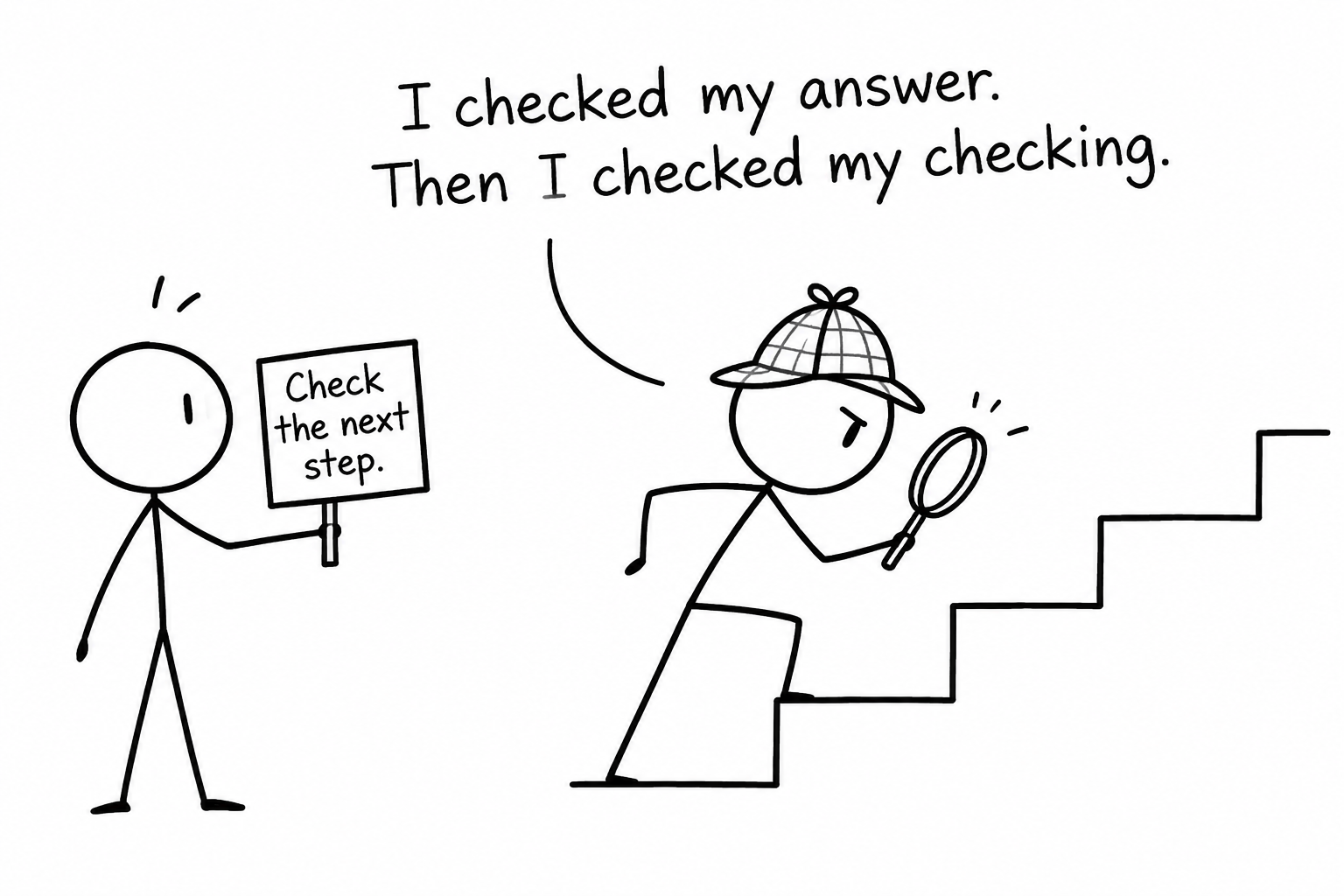 A student detective carefully checking their checking during revision
Mistake: subtracting in the wrong direction
After finding an2an^2an2, subtract its terms from the original sequence. Reversing the subtraction changes every sign and produces the wrong linear remainder.
For the sequence above, the correct calculation is:
original term−2n2 \text{original term}-2n^2 original term−2n2For the second term:
9−8=1 9-8=1 9−8=1It is not:
8−9=−1 8-9=-1 8−9=−1Writing the two rows vertically can prevent this. Put the original sequence on top, the an2an^2an2 sequence underneath, and subtract downwards.
Mistake: assuming the quadratic coefficient is positive
Quadratic sequences do not always rise faster and faster. Their second difference can be negative.
Consider:
10, 15, 18, 19, 18 10,\ 15,\ 18,\ 19,\ 18 10, 15, 18, 19, 18The first differences are:
5, 3, 1, −1 5,\ 3,\ 1,\ -1 5, 3, 1, −1The second differences are:
−2, −2, −2 -2,\ -2,\ -2 −2, −2, −2Therefore:
2a=−2 2a=-2 2a=−2 a=−1 a=-1 a=−1The quadratic part is −n2-n^2−n2. Its values are:
−1, −4, −9, −16, −25 -1,\ -4,\ -9,\ -16,\ -25 −1, −4, −9, −16, −25Subtracting these from the original sequence gives:
11, 19, 27, 35, 43 11,\ 19,\ 27,\ 35,\ 43 11, 19, 27, 35, 43This is a linear sequence with nth term 8n+38n+38n+3. The complete nth term is:
−n2+8n+3 -n^2+8n+3 −n2+8n+3Check the fifth term:
−(5)2+8(5)+3=−25+40+3=18 -(5)^2+8(5)+3=-25+40+3=18 −(5)2+8(5)+3=−25+40+3=18The negative sign is essential. A missing sign can undo an otherwise correct method.
Mistake: misaligning the differences
A first-difference row has one fewer value than the original sequence. The second-difference row has one fewer value again. Students sometimes add an extra difference or compare terms that are not adjacent.
For four terms u1,u2,u3,u4u_1,u_2,u_3,u_4u1,u2,u3,u4, the first differences are:
u2−u1,u3−u2,u4−u3 u_2-u_1,\quad u_3-u_2,\quad u_4-u_3 u2−u1,u3−u2,u4−u3There must be exactly three of them. Slow, organised subtraction is more reliable than trying to see every pattern mentally. This matters particularly when terms are negative.
Common mistakes to catch before the exam
Before moving to another question, ask:
- Did I calculate second differences rather than stop at the first?
- Did I divide the constant second difference by 222?
- Did I subtract an2an^2an2 from the original terms in the correct direction?
- Did I find the remaining linear expression?
- Did I keep negative signs visible?
- Did I give an expression in nnn, rather than another term in the sequence?
- Did I test my nth term using an original term?
That final check is especially valuable. A formula can look neat and still be wrong. Substitution turns confidence into evidence.
Exam-style quadratic sequences practice
Try these without looking back at the worked examples.
Question A
Find the nth term of:
6, 15, 28, 45, 66 6,\ 15,\ 28,\ 45,\ 66 6, 15, 28, 45, 66Question B
Find the nth term of:
4, 11, 22, 37, 56 4,\ 11,\ 22,\ 37,\ 56 4, 11, 22, 37, 56Question C
Find the nth term of:
12, 19, 22, 21, 16 12,\ 19,\ 22,\ 21,\ 16 12, 19, 22, 21, 16Answers
For Question A, the first differences are 9,13,17,219,13,17,219,13,17,21 and the second difference is 444. The answer is:
2n2+3n+1 2n^2+3n+1 2n2+3n+1For Question B, the first differences are 7,11,15,197,11,15,197,11,15,19 and the second difference is 444. The answer is:
2n2+n+1 2n^2+n+1 2n2+n+1For Question C, the first differences are 7,3,−1,−57,3,-1,-57,3,−1,−5 and the second difference is −4-4−4. The answer is:
−2n2+13n+1 -2n^2+13n+1 −2n2+13n+1When you mark your work, do not record only whether an answer was right or wrong. Identify the precise line where it went wrong. The GCSE exam papers and mark schemes can then help you practise applying the method in a wider exam context.
Turn the method into reliable marks
Knowing the steps is not quite the same as following them accurately when the numbers become awkward. The student in our example improves by checking one decision at a time: second differences, halving, subtraction, linear remainder and substitution.
Your turn. Start the Maths Genie quadratic sequences lessons and Question Bank and practise the method until those avoidable quadratic sequence errors stop costing you marks.