

Common Mistakes with HCF and LCM in GCSE Maths
Common mistakes with HCF and LCM in GCSE Maths explained through worked examples, clear checks and exam-style practice to help you avoid losing easy marks.
It is frustrating to finish a calculation neatly and discover that you answered the wrong question. Common mistakes with HCF and LCM in GCSE Maths usually come from confusing factors with multiples, losing repeated prime factors, or choosing the wrong method in a word problem. The fix is to decide what your answer must do before you calculate it.
Treat each error as a specific check: identify the misunderstanding, then practise the correct method.
Your HCF and LCM checklist
- HCF means highest common factor: the largest positive whole number that divides exactly into every given number.
- LCM means lowest common multiple: the smallest positive whole number that every given number divides into exactly.
- Prime factorisation preserves every factor: repeated primes must stay in your working.
- Context determines the method: equal groups often suggest HCF; repeating events meeting again often suggest LCM.
- Your answer needs checking: does it divide the original numbers, or is it divisible by them?
These ideas belong together, which is why MathsGenie's Prime Factors, HCF and LCM lesson covers them as one topic.
Common mistakes with HCF and LCM in GCSE Maths
Confusing factors with multiples
The mistake: our imagined student finds a number larger than both starting numbers and labels it the HCF.
The correct method: ask which direction the division goes. A factor divides into a number; a multiple is divisible by that number.
For 121212 and 181818, list the positive factors:
12:1,2,3,4,6,1212:\quad 1,2,3,4,6,1212:1,2,3,4,6,12 18:1,2,3,6,9,1818:\quad 1,2,3,6,9,1818:1,2,3,6,9,18The largest shared factor is 666, so:
HCF(12,18)=6\operatorname{HCF}(12,18)=6HCF(12,18)=6Now list positive multiples:
12:12,24,36,48,…12:\quad 12,24,36,48,\ldots12:12,24,36,48,… 18:18,36,54,…18:\quad 18,36,54,\ldots18:18,36,54,…The first shared multiple is 363636, so:
LCM(12,18)=36\operatorname{LCM}(12,18)=36LCM(12,18)=36Check: for positive whole numbers, the HCF cannot exceed the smaller number. The LCM cannot be smaller than the larger number. These checks catch many swapped answers.
Stopping a factor tree too early
The mistake: the student writes 60=6×1060=6\times1060=6×10 and treats that as a prime factorisation.
The correct method: neither 666 nor 101010 is prime. Continue splitting every composite factor until all the end numbers are prime:
60=6×10=(2×3)×(2×5)60=6\times10=(2\times3)\times(2\times5)60=6×10=(2×3)×(2×5)Therefore:
60=22×3×560=2^2\times3\times560=22×3×5Multiply back to check that no factor disappeared. Also remember that 111 is not prime, so it should not appear as a prime factor at the end of a branch.
The shape of the factor tree does not matter. Starting with a different factor pair must still produce the same prime factors, including repetitions.
Losing repeated primes when finding the HCF
The mistake: the student sees that two numbers share the primes 222 and 333, then uses each only once.
Consider:
48=24×3,72=23×3248=2^4\times3,\qquad72=2^3\times3^248=24×3,72=23×32Both numbers contain three copies of 222 and one copy of 333. Therefore:
HCF(48,72)=23×3=24\operatorname{HCF}(48,72)=2^3\times3=24HCF(48,72)=23×3=24The correct method: for the HCF, use only shared primes and take the smaller power of each.
If you use a Venn diagram, place matching prime factors in the overlap one pair at a time. Multiply the factors in the overlap to find the HCF. Do not add them.
Multiplying both numbers to find the LCM
The mistake: the student automatically multiplies the two original numbers.
Why it happens: their product is certainly a common multiple, but it is not necessarily the lowest one. Shared factors can be counted unnecessarily.
Using the same factorisations, the LCM needs enough copies of each prime to contain either original number:
LCM(48,72)=24×32=144\operatorname{LCM}(48,72)=2^4\times3^2=144LCM(48,72)=24×32=144The correct method: use every prime that appears and take the larger power of each.
Check both divisions:
144÷48=3,144÷72=2144\div48=3,\qquad144\div72=2144÷48=3,144÷72=2In a Venn diagram, multiply all the factors across the entire diagram, counting each entry once. The overlap is already shared, so do not count it twice.
Use the MathsGenie lesson and Question Bank to practise choosing smaller powers for HCF and larger powers for LCM while the distinction is fresh.
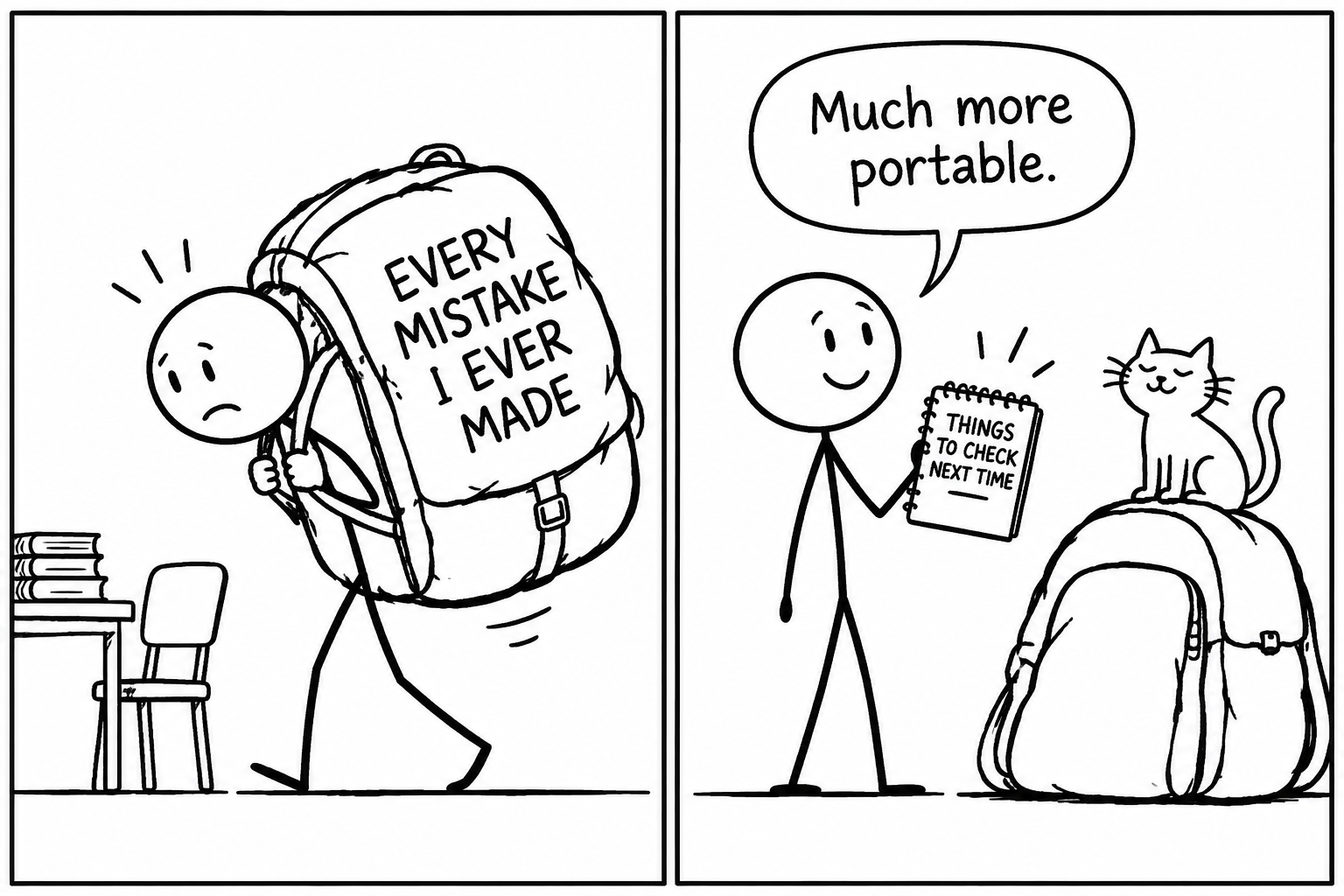 A stick-figure student replaces a huge bag of past mistakes with a small notebook of things to check next time.
Choosing a method from one word
The mistake: the student spots “largest” and chooses HCF without considering what the answer represents.
The correct method: describe the job of the unknown number.
Suppose a club has 484848 pencils and 727272 stickers. It wants the greatest possible number of identical packs, with no items left over. The number of packs must divide both quantities, so use HCF:
Number of packs=24\text{Number of packs}=24Number of packs=24Each pack contains:
48÷24=2 pencils,72÷24=3 stickers48\div24=2\text{ pencils},\qquad72\div24=3\text{ stickers}48÷24=2 pencils,72÷24=3 stickersNow suppose two lights flash every 484848 seconds and 727272 seconds. They flash together now. The next shared flashing time must be a multiple of both intervals, so use LCM:
Time until they next flash together=144 seconds\text{Time until they next flash together}=144\text{ seconds}Time until they next flash together=144 secondsThe numbers have not changed. The relationship has. Always finish by answering the actual question, including units where needed.
Make your working useful to the examiner
A correct method should be visible, not hidden in your head. Write the prime factorisations clearly, label whether you are finding HCF or LCM, and show the multiplication that produces your answer.
For questions involving three numbers, extend the same rule carefully: an HCF prime must occur in all three, while the LCM must include enough copies to accommodate each number.
HCF and LCM sit within the wider number content of GCSE Maths revision. When you later meet them in topic-based exam booklets, keep using the same checking routine rather than relying on how familiar a question looks.
Exam-style practice: find the error before it happens
Try these independently, explaining your choice of method before checking the answers.
- Find the HCF and LCM of 181818 and 303030.
- A student says the LCM of 888 and 121212 is 969696 because 8×12=968\times12=968×12=96. Explain the mistake and give the correct answer.
- A teacher shares 363636 red counters and 545454 blue counters into the greatest possible number of identical groups. Find the number of groups and the contents of each group.
Answers and checks
For the first question:
18=2×32,30=2×3×518=2\times3^2,\qquad30=2\times3\times518=2×32,30=2×3×5Therefore:
HCF=2×3=6,LCM=2×32×5=90\operatorname{HCF}=2\times3=6,\qquad\operatorname{LCM}=2\times3^2\times5=90HCF=2×3=6,LCM=2×32×5=90For the second, 969696 is a common multiple, but not the lowest. Since 8=238=2^38=23 and 12=22×312=2^2\times312=22×3, the LCM is 23×3=242^3\times3=2423×3=24.
For the third, use HCF because the group count must divide both quantities. The HCF is 181818, giving 181818 groups containing 222 red counters and 333 blue counters each.
Turn each mistake into your next check
The goal is to choose the method yourself, even when a question looks different. Turn your errors into checks, then use MathsGenie's Lessons and Question Bank to practise the mistake you most need to fix.















