Common Mistakes with Growth and Decay in GCSE Maths
Common mistakes with growth and decay in GCSE Maths explained through worked examples, exam tips and focused practice to help you protect more marks.
A growth and decay question can look familiar enough to do quickly. That is often where the trouble begins. A student sees a percentage, remembers something about multipliers and enters numbers into a calculator before deciding what those numbers mean.
The most common mistakes with growth and decay in GCSE Maths come from using the wrong multiplier, treating compound change as simple change, counting the periods incorrectly or rounding too soon. The reliable method is to identify the starting amount, convert the percentage into a multiplier, raise that multiplier to the number of periods and round only the final answer.
Imagine a student called Aisha reviewing the marks she lost in a practice paper. Her calculator skills are fine. The real problem is that several small decisions were made too quickly. Here is how she can fix each one.
The growth and decay checklist
Before touching the calculator, write down these six things:
- Identify the original amount.
- Decide whether the quantity is growing or decaying.
- Convert the percentage rate into a decimal multiplier.
- Count the number of repeated periods carefully.
- Use the multiplier as a power.
- Keep the full calculator value and round at the end.
For an original amount PPP, a decimal multiplier mmm and nnn periods, the general calculation is:
P×mnP \times m^nP×mnFor growth at r%r\%r%, the multiplier is:
1+r1001 + \frac{r}{100}1+100rFor decay at r%r\%r%, the multiplier is:
1−r1001 - \frac{r}{100}1−100rThe Repeated Percentage Change lesson brings together the lesson, questions and supporting revision resources for this method.
Once this checklist is familiar, use the Maths Genie GCSE Maths lessons and GCSE Maths Question Bank to practise recognising the correct setup before calculating.
Mistake: adding the same percentage each time
Aisha sees an investment of £240\pounds 240£240 growing by 5%5\%5% each year for three years. She calculates 5%5\%5% of £240\pounds 240£240, gets £12\pounds 12£12 and adds it three times:
240+3×12=276240 + 3 \times 12 = 276240+3×12=276Why this happens
This treats the question as simple growth. However, repeated percentage change usually means the amount changes after every period. In the second year, the 5%5\%5% is calculated from the new balance, not the original £240\pounds 240£240.
The correct method
A growth rate of 5%5\%5% gives the multiplier:
1+5100=1.051 + \frac{5}{100} = 1.051+1005=1.05There are three years, so raise the multiplier to the power of 333:
240×1.053=277.83240 \times 1.05^3 = 277.83240×1.053=277.83The investment is worth £277.83\pounds 277.83£277.83 after three years. The power matters because it applies the percentage change to each new balance.
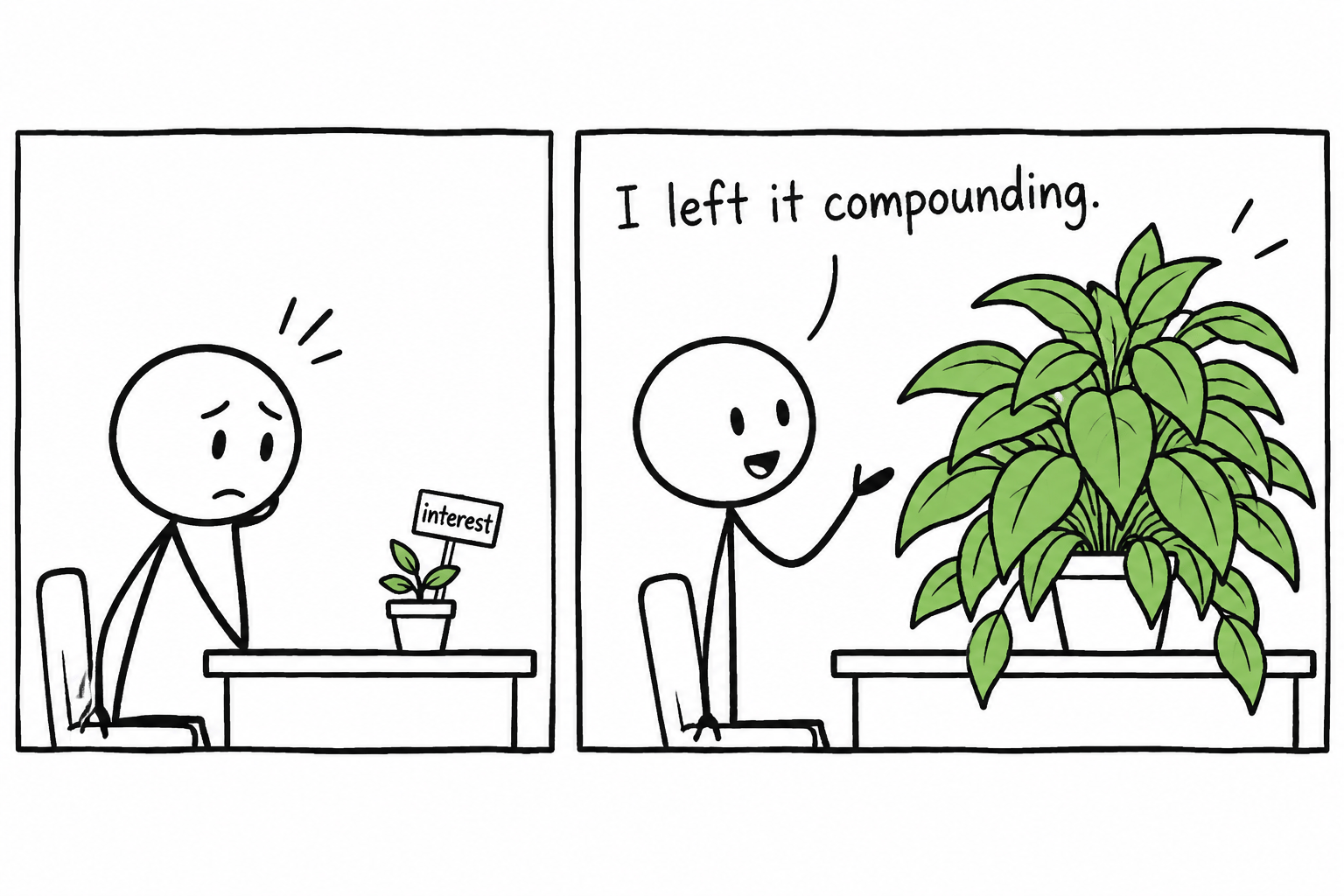 A student discovers that interest has grown into an enormous houseplant
Mistake: subtracting the rate instead of finding the multiplier
The next question says that a machine worth £850\pounds 850£850 depreciates by 12%12\%12% each year for four years. Aisha enters 850×0.124850 \times 0.12^4850×0.124.
Why this happens
The number 0.120.120.12 represents the proportion being lost. It does not represent the proportion remaining. Decay questions require the amount left after the decrease.
The correct method
If 12%12\%12% is lost, then 88%88\%88% remains:
100%−12%=88%100\% - 12\% = 88\%100%−12%=88%Convert 88%88\%88% into a decimal multiplier:
88100=0.88\frac{88}{100} = 0.8810088=0.88Now apply this multiplier four times:
850×0.884=509.741056850 \times 0.88^4 = 509.741056850×0.884=509.741056Rounded to the nearest penny, the machine is worth:
£509.74\pounds 509.74£509.74For more targeted questions, the Compound Interest and Depreciation exam booklet provides structured practice on choosing and applying multipliers.
Mistake: using the number of dates instead of the number of changes
Suppose a population is recorded at the beginning of 202320232023 and grows by 4%4\%4% annually. A question asks for its value at the beginning of 202620262026.
Aisha notices four year labels, 202320232023, 202420242024, 202520252025 and 202620262026, so she uses a power of 444.
Why this happens
Dates are being counted instead of intervals. Growth occurs across the gaps between them.
The correct method
List the changes:
- Beginning of 202320232023 to beginning of 202420242024: one change.
- Beginning of 202420242024 to beginning of 202520252025: two changes.
- Beginning of 202520252025 to beginning of 202620262026: three changes.
The correct power is therefore 333. If the initial population is 2,5002{,}5002,500, the calculation is:
2500×1.043=2812.162500 \times 1.04^3 = 2812.162500×1.043=2812.16If the context requires a whole number of people, interpret the rounding instruction carefully. The calculation and the interpretation are separate decisions.
Mistake: multiplying when the original amount is unknown
Aisha reaches a reverse growth problem: an account contains £529.20\pounds 529.20£529.20 after increasing by 8%8\%8%. She multiplies by 0.920.920.92 because she wants to go backwards.
Why this happens
It feels natural to undo an 8%8\%8% increase with an 8%8\%8% decrease. But the two percentages would be based on different amounts. Reverse percentages require division by the original multiplier.
The correct method
An 8%8\%8% increase uses a multiplier of:
1.081.081.08Let the original amount be xxx. Then:
x×1.08=529.20x \times 1.08 = 529.20x×1.08=529.20Divide both sides by 1.081.081.08:
x=529.201.08=490x = \frac{529.20}{1.08} = 490x=1.08529.20=490The original amount was £490\pounds 490£490. The same principle applies after several periods, but you divide by the complete repeated multiplier:
P=AmnP = \frac{A}{m^n}P=mnAMistake: assuming equal growth and decay cancel
A price of £600\pounds 600£600 rises by 10%10\%10% and then falls by 10%10\%10%. Aisha expects the answer to return to £600\pounds 600£600.
Why this happens
The percentages look equal, but they act on different amounts. The decrease is applied after the price has grown.
The correct method
Use the growth multiplier followed by the decay multiplier:
600×1.10×0.90=594600 \times 1.10 \times 0.90 = 594600×1.10×0.90=594The final price is £594\pounds 594£594, not £600\pounds 600£600. A quick multiplier check explains why:
1.10×0.90=0.991.10 \times 0.90 = 0.991.10×0.90=0.99The combined effect leaves 99%99\%99% of the original amount, which is an overall decrease of 1%1\%1%.
Mistake: rounding during the calculation
Some growth and decay mistakes are not about the method at all. They happen because an intermediate answer is rounded and then used in the next stage.
Why this happens
Money is commonly written to two decimal places, so students may round after every year. That introduces a small error, which can become larger across several periods.
The correct method
Enter the complete calculation in one line:
P×mnP \times m^nP×mnKeep all the digits shown by the calculator. Round only the final answer, following the question's instruction. For money, this will often be to the nearest penny; for a population, it may be to the nearest whole number.
A quick summary of growth and decay mistakes
| Mistake | Better decision |
|---|---|
| Adding the same percentage amount repeatedly | Use P×mnP \times m^nP×mn for compound change |
| Using the percentage lost as the decay multiplier | Subtract the rate from 111 |
| Counting dates rather than intervals | Count how many changes actually occur |
| Multiplying to find an original value | Divide by the multiplier |
| Assuming equal increases and decreases cancel | Multiply the two multipliers |
| Rounding after every period | Round only the final result |
The pattern is simple: most lost marks begin before the calculator is used. Write the multiplier and number of periods explicitly, then calculate.
Exam-style practice
Try these without looking back at the examples.
Question one
A car is worth £18,000\pounds 18{,}000£18,000 and depreciates by 14%14\%14% each year. Find its value after three years, giving your answer to the nearest penny.
18000×0.863=11448.79218000 \times 0.86^3 = 11448.79218000×0.863=11448.792The value is £11,448.79\pounds 11{,}448.79£11,448.79.
Question two
A town has a population of 32,00032{,}00032,000. Its population grows by 2.5%2.5\%2.5% each year. Find the population after five years, giving your answer to the nearest whole number.
32000×1.0255=36205.0625…32000 \times 1.025^5 = 36205.0625\ldots32000×1.0255=36205.0625…The population is approximately 36,20536{,}20536,205.
Question three
An investment is worth £1,331\pounds 1{,}331£1,331 after growing by 10%10\%10% annually for three years. Find its original value.
13311.103=1000\frac{1331}{1.10^3} = 10001.1031331=1000The original investment was £1,000\pounds 1{,}000£1,000.
Build speed only after the setup is dependable. The Maths Genie Question Rush is useful when you are ready to make these decisions more quickly, while the GCSE Maths videos can help you revisit a method that still feels uncertain.
Turn corrected mistakes into secure marks
Aisha's errors were not fixed by pressing calculator buttons faster. They were fixed by pausing long enough to identify the multiplier, the periods and whether the question was moving forwards or backwards. Knowing that method is the first step; following it consistently under exam pressure takes focused practice.
Start the matching Maths Genie lesson on repeated percentage change, then apply each correction in the GCSE Maths Question Bank.