

Common Composite Functions Mistakes at GCSE
Common mistakes with composite functions in GCSE Maths explained through worked examples, correction steps and focused exam-style practice.
A composite-functions question can look harmless: two short rules, familiar algebra and perhaps only a few marks. Then the order gets reversed, a bracket disappears, or a student tries to multiply the functions together.
These common mistakes with composite functions in GCSE Maths usually come from notation rather than difficult calculations. The central rule is simple: for fg(x)fg(x)fg(x), apply ggg first and then apply fff. Once you learn to show that order clearly, the algebra becomes far more manageable.
This guide follows a student correcting the errors that tend to cost marks. Each mistake includes why it happens, the correct method and an exam-style question to try.
The composite functions checklist
Before working through a question, use this short routine:
- Read fg(x)fg(x)fg(x) from right to left: apply ggg first, then fff.
- Write the inner result before doing anything else.
- Substitute the whole inner expression into the outer function.
- Use brackets whenever an expression replaces xxx.
- Expand, simplify and check only after the substitution is complete.
- If a number is given, decide whether direct substitution or finding the general expression will be clearer.
You can review the complete method on the Maths Genie inverse and composite functions lesson, which includes lesson material, exam-style questions and worked solutions.
Mistake: applying the functions in the wrong order
Suppose
f(x)=2x+3andg(x)=x2.f(x)=2x+3 \qquad \text{and} \qquad g(x)=x^2.f(x)=2x+3andg(x)=x2.A student asked to find fg(x)fg(x)fg(x) might begin with f(x)f(x)f(x) because its letter appears first. That produces g(f(x))g(f(x))g(f(x)), which is actually gf(x)gf(x)gf(x).
The notation describes nesting:
fg(x)=f(g(x)).fg(x)=f(g(x)).fg(x)=f(g(x)).The function beside the input acts first. Here, apply ggg, then feed its output into fff:
g(x)=x2,g(x)=x^2,g(x)=x2, f(g(x))=f(x2)=2x2+3.f(g(x))=f(x^2)=2x^2+3.f(g(x))=f(x2)=2x2+3.Therefore,
fg(x)=2x2+3.fg(x)=2x^2+3.fg(x)=2x2+3.To see why order matters, calculate the reverse composition:
gf(x)=g(2x+3)=(2x+3)2.gf(x)=g(2x+3)=(2x+3)^2.gf(x)=g(2x+3)=(2x+3)2.In general, fg(x)fg(x)fg(x) and gf(x)gf(x)gf(x) are not equal. The order is part of the question, not a presentational detail.
Memory prompt: start with the function closest to xxx.
Mistake: multiplying the functions
The notation fg(x)fg(x)fg(x) can resemble multiplication. A student may incorrectly write
fg(x)=f(x)g(x).fg(x)=f(x)g(x).fg(x)=f(x)g(x).But juxtaposed function names indicate composition in this GCSE context. They do not tell you to multiply the two formulas.
Let
f(x)=x−4andg(x)=3x+1.f(x)=x-4 \qquad \text{and} \qquad g(x)=3x+1.f(x)=x−4andg(x)=3x+1.To find fg(x)fg(x)fg(x), first identify the inner output:
g(x)=3x+1.g(x)=3x+1.g(x)=3x+1.Now use this entire expression as the input of fff. Since fff subtracts 444 from its input,
f(g(x))=(3x+1)−4=3x−3.f(g(x))=(3x+1)-4=3x-3.f(g(x))=(3x+1)−4=3x−3.So
fg(x)=3x−3.fg(x)=3x-3.fg(x)=3x−3.Multiplying would give (x−4)(3x+1)(x-4)(3x+1)(x−4)(3x+1), which answers a different question. When uncertain, rewrite the notation as f(g(x))f(g(x))f(g(x)). The nested brackets make the intended operation visible.
Mistake: substituting only part of the expression
Now suppose
f(x)=5−2xandg(x)=x2+3x.f(x)=5-2x \qquad \text{and} \qquad g(x)=x^2+3x.f(x)=5−2xandg(x)=x2+3x.To find fg(x)fg(x)fg(x), every occurrence of xxx in the outer rule must be replaced by the whole expression x2+3xx^2+3xx2+3x:
fg(x)=f(g(x))=5−2(x2+3x).fg(x)=f(g(x))=5-2(x^2+3x).fg(x)=f(g(x))=5−2(x2+3x).Only then should you expand:
fg(x)=5−2x2−6x.fg(x)=5-2x^2-6x.fg(x)=5−2x2−6x.A common incorrect line is
5−2x2+3x.5-2x^2+3x.5−2x2+3x.Here, the multiplication by −2-2−2 has reached only the first term. The bracket protects the complete input until the substitution has been handled.
This is an important habit beyond composite functions. Whenever an expression replaces a variable, place it in brackets first.
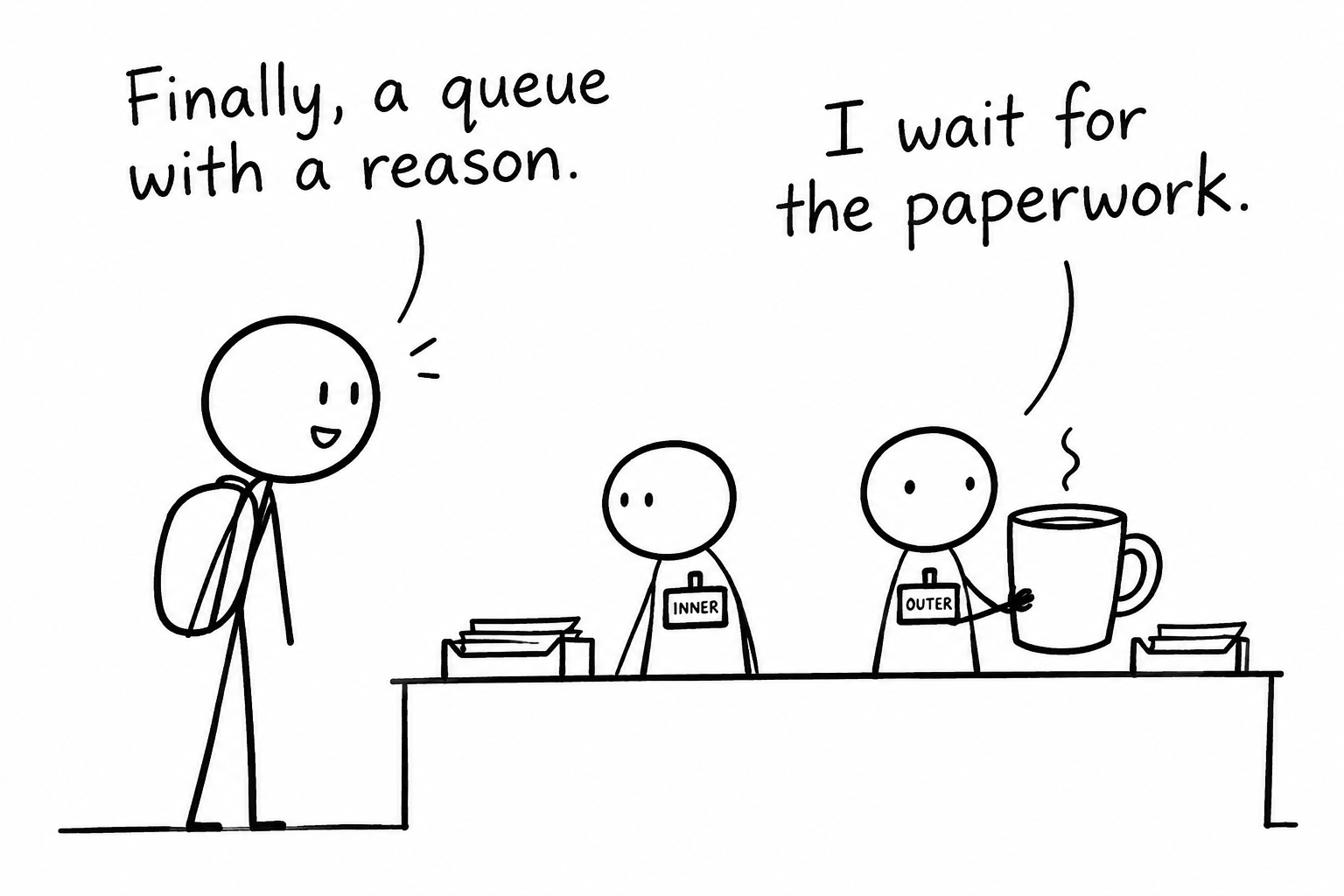 A student sends function inputs through an inner and outer office queue
You now have the working routine; use the lesson and Question Bank on the Maths Genie composite functions topic page to practise applying it without having to assemble questions yourself.
Mistake: expanding a squared bracket incorrectly
Composite functions often expose an algebra mistake rather than a functions mistake.
Let
f(x)=x2+1andg(x)=x−3.f(x)=x^2+1 \qquad \text{and} \qquad g(x)=x-3.f(x)=x2+1andg(x)=x−3.For fg(x)fg(x)fg(x), substitute the whole of g(x)g(x)g(x) into the squared input of fff:
fg(x)=f(x−3)=(x−3)2+1.fg(x)=f(x-3)=(x-3)^2+1.fg(x)=f(x−3)=(x−3)2+1.The square applies to the entire bracket. It does not mean squaring each term separately:
(x−3)2=(x−3)(x−3).(x-3)^2=(x-3)(x-3).(x−3)2=(x−3)(x−3).Expanding gives
(x−3)2=x2−6x+9.(x-3)^2=x^2-6x+9.(x−3)2=x2−6x+9.Therefore,
fg(x)=x2−6x+10.fg(x)=x^2-6x+10.fg(x)=x2−6x+10.The lost middle term is one of the most frequent composite functions mistakes. If the outer function contains a square, keep the substituted expression in brackets and expand it as a product.
Mistake: mishandling negative inputs
A question may ask for a value such as fg(−2)fg(-2)fg(−2). Negative inputs need visible brackets.
Suppose
f(x)=3x−1andg(x)=x2+2.f(x)=3x-1 \qquad \text{and} \qquad g(x)=x^2+2.f(x)=3x−1andg(x)=x2+2.Work from the inside:
g(−2)=(−2)2+2=4+2=6.g(-2)=(-2)^2+2=4+2=6.g(−2)=(−2)2+2=4+2=6.Then apply fff:
f(6)=3(6)−1=17.f(6)=3(6)-1=17.f(6)=3(6)−1=17.Hence,
fg(−2)=17.fg(-2)=17.fg(−2)=17.Writing −22-2^2−22 without brackets can lead to the wrong interpretation. When the input is negative, use (−2)2(-2)^2(−2)2 so that the number being squared is unmistakable.
Mistake: finding a formula when only a value is needed
Finding the general expression for fg(x)fg(x)fg(x) is valid, but it is not always the quickest route.
Let
f(x)=4x+5andg(x)=x−7.f(x)=4x+5 \qquad \text{and} \qquad g(x)=x-7.f(x)=4x+5andg(x)=x−7.To calculate fg(10)fg(10)fg(10), process the number through the two functions:
g(10)=10−7=3,g(10)=10-7=3,g(10)=10−7=3, f(3)=4(3)+5=17.f(3)=4(3)+5=17.f(3)=4(3)+5=17.Therefore,
fg(10)=17.fg(10)=17.fg(10)=17.This direct route reduces the amount of algebra. However, if the question asks you to find fg(x)fg(x)fg(x), or uses the composition repeatedly, form the general expression. The best method depends on what the question actually requests.
A reliable method for exam questions
When nerves make notation feel slippery, use an input-output chain:
x⟶g(x)⟶f(g(x)).x \longrightarrow g(x) \longrightarrow f(g(x)).x⟶g(x)⟶f(g(x)).For example, if
f(x)=2x2andg(x)=x+4,f(x)=2x^2 \qquad \text{and} \qquad g(x)=x+4,f(x)=2x2andg(x)=x+4,then
x⟶x+4⟶2(x+4)2.x \longrightarrow x+4 \longrightarrow 2(x+4)^2.x⟶x+4⟶2(x+4)2.Thus,
fg(x)=2(x+4)2.fg(x)=2(x+4)^2.fg(x)=2(x+4)2.If an expanded expression is required,
fg(x)=2(x2+8x+16)=2x2+16x+32.fg(x)=2(x^2+8x+16)=2x^2+16x+32.fg(x)=2(x2+8x+16)=2x2+16x+32.The chain separates the functions before the algebra begins. It also gives the examiner a clear record of your method, which matters when a final arithmetic slip occurs.
Exam-style practice
Try these without looking back at the worked examples. Show the inner function first and use brackets around every substituted expression.
Question A
Given
f(x)=3x+2andg(x)=x−5,f(x)=3x+2 \qquad \text{and} \qquad g(x)=x-5,f(x)=3x+2andg(x)=x−5,find fg(x)fg(x)fg(x).
Question B
Given
f(x)=x2−4andg(x)=2x+1,f(x)=x^2-4 \qquad \text{and} \qquad g(x)=2x+1,f(x)=x2−4andg(x)=2x+1,find fg(x)fg(x)fg(x) and simplify your answer.
Question C
Given
f(x)=5x−3andg(x)=x2+1,f(x)=5x-3 \qquad \text{and} \qquad g(x)=x^2+1,f(x)=5x−3andg(x)=x2+1,find gf(−2)gf(-2)gf(−2).
Answers
For Question A,
fg(x)=f(x−5)=3(x−5)+2=3x−13.fg(x)=f(x-5)=3(x-5)+2=3x-13.fg(x)=f(x−5)=3(x−5)+2=3x−13.For Question B,
fg(x)=f(2x+1)=(2x+1)2−4=4x2+4x−3.fg(x)=f(2x+1)=(2x+1)^2-4=4x^2+4x-3.fg(x)=f(2x+1)=(2x+1)2−4=4x2+4x−3.For Question C, apply fff first because gf(−2)=g(f(−2))gf(-2)=g(f(-2))gf(−2)=g(f(−2)):
f(−2)=5(−2)−3=−13,f(-2)=5(-2)-3=-13,f(−2)=5(−2)−3=−13, g(−13)=(−13)2+1=170.g(-13)=(-13)^2+1=170.g(−13)=(−13)2+1=170.Therefore,
gf(−2)=170.gf(-2)=170.gf(−2)=170.Turn the correction into a habit
Knowing that composite functions work from right to left is only the first step. The gap is applying that rule accurately when brackets, squares and negative values appear under exam pressure.
Maths Genie brings the explanation and focused practice together, so you can correct each of these composite functions mistakes and then check whether the method has stuck. Start the composite functions Lesson and Question Bank and practise writing the inner function first.















