

Common Best Buys Mistakes in GCSE Maths
Common mistakes with best buys in GCSE Maths explained through worked examples, correct unit-price methods and exam-style practice questions.
Best buys questions can look almost too ordinary. Two packets, two prices, one choice. Yet many students lose marks because they compare the wrong numbers, overlook different units or round before the calculation is finished.
The common mistakes with best buys in GCSE Maths all come back to one principle: prices can only be compared fairly when the quantities are made equal. This usually means finding the cost of one item, one gram, one kilogram or another common quantity.
Imagine a student called Sam reviewing a marked paper. Sam understood what “best value” meant, but the working compared pack prices rather than equivalent quantities. The fix was not more complicated arithmetic. It was a more reliable method.
The best buys method
Use this checklist whenever you compare value for money:
- Identify the price and quantity for each option.
- Check whether the quantities use the same unit.
- Choose one common comparison, such as the cost per item or cost per kilogram.
- Calculate that value for every option.
- Keep enough calculator digits until the final comparison.
- State which option is the best buy and support the decision with figures.
The central calculation is:
unit cost=pricequantity\text{unit cost}=\frac{\text{price}}{\text{quantity}}unit cost=quantitypriceThe lowest unit cost is normally the best buy, provided the question asks only about value for money.
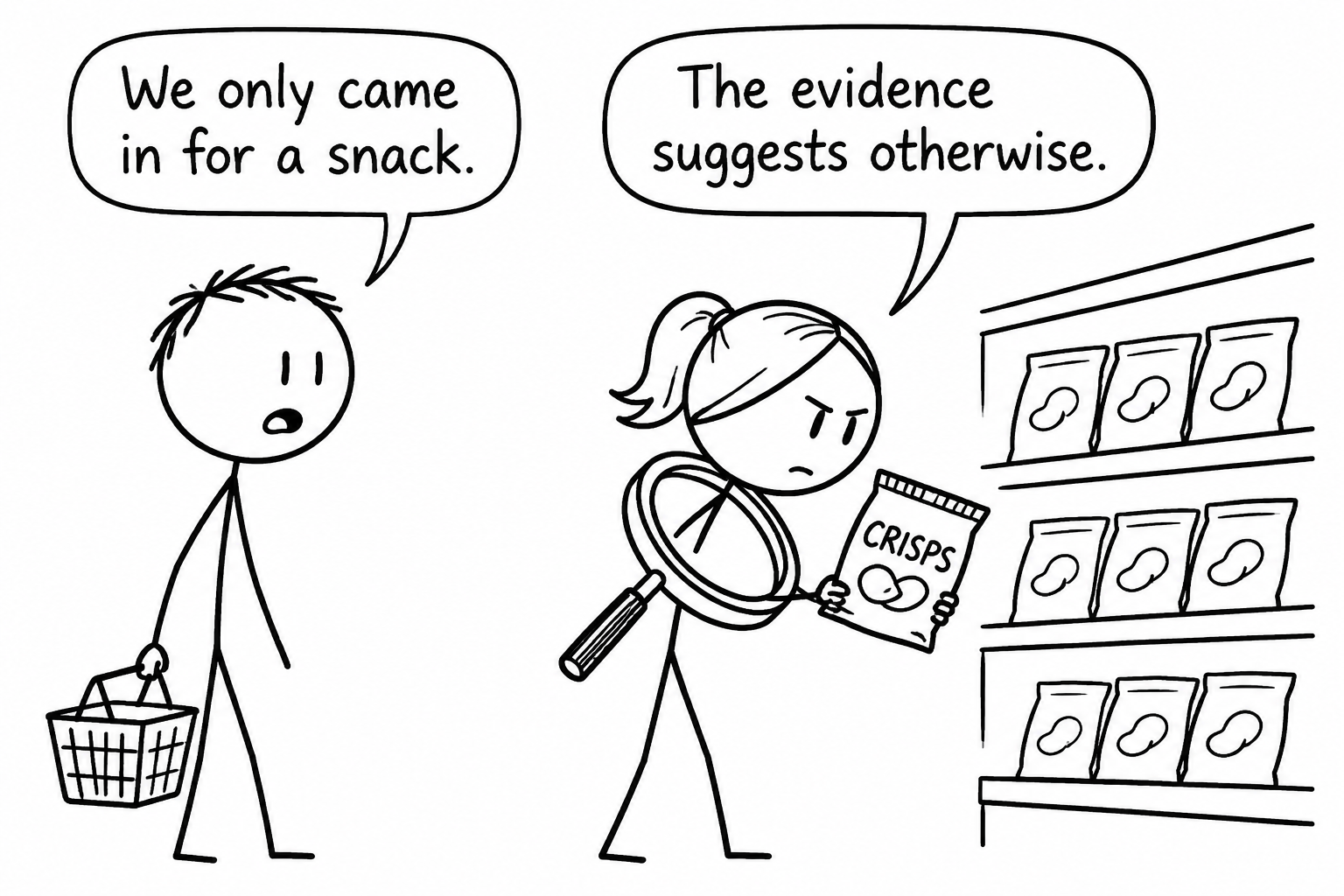 A student treating supermarket best buys like a detective case
Mistake: choosing the lowest pack price
Sam first sees these cereal offers:
- Pack A contains 500 g500\text{ g}500 g and costs £2.40£2.40£2.40.
- Pack B contains 750 g750\text{ g}750 g and costs £3.15£3.15£3.15.
Pack A is cheaper to buy, but that does not prove it is better value. The packs contain different amounts.
Correct method
Find the cost per gram.
For Pack A:
£2.40÷500=£0.0048£2.40 \div 500=£0.0048£2.40÷500=£0.0048For Pack B:
£3.15÷750=£0.0042£3.15 \div 750=£0.0042£3.15÷750=£0.0042Pack B has the lower cost per gram, so Pack B is the best buy.
You could instead compare the cost per 100 g100\text{ g}100 g:
£0.0048×100=£0.48£0.0048\times100=£0.48£0.0048×100=£0.48 £0.0042×100=£0.42£0.0042\times100=£0.42£0.0042×100=£0.42Both approaches give the same conclusion. Cost per 100 g100\text{ g}100 g can simply be easier to interpret.
Mistake: dividing in different directions
A common best buys mistake is calculating price divided by quantity for one product, then quantity divided by price for the other. These answers represent different things and cannot be compared.
Suppose one box contains 121212 bars for £3.30£3.30£3.30 and another contains 151515 bars for £3.90£3.90£3.90.
Correct method
Use price divided by number of bars both times.
First box:
£3.30÷12=£0.275£3.30\div12=£0.275£3.30÷12=£0.275Second box:
£3.90÷15=£0.26£3.90\div15=£0.26£3.90÷15=£0.26The second box is the best buy because each bar costs £0.26£0.26£0.26, compared with £0.275£0.275£0.275 in the first box.
Writing the calculation as a fraction helps keep the order consistent:
pricenumber of items\frac{\text{price}}{\text{number of items}}number of itemspriceOnce you have this method in hand, use the Maths Genie Lessons and Question Bank to practise setting up the comparison correctly rather than relying on which pack merely looks cheaper.
Mistake: comparing different units
Sam then meets a question in which one quantity is given in kilograms and another in grams. Dividing immediately would produce unit costs based on different units.
A 1.5 kg1.5\text{ kg}1.5 kg bag of rice costs £4.20£4.20£4.20. A 900 g900\text{ g}900 g bag costs £2.70£2.70£2.70.
Correct method
Convert the quantities to the same unit first.
1.5 kg=1500 g1.5\text{ kg}=1500\text{ g}1.5 kg=1500 gFor the larger bag:
£4.20÷1500=£0.0028 per gram£4.20\div1500=£0.0028\text{ per gram}£4.20÷1500=£0.0028 per gramFor the smaller bag:
£2.70÷900=£0.003 per gram£2.70\div900=£0.003\text{ per gram}£2.70÷900=£0.003 per gramThe 1.5 kg1.5\text{ kg}1.5 kg bag is the best buy because £0.0028<£0.003£0.0028<£0.003£0.0028<£0.003 per gram.
Useful metric facts include:
1 kg=1000 g1\text{ kg}=1000\text{ g}1 kg=1000 g 1 litre=1000 ml1\text{ litre}=1000\text{ ml}1 litre=1000 mlConverting first makes the comparison fair and reduces the chance of attaching the wrong unit to an answer.
Mistake: rounding too early
Some best buys GCSE questions use values that produce long decimals. Rounding those values too soon can hide a small but important difference.
Consider these two offers:
- Offer A: 181818 bottles for £11.50£11.50£11.50.
- Offer B: 242424 bottles for £15.20£15.20£15.20.
For Offer A:
£11.50÷18=£0.638888…£11.50\div18=£0.638888\ldots£11.50÷18=£0.638888…For Offer B:
£15.20÷24=£0.633333…£15.20\div24=£0.633333\ldots£15.20÷24=£0.633333…If both results were carelessly rounded to £0.64£0.64£0.64 at an early stage, the offers might appear equal. Keeping the calculator values shows that Offer B has the lower unit cost.
Round money appropriately only after the comparison, unless the question asks for a specified degree of accuracy.
Mistake: ignoring special offers
A discount changes either the price paid or the quantity received. It must be included before the unit cost is calculated.
A shop sells packs of 888 yoghurts for £3.60£3.60£3.60 with a “buy two packs, get one pack free” offer. Another shop sells 202020 yoghurts for £5.80£5.80£5.80.
Correct method
Under the special offer, paying for two packs costs:
2×£3.60=£7.202\times£3.60=£7.202×£3.60=£7.20Three packs contain:
3×8=24 yoghurts3\times8=24\text{ yoghurts}3×8=24 yoghurtsThe offer's unit cost is:
£7.20÷24=£0.30£7.20\div24=£0.30£7.20÷24=£0.30For the other shop:
£5.80÷20=£0.29£5.80\div20=£0.29£5.80÷20=£0.29The second shop is the best buy. The word “free” is persuasive, but the complete calculation matters more than the label.
Mistake: giving a choice without evidence
A correct numerical comparison may earn method marks, but a response should still answer the question directly. Do not finish with two unexplained decimals.
A strong conclusion names the product and includes the comparison:
The second shop is the best buy because its cost is £0.29£0.29£0.29 per yoghurt, which is less than £0.30£0.30£0.30 per yoghurt under the first shop's offer.
This final sentence makes the reasoning visible. It also gives you a quick opportunity to spot whether you accidentally selected the larger unit price.
A reliable exam routine
Sam's corrected routine is short enough to use under exam pressure:
Make the units match
Convert kilograms to grams, litres to millilitres or otherwise put both quantities into an equivalent form.
Choose one comparison
Use cost per item, cost per gram or cost for a common quantity. Apply the same comparison to every option.
Keep calculator accuracy
Do not round working values before deciding which cost is lower.
Write the conclusion
Name the best buy and quote the comparable figures with units.
The arithmetic in these questions is often accessible. The real test is whether the comparison is consistent.
Exam-style practice
Try these without looking back at the worked examples.
Question A
A 600 g600\text{ g}600 g packet costs £2.64£2.64£2.64. A 900 g900\text{ g}900 g packet costs £3.87£3.87£3.87. Determine the best buy.
Question B
A pack of 101010 pens costs £4.25£4.25£4.25. A pack of 161616 pens costs £6.56£6.56£6.56. Determine the best buy.
Question C
A 2 litre2\text{ litre}2 litre bottle costs £3.50£3.50£3.50. A 750 ml750\text{ ml}750 ml bottle costs £1.35£1.35£1.35. Determine the best buy.
Answers
For Question A:
£2.64÷600=£0.0044£2.64\div600=£0.0044£2.64÷600=£0.0044 £3.87÷900=£0.0043£3.87\div900=£0.0043£3.87÷900=£0.0043The 900 g900\text{ g}900 g packet is the best buy.
For Question B:
£4.25÷10=£0.425£4.25\div10=£0.425£4.25÷10=£0.425 £6.56÷16=£0.41£6.56\div16=£0.41£6.56÷16=£0.41The pack of 161616 pens is the best buy.
For Question C, first use 2 litres=2000 ml2\text{ litres}=2000\text{ ml}2 litres=2000 ml:
£3.50÷2000=£0.00175£3.50\div2000=£0.00175£3.50÷2000=£0.00175 £1.35÷750=£0.0018£1.35\div750=£0.0018£1.35÷750=£0.0018The 2 litre2\text{ litre}2 litre bottle is the best buy.
Turn the correction into marks
Sam's progress came from replacing guesswork with one repeatable comparison: match the units, calculate the same unit cost, retain accuracy and justify the choice. Knowing that routine is useful, but marks depend on being able to apply it when quantities, units and offers change.
Build that habit with the Maths Genie Lessons and Question Bank, focusing on best buys questions until the setup feels automatic.















