

Calculator Paper Strategies for the Resit
Calculator paper strategies for the resit: calculate accurately, manage time, show working and target weak topics before your GCSE maths exam.
A GCSE maths resit rarely exists in isolation. It sits beside college assignments, work shifts, travel and the frustration of having already taken the exam once. That makes efficient preparation more important than simply doing more revision.
Imagine a post-16 student called Sam. This is a hypothetical example, but the situation is familiar. Sam understands percentages in class, yet loses marks by typing the wrong calculation. Trigonometry feels manageable until the calculator is in radians. Long questions become rushed because too much time has gone on one stubborn problem.
The most useful calculator paper strategies for the resit address those avoidable losses. Know your calculator, write down your method, estimate before trusting the display and practise under timed conditions. Your calculator should remove arithmetic pressure. It should not replace mathematical decisions.
Your calculator-paper checklist
Before the exam, make sure you can:
- use the same permitted scientific calculator that you have practised with
- enter fractions, powers, roots, brackets and standard form correctly
- check whether the calculator is in degree mode
- distinguish an exact value from a rounded answer
- estimate the likely size of an answer
- show enough working for the method to be understood
- move on when a question is consuming too much time
- check units, rounding instructions and the wording of the final answer
Start with free GCSE maths revision resources for your exam board and tier. The specifications differ between Edexcel, AQA, OCR and Eduqas, so use papers that match the qualification entered by your college or exam centre.
Know the tool before you need it
A calculator paper is not the right place to discover what a button does. During revision, learn how your own model handles negative numbers, mixed numbers, fractions, powers, roots and brackets.
For instance, an expression such as
7.22−4.83.6+1.2\frac{7.2^2-4.8}{3.6+1.2}3.6+1.27.22−4.8should be entered with the correct numerator and denominator grouping. On some calculators, a fraction template makes that structure visible. On others, careful use of brackets is essential.
You should also recognise calculator notation. A display such as 3.4×1053.4\times10^53.4×10⁵ is standard form, while a long decimal may need to be rounded only after the full calculation is complete. MathsGenie's standard form revision guide can help if the display itself is causing uncertainty.
The current JCQ instructions tell candidates using calculators to clear stored memory, use exam mode where required, and remove cases, lids or covers containing printed instructions or formulae. You should also check that the calculator and batteries work properly. Your centre is responsible for applying the rules, so ask before the exam if you are unsure whether a particular model is permitted.
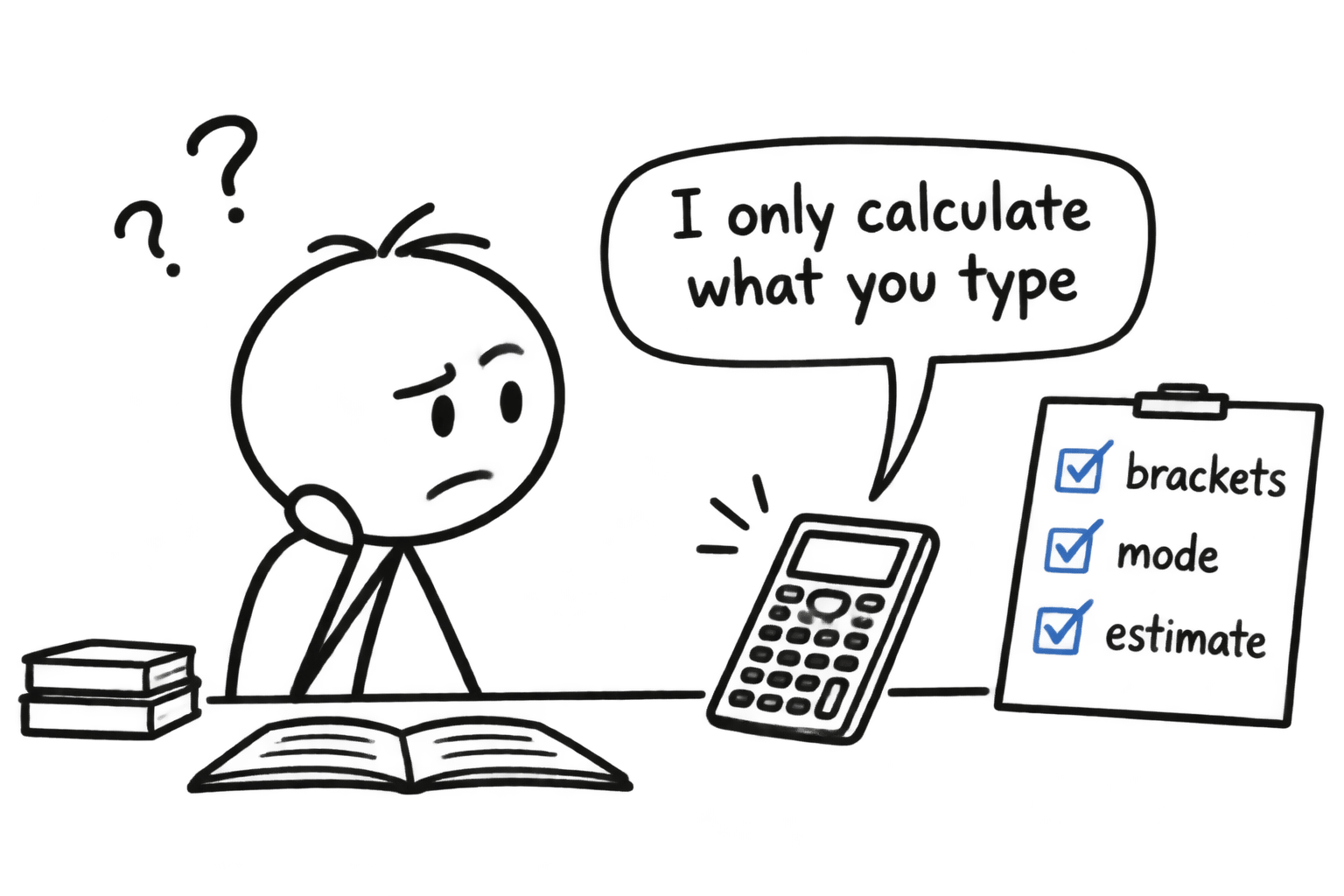 A post-16 student reminds a calculator that it only calculates what is typed
Write the calculation before pressing buttons
Sam's original habit was to read a question and begin typing immediately. A better routine has three stages:
- identify what the question is asking
- write the mathematical operation or formula
- enter it carefully and check the display
This matters because a correct number without a visible method may not protect you if the final entry is wrong. Mark schemes often award method marks when a valid process is shown. The safest approach is to treat the calculator as the final stage of a mathematical argument, not the beginning of one.
For a percentage multiplier, write the multiplier first. An increase of 18%18\%18% uses 1.181.181.18, while a decrease of 18%18\%18% uses 0.820.820.82. For focused practice, use the GCSE percentages revision lesson and compare your layout with the worked solutions.
For trigonometry, write the relationship before substituting values. Then check that the calculator is in degrees. The SOHCAHTOA revision guide provides targeted practice for this process.
Estimate before trusting the screen
A calculator can give a precise answer to the wrong calculation. Estimation is the quickest defence.
Suppose your inputs are roughly 505050, 101010 and 555. You should have a broad sense of whether the answer will be close to 111, 101010, 100100100 or 100010001000. You do not need a perfect mental calculation. You need a warning system.
Pause if:
- a probability is below 000 or above 111
- a percentage increase produces a smaller value
- a length is negative
- an angle in a triangle seems impossible
- a money answer has an unreasonable number of decimal places
- your answer is hundreds of times larger than the quantities in the question
This habit is particularly valuable in a GCSE maths resit because many lost marks come from transcription, bracket or mode errors rather than a complete lack of understanding.
Keep full accuracy until the final line
Do not round every intermediate result. If the question asks for an answer to 333 significant figures, retain the calculator's full value during the calculation and round once at the end.
Using the calculator's answer function can help preserve accuracy, provided you understand which stored result is being reused. If you write an intermediate decimal, include enough figures to avoid changing the final answer. A rounded intermediate value should be indicated with ≈\approx≈, not ===.
Read the instruction carefully. Decimal places and significant figures are different. Money is normally stated to the nearest penny unless the context or question says otherwise, so a final amount may require 222 decimal places.
Manage the paper in passes
A November resit paper can feel shorter than expected once one difficult question absorbs several minutes. Use a pass system instead.
First pass
Answer questions where the method is clear. Read every instruction, show working and collect the marks you can access confidently.
Second pass
Return to questions that need more thought. Break each one into smaller decisions: what is known, what is unknown, which topic is being tested and what calculation connects them?
Final check
Revisit flagged questions and inspect calculator entries. Check units, signs, brackets and rounding. Make sure an answer written on the calculator display has actually been copied onto the paper.
Use the number of marks as a rough guide to the amount of work expected, but do not impose a rigid number of seconds per mark. Paper lengths and structures vary by exam board. Confirm the exact duration and calculator-paper arrangement from your specification, entry details and centre.
November examination dates also change each year. Use the official timetable supplied by your college or exam centre rather than relying on a date remembered from an older paper.
Practise like a resit student, not a Year 11 class
You do not need to repeat an entire school year in order. Your previous paper, assessments and marked practice already contain useful evidence.
Review Edexcel GCSE maths past papers, or select the corresponding page for your board. After each calculator paper, sort mistakes into four groups:
- knowledge gap
- wrong method
- calculator-entry error
- exam-management error
That distinction changes what you do next. A knowledge gap needs a revision lesson and practice questions. A calculator-entry error needs repetition on the same device. A time-management problem needs timed sections or a full paper.
MathsGenie past papers include mark schemes and worked video solutions where available. Do not merely record a total mark. Find the first line where your reasoning moved away from the valid method, then practise that decision again.
Common mistakes on calculator papers
Typing before planning: Write the operation first so that brackets and order are visible.
Using radians for GCSE trigonometry: Check for degree mode before using sine, cosine or tangent.
Rounding too early: Keep full calculator accuracy until the final answer unless the question instructs otherwise.
Giving only a calculator display: Show substitution, formulae and intermediate reasoning so your method can be followed.
Ignoring units: Convert units before calculating when necessary, then include the correct unit in the answer.
Assuming the calculator detects nonsense: It checks arithmetic, not context. An estimate and a final sense-check remain your responsibility.
Practising without reviewing: A completed paper is evidence, not automatically improvement. Use its errors to choose the next task.
Turn your weak areas into the next paper
Sam's progress does not come from pressing buttons faster. It comes from making fewer unexamined decisions. The calculator is checked before the exam. Each expression is planned before entry. Strange answers trigger an estimate. Weak topics determine the next revision session.
That is a practical resit strategy because it respects limited time. Start with the MathsGenie GCSE Mock Exam Builder and build a targeted practice paper around the topics costing you marks. Sit it under timed conditions, mark it carefully, use the video solutions and repeat the process with a narrower list of weaknesses.
A resit is not a return to the beginning. It is a second attempt with better evidence. Build your targeted practice paper in the Mock Exam Builder and make every calculator session answer a specific need.















