

AQA Higher Maths Grade Boundaries Explained
AQA higher maths grade boundaries explained clearly, including available grades, combined paper marks and examples from recent exam series.
A grade boundary can feel like a finish line that moves after you have started running. You complete three papers, collect marks one question at a time, and wait for AQA to decide where each grade begins.
The reassuring truth is that AQA higher maths grade boundaries do not change how your paper is marked. Your marks from all three papers are simply added together. AQA then sets boundaries for that specific exam series, taking account of the overall demand of the papers and evidence about student performance.
You cannot know the exact boundary in advance. You can, however, understand the system, use previous boundaries sensibly and focus your revision on marks that remain within your control.
AQA higher maths grade boundaries at a glance
For AQA GCSE Mathematics Higher tier:
- there are three written papers
- each paper is worth 808080 marks
- Paper 1 is non-calculator
- Papers 2 and 3 allow a calculator
- your marks are combined to give a total out of 240240240
- the principal available grades are 999-444
- a grade 333 may be awarded when a student narrowly misses grade 444
- boundaries are set after the papers have been taken
- boundaries can differ between exam series
The calculation itself is simple. If your three marks are m1m_1m1, m2m_2m2 and m3m_3m3, your total is:
T=m1+m2+m3T=m_1+m_2+m_3T=m1+m2+m3Your grade is based on TTT, not on securing a particular grade separately in every paper.
How marks from the three AQA papers combine
AQA GCSE Maths Higher consists of three equally weighted papers. Each contributes one third of the qualification and carries 808080 marks, giving:
80+80+80=24080+80+80=24080+80+80=240Suppose a student receives 484848, 555555 and 515151 marks. The combined total is:
48+55+51=15448+55+51=15448+55+51=154AQA compares that total of 154154154 with the subject-level boundaries for the relevant exam series. It does not matter that Paper 1 was the student's weakest paper. A stronger result on another paper can compensate for it.
This matters psychologically. Students sometimes leave the first exam convinced that their target grade has disappeared. Usually, that conclusion is premature. One difficult paper is only 808080 marks out of 240240240, and questions you found difficult may also have challenged many other candidates.
Use the free AQA GCSE Maths grade calculator to combine practice-paper marks and compare them with boundaries from previous years. Treat the result as a revision guide, not a promise about a future boundary.
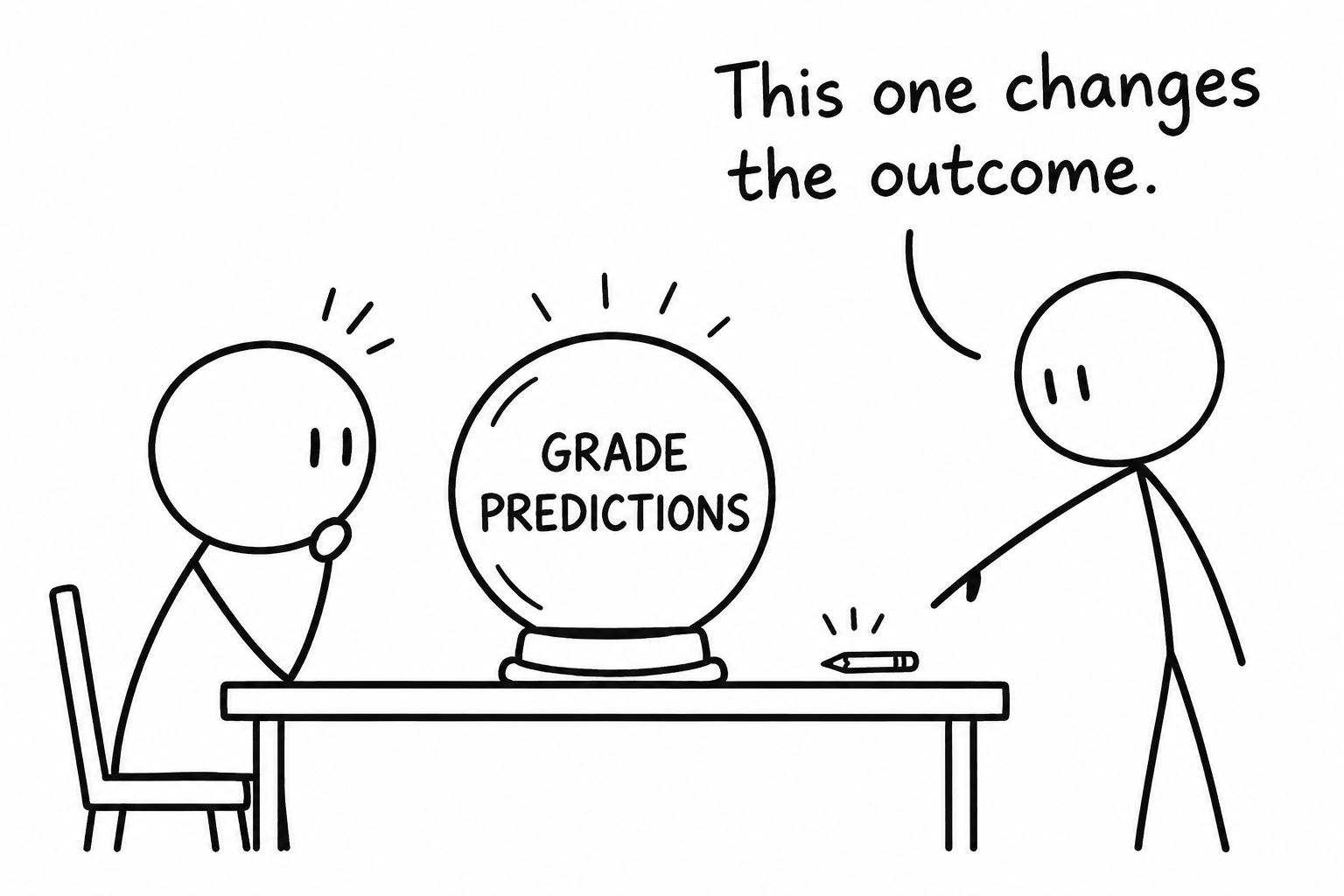 A student discovers that a pencil is more useful than a grade-prediction crystal ball
Which grades are available on AQA GCSE Maths Higher?
Higher tier is designed for grades 999-444. Grade 999 is the highest possible grade, while grade 444 is the lowest standard grade normally available on the tier.
A grade 333 can be awarded to a higher-tier candidate who falls just below the grade 444 boundary. Below the published grade 333 threshold, the result is unclassified. This is one reason tier entry deserves careful discussion with your teacher. Higher tier offers access to grades above 555, but its lower-grade safety margin is limited.
Foundation tier has a different range and a different set of papers. Its maximum available grade is 555. You therefore cannot compare a raw foundation mark directly with the same raw higher mark and assume that they represent equal performance.
For higher-tier students, the practical message is clearer than the regulations may first appear: build a secure base of accessible marks before relying on the hardest questions. A grade is assembled across the whole paper, including method marks and routine topics.
What previous boundaries can tell you
Past boundaries are useful reference points. They show the approximate totals that have previously been needed, but they are not fixed targets for the next examination.
The following examples are AQA subject boundaries for GCSE Mathematics Higher tier, with totals out of 240240240:
| Exam series | Grade 999 | Grade 777 | Grade 444 | Grade 333 |
|---|---|---|---|---|
| June 2023 | 214214214 | 158158158 | 595959 | 424242 |
| June 2024 | 219219219 | 163163163 | 616161 | 444444 |
These figures illustrate movement between years. For example, the grade 777 boundary increased from 158158158 in June 2023 to 163163163 in June 2024. That does not mean students should assume boundaries will keep rising. It means the boundary belongs to its particular set of papers and exam series.
The percentage of available marks associated with a historical boundary can be calculated using:
percentage=boundary240×100\text{percentage}=\frac{\text{boundary}}{240}\times 100percentage=240boundary×100For the June 2024 grade 777 boundary:
163240×100≈67.9%\frac{163}{240}\times 100\approx67.9\%240163×100≈67.9%This percentage is descriptive, not predictive. GCSE grades are awarded using marks and published boundaries, rather than a permanent rule that a particular percentage always produces a particular grade.
Why grade boundaries change
An exam board cannot guarantee that two different papers will have precisely equal difficulty. Even with careful question writing and review, one series may prove more demanding than another.
Grade boundaries help account for those differences. If a paper is more challenging overall, a comparable standard of performance may correspond to a lower raw mark. If it is less challenging, the relevant boundary may be higher.
This is why comments such as “grade 777 is always about this many marks” should be treated cautiously. A past-paper score becomes more meaningful when you compare it with the boundary for that exact paper series.
When using predicted papers, remember that any associated grade estimate is only indicative. Predicted papers can sharpen timing, topic recall and exam technique, but nobody can publish an official boundary before AQA has completed the awarding process.
How to use boundaries in your revision
Boundaries are most useful when they lead to a decision. Start by completing a full paper under timed conditions, marking it carefully and combining your scores across three papers where possible.
Then inspect the marks you lost. Sort them into four groups:
- knowledge you had not revised
- methods you understood but applied incorrectly
- calculator or arithmetic errors
- questions lost through poor presentation, timing or missing working
The second, third and fourth groups often contain the quickest gains. A student chasing five more marks may not need to master the final question on every paper. Those marks might come from checking units, writing a complete probability statement, showing algebraic steps or interpreting a graph accurately.
Use Maths Genie GCSE revision resources to move from diagnosis to practice. The revision lessons organise topics by grade, helping you identify content that is both accessible and relevant to your target.
A sensible cycle looks like this:
- complete a paper or mini test
- mark it using the mark scheme
- record weak topics rather than only recording the total
- watch the relevant video solutions or revision lessons
- complete focused practice questions
- return to a mixed paper and measure the change
This turns a boundary from something you worry about into a benchmark you can use.
Focus on the topics that move marks most
The best topic depends on your current gaps. There is no universal list that guarantees the same gain for every student. However, secure fluency in frequently connected areas gives you more ways to collect marks.
These areas include fractions, percentages, ratio, algebraic manipulation, equations, graphs, probability and geometry. They support more advanced questions as well as appearing in their own right. A weakness in fractions, for example, can affect probability, algebra and proportion.
Begin with the Maths Genie lesson closest to an error you actually made. Then answer practice questions without copying the method. Finally, use a mark scheme or video solution to identify exactly where your reasoning changed course.
That last stage matters. Reading a solution can create recognition, but recognition is not the same as recall. In the exam, the question arrives without the solution beside it.
Common mistakes when interpreting grade boundaries
Treating a past boundary as a future guarantee
June 2024 figures describe June 2024 papers. They can support target setting, but they cannot reveal the next official boundaries.
Averaging three paper grades
You do not receive three separate GCSE grades and average them. AQA adds the raw marks first, then applies the overall subject boundary.
Assuming every paper must be equally strong
Your total matters. A weaker Paper 1 can be balanced by stronger calculator papers, or the other way around.
Comparing higher and foundation raw marks directly
The tiers use different papers and have different available grade ranges. The same numerical mark does not automatically represent the same outcome.
Revising only the hardest content
High-grade questions matter, but losing routine marks can be more damaging. Secure the questions you are capable of answering before spending all your time on the most demanding material.
Turn the boundary into a revision plan
The boundary is outside your control. Your preparation is not.
Complete papers, add the three scores and use dated boundaries to understand roughly where your current performance sits. Then look beneath the total. Every missing mark has a reason, and many of those reasons can be corrected through deliberate practice.
Start with Maths Genie GCSE revision and choose lessons on the topics that will move your marks most. Use the practice questions, mini tests, mark schemes and video solutions to close specific gaps, then return to a full paper. That is how a target grade becomes less mysterious: not through guessing the next boundary, but through collecting one more reliable mark at a time.















