

AQA GCSE Maths Grade 7 Boundary: Marks Needed
AQA GCSE maths grade 7 boundary explained with dated marks, tier rules and a practical target. See why boundaries change and plan your revision confidently.
A Year 11 student totals the marks on a past paper and asks the question that makes every other calculation feel secondary: is this enough for a grade 7?
The AQA GCSE maths grade 7 boundary is the minimum combined Higher-tier mark needed for that grade in a particular exam series. Past boundaries provide a reference, but they cannot guarantee the mark needed next time. For revision, around 170170170 marks out of 240240240 is a useful working target, with room to aim higher.
The answer at a glance
- Grade 7 is available only on Higher tier.
- AQA GCSE Mathematics has three papers worth 808080 marks each.
- The total available mark is 240240240.
- Your final grade comes from your combined mark across all three papers.
- Boundaries change between exam series and are set after marking.
Use the free AQA GCSE Maths revision hub to find revision resources for the specification.
Recent AQA GCSE maths grade 7 boundary examples
A boundary only makes sense alongside its exam series. These June boundaries show why quoting one percentage as the permanent requirement can mislead students.
| AQA exam series | Grade 7 boundary | Approximate percentage |
|---|---|---|
| June 2023 | 158158158 out of 240240240 | 65.8%65.8\%65.8% |
| June 2024 | 163163163 out of 240240240 | 67.9%67.9\%67.9% |
| June 2025 | 164164164 out of 240240240 | 68.3%68.3\%68.3% |
These are subject-level Higher-tier boundaries for AQA Mathematics specification 830083008300. Always match a boundary to the exact exam board, specification, tier and series. Do not treat an unverified figure for a later series as an official result.
The AQA GCSE Maths grade calculator offers a way to compare practice marks with historical boundaries. Keep that comparison in perspective: it describes performance against a particular past standard, rather than predicting a future grade with certainty.
Which tier includes grade 7 maths?
AQA Foundation tier covers grades 111-555, while Higher tier targets grades 444-999, with a grade 333 available to students narrowly below the grade 444 boundary. A student taking Foundation cannot receive a grade 777, regardless of their raw mark.
All three papers must be taken at the same tier. Paper 111 is non-calculator; Papers 222 and 333 allow a calculator. Each contributes equally to the subject total.
A disappointing first paper therefore does not settle your final grade. Marks gained on the remaining papers still count towards the same total. There is no requirement to achieve one-third of the grade boundary on every paper, so uneven performance can still produce the required overall result.
Why AQA grade boundaries change
Exam boards aim to make papers comparable, but different sets of questions cannot have precisely identical difficulty. Familiar methods may appear in unfamiliar contexts, and multi-step questions may prove more demanding than expected.
Boundaries are set after marking, using evidence about paper difficulty and standards of performance. A harder set of papers may have lower boundaries; a more accessible set may have higher ones. The aim is to maintain broadly comparable grading standards over time.
A rising boundary therefore does not automatically mean that earning the grade has become harder. Nor should students assume that a fixed percentage always earns the same grade.
For revision, the useful response is to build a margin above recent thresholds rather than trying to forecast the next boundary.
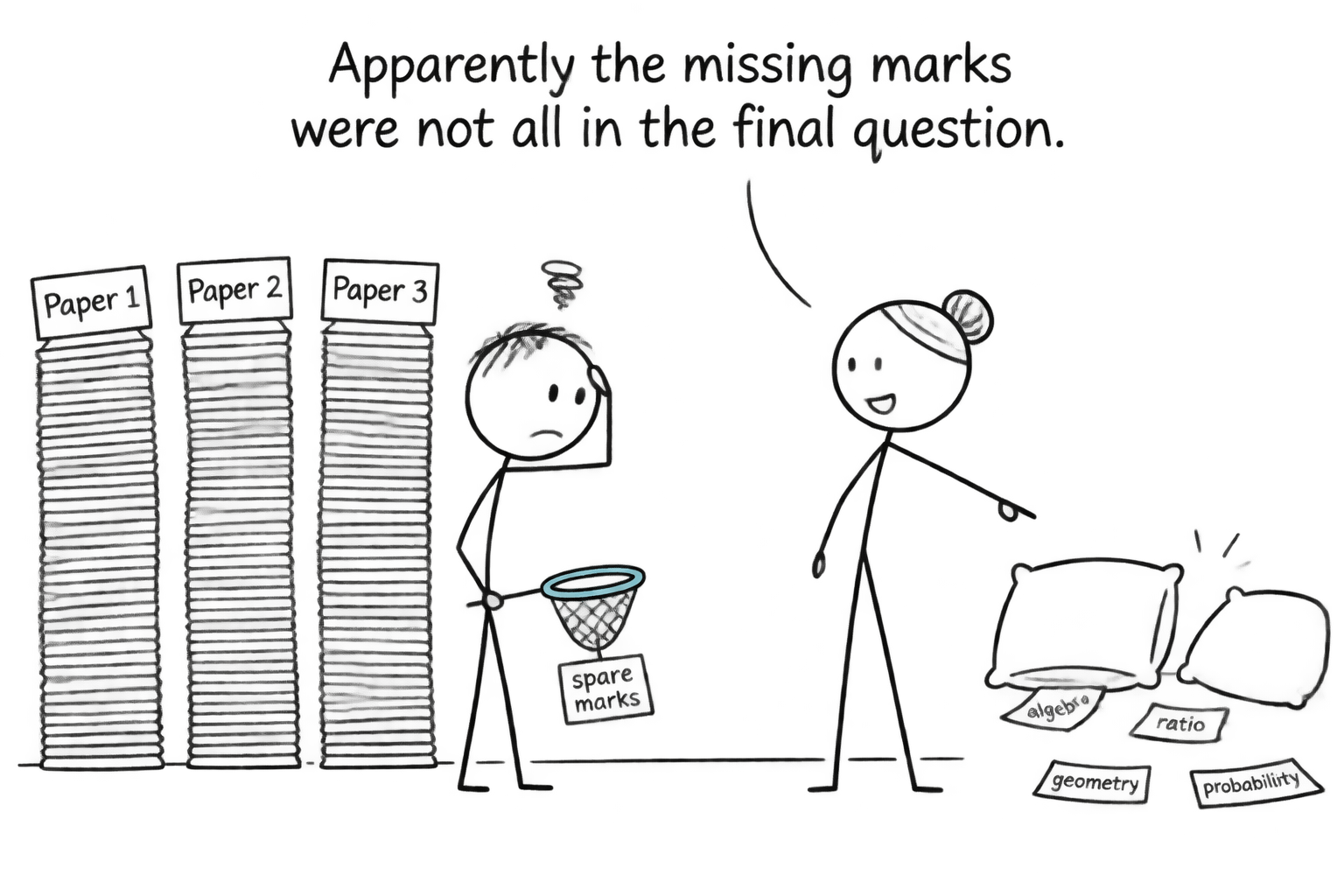 A Year 11 student searching for spare marks across three papers
Turning the boundary into a practical target
A working target of around 170170170 marks gives your revision direction, but it remains a benchmark rather than a guarantee. Increase it as your performance improves.
Begin with a complete past-paper set from the same series. Mixing papers from different years can help with practice, but it does not reproduce the assessment associated with one historical boundary.
Use this routine:
- Complete papers under timed conditions.
- Mark strictly using the published mark schemes.
- Record lost marks by topic and cause.
- Revisit the methods behind recurring errors.
- Practise focused questions before attempting another full paper.
The free GCSE Maths revision resources support topic practice alongside exam preparation. Use the revision planner to turn your findings into manageable sessions.
Keep your original answers when reviewing a paper. They reveal whether a mistake came from choosing the wrong method, losing accuracy halfway through, or running out of time. A corrected answer alone can hide that useful distinction.
Find your next reliable marks
There is no universal list of questions guaranteed to appear. Your most valuable revision topics are those where marked work reveals repeated, fixable losses.
For students approaching grade 777, priorities may include algebra, equations, graphs, ratio, trigonometry, probability, similarity, vectors and geometry. Let your own papers determine the order.
Separate mistakes into three groups. A knowledge gap means the method needs learning. An application gap means you knew the method but did not recognise when to use it. An accuracy gap means arithmetic, signs, notation or rounding interrupted a sound approach.
Each needs a different response: revisit a lesson, practise mixed questions, or build a checking habit. Repeating whole papers without addressing the cause can leave the same marks out of reach.
Common mistakes when using grade boundaries
Treating a past boundary as a prediction
A historical boundary applies to its own series. Leave a margin when choosing your target.
Focusing on one paper
Use individual papers to diagnose weaknesses, but judge overall performance through the combined total.
Marking too generously
Follow requirements for working, units, rounding and acceptable answers. An inflated practice score makes revision priorities harder to identify.
Revising only the hardest questions
Secure standard methods and straightforward marks alongside demanding problems. Reliable accuracy matters across the whole paper.
Build the marks you can control
Start with a timed AQA paper, identify where marks disappear, and return to the relevant Maths Genie lessons. Practise, mark and review. A grade 777 becomes more manageable when each revision session addresses a specific, fixable weakness.















