

AQA Further Maths A* Boundary: Marks You Need
AQA Further Maths A* boundary explained with dated marks, optional-paper codes and a practical way to set your target across all three papers.
A student checking the AQA Further Maths A* boundary usually wants one reassuring number. The honest answer is that there is no permanent mark for an A*. The boundary changes after each exam series, and it can differ according to the two optional units taken.
Recent published boundaries provide a useful guide. For example, in June 2024 the A* thresholds ranged from 234234234 to 239239239 marks out of 300300300 across the available option combinations. That is roughly 78%78\%78% to 80%80\%80%. These are historical illustrations, not predictions of the boundary in your own year.
Your best revision target is therefore not the last published threshold exactly. Aim above the recent range, track your total across all three papers and use your mistakes to decide which topics deserve your next hour.
The short answer
Here is the practical checklist:
- AQA A Level Further Mathematics is marked out of 300300300 in total.
- The qualification has three written papers, each worth 100100100 marks.
- Papers 111 and 222 assess compulsory content.
- Paper 333 combines two optional units selected for your course.
- Each optional combination has its own entry code and may have a slightly different overall grade boundary.
- In June 2024, the A* boundary was between 234234234 and 239239239 out of 300300300, depending on the option combination.
- Treat dated grade boundaries as evidence, not a promise.
If you are starting a broader revision plan, the A Level Maths revision hub brings together free revision resources, papers, mark schemes and grade-boundary information. You can also browse all available resources through the MathsGenie A Level subjects page.
Why the AQA Further Maths A* boundary changes
A grade boundary is set after the papers have been taken and marked. Its purpose is to keep the standard represented by a grade consistent when the difficulty of an assessment changes.
This matters because percentages do not carry fixed meanings. An unusually demanding paper may produce a lower boundary, while a more accessible paper may produce a higher one. The grade is awarded from your total mark, not from a universal rule saying that every A* must equal a particular percentage.
That uncertainty can feel inconvenient. Yet it points towards a healthier revision decision: prepare for the range of papers AQA could set rather than trying to predict one exact cut-off.
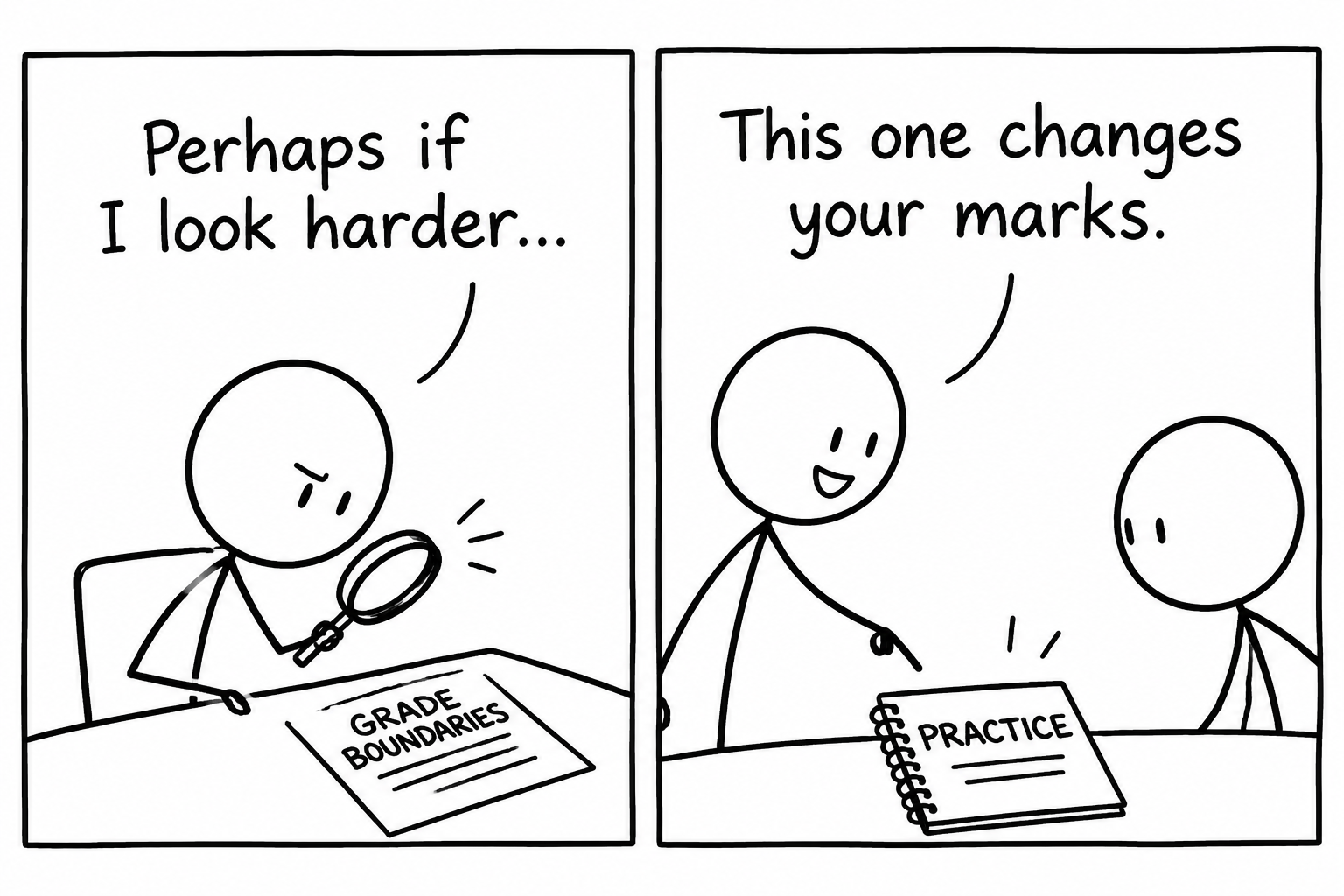 A student discovers that practice changes marks more reliably than staring at grade boundaries
How optional papers affect your total
AQA's optional content is the detail most likely to cause confusion. Your result is still calculated out of 300300300, regardless of the combination studied. The difference is that candidates taking different combinations can appear under different specification entry codes in the grade-boundary document.
The option abbreviations are:
| Code | Optional unit |
|---|---|
| D | Discrete mathematics |
| M | Mechanics |
| S | Statistics |
A code such as 7367DS7367\mathrm{DS}7367DS means that the candidate completed the discrete mathematics and statistics options. The other combinations are 7367DM7367\mathrm{DM}7367DM and 7367MS7367\mathrm{MS}7367MS. Order is not mathematically significant here; it identifies the selected pair.
Paper 333 is worth 100100100 marks overall, with each chosen option contributing 505050 marks. Your qualification total can therefore be written as
T=P1+P2+O1+O2,T=P_1+P_2+O_1+O_2,T=P1+P2+O1+O2,where P1P_1P1 and P2P_2P2 are each marked out of 100100100, and O1O_1O1 and O2O_2O2 are each marked out of 505050. Hence
T≤100+100+50+50=300.T\leq 100+100+50+50=300.T≤100+100+50+50=300.There is no requirement to reach the A* standard on every individual paper. A stronger performance in one component can compensate for a weaker performance elsewhere because the final grade uses the aggregate mark.
Dated AQA Further Maths grade boundaries
The June 2024 AQA boundary document gave the following A* marks:
| Option combination | A* mark | Maximum mark | Approximate percentage |
|---|---|---|---|
| Discrete and statistics, 7367DS7367\mathrm{DS}7367DS | 239239239 | 300300300 | 79.7%79.7\%79.7% |
| Discrete and mechanics, 7367DM7367\mathrm{DM}7367DM | 234234234 | 300300300 | 78.0%78.0\%78.0% |
| Statistics and mechanics, 7367SM7367\mathrm{SM}7367SM | 238238238 | 300300300 | 79.3%79.3\%79.3% |
For example, the percentage corresponding to 239239239 marks is
239300×100=79.666…%≈79.7%.\frac{239}{300}\times 100=79.666\ldots\%\approx79.7\%.300239×100=79.666…%≈79.7%.These small differences are why a claim such as “the boundary is always 80%80\%80%” is too simple. It may be a convenient planning estimate, but it is not an assessment rule.
Always check the year and the complete option code when reading AQA Further Maths grade boundaries. A figure for standard A Level Mathematics, a different exam board or another optional combination does not answer your question.
What mark should you target?
Suppose you decide on a working target of 245245245 out of 300300300. This is not a predicted boundary. It is a revision target that sits above the June 2024 range and leaves some protection against natural variation between papers.
One possible route is:
82+81+42+40=245.82+81+42+40=245.82+81+42+40=245.Here the first two marks represent Papers 111 and 222, while the last two represent the 505050-mark optional sections. Another student might reach the same total through a different balance. The important question is not whether every mark is identical, but whether the aggregate is moving towards the target.
A useful review process is:
- complete a paper under timed conditions;
- mark it strictly using the official mark scheme;
- record marks lost by topic and by cause;
- revisit the highest-value weaknesses;
- complete fresh questions before retaking similar material.
You can find paper-based preparation through the MathsGenie A Level Maths resources. Where core A Level techniques need strengthening, the Edexcel A Level revision collection can also provide useful topic practice, although you should use AQA specification materials for board-specific coverage and paper structure. The A Level Maths past-paper collection offers further timed practice for shared mathematical skills.
Topics that move marks most
Further Maths rewards connected knowledge. A weakness in algebra can appear inside matrices, differential equations, complex numbers or mechanics. That is why correcting a recurring manipulation error can be more valuable than completing another full paper without reviewing it.
Prioritise topics using evidence from your marked work. Look particularly for:
- compulsory topics producing repeated losses across both core papers;
- optional topics where an entire method is missing;
- incomplete reasoning that loses method or accuracy marks;
- calculator or transcription errors that survive every check;
- questions left unfinished because earlier stages take too long.
The best topic is not necessarily the one you dislike most. It is the one where focused practice can recover the largest reliable block of marks. Use MathsGenie's free revision resources to return to the relevant lessons, practise the technique, and then test whether it holds under exam conditions.
Common mistakes when checking the boundary
Looking at the wrong qualification
AQA A Level Mathematics and AQA A Level Further Mathematics have different papers and boundaries. Confirm that the code begins with 736773677367.
Ignoring the option letters
The options can lead to different aggregate boundaries. Match the full code to the two units taught by your school or college.
Treating an old boundary as a prediction
A historical threshold describes that exam series only. Difficulty changes, so the next boundary can move.
Thinking every paper needs the same percentage
Your total matters. Do not abandon an A* target because one paper falls below your average if another component can recover the difference.
Counting generous self-marking as progress
Marks should be awarded only where the mark scheme supports them. If you are uncertain, record the stricter score and ask your teacher to review the response.
Turn the boundary into a revision decision
The boundary is useful because it gives scale. It tells you that an A* requires consistently strong performance, not perfection. But once you have checked the correct dated figure and option code, repeatedly searching for a more comforting number adds little.
The productive question is now: where can the next five marks come from?
Start with MathsGenie Lessons and revision resources on the topics that move your marks most. Follow them with practice questions, mini tests where available, timed papers and careful mark-scheme review. A boundary is something the exam board sets later. The quality of your next revision session is something you can change today.















