

AQA A-Level Maths B Boundary: Marks Needed
AQA A-Level maths B boundary explained with recent marks, paper totals and practical advice for turning past-paper results into focused revision.
A Year 13 student finishes a timed paper, adds the marks twice and opens a search tab. The question is simple: what is the AQA A-Level maths B boundary, and am I above it?
For the June 2024 AQA A-Level Mathematics exams, a grade B required 184184184 marks out of 300300300. That is about 61.3%61.3\%61.3%. This is a useful reference, not a guaranteed target for another year. AQA sets grade boundaries after the papers have been taken and marked, so the mark needed can change with the overall demand of that year's assessments.
The most useful approach is therefore to understand how your marks combine, compare like with like and build a sensible margin above past boundaries.
The quick answer
Here is the essential checklist:
- AQA A-Level Mathematics, specification 735773577357, has three papers.
- Each paper is worth 100100100 marks.
- Your marks are added to give a total out of 300300300.
- The June 2024 grade B boundary was 184184184 out of 300300300.
- Boundaries vary between exam series.
- You do not need to achieve a B on every individual paper.
- A past boundary should guide revision, not become an exact prediction.
You can enter three paper marks into the AQA A-Level Maths grade calculator to see how the combined total compares with available boundaries.
How the three AQA paper totals combine
AQA A-Level Maths is assessed through three written papers, each carrying 100100100 marks. Your qualification result is based on the combined total:
Overall mark=Paper 1+Paper 2+Paper 3.\text{Overall mark}=\text{Paper 1} + \text{Paper 2} + \text{Paper 3}.Overall mark=Paper 1+Paper 2+Paper 3.Suppose our Year 13 student has completed three timed papers and recorded these marks:
| Paper | Mark |
|---|---|
| Paper 1 | 585858 |
| Paper 2 | 636363 |
| Paper 3 | 676767 |
| Total | 188188188 |
The calculation is:
58+63+67=188.58+63+67=188.58+63+67=188.Against the June 2024 boundary, 188188188 would have been four marks above the B threshold of 184184184.
This example reveals something important. The student did not need identical marks on all three papers. A stronger performance on one paper compensated for a weaker performance on another. Qualification grades are awarded from the total subject mark, rather than by requiring the same grade on each component.
A rough average based on the 2024 B boundary would be:
1843=61.33‾.\frac{184}{3}=61.3\overline{3}.3184=61.33.That is approximately 616161 or 626262 marks per paper. It is only a planning average. It is not a separate paper requirement.
What past AQA A-Level grade boundaries tell you
The confirmed June 2024 AQA table placed the main subject boundaries as follows:
| Grade | June 2024 boundary out of 300300300 |
|---|---|
| A* | 259259259 |
| A | 222222222 |
| B | 184184184 |
| C | 147147147 |
| D | 110110110 |
| E | 737373 |
These dated figures are valuable because they turn a vague ambition into a scale. In that series, the difference between a B and an A was:
222−184=38 marks.222-184=38\text{ marks}.222−184=38 marks.But the table is historical evidence, not a promise. If you are sitting a later exam, nobody can know the confirmed boundary in advance. Predicted grade boundaries may be informed estimates, but they cannot replace the official boundaries published after marking and awarding.
There is another trap here. AQA also publishes notional component boundaries for individual papers. These can help schools interpret performance, but the qualification grade comes from the aggregate mark across all three papers. Adding your raw marks is the clearest way to judge a full set of practice papers.
Why the mark needed for a B changes
Grade boundaries exist to translate raw marks into grades while accounting for differences in assessment demand. One year's papers may be more accessible in particular areas; another year's may contain questions that students find less accessible. Keeping every boundary fixed would ignore those differences.
This is why a difficult paper does not automatically mean that everyone receives a lower grade. The awarding process considers the quality of work needed for each grade, alongside statistical and examiner evidence. The boundary is then confirmed for that exam series.
For revision, the practical lesson is uncomplicated: do not aim for the narrowest possible win. If a previous B boundary was 184184184, targeting exactly 184184184 leaves no allowance for an awkward question, a missed negative sign or normal variation between papers.
A personal working target might instead include a margin. For example:
184+15=199.184+15=199.184+15=199.That does not predict a future boundary, and it does not guarantee a B. It simply creates a more useful revision goal than trying to land on one historical cut-off mark.
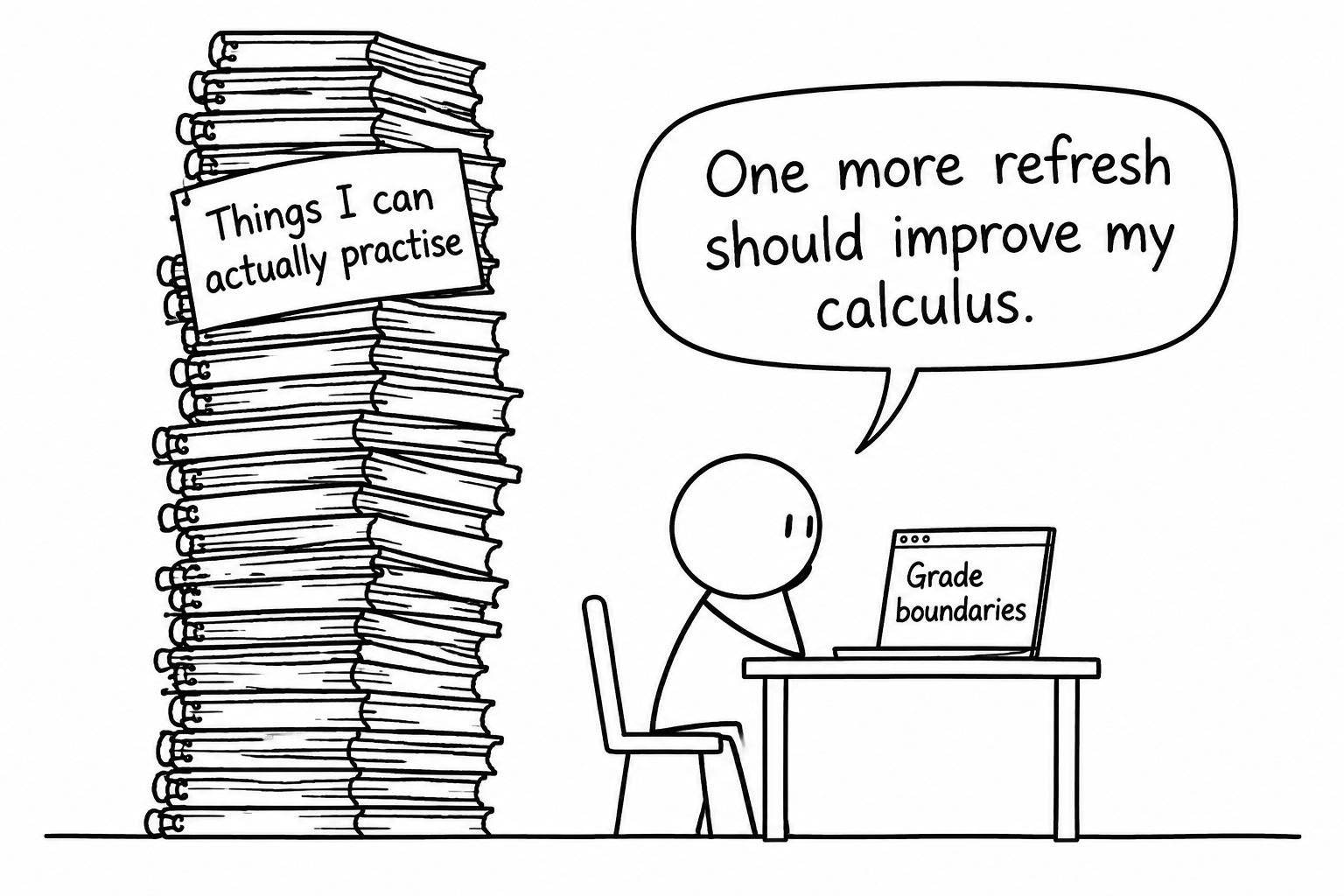 A student tries to improve calculus by refreshing grade boundaries
Turn the boundary into a revision plan
The boundary tells you where the line was. Your marked work tells you how to move.
After every timed paper, sort lost marks into three groups:
- Knowledge gaps: you did not know the method or result.
- Application gaps: you knew the topic but could not adapt it to the question.
- Execution errors: algebra, arithmetic, notation or incomplete reasoning cost marks.
Then look for repetition. One integration error may be chance. Losing marks on integration in four papers is a revision priority. The same principle applies to differentiation, trigonometry, vectors, logarithms, proof, statistics and mechanics.
Use Maths Genie A-Level revision to revisit the lessons behind repeated gaps. The aim is not to watch everything. Start with the topics that repeatedly move your total away from the B range, complete the practice questions, mark them carefully and return to timed papers.
Past papers become much more useful when paired with the mark scheme. Award marks strictly, including method marks and required conclusions. Where available, video solutions can also expose the decision that unlocked a question, not merely its final answer.
A simple cycle works well:
paper→mark→diagnose→practise→retest.\text{paper}\rightarrow\text{mark}\rightarrow\text{diagnose}\rightarrow\text{practise}\rightarrow\text{retest}.paper→mark→diagnose→practise→retest.That cycle turns an A-Level maths B target from a hope into a collection of fixable decisions.
Common mistakes when checking your grade
Treating one paper as the whole qualification
A mark of 606060 on one paper does not by itself determine your final grade. Add three comparable paper marks to obtain a total out of 300300300.
Using a boundary from the wrong year or specification
Always check the exam series, subject and specification code. A boundary for another exam board, another qualification or an older specification is not interchangeable with AQA Mathematics 735773577357.
Confusing notional paper boundaries with the subject boundary
Individual component boundaries are illustrative. Your final AQA A-Level Maths grade is based on the combined subject total.
Assuming the latest boundary will repeat
Past AQA A-Level grade boundaries are benchmarks, not forecasts. Build a margin and revise the weaknesses shown by your papers.
Counting generous self-marking as progress
If a method is incomplete or a required conclusion is missing, follow the mark scheme. Accurate marking may feel less comforting today, but it makes the next revision choice more valuable.
From checking the line to moving beyond it
Our Year 13 student began with a boundary search. That was reasonable. Knowing that the June 2024 B boundary was 184184184 out of 300300300 gives the target shape, and understanding the three-paper total prevents misleading comparisons.
But boundaries are the scoreboard, not the training. The marks most likely to change your result are sitting inside unfinished methods, recurring topic gaps and questions you have not yet reviewed properly.
Start with the Maths Genie A-Level lessons on the topics costing you the most marks. Then use practice questions, mark schemes, past papers and video solutions to test whether the gap has actually closed. Check your combined marks with the AQA predicted grade calculator, but let your errors decide what you revise next.















