

AQA A-Level Maths A Boundary: What Mark?
AQA A-Level maths A boundary explained using recent results. See how three paper marks combine, why boundaries change and what score to target.
A Year 13 student checks a mock result, opens a grade-boundary table and looks for one letter: A. The instinct is understandable. A single number seems to promise certainty.
The short answer is that the AQA A-Level maths A boundary changes each year. In June 2025, an A required 221221221 marks out of 300300300. In June 2024, it required 222222222 marks. Those figures are useful reference points, but they are not guaranteed boundaries for a future exam series.
Your final result comes from adding the raw marks from three equally weighted papers. The most sensible revision target is therefore not last year's exact boundary. It is a total comfortably above recent boundaries, supported by honest marking and consistent performance across complete papers.
The answer at a glance
- AQA A-Level Mathematics, specification 735773577357, has three papers.
- Each paper is worth 100100100 marks and lasts two hours.
- Each contributes 3313%33\frac{1}{3}\%3331% of the qualification.
- The three raw marks combine to give a total out of 300300300.
- In June 2025, the A boundary was 221221221 out of 300300300, approximately 73.7%73.7\%73.7%.
- In June 2024, the A boundary was 222222222 out of 300300300, exactly 74%74\%74%.
- Boundaries are set for each exam series, so a past boundary is a guide rather than a promise.
You can enter practice-paper marks into the AQA A-Level Maths grade calculator to see how your combined score compares with available boundaries.
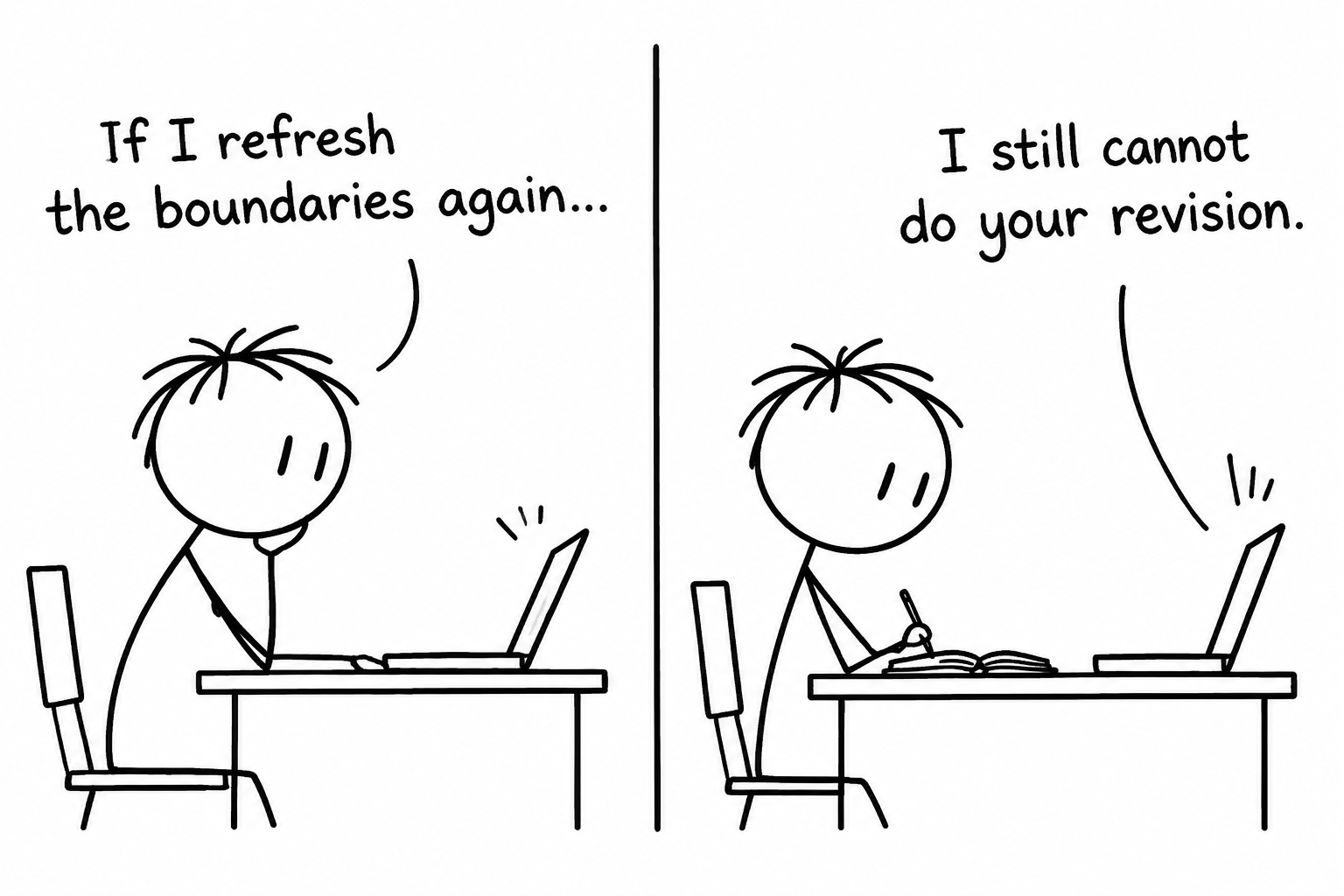 A student discovers that refreshing grade boundaries cannot do the revision
How the three AQA paper totals combine
AQA assesses A-Level Mathematics through Paper 111, Paper 222 and Paper 333. Each is marked out of 100100100, with no extra weighting applied to one paper. Your qualification total is simply:
T=P1+P2+P3T=P_1+P_2+P_3T=P1+P2+P3Here, P1P_1P1, P2P_2P2 and P3P_3P3 are your raw paper marks, while TTT is your total out of 300300300.
Suppose the Year 13 student has marked three timed papers and obtained:
P1=72,P2=76,P3=78P_1=72,\qquad P_2=76,\qquad P_3=78P1=72,P2=76,P3=78The combined mark is:
T=72+76+78=226T=72+76+78=226T=72+76+78=226Against the June 2025 boundary, 226226226 would have been enough for an A. It would also have cleared the June 2024 boundary. That does not make an A certain in another year, but it gives the student more useful information than any isolated paper mark.
The papers do not need matching scores. A mark of 656565 on one paper can be balanced by stronger marks elsewhere. For example:
65+79+80=22465+79+80=22465+79+80=224That total would also have exceeded the published A boundaries for June 2024 and June 2025. Still, relying on one exceptional paper is risky. Balanced preparation gives you more ways to recover when an unfamiliar question appears.
Recent AQA A-Level grade boundaries
Dated boundaries should be read as historical illustrations. They show what was required in that particular series after the papers had been sat and assessed.
| Exam series | Maximum mark | A boundary | Percentage equivalent |
|---|---|---|---|
| June 2024 | 300300300 | 222222222 | 74%74\%74% |
| June 2025 | 300300300 | 221221221 | approximately 73.7%73.7\%73.7% |
The one-mark difference is a useful lesson. The grade standard is intended to remain comparable, but raw marks needed to demonstrate that standard can change because exam papers are not identical.
A student scoring 221221221 should not think, “That is always an A.” The accurate conclusion is narrower: it was the minimum total for an A in June 2025. Future boundaries are unknown until that exam series has been assessed.
For current board-specific resources, begin with the A Level Maths revision centre. It brings together revision materials, papers, mark schemes and grade-boundary support rather than treating the boundary as an isolated number.
Why the AQA A-Level maths A boundary changes
No exam board can make every paper precisely equal in difficulty. One series may contain an unusually demanding integration problem. Another may have accessible early questions but more subtle modelling later.
Grade boundaries account for these differences. Broadly, a more demanding paper may lead to lower raw boundaries, while a more accessible paper may lead to higher ones. This is why boundaries are not sensibly fixed before the completed work has been considered.
It also explains why online reactions immediately after an exam are poor evidence. A question can feel difficult because it appeared in an unexpected form, yet students nationally may have handled it well. Conversely, a familiar-looking question can expose a widespread misconception.
The practical conclusion is reassuring: you do not need to predict the boundary. You need to collect as many secure marks as possible from the specification in front of you.
What mark should you target for an A?
Recent AQA A-Level grade boundaries offer a benchmark, not a revision target. If the historical boundary sits near the low 220220220s, aiming for exactly that total leaves little room for stricter marking, a harder day or a future rise.
A more resilient working target might be around 230230230-240240240 out of 300300300, equivalent to an average of roughly:
2303≈76.7\frac{230}{3}\approx76.73230≈76.7or
2403=80\frac{240}{3}=803240=80marks per paper. This is revision advice, not an official predicted boundary or a guarantee. Your appropriate target should reflect your school assessments, intended university course and current consistency.
Track both the total and the variation between papers. Scores of 787878, 777777 and 797979 suggest something different from 606060, 858585 and 898989, even though the totals are similar. The first profile looks stable. The second suggests a vulnerable content area that could decide the final grade.
Focus on the topics that move marks most
Boundary checking feels productive because it converts uncertainty into a number. But marks move when weaknesses become methods you can reproduce under pressure.
Start by sorting lost marks into three groups:
- Knowledge gaps: you did not know the relevant fact, definition or technique.
- Application gaps: you knew the method but did not recognise when to use it.
- Execution errors: your approach was valid, but algebra, calculator work or communication cost marks.
Then revise in that order. Use a clear lesson to repair the idea, targeted practice questions to make the method familiar, and a timed paper to test whether it survives exam pressure. The MathsGenie home page provides access to free revision support, while the A Level Maths resources keep your work focused at the correct qualification level.
Do not ignore ordinary marks while chasing the hardest questions. Accurate differentiation, integration, algebraic manipulation, trigonometry, logarithms, vectors, statistics and mechanics build the total. An A is often shaped by the marks you stop giving away, not just the hardest problem you finally solve.
Common mistakes when estimating an A-Level maths A
Averaging percentages incorrectly
Because all three papers are worth 100100100 marks, adding their raw marks is straightforward. Problems arise when students mix percentages from incomplete or differently formatted assessments. For official papers, use the raw marks out of 100100100 and find the total out of 300300300.
Treating component boundaries as the final result
A paper-level boundary can help you interpret performance, but the qualification grade is awarded from the combined total. One paper below a notional A level does not automatically prevent an overall A.
Using one year's boundary as a prediction
June 2025 tells you what happened in June 2025. It does not fix the next boundary. Compare several practice results and leave a margin rather than building a plan around one historical mark.
Marking practice papers generously
A method that “basically works” may still miss an accuracy, reasoning or conclusion mark. Use the mark scheme carefully, record doubtful marks separately and review full solutions. A falsely high total is comforting for a day but expensive in the exam.
Revising only favourite pure topics
The final total rewards breadth. Statistics and mechanics marks count just as surely as calculus marks. Your error log should decide what you revise next, not which chapter feels most comfortable.
Turn the boundary into a plan
The Year 13 student began with a question about one number. The better question is now clearer: where can the next 101010 secure marks come from?
Complete a paper under timed conditions, mark it strictly and add all three paper scores. Then identify the recurring losses. Use MathsGenie A Level Maths revision to find lessons on the topics that move your marks most, followed by practice questions, past papers and mark schemes.
Check the boundary occasionally. Build the marks daily. The second habit is the one that changes the result.















