Apprenticeship GCSE English Language Requirement
Apprenticeship GCSE English Language requirement explained: see which routes set grade rules, accepted equivalents and what to do if you fall short.
A single line in an apprenticeship advert can create more worry than the rest of the application combined: “GCSE English Language at grade 444 or above.” If your result is lower, pending or listed under a different qualification, it can feel as though the door has already closed.
The short answer is that an apprenticeship GCSE English Language requirement is not universal. Employers, training providers and universities can set their own entry criteria. Some regulated routes also have professional requirements. A grade 444 in English Language is common, especially for degree apprenticeships, teacher training and competitive vacancies, but many programmes accept an equivalent qualification or allow English to be completed during the apprenticeship.
The important question is not simply, “What do apprenticeships require?” It is, “What does this particular vacancy require, and who has set that rule?”
The quick apprenticeship requirement checklist
Before deciding whether you are eligible, check:
- whether the advert names GCSE English Language specifically
- whether grade 444 or grade CCC is described as essential or preferred
- whether Functional Skills Level 222 or another equivalent is accepted
- whether the employer, training provider or university sets the condition
- whether you can apply with a resit result pending
- whether the route leads to a regulated profession with separate entry rules
- whether the apprenticeship is in England, Wales, Scotland or Northern Ireland, where systems and funding arrangements differ
Never assume that English Literature automatically replaces English Language. It may be accepted by a particular organisation, but only when its admissions policy or recruitment team confirms this.
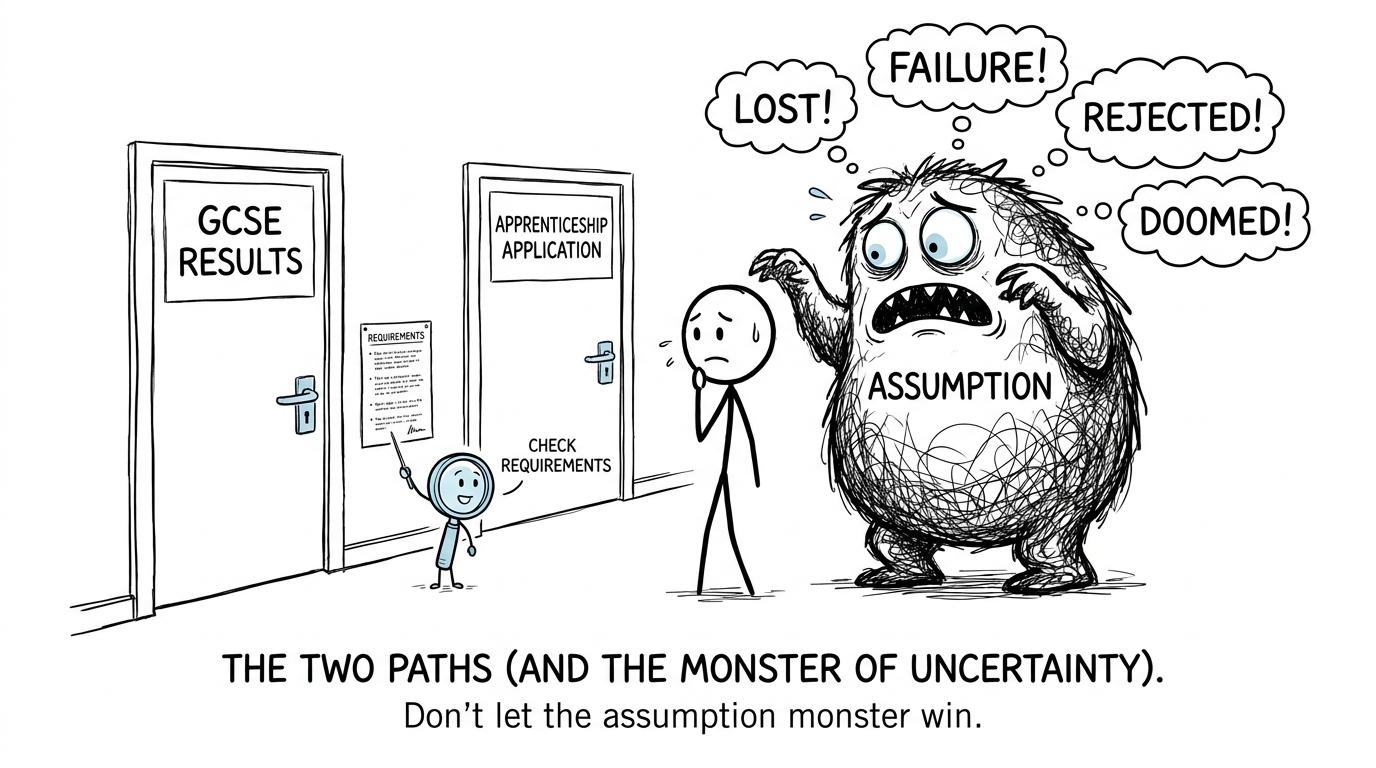 A student checks the small print while an assumption monster guesses at apprenticeship requirements
Is there a universal GCSE English grade for apprenticeships?
No. There is no single GCSE English Language grade that every UK apprentice must hold before applying.
An apprenticeship vacancy brings several sets of rules together:
- the employer chooses who it wants to recruit
- the training provider checks whether applicants can complete the programme
- a university may impose admissions criteria for a degree apprenticeship
- a professional or statutory body may set requirements for a regulated occupation
- apprenticeship funding rules can affect whether English and maths must be studied during the programme
These rules are related, but they are not interchangeable. An employer asking for grade 444 at application is setting an entry requirement. A funding rule requiring an apprentice to continue studying English concerns what happens during the apprenticeship. Confusing the two can lead students to reject opportunities for which they may still be eligible.
In England, current apprenticeship arrangements distinguish between younger and adult apprentices who have not already achieved the required level in English and maths. Apprentices aged 161616 to 181818 are generally expected to continue working towards the relevant English and maths qualifications. For adult apprentices, whether funded English and maths study is included can depend on the current rules and agreement between the employer and apprentice.
That does not force an employer to accept an applicant without its advertised grade. Entry criteria remain a recruitment decision unless another rule applies. Funding policies can also change, so applicants should confirm the position with the training provider for their proposed start date.
Which apprenticeship routes set specific English grades?
The route title alone rarely gives a complete answer. A Level 333 or Level 666 apprenticeship does not automatically carry one national English Language requirement. Specific grades usually appear in the following situations.
Teacher apprenticeships and routes leading to qualified teacher status
Teacher training is one of the clearest examples. In England, routes leading to qualified teacher status normally require GCSE English and maths at grade 444 or grade CCC, or an accepted equivalent. Primary teaching routes normally require science as well.
The provider decides whether another qualification or an equivalency assessment satisfies the condition. A general Functional Skills qualification should not be assumed to meet teacher training admissions rules without written confirmation.
Degree apprenticeships with university admission
Degree apprenticeships combine employment with higher education. The university and employer may therefore impose separate criteria.
A university can require GCSE English Language at grade 444, grade 555 or another stated level, even when the apprenticeship standard itself does not prescribe that grade. Some programmes also request particular A Levels, BTECs or UCAS tariff evidence.
Requirements vary between vacancies carrying the same apprenticeship title. One engineering, digital or business degree apprenticeship may accept Level 222 equivalents; another may explicitly require GCSE English Language. Always read both the employer’s advert and the university course information.
Students balancing GCSE preparation with longer-term plans can use MathsGenie’s free GCSE maths revision resources to secure the maths requirement that frequently appears beside English.
Healthcare and other regulated programmes
Nursing, allied health, social care and other regulated routes can involve employer, university and professional suitability checks. English and maths at Level 222, often expressed as GCSE grade 444 or above, commonly appear in vacancies.
However, it is unsafe to treat one healthcare vacancy as evidence of a rule covering every healthcare apprenticeship. The accepted qualifications and the stage by which they must be achieved can vary. Check whether the condition comes from the employer, education provider or professional programme.
Competitive engineering, finance, digital and public-service vacancies
Large employers often receive many applications. They may use GCSE grades as an initial screening measure, asking for five GCSEs at grades 999 to 444, including English Language and maths.
This is usually an employer’s recruitment threshold rather than a universal rule attached to the occupation. Smaller employers offering the same apprenticeship standard may use different criteria and place more weight on an assessment, interview, portfolio or prior experience.
| Wording in the vacancy | What it usually means |
|---|---|
| “GCSE English Language grade 444 essential” | You normally need that grade or an explicitly accepted equivalent before starting. |
| “Grade 444 preferred” | You may still be considered, but stronger applicants could have an advantage. |
| “GCSE English or Functional Skills Level 222” | Either named qualification is likely to satisfy the requirement. |
| “Must achieve Level 222 English during the apprenticeship” | You may be able to start without it and study alongside occupational training. |
| “English Language result pending” | Contact recruitment and ask whether a conditional application is possible. |
Why English and maths are often considered together
Apprenticeships involve more than practical occupational skills. Apprentices read instructions, record evidence, communicate with customers, interpret technical information and complete assessments. Employers therefore often list English and maths together.
If maths is also part of your offer, focus first on the grade boundary you need. MathsGenie organises topics by grade, including dedicated grade 3 revision, grade 4 revision and grade 5 revision. This makes revision more deliberate: strengthen the topics near your target before spending time on material far beyond it.
Students taking foundation tier should also remember that grade 555 is the highest available grade. The right tier should be discussed with your school rather than chosen from an apprenticeship advert alone.
What to do if you are short of the required grade
Being one grade short is a problem to solve, not a reason to disappear from the process.
Ask whether the wording is flexible
Contact the employer or training provider before applying if the advert is unclear. Ask a precise question: does the programme accept Functional Skills Level 222, an overseas qualification, a Scottish qualification, an equivalency assessment or a GCSE resit result pending?
Keep the reply in writing. Recruitment teams can make a more useful decision when you provide the qualification title, subject, grade and awarding organisation rather than saying only that you have “an equivalent”.
Distinguish essential from desirable criteria
If grade 444 is essential, an automated application system may reject applicants who do not meet it. If it is preferred or desirable, you can still apply and demonstrate your suitability elsewhere.
Do not claim a qualification you have not achieved. State a resit accurately, including the expected result date where the application allows it.
Consider a GCSE resit or accepted alternative
A GCSE English Language resit may be the clearest option when your intended route repeatedly asks for that exact qualification. Functional Skills Level 222 can be a practical alternative for many apprenticeships, but acceptance is not automatic for every university or regulated route.
Your school, college, training provider or prospective employer can explain what is available and which qualification it will accept. If maths also needs attention, build regular exam practice around GCSE maths past papers rather than relying only on notes.
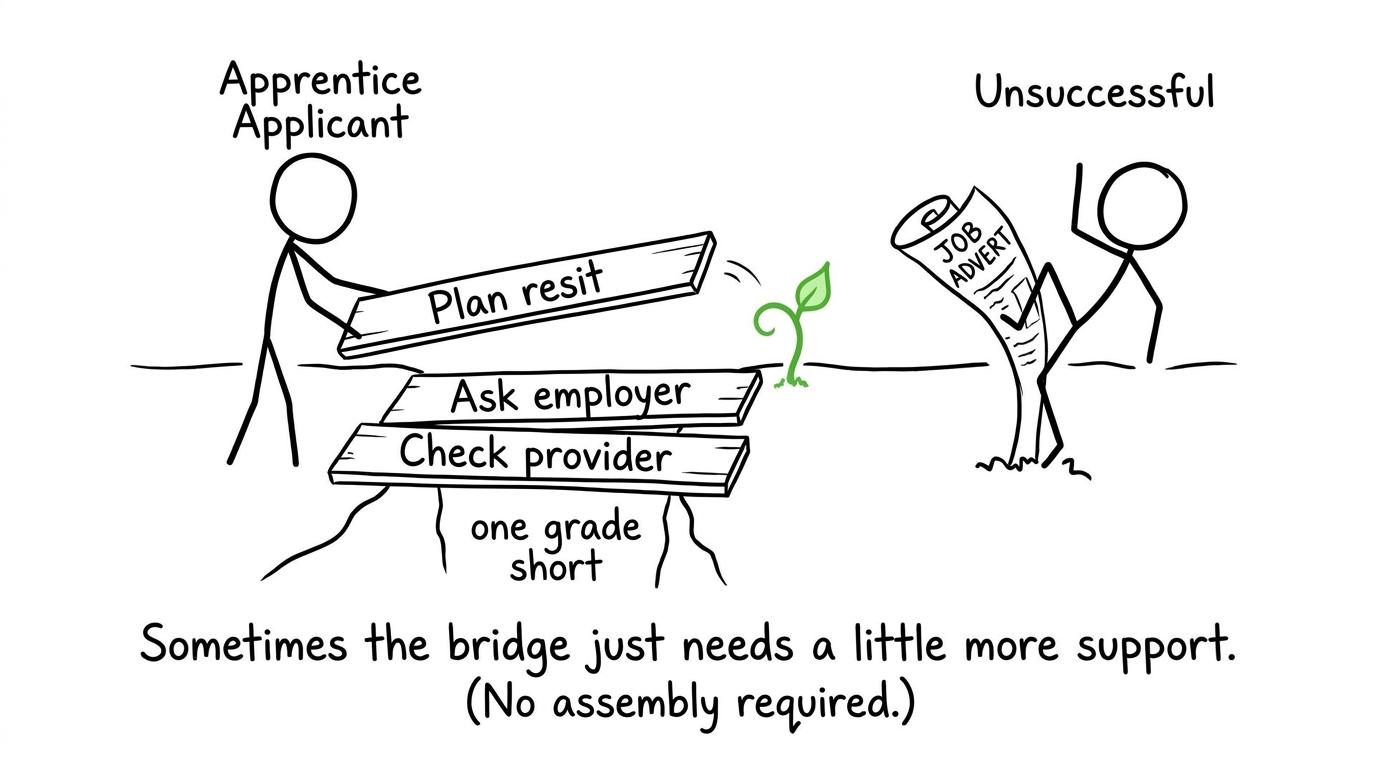 An applicant builds a practical bridge across a one-grade gap
Apply for routes with different entry criteria
The same occupation may be available through several employers or apprenticeship levels. A Level 222 or Level 333 route may provide progression into a higher apprenticeship after you have gained experience and completed English or maths.
This is not about lowering ambition. It is about sequencing it. Careers often move through several doors rather than one perfect entrance.
How to protect the maths side of your application
English may be the immediate concern, but many adverts request both subjects at grade 444. A small, consistent maths routine can prevent a second eligibility issue.
Use grade 4 GCSE maths topics to identify gaps, then complete questions without notes. Mark the work carefully and return to the topics where marks were lost. As exams approach, use MathsGenie predicted papers alongside official past papers. Predicted papers are revision tools, not forecasts of exact exam questions.
If you progress to sixth form before applying for a higher or degree apprenticeship, MathsGenie also provides A Level maths revision with topic lessons and exam practice.
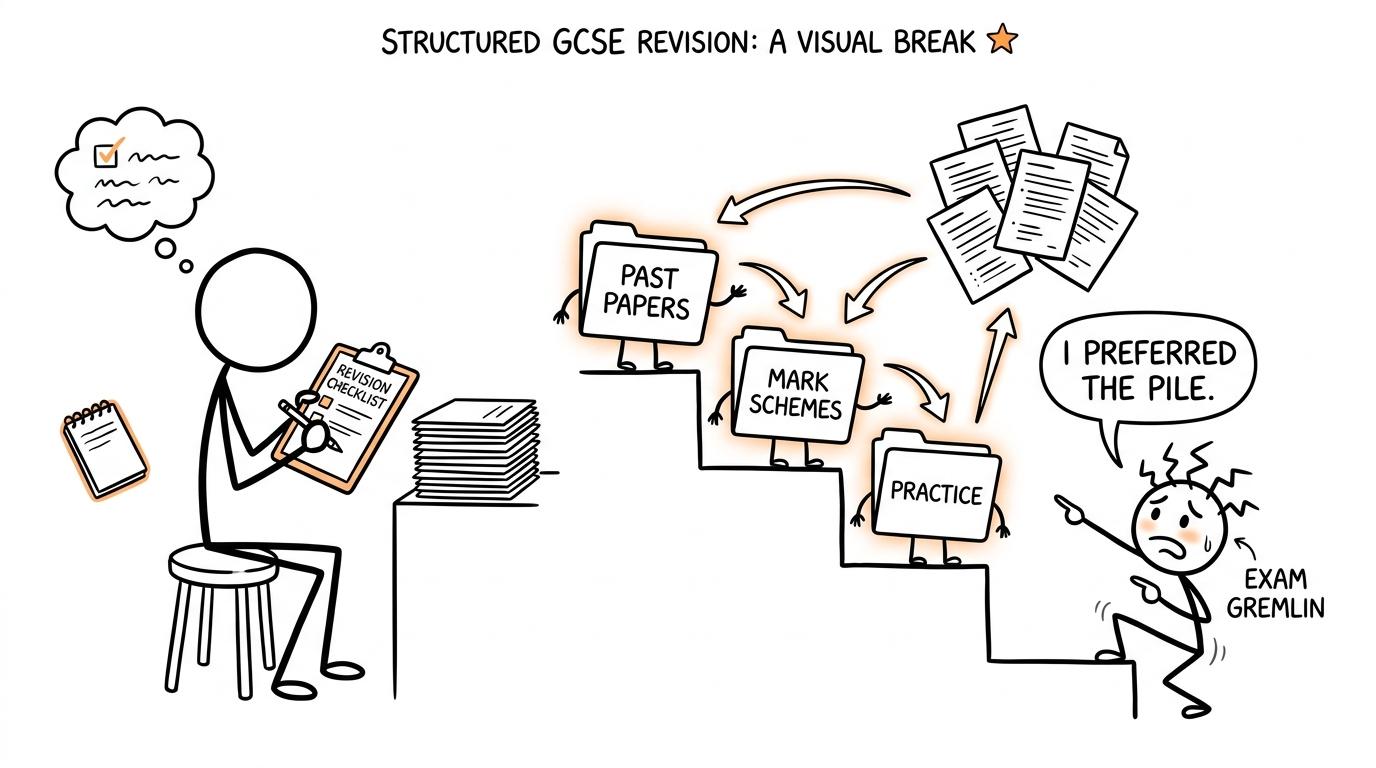 A revision checklist turns a chaotic pile of resources into a staircase
Common mistakes when checking apprenticeship requirements
Assuming every apprenticeship needs grade 444
Grade 444 is common, but it is not a blanket entry rule. Read the live vacancy rather than relying on a friend’s application or an older advert.
Treating English Literature as English Language
Some organisations accept either subject; others name English Language deliberately. Ask if the policy does not explain accepted alternatives.
Assuming “equivalent” means every Level 222 qualification
Equivalence depends on the purpose and the organisation making the decision. A qualification accepted for apprenticeship funding may not satisfy a university or professional admissions policy.
Ignoring who set the condition
An employer may be flexible while its university partner is not, or the reverse. Identifying the decision-maker tells you whom to contact.
Waiting until results day to investigate
Research likely routes before results arrive. You can identify resit arrangements, alternative vacancies and contact details without predicting your result.
Neglecting exam technique in maths
Knowing a topic is different from earning its marks under time pressure. Use MathsGenie GCSE past papers, mark schemes and video solutions to find where your method, notation or timing needs improvement.
Turn the requirement into a plan
A GCSE requirement can look like a judgement on your future. Usually, it is simply a condition with several possible responses: meet it now, confirm an accepted equivalent, resit, complete English during the programme or choose another route into the same career.
Start with the exact advert. Separate employer preferences from university, professional and funding rules. Then ask direct questions before ruling yourself out.
For the maths qualification that so often sits beside English, begin with MathsGenie’s GCSE revision lessons. Move from topic practice to past papers, mark schemes, video solutions and predicted papers. A requirement becomes less intimidating when it is translated into the next useful action; and then the one after that.