What you'll learn
- How sensory, relay and motor neurons are structured and what each one does.
- How a nerve impulse travels within a neuron and between neurons.
- How neurotransmitters can cause excitation or inhibition.
- How to apply and evaluate this content in AQA A-Level Psychology answers.
The big picture: communication in the nervous system
Biopsychology looks at how biological systems help explain behaviour. A key idea is that the body and brain communicate using specialised cells called neurons.
Neuron
A neuron is a specialised nerve cell that carries information around the body using electrical and chemical signals.
A message usually travels electrically within a neuron, then chemically across the gap between neurons. This allows the nervous system to respond quickly to changes, such as touching something hot or hearing your name.
The central nervous system, or CNS, is the brain and spinal cord. The peripheral nervous system, or PNS, is the network of nerves outside the CNS.
Electrical within, chemical between
A nerve impulse travels along a neuron as an electrical signal, but communication across a synapse uses chemical messengers called neurotransmitters.
Basic neuron structure
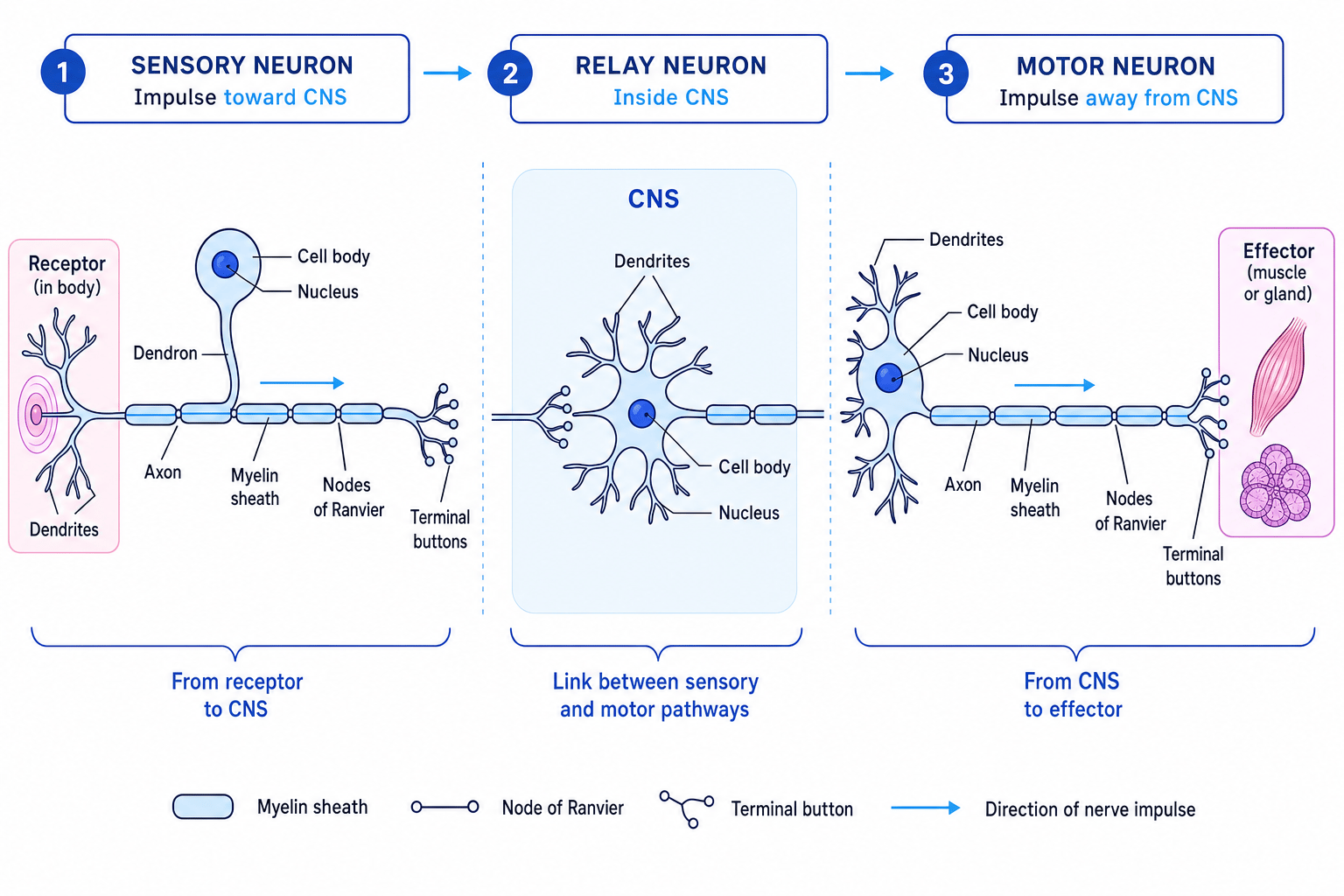
Although neurons come in different shapes, they share some important parts.
- Dendrites are branch-like structures that receive signals from other neurons or from sensory receptors.
- The cell body, sometimes called the soma, contains the nucleus, which controls the cell’s activities.
- The axon is a long fibre that carries the nerve impulse away from the cell body.
- The myelin sheath is a fatty insulating layer around some axons. It speeds up transmission.
- Nodes of Ranvier are small gaps in the myelin sheath. The impulse effectively jumps between these gaps, making transmission faster.
- Terminal buttons are the endings of the neuron. They help pass the message on to the next neuron, muscle or gland.
- An action potential is a brief electrical impulse that travels along the axon when the neuron has been sufficiently stimulated.
Mixing up the signal types
Do not say neurotransmitters travel all the way along the axon. The signal along the axon is electrical; neurotransmitters are involved at the synapse.
The three main types of neuron
AQA expects you to know the structure and function of sensory neurons, relay neurons and motor neurons.
A stimulus is a change in the environment, such as heat, pressure or light. A receptor is a specialised cell that detects a stimulus. An effector is a muscle or gland that produces a response.
| Type of neuron | Direction of message | Main function | Key structure |
|---|---|---|---|
| Sensory neuron | From receptors to the CNS | Carries information about stimuli | Often has the cell body part-way along the fibre or off to the side |
| Relay neuron | Within the CNS | Connects sensory neurons to motor neurons | Usually short, with many dendrites to connect with other neurons |
| Motor neuron | From the CNS to effectors | Carries commands to muscles or glands | Cell body at one end, with a long axon leading to the effector |
Sensory neurons
A sensory neuron carries information from sensory receptors towards the CNS. For example, receptors in your skin detect heat, and sensory neurons carry that message to the spinal cord or brain.
Relay neurons
A relay neuron, also called an interneuron, is found in the CNS. It connects sensory neurons to motor neurons. Relay neurons are important because they allow information to be processed before a response is produced.
Motor neurons
A motor neuron carries messages away from the CNS to an effector. If the effector is a muscle, the message may cause it to contract. If the effector is a gland, the message may cause it to release a chemical.
Afferent and efferent
If you meet the terms afferent and efferent: sensory neurons are afferent because information arrives at the CNS; motor neurons are efferent because information exits the CNS.
Tracing a reflex pathway
A person touches a hot pan and quickly pulls their hand away.
- The heat is detected by receptors in the skin, so the first neuron involved must be a sensory neuron carrying information from the body towards the CNS.
- In the spinal cord, a relay neuron connects the sensory message to the response pathway, allowing a very quick reaction.
- A motor neuron then carries the command away from the CNS to the arm muscles, which act as effectors and contract to pull the hand away.
Synapses: where neurons communicate
A synapse is the junction between two neurons. More precisely, it includes the end of the first neuron, the tiny gap between neurons, and the membrane of the next neuron.
Synapse
A synapse is the junction where one neuron communicates with another neuron, usually using chemical messengers.
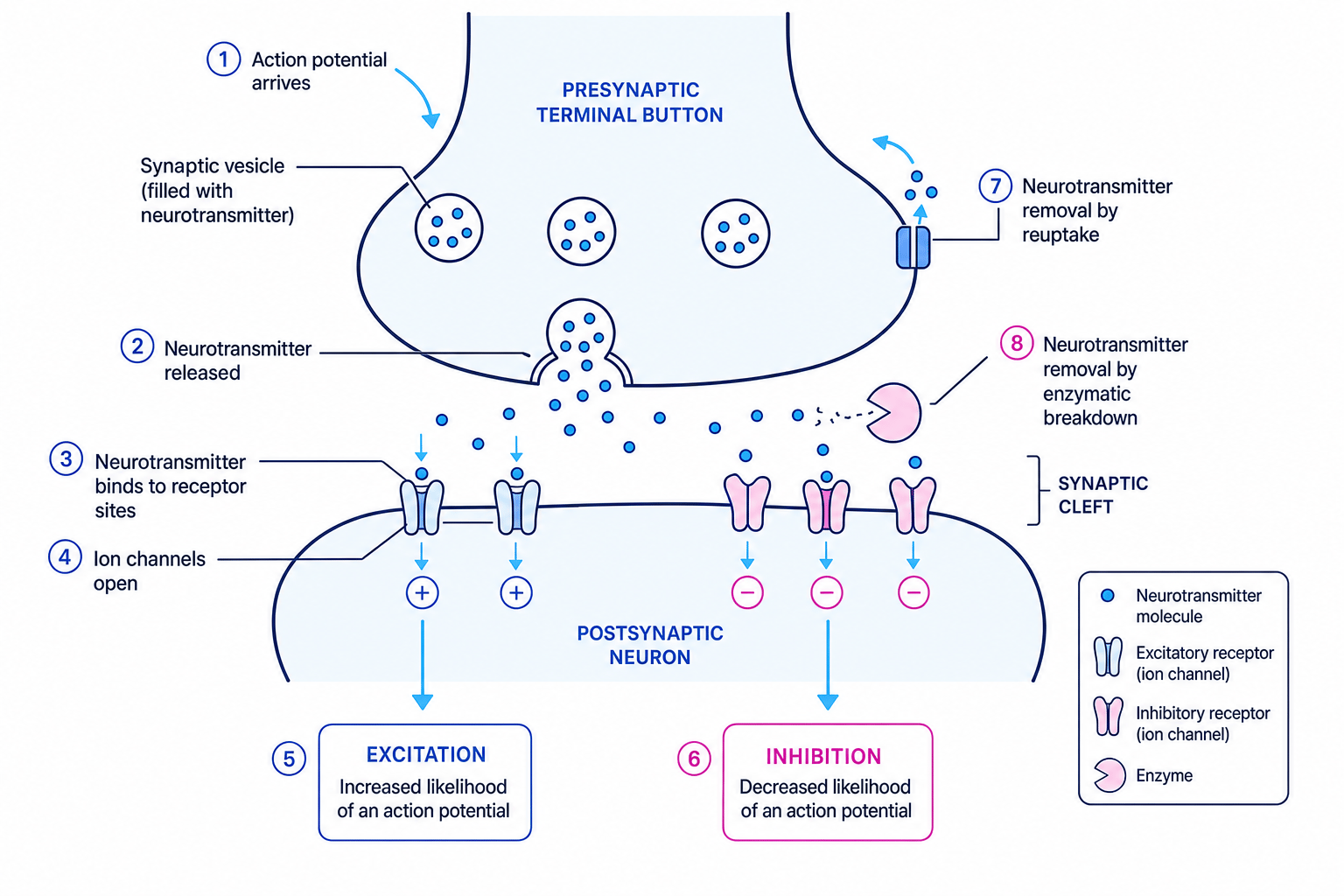
The neuron sending the message is the presynaptic neuron. The neuron receiving the message is the postsynaptic neuron. The small gap between them is the synaptic cleft.
Synaptic transmission step by step
Synaptic transmission is the process by which neurons communicate across the synapse.
- An action potential reaches the terminal button of the presynaptic neuron.
- Tiny sacs called synaptic vesicles release neurotransmitters into the synaptic cleft.
- The neurotransmitters diffuse across the gap.
- They bind to specific receptor sites on the postsynaptic membrane. A receptor site is a molecule that only certain neurotransmitters can attach to.
- This changes the activity of the postsynaptic neuron, making it either more likely or less likely to fire.
- The neurotransmitter is then removed from the synaptic cleft, for example through reuptake, where it is taken back into the presynaptic neuron, or through enzymatic breakdown, where enzymes break it down.
Lock and key
A neurotransmitter and receptor site work a bit like a key fitting a lock: the neurotransmitter must have the right shape to bind to that receptor.
Synaptic transmission is usually one-way because neurotransmitters are released from the presynaptic side and receptor sites are found on the postsynaptic side.
Neurotransmitters, excitation and inhibition
Neurotransmitter
A neurotransmitter is a chemical messenger that carries signals across a synapse from one neuron to another.
Examples include dopamine, serotonin, acetylcholine and GABA. You do not need detailed chemistry for this topic, but you should understand that neurotransmitters affect whether the next neuron is likely to fire.
Excitation means the postsynaptic neuron becomes more likely to fire an action potential. Inhibition means it becomes less likely to fire an action potential.
A single neuron can receive many excitatory and inhibitory signals at the same time. Summation is the adding together of these signals. If the overall effect reaches the threshold, meaning the minimum level of stimulation needed, the postsynaptic neuron fires.
Deciding whether a postsynaptic neuron fires
A postsynaptic neuron receives several excitatory signals and one inhibitory signal at the same time.
- The excitatory signals make the neuron more likely to fire, while the inhibitory signal makes it less likely to fire.
- The nervous system combines these influences through summation, so the overall effect depends on which influence is stronger.
- If the excitatory influence outweighs the inhibitory influence and reaches threshold, the postsynaptic neuron will fire an action potential.
Excitatory does not mean positive
In Psychology, excitatory does not mean “happy” or “good”, and inhibitory does not mean “sad” or “bad”. They only refer to whether the next neuron is more or less likely to fire.
Neurotransmitters are not always simple
Some textbooks describe particular neurotransmitters as mainly excitatory or mainly inhibitory, but the effect can depend on the receptor type and where in the nervous system the synapse is located.
Applying synaptic transmission
Understanding synapses helps explain how drugs can affect behaviour. For example, some drugs influence the amount of neurotransmitter in the synaptic cleft, or block receptor sites so neurotransmitters cannot bind.
Applying a reuptake blocker
A drug blocks the reuptake of a neurotransmitter.
- Reuptake normally removes neurotransmitter from the synaptic cleft by taking it back into the presynaptic neuron.
- If reuptake is blocked, more of that neurotransmitter remains in the synaptic cleft for longer.
- If that neurotransmitter has an excitatory effect at that synapse, the postsynaptic neuron becomes more likely to fire; if it has an inhibitory effect, the postsynaptic neuron becomes less likely to fire.
This is a useful AO2 point because it shows you can apply the biological mechanism to an unfamiliar scenario, such as a drug, toxin or neurological condition.
AO3: evaluating this biological approach
Although this topic is mainly AO1 description, you can still evaluate it when writing broader biopsychology essays.
Strengths
One strength is that neurons and synapses give a scientific and objective explanation of behaviour. Neural communication can be investigated using controlled laboratory methods, brain-recording techniques and drug studies. This gives the explanation credibility because it is based on observable biological processes.
A second strength is real-world application. Many treatments work by changing synaptic activity. For example, some drugs affect reuptake, neurotransmitter release or receptor binding. This shows that understanding synaptic transmission has practical value in medicine and mental health.
Limitations
One limitation is biological reductionism. This means reducing complex behaviour to biological mechanisms alone. Synapses are important, but behaviour is also influenced by thoughts, learning, social context and culture.
Another limitation is that neurotransmitter explanations can be oversimplified. It is tempting to say “low serotonin causes depression” or “dopamine causes pleasure”, but real behaviour involves multiple neurotransmitters, brain areas and environmental factors.
Ethics and methodology
Research into neural processes may involve drug manipulation, brain scanning, animal studies or invasive procedures. In human research, psychologists must consider informed consent, right to withdraw, protection from harm, confidentiality and debriefing. In animal research, researchers must justify the scientific value and minimise suffering.
AO3 link phrase
A strong evaluation sentence often starts: “This matters because…” For example, “This matters because it shows synaptic explanations are useful, but may be incomplete when used alone.”
In the exam
- For neuron questions, always link structure to function: sensory to receptors and CNS, relay within CNS, motor from CNS to effectors.
- For synaptic transmission, keep the sequence in order: action potential, vesicle release, diffusion, receptor binding, excitation or inhibition, removal.
- Define excitation and inhibition as more likely to fire and less likely to fire, not as emotional states.
- For AO3, use clear evaluation points such as scientific support, real-world drug applications, reductionism, complexity and ethical issues.
Check yourself
- How is the direction of a sensory neuron different from the direction of a motor neuron?
- What happens to neurotransmitters after they bind to postsynaptic receptors?
- Why might the same neurotransmitter not always have the same effect at every synapse?
