What you'll learn
- What the endocrine system is and how it communicates using hormones.
- The difference between glands, hormones, target organs and receptors.
- The main endocrine glands you should know for AQA Biopsychology.
- How to apply endocrine knowledge to scenarios and evaluate biological explanations.
The big picture: body communication
In biopsychology, you need to understand how the body communicates internally. The nervous system uses fast electrical and chemical signals through neurons. The endocrine system uses slower chemical signals carried in the blood.
Both systems help the body respond to internal and external changes, and they often work together.
Endocrine system
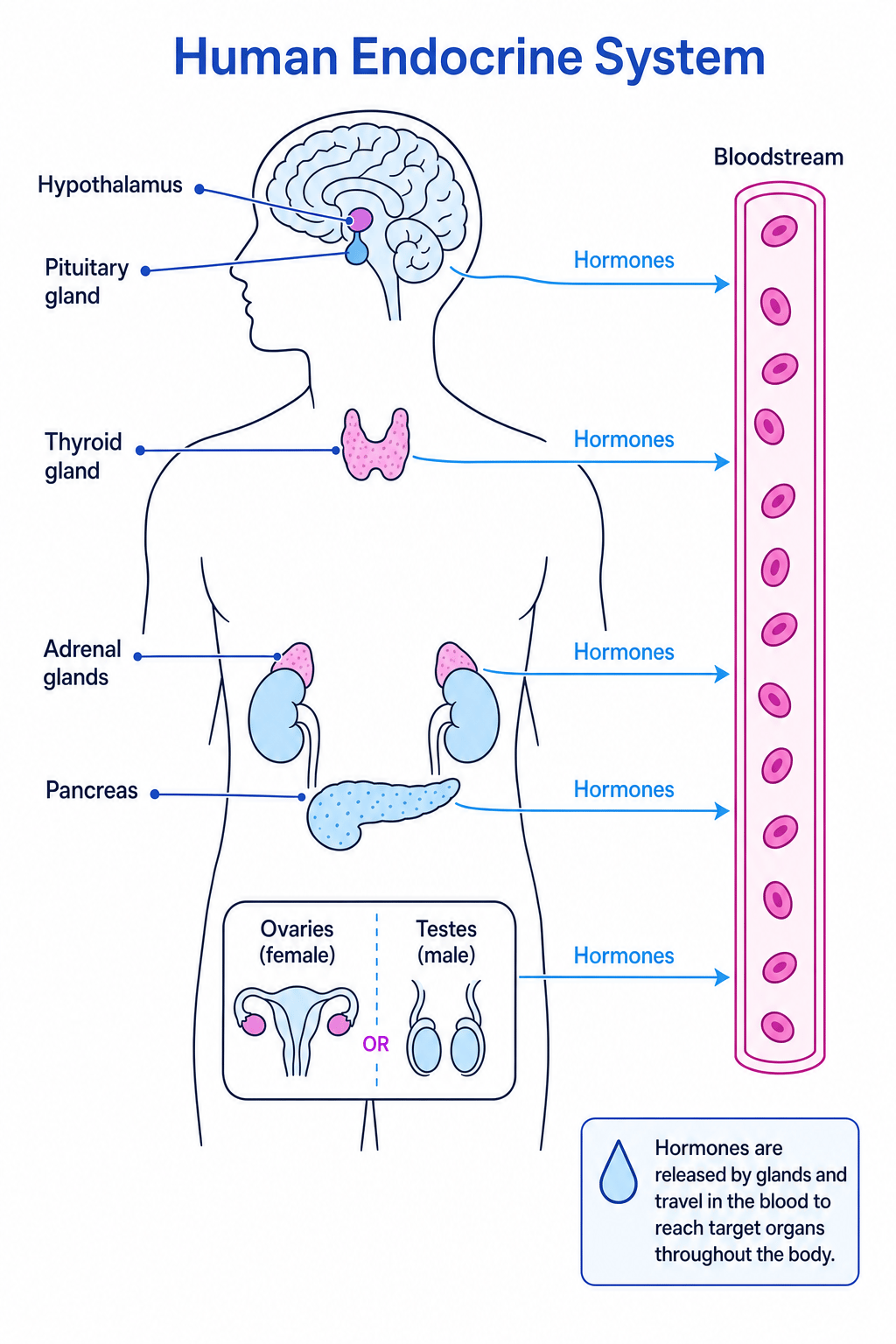
The endocrine system is a network of glands that release chemical messengers called hormones directly into the bloodstream. These hormones travel around the body and affect specific target organs or cells.
The endocrine system is spread across the body. Glands are found in the brain, neck, abdomen and reproductive organs.
Glands and hormones
What is a gland?
A gland is an organ or tissue that produces and releases a substance. In the endocrine system, glands are ductless, meaning they do not send substances through tubes. Instead, they release hormones directly into the blood.
What is a hormone?
A hormone is a chemical messenger. Hormones travel in the bloodstream and influence cells that have the correct receptor.
Target organs and receptors
A target organ is the part of the body affected by a particular hormone. A receptor is a specialised site on or inside a cell that responds to a specific hormone.
This is why a hormone can travel around the whole body but only affect certain tissues. For example, adrenaline circulates widely, but only cells with adrenaline receptors will respond strongly.
Gland → hormone → target
For AO1, describe endocrine communication as a chain: a gland releases a hormone into the bloodstream, the hormone travels to target organs, and it changes bodily activity or behaviour.
Endocrine system vs nervous system
The endocrine system is usually slower than the nervous system because hormones must travel through the blood. However, endocrine effects are often longer-lasting.
| Feature | Nervous system | Endocrine system |
|---|---|---|
| Main message | Electrical impulses and neurotransmitters | Hormones |
| Route | Neurons and synapses | Bloodstream |
| Speed | Very fast | Slower |
| Duration | Usually short-lived | Often longer-lasting |
| Typical effect | Precise and immediate | Widespread and sustained |
For example, pulling your hand away from a hot surface is mainly a nervous-system response. Feeling alert and physically prepared during stress involves endocrine activity, especially hormones such as adrenaline.
Hormones are not nerve impulses
Do not write that hormones “fire” or “travel along neurons”. Hormones are chemical messengers released by glands and carried in the blood.
Main endocrine glands for AQA
You do not need to know every hormone in the body, but you should be confident with the major glands and what they broadly do.
| Gland | Location | Main hormone examples | Main function |
|---|---|---|---|
| Hypothalamus | Brain | Releasing and inhibiting hormones | Links the nervous system to the endocrine system and controls the pituitary gland |
| Pituitary gland | Base of the brain | Growth hormone, ACTH, TSH, FSH, LH | Often called the “master gland” because it controls other endocrine glands |
| Thyroid gland | Neck | Thyroxine | Regulates metabolic rate, energy use and growth |
| Adrenal glands | On top of the kidneys | Adrenaline, noradrenaline, cortisol | Involved in arousal, stress and fight-or-flight responses |
| Pancreas | Abdomen | Insulin, glucagon | Regulates blood glucose |
| Ovaries | Female reproductive system | Oestrogen, progesterone | Involved in the menstrual cycle, pregnancy and sexual development |
| Testes | Male reproductive system | Testosterone | Involved in sperm production, sexual development and some behavioural influences |
The pituitary gland
The pituitary gland is especially important in biopsychology. It is sometimes called the master gland because it releases hormones that influence other glands.
However, it is not completely in charge by itself. It is controlled by the hypothalamus, a brain structure involved in maintaining bodily balance.
Pituitary precision
A strong answer says the pituitary is “often called the master gland” but also notes that it is regulated by the hypothalamus. This avoids making the pituitary sound magically independent.
How hormones affect behaviour
Hormones influence behaviour indirectly by changing the body’s internal state. For example, they can affect arousal, energy levels, metabolism, sexual development, stress responses and mood.
A good biopsychology answer should avoid saying “one hormone causes one behaviour” too simply. Hormones usually interact with the nervous system, cognition and the environment.
Adrenaline and arousal
The adrenal glands release adrenaline during stress or threat. Adrenaline prepares the body for action by increasing heart rate, redirecting blood flow to muscles and increasing alertness.
This is why endocrine activity is important in the biological explanation of the fight-or-flight response.
Applying hormones to a stress scenario
A student sees a car suddenly swerve towards them and feels their heart race.
- Identify the relevant gland: The stressor activates bodily systems linked to the adrenal glands, which sit above the kidneys.
- Name the hormone: The adrenal medulla releases adrenaline into the bloodstream.
- Link hormone to target effects: Adrenaline affects target organs such as the heart and muscles, increasing heart rate and preparing the body for rapid action.
- Connect to behaviour: The student may jump back quickly, feel alert and experience shaking because the body is mobilising energy for a fight-or-flight response.
Hormones and negative feedback
The endocrine system must keep hormone levels within a useful range. Too little or too much hormone can disrupt normal functioning.
Homeostasis and negative feedback
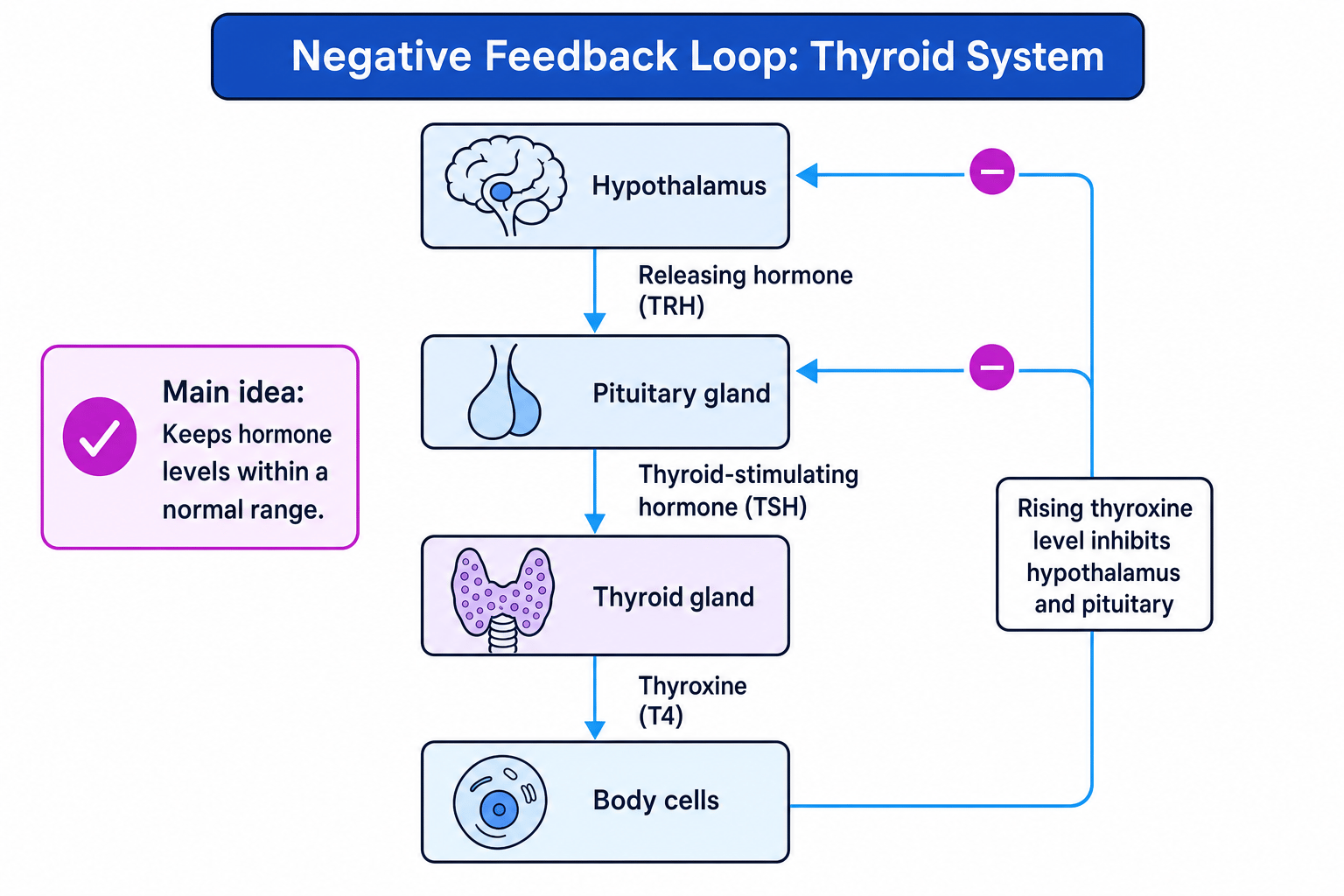
Homeostasis means maintaining a stable internal state. Negative feedback is a control process where a change triggers responses that reduce or reverse the original change.
A classic example is the thyroid system. The hypothalamus and pituitary stimulate the thyroid gland to release thyroxine. When thyroxine rises enough, it inhibits further release from the hypothalamus and pituitary.
Explaining negative feedback
A person’s thyroxine level rises above the normal range.
- Locate the change: The body detects that thyroxine is higher than needed for normal metabolic regulation.
- Apply the feedback rule: Because this is negative feedback, the response should reduce the original increase.
- Trace the pathway: High thyroxine inhibits the hypothalamus and pituitary gland, so they release less stimulation to the thyroid.
- Explain the outcome: The thyroid releases less thyroxine, helping levels return towards the normal range.
Assuming more hormone is always better
Endocrine control is about balance. High hormone levels can be just as disruptive as low hormone levels, so feedback systems regulate release.
AO2: applying endocrine knowledge
In scenario questions, look for clues that point to endocrine activity:
- The response involves glands or hormones.
- The message travels through the bloodstream.
- The effect is slower or longer-lasting than a reflex.
- The scenario involves stress, arousal, metabolism, growth, reproduction or blood glucose regulation.
For example, if a question describes someone feeling energised for several minutes after a frightening event, endocrine explanations are relevant because adrenaline can continue affecting the body after the initial neural response.
AO3: evaluating endocrine explanations
Strengths
Endocrine explanations are scientific because hormones can be measured objectively through blood or saliva samples. This gives biopsychology a strong empirical basis.
They also have useful real-world applications. Understanding hormones helps explain medical conditions such as thyroid imbalance or diabetes, and it informs treatments such as insulin therapy or hormone replacement.
Endocrine explanations also show how biology can influence behaviour without relying only on conscious thought. This is useful for explaining automatic responses such as stress arousal.
Limitations
A key weakness is biological reductionism. This means explaining complex human behaviour mainly in terms of biological factors. Hormones matter, but behaviour is also shaped by learning, cognition, culture and social context.
Another issue is biological determinism. If an answer implies that hormones completely control behaviour, it ignores human choice and environmental influence. A better approach is interactionist: hormones can increase the likelihood of certain responses, but they do not make behaviour inevitable.
There are also methodological problems. Many hormone studies are correlational, so they may show a relationship between hormone level and behaviour without proving that the hormone caused the behaviour. Behaviour can also affect hormones; for example, stress may increase cortisol, but cortisol may also alter how stress is experienced.
Ethically, research involving hormones or stress must consider informed consent, protection from harm, confidentiality and debriefing. If participants are deceived about the purpose of a stress task or given a placebo, researchers must justify this and fully debrief them afterwards.
Bringing it together
The endocrine system is a chemical communication system. It works more slowly than the nervous system, but its effects can be widespread and long-lasting. For AQA, the most important idea is the relationship between glands, hormones, the bloodstream and target organs.
In the exam
- Define the endocrine system clearly: glands release hormones directly into the bloodstream.
- Use at least one accurate example, such as the adrenal glands releasing adrenaline or the thyroid gland releasing thyroxine.
- For evaluation, avoid “hormones cause behaviour” determinism; explain that hormones influence behaviour alongside neural, cognitive and environmental factors.
Check yourself
- What is the difference between a gland, a hormone and a target organ?
- Why is the endocrine system usually slower but longer-lasting than the nervous system?
- How does negative feedback help regulate hormone levels?
