What you'll learn
- How the central nervous system and peripheral nervous system are divided.
- The difference between the somatic nervous system and the autonomic nervous system.
- How to apply these divisions to everyday behaviours, such as moving your hand or reacting to stress.
- Common exam pitfalls when describing “voluntary” and “involuntary” responses.
The starting point: what is the nervous system?
The nervous system is the body’s main communication network. It uses specialised cells called neurons to send rapid electrical and chemical messages around the body.
These messages allow you to do things like:
- detect information from the environment, such as light, sound, pain, or temperature
- process information and make decisions
- coordinate responses, such as moving muscles or changing heart rate
Nervous system
The nervous system is a network of neurons that carries messages between different parts of the body, allowing the organism to detect, process, and respond to internal and external changes.
The AQA specification wants you to know the basic divisions of the nervous system: the central nervous system and the peripheral nervous system, with the peripheral nervous system split into the somatic and autonomic systems.
The big structure
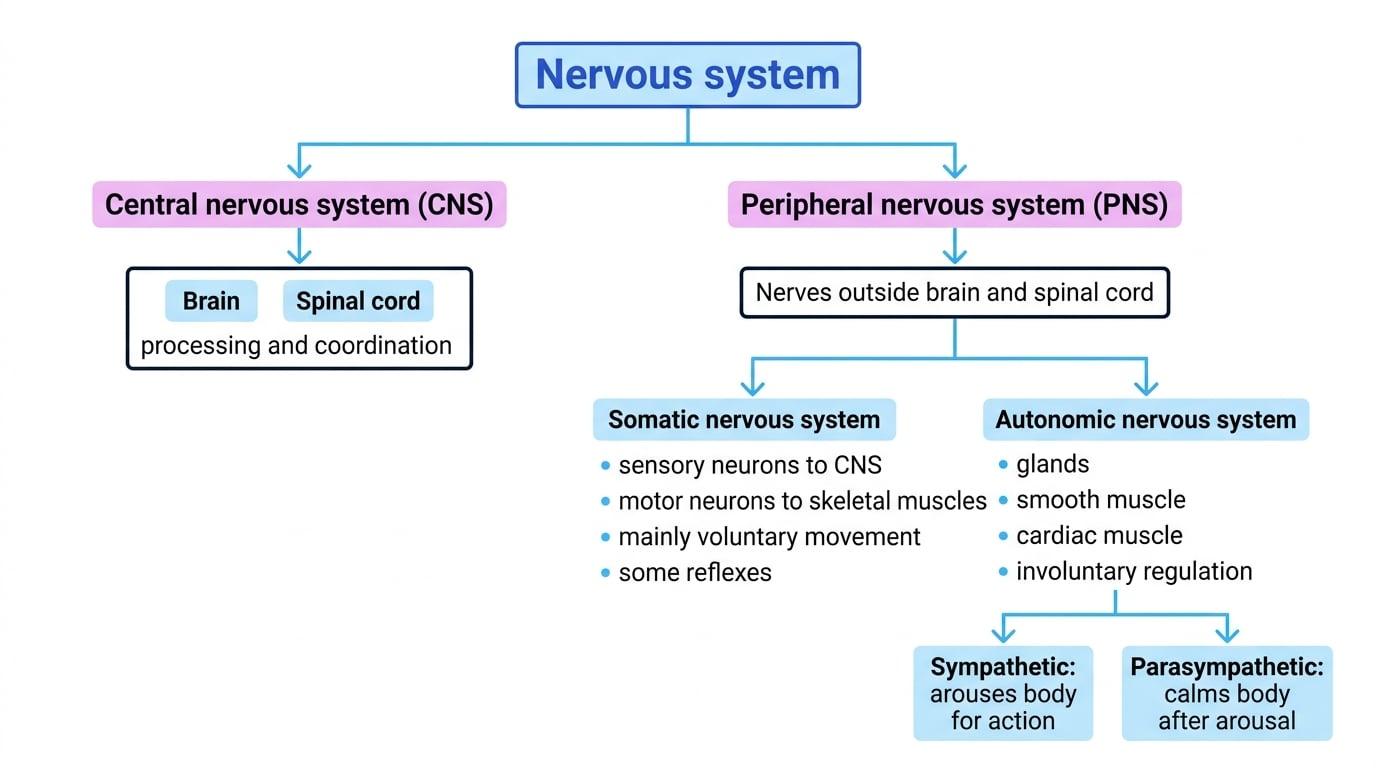
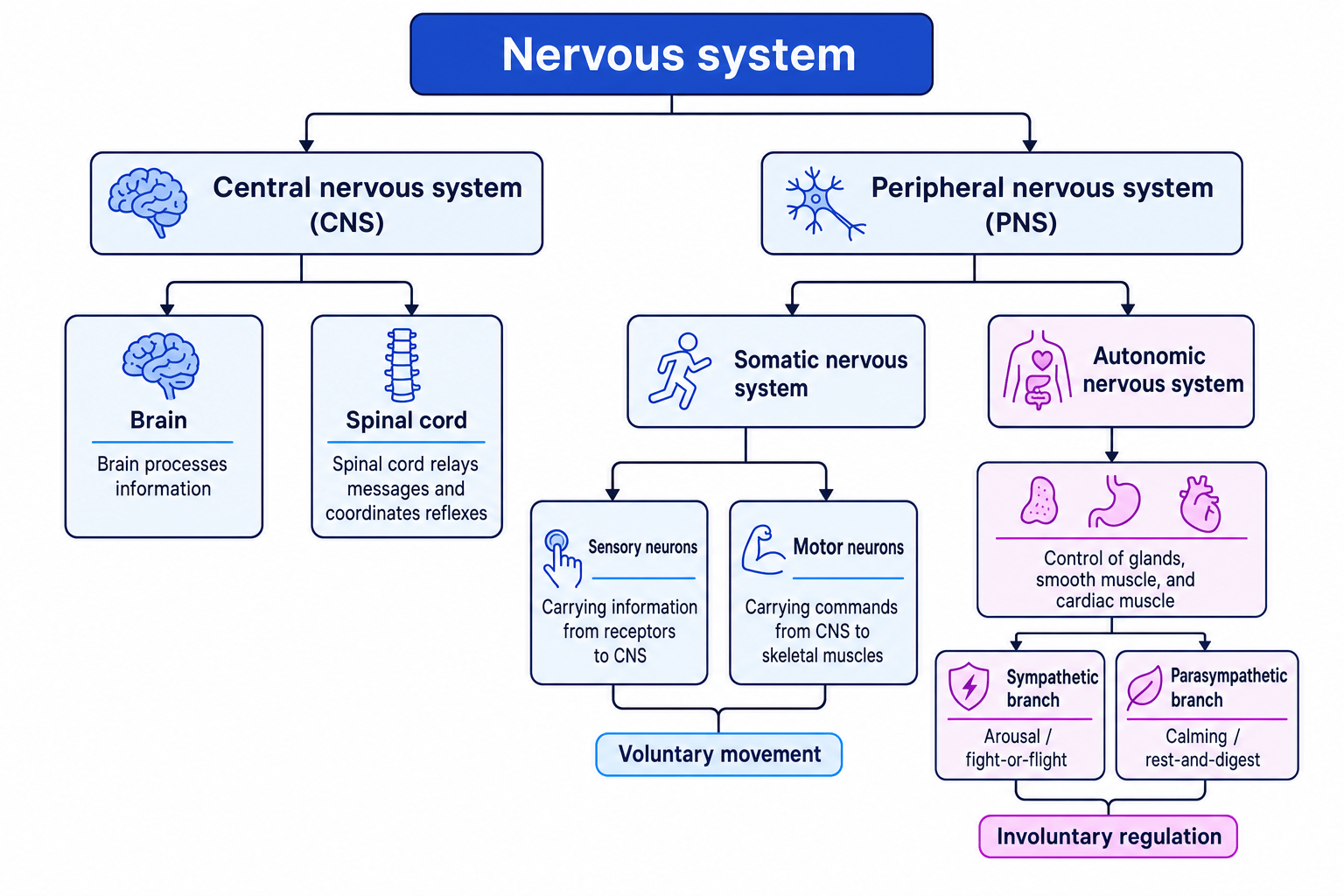
The nervous system is usually described as a hierarchy: nervous system → CNS and PNS → somatic and autonomic divisions of the PNS.
The central nervous system: CNS
The central nervous system, or CNS, is made up of the brain and the spinal cord.
The CNS is called “central” because it is the main processing and coordination centre. It receives information from the body and environment, interprets that information, and helps coordinate an appropriate response.
Central nervous system
The central nervous system (CNS) consists of the brain and spinal cord. It processes information and coordinates responses.
The brain
The brain is responsible for complex processing. It is involved in thought, memory, language, emotion, decision-making, perception, and the control of behaviour.
For example, if you see a car approaching as you cross the road, your brain processes visual information, judges danger, and helps you decide to stop or move faster.
The spinal cord
The spinal cord is a long bundle of nerve fibres running down the back. It connects the brain to the rest of the body.
It also coordinates some reflex actions. A reflex action is a fast, automatic response to a stimulus. For example, if you touch something very hot, your hand may withdraw before you consciously feel pain.
Remember the CNS
CNS = Control centre: the brain processes information, and the spinal cord links the brain with the body and coordinates some reflexes.
The peripheral nervous system: PNS
The peripheral nervous system, or PNS, includes all the nerves outside the brain and spinal cord.
A nerve is a bundle of neuron fibres. These nerves carry messages between the CNS and the rest of the body.
Peripheral nervous system
The peripheral nervous system (PNS) is the network of nerves outside the CNS. It carries information to and from the brain and spinal cord.
The PNS has two major jobs:
- carrying sensory information from receptors to the CNS
- carrying motor commands from the CNS to muscles and glands
A sensory neuron carries information from receptors, such as receptors in the skin or eyes, towards the CNS. A motor neuron carries instructions from the CNS to effectors, such as muscles or glands.
CNS is not just the brain
A common mistake is to write that the CNS is “the brain”. The CNS is the brain and spinal cord. Missing the spinal cord can lose easy AO1 marks.
The somatic nervous system
The somatic nervous system is one division of the PNS. It is mainly involved in voluntary movement and communication with skeletal muscles.
Skeletal muscles are the muscles attached to bones, such as those in your arms, legs, face, and hands. They allow conscious movement, such as walking, writing, or raising your hand.
Somatic nervous system
The somatic nervous system is the part of the PNS that carries sensory information to the CNS and motor commands from the CNS to skeletal muscles. It is mainly associated with voluntary movement.
For example, when you decide to pick up a pen:
- sensory information tells the CNS where the pen is
- the brain plans the movement
- motor neurons carry commands to skeletal muscles in your hand and arm
Reflexes and the somatic system
The somatic nervous system is often described as “voluntary”, but this is a slight simplification. Some reflexes involve skeletal muscles and therefore involve the somatic system, even though the response is not consciously chosen.
Voluntary does not mean every somatic action is conscious
Do not assume that every action involving the somatic nervous system is fully conscious. A withdrawal reflex uses skeletal muscles, so it is somatic, even though it happens automatically.
Classifying a reflex response
A person touches a very hot surface and quickly pulls their hand away.
- Identify the effectors involved: the response uses skeletal muscles in the arm and hand to pull away.
- Link the effectors to the correct PNS division: skeletal muscles are controlled by the somatic nervous system, not the autonomic nervous system.
- Identify the CNS role: the spinal cord can coordinate the reflex rapidly before the brain fully processes the pain.
- Put it together: this is an automatic reflex involving the CNS and the somatic division of the PNS.
The autonomic nervous system
The autonomic nervous system, or ANS, is the other main division of the PNS. It regulates internal body processes that usually happen without conscious control.
It controls effectors such as:
- glands, such as sweat glands
- smooth muscle, such as muscle in the digestive system
- cardiac muscle, meaning heart muscle
Autonomic nervous system
The autonomic nervous system (ANS) is the part of the PNS that regulates involuntary internal processes, including heart rate, digestion, sweating, breathing rate, and gland activity.
The ANS helps maintain homeostasis, which means keeping the body’s internal environment stable. For example, it helps regulate temperature, blood pressure, and digestion.
Sympathetic and parasympathetic branches
Although the spec point names the autonomic system rather than requiring a full fight-or-flight essay here, it is useful to know that the ANS has two main branches:
| Branch | Main role | Example |
|---|---|---|
| Sympathetic nervous system | Arouses the body for action | Increases heart rate during fear or stress |
| Parasympathetic nervous system | Calms the body after arousal | Slows heart rate and supports digestion |
The sympathetic nervous system is linked to the fight-or-flight response. It prepares the body to deal with threat by increasing heart rate, dilating pupils, and reducing digestion.
The parasympathetic nervous system returns the body towards a calmer “rest-and-digest” state.
Somatic versus autonomic
The clearest difference is the target: the somatic nervous system controls skeletal muscles, while the autonomic nervous system controls glands, smooth muscle, and cardiac muscle.
Sorting body responses during stress
A student is about to give a presentation. Their heart beats faster, their palms sweat, and they choose to walk to the front of the classroom.
- Separate the responses by target organ: heart muscle and sweat glands are internal effectors, while leg muscles are skeletal muscles.
- Classify the internal changes: increased heart rate and sweating are controlled by the autonomic nervous system, especially the sympathetic branch.
- Classify the chosen movement: walking uses skeletal muscles, so it involves the somatic nervous system.
- Link both to the CNS: the brain processes the situation as stressful and coordinates responses through different parts of the PNS.
AO2: applying the divisions to behaviour
In exam scenarios, you may be given a behaviour and asked to identify which part of the nervous system is involved. The trick is to ask two questions.
Question 1: is it CNS or PNS?
If the scenario involves processing, decision-making, or coordination, you are probably talking about the CNS.
Examples:
- interpreting a sound as threatening
- deciding to run
- coordinating a reflex in the spinal cord
If the scenario involves messages travelling between the CNS and the body, you are probably talking about the PNS.
Examples:
- sensory information travelling from the skin to the spinal cord
- motor commands travelling from the brain to the hand muscles
- signals changing heart rate or sweating
Question 2: if it is PNS, is it somatic or autonomic?
Use the target of the response:
- skeletal muscles → somatic nervous system
- heart, glands, digestion, internal organs → autonomic nervous system
Fast exam shortcut
Ask: “What is being controlled?” If it is a skeletal muscle, think somatic. If it is heart rate, sweating, digestion, or glands, think autonomic.
AO3: evaluating this division of the nervous system
This topic is mostly AO1 description and AO2 application, but you can still make evaluative comments if asked to discuss divisions of the nervous system.
Strength: clear and useful classification
Dividing the nervous system into CNS and PNS is useful because it organises a complex biological system into understandable parts.
It also has real-world value. For example, damage to the spinal cord can disrupt communication between the brain and body, while damage to peripheral nerves can affect sensation or movement in specific body areas.
Strength: links biology to behaviour
The divisions help explain how biological systems produce behaviour. For instance, the somatic system explains voluntary movement, while the autonomic system explains bodily arousal during stress.
This supports the broader biopsychology approach because it shows that behaviour is not just “mental”; it depends on physical communication between the brain, spinal cord, nerves, muscles, and glands.
Limitation: the divisions can be oversimplified
The categories are useful, but real behaviour usually involves several divisions working together.
For example, if you see a spider and run away:
- the brain processes the spider as a threat
- the autonomic system increases heart rate
- the somatic system moves the leg muscles
- the spinal cord helps relay messages between brain and body
So, it would be too simplistic to say that one behaviour is controlled by only one division.
Limitation: “voluntary” and “involuntary” are not perfect labels
The somatic system is mainly linked with voluntary control, but reflex actions can be automatic. The autonomic system is mainly involuntary, but people can sometimes influence autonomic responses indirectly, such as slowing breathing to reduce arousal.
This means exam answers should avoid overly rigid statements.
Avoid absolute wording
Be careful with words like “always” and “only”. It is safer to write that the somatic system is mainly associated with voluntary movement and the autonomic system is mainly associated with involuntary regulation.
Quick comparison table
| Division | What it includes | Main function | Example |
|---|---|---|---|
| CNS | Brain and spinal cord | Processes information and coordinates responses | Brain deciding to move; spinal reflex |
| PNS | Nerves outside the CNS | Carries messages between CNS and body | Nerves carrying pain signals from skin |
| Somatic nervous system | Sensory and motor pathways linked to skeletal muscles | Voluntary movement and some reflexes | Raising your hand |
| Autonomic nervous system | Pathways controlling glands and internal organs | Involuntary regulation | Increased heart rate when anxious |
In the exam
- Start with the hierarchy: nervous system → CNS/PNS → somatic/autonomic.
- For AO2 scenarios, classify responses by their target: skeletal muscle means somatic; glands, heart, digestion, and internal organs mean autonomic.
- Avoid vague answers like “the nervous system controls the body”; name the specific division and explain its role in that behaviour.
Check yourself
- What two structures make up the central nervous system?
- How is the somatic nervous system different from the autonomic nervous system?
- In a fear response, which parts of the nervous system might be involved, and why?