What you'll learn
- How murder is built from actus reus and mens rea.
- How loss of control and diminished responsibility reduce murder to voluntary manslaughter.
- How unlawful act manslaughter and gross negligence manslaughter work.
- How to apply homicide rules using authority and evaluate whether the law is fair and effective.
The big picture: homicide offences
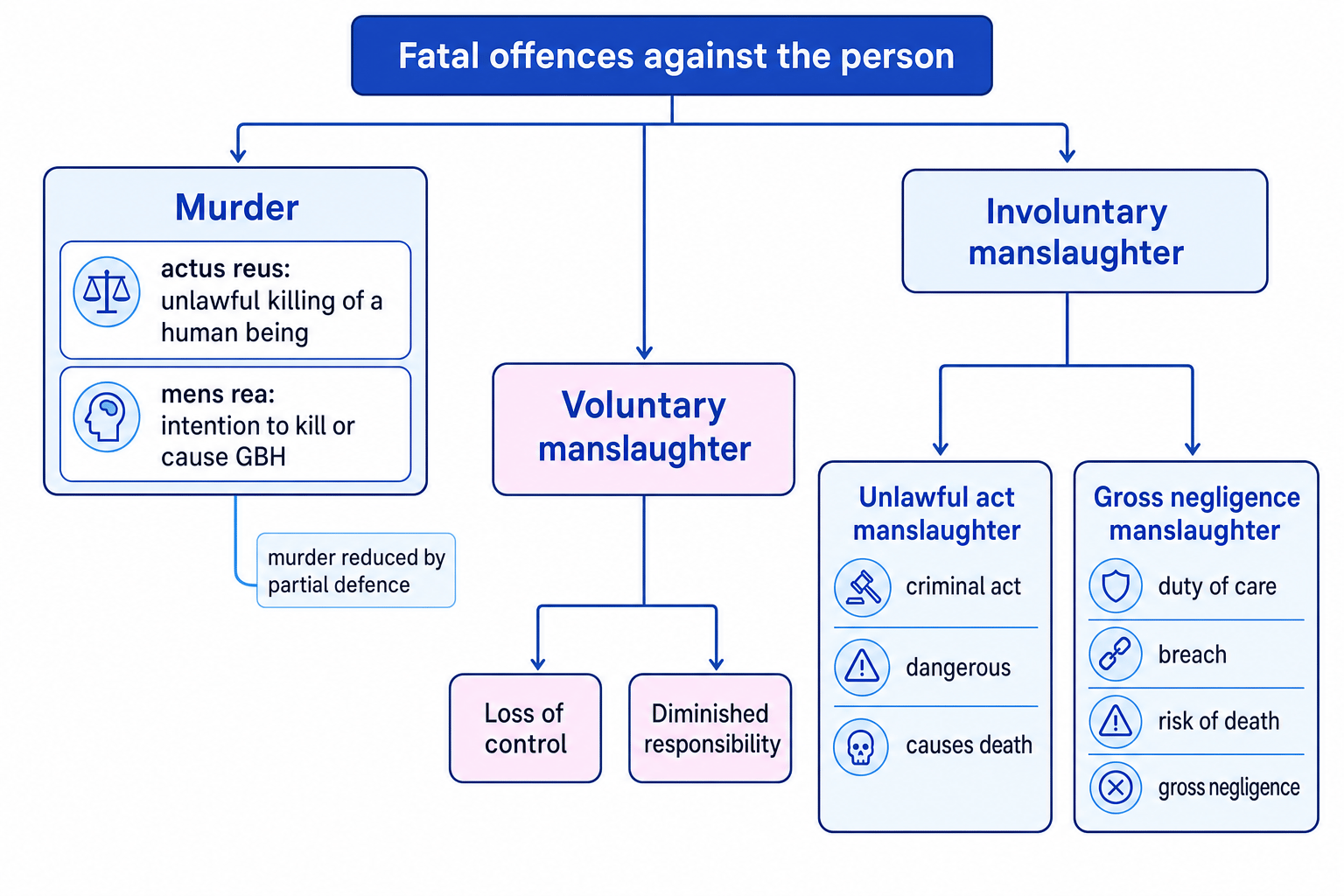
Fatal offences are offences where the victim dies. In A-Level Law, the key homicide offences are murder, voluntary manslaughter, and involuntary manslaughter.
Actus reus and mens rea
Actus reus means the guilty act: the external element of the offence. Mens rea means the guilty mind: the fault element required for liability.
Manslaughter is not one single route
Voluntary manslaughter starts as murder, but a partial defence reduces liability. Involuntary manslaughter is where D causes death without the mens rea for murder.
Murder
Definition of murder
Murder is a common law offence, traditionally defined as the unlawful killing of a reasonable creature in being under the King’s peace with malice aforethought.
In modern exam language:
- Unlawful killing: the killing is not legally justified.
- Human being in being: the victim must be a living human being.
- Under the King’s peace: excludes enemy combatants killed in lawful warfare.
- Malice aforethought: means intention to kill or cause grievous bodily harm, not necessarily hatred or planning.
Actus reus of murder
The actus reus of murder is that D unlawfully causes the death of a human being.
You must prove causation:
- Factual causation asks: “But for D’s conduct, would V have died when and how they did?”
- Legal causation asks whether D’s conduct was a significant and operating cause of death.
Useful cases:
- R v White (1910): D put poison in his mother’s drink, but she died of a heart attack before drinking it. D was not the factual cause of death.
- R v Pagett (1983): D used his pregnant girlfriend as a human shield; police returned fire and killed her. The police response did not break the chain of causation.
- R v Blaue (1975): V refused a blood transfusion for religious reasons after being stabbed. D had to take the victim as found.
Mens rea of murder
The mens rea of murder is intention to kill or intention to cause grievous bodily harm, meaning really serious harm.
Key cases:
- R v Vickers (1957): D broke into a shop and attacked an elderly woman, who died. Intention to cause GBH was enough for murder.
- R v Cunningham (1982): D repeatedly struck V with a chair. The House of Lords confirmed that intention to cause GBH is sufficient for murder.
- R v Woollin (1998): D threw his baby, causing death. The jury may find intention where death or serious injury was a virtual certainty and D appreciated that.
Malice aforethought does not mean spite
For murder, “malice aforethought” does not require hatred, revenge, or pre-planning. A sudden intention to cause GBH can be enough.
Applying murder
D punches V hard in the head several times during an argument. V falls, suffers a skull fracture, and dies.
- The issue is whether D committed murder, so you need both the actus reus of causing death and the mens rea of intention to kill or cause GBH.
- D’s punches are the factual cause if, but for the punches, V would not have died when they did. They are also likely the legal cause because the injury directly caused death.
- For mens rea, repeated hard blows to the head may show intention to cause really serious harm, even if D did not want V to die. Under R v Vickers (1957) and R v Cunningham (1982), intention to cause GBH is enough.
- D is likely guilty of murder unless a partial defence, such as loss of control or diminished responsibility, applies.
Voluntary manslaughter
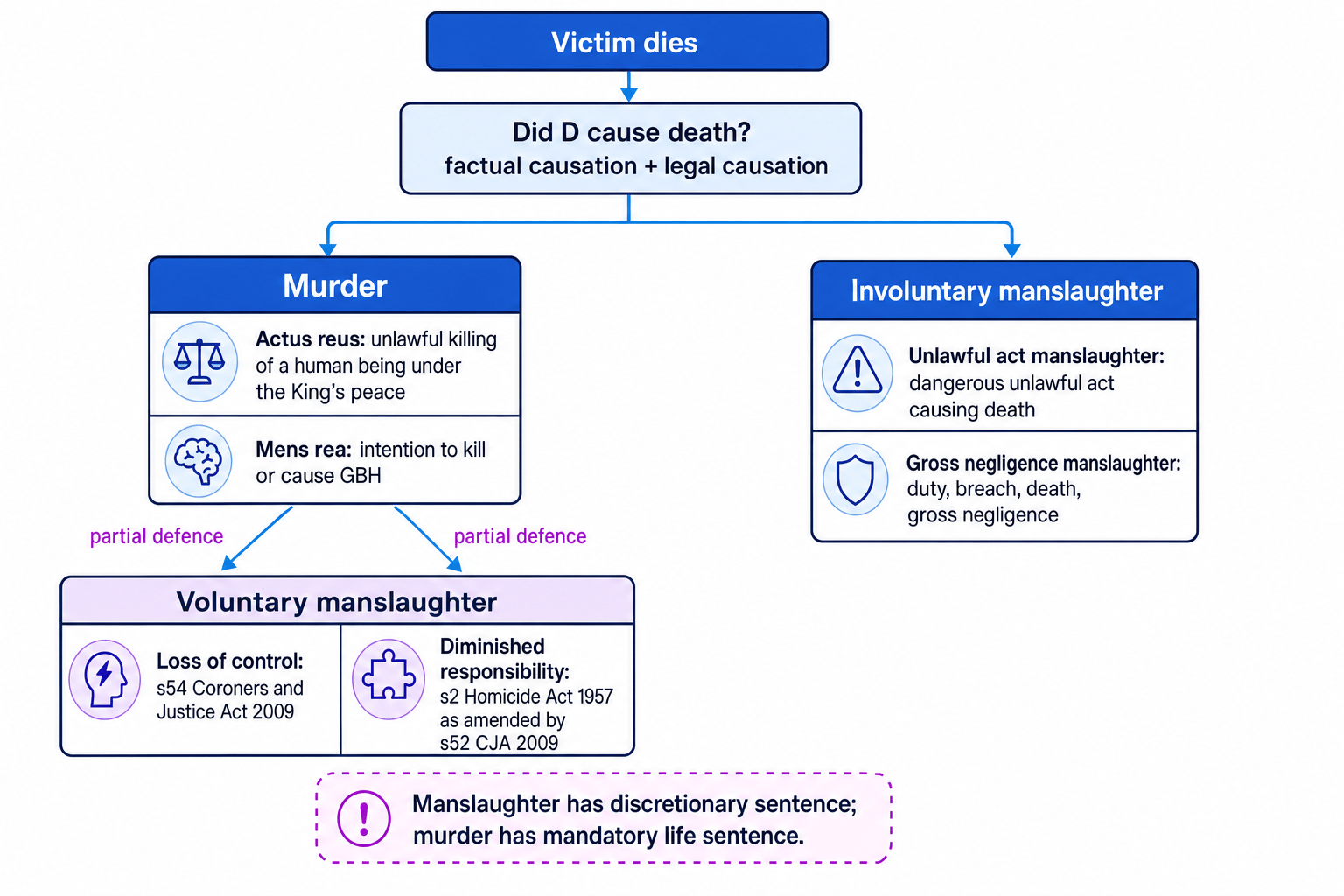
Voluntary manslaughter applies where D has committed murder, but a partial defence reduces liability from murder to manslaughter. This matters because murder carries a mandatory life sentence, while manslaughter gives the judge sentencing discretion.
Loss of control
Loss of control is a partial defence under s54 Coroners and Justice Act 2009.
D must show:
- D’s acts or omissions resulted from a loss of self-control.
- The loss of self-control had a qualifying trigger.
- A person of D’s sex and age, with a normal degree of tolerance and self-restraint and in D’s circumstances, might have reacted in the same or similar way.
The loss of control does not need to be sudden, which helps defendants who may have experienced long-term abuse.
Qualifying triggers
Under s55 Coroners and Justice Act 2009, the main triggers are:
- Fear of serious violence from V against D or another.
- Things said or done which were of an extremely grave character and gave D a justifiable sense of being seriously wronged.
- A combination of both.
Limits:
- Revenge is excluded by s54(4).
- Sexual infidelity is excluded on its own by s55(6)(c).
- D cannot rely on a trigger they deliberately caused as an excuse for violence.
Key cases:
- R v Clinton (2012): V taunted D about affairs and suicide. Sexual infidelity alone is excluded, but it may be considered as part of the wider context.
- R v Dawes (2013): D confronted V and provoked violence. A defendant cannot rely on a trigger they engineered as an excuse.
- R v Jewell (2014): D took weapons to the scene and killed V. Evidence of revenge or planning made loss of control unlikely.
Testing loss of control
D has been threatened by V for weeks. One evening, V raises a knife and says they will kill D’s brother. D grabs a heavy object and kills V.
- Start from murder: if D intentionally caused death or GBH, liability is murder unless a partial defence applies.
- There is evidence of loss of self-control because D reacted violently during a threatening confrontation.
- There is a likely qualifying trigger under s55, because D feared serious violence against another person, his brother.
- The final question is whether a person of D’s sex and age, with normal tolerance and self-restraint and in D’s circumstances, might have reacted similarly. If yes, the offence is reduced to voluntary manslaughter.
Diminished responsibility
Diminished responsibility is a partial defence under s2(1) Homicide Act 1957, as amended by s52 Coroners and Justice Act 2009.
D must prove that:
- They were suffering from an abnormality of mental functioning.
- It arose from a recognised medical condition.
- It substantially impaired D’s ability to understand their conduct, form a rational judgment, or exercise self-control.
- It provides an explanation for D’s acts or omissions in killing V.
Abnormality of mental functioning
An abnormality of mental functioning is a mental state so different from that of ordinary people that the reasonable person would regard it as abnormal.
Key cases:
- R v Byrne (1960): D killed and mutilated a young woman. The case explains abnormality as a state of mind substantially different from ordinary people.
- R v Golds (2016): D stabbed his partner while suffering from mental illness. “Substantial” impairment means important or weighty, not trivial.
- R v Dietschmann (2003): D killed while grieving and intoxicated. Intoxication does not automatically defeat the defence if the abnormality still substantially impaired D.
Applying diminished responsibility
D, diagnosed with severe depression, kills V during a psychotic episode. Medical evidence says D’s condition seriously impaired rational judgment.
- The starting point is murder if D intentionally killed or caused GBH.
- Severe depression may be a recognised medical condition, satisfying the medical basis of the defence.
- If the condition seriously impaired D’s ability to form rational judgment, the impairment is likely “substantial” under R v Golds (2016).
- If the condition explains D’s role in the killing, diminished responsibility may reduce murder to voluntary manslaughter.
Loss of control or diminished responsibility?
Loss of control focuses on D’s reaction to a trigger. Diminished responsibility focuses on D’s abnormal mental functioning caused by a recognised medical condition.
Involuntary manslaughter
Involuntary manslaughter applies where D causes death but does not have the mens rea for murder.
There are two main forms for this topic:
| Type | Core idea |
|---|---|
| Unlawful act manslaughter | D commits a dangerous criminal act which causes death. |
| Gross negligence manslaughter | D owes a duty, breaches it very seriously, and causes death. |
Unlawful act manslaughter
Unlawful act manslaughter is also called constructive manslaughter because liability is built from another criminal act.
The prosecution must prove:
- D committed an unlawful criminal act.
- The act was dangerous.
- The act caused V’s death.
- D had the mens rea for the unlawful act.
The dangerousness test comes from R v Church (1966): sober and reasonable people must recognise that the act exposes another person to the risk of some physical harm.
Key cases:
- R v Lowe (1973): D neglected his baby, who died. An omission is not enough for unlawful act manslaughter.
- R v Church (1966): D knocked V unconscious and threw her into a river. The unlawful act must be objectively dangerous.
- R v Newbury and Jones (1976): boys pushed a paving stone from a bridge, killing a train guard. D need not foresee harm; they only need the mens rea for the unlawful act.
Applying unlawful act manslaughter
D intentionally throws a heavy stone from a bridge to scare drivers. It smashes a car windscreen and V dies.
- The unlawful act could be criminal damage or an assault-type offence, depending on the facts.
- The act is dangerous because sober and reasonable people would recognise a risk of physical harm from throwing a heavy stone at traffic, applying R v Church (1966).
- If the stone caused the crash and death, causation is satisfied.
- D need not intend or foresee death. Under R v Newbury and Jones (1976), it is enough that D had the mens rea for the base unlawful act.
Gross negligence manslaughter
Gross negligence manslaughter is used where D’s carelessness is so serious that it becomes criminal.
The leading case is R v Adomako (1994): an anaesthetist failed to notice that an oxygen tube had disconnected during surgery, and the patient died. The House of Lords set out the modern test.
The prosecution must prove:
- D owed V a duty of care.
- D breached that duty.
- The breach caused V’s death.
- There was an obvious risk of death.
- The negligence was so gross as to justify criminal liability.
The fault element is not intention or recklessness. It is gross negligence: conduct falling so far below the expected standard that it deserves criminal punishment.
Key case:
- R v Misra and Srivastava (2004): doctors failed to diagnose and treat a serious infection after surgery. The risk must be a risk of death, and the jury decides whether the negligence is gross.
Applying gross negligence manslaughter
A carer is responsible for an elderly resident who cannot feed herself. The carer repeatedly fails to provide food or call medical help, and the resident dies.
- D likely owes a duty of care because they have accepted responsibility for V’s welfare.
- Repeatedly failing to feed V or seek help is a breach of that duty.
- If medical evidence shows V died because of neglect, the breach caused death.
- The risk is a risk of death, not just minor harm. If the neglect is extremely serious, a jury may find gross negligence manslaughter under R v Adomako (1994).
Confusing the two involuntary routes
Unlawful act manslaughter needs a positive unlawful act. Gross negligence manslaughter can be based on a serious omission where D owed a duty of care.
AO3: evaluating fatal offences
The law is partly fit for purpose because it separates different levels of blameworthiness: murder for intentional killing or GBH, voluntary manslaughter for reduced responsibility, and involuntary manslaughter for fatal wrongdoing without murder mens rea.
However, murder can be criticised as unjust because intention to cause GBH is enough for murder, even if D never intended death. This is severe because murder carries a mandatory life sentence.
The 2009 reforms are more up-to-date than the old law. Loss of control no longer has to be sudden, which better reflects some domestic abuse situations. Diminished responsibility also uses recognised medical conditions, making the law more medically grounded.
Involuntary manslaughter balances principle and policy less neatly. Unlawful act manslaughter is effective for deterring dangerous criminal acts, but it can be harsh because D need only foresee or intend the base offence, not death. Gross negligence manslaughter is useful for serious professional or caring failures, but “gross” can be uncertain and leaves much to the jury.
In the exam
- Start with the likely offence: murder first if D caused death and may have intended death or GBH.
- If murder is made out, test partial defences separately: loss of control under s54 CJA 2009, then diminished responsibility under s2 Homicide Act 1957 as amended.
- If murder mens rea is missing, consider involuntary manslaughter and choose the correct route: unlawful act for a dangerous crime, gross negligence for a duty-based failure.
Check yourself
- What is the mens rea for murder, and which cases support it?
- Why does loss of control reduce murder to manslaughter rather than create an acquittal?
- How would you distinguish unlawful act manslaughter from gross negligence manslaughter in a scenario?