What you'll learn
- How actus reus and mens rea work together to create criminal liability.
- When omissions, involuntary acts, state-of-affairs offences and causation matter.
- How intention, recklessness, negligence, strict liability, transferred malice and coincidence are tested.
- How to apply these ideas in AO2 problem scenarios and evaluate them for AO3.
The basic structure of criminal liability
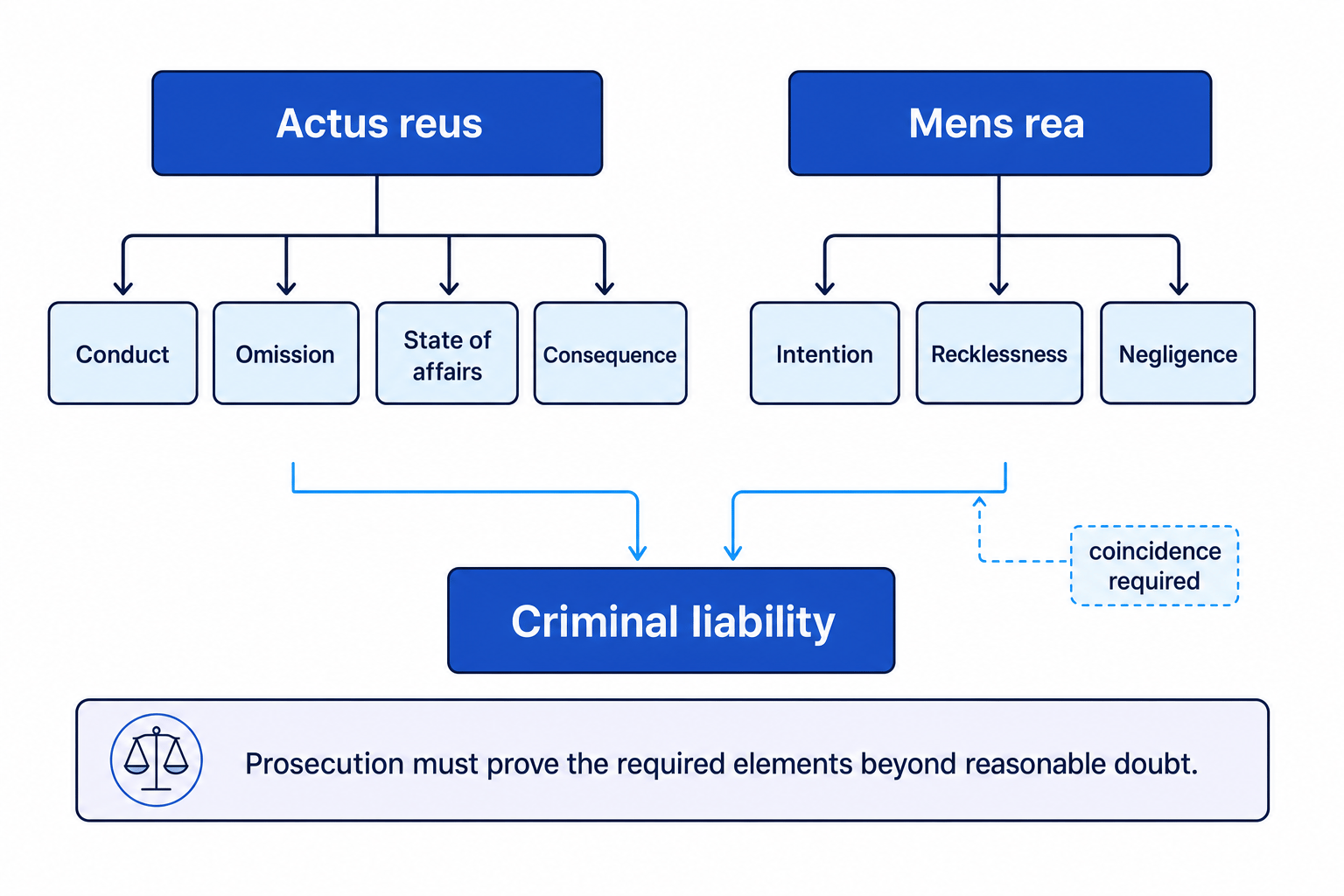
Most crimes require two broad elements: an external element and a fault element. The prosecution must prove each required element beyond reasonable doubt.
Actus reus and mens rea
Actus reus means the “guilty act”: the external part of the offence, such as conduct, an omission, a state of affairs, or a prohibited consequence. Mens rea means the “guilty mind”: the fault element, such as intention, recklessness or negligence.
A useful starting checklist is: What did the defendant do or fail to do? What fault did they have? Did the fault coincide with the prohibited conduct or result?
The headline rule
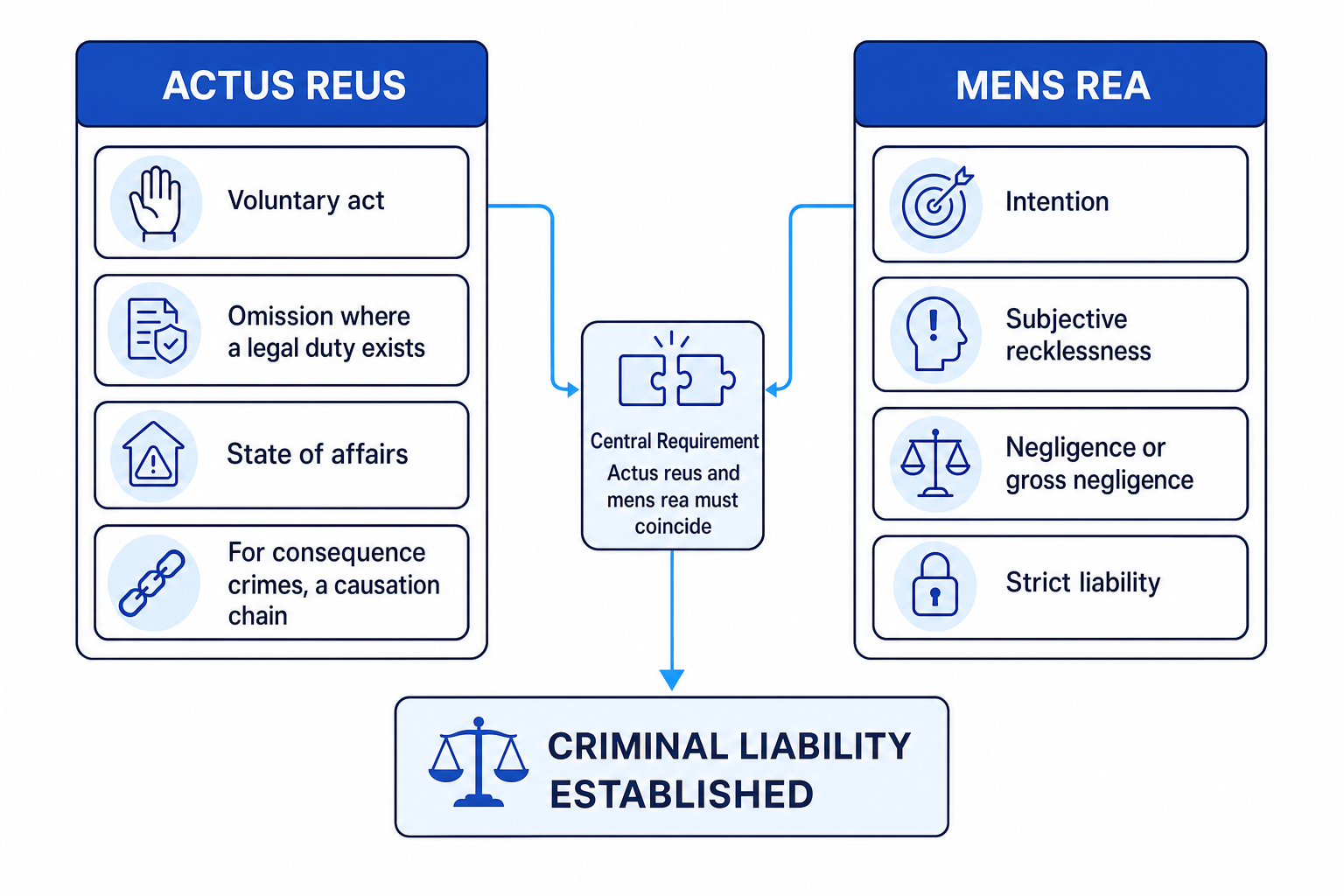
Criminal liability usually requires both actus reus and mens rea, but some offences reduce or remove the need for fault through negligence or strict liability.
1. Actus reus: the external element
Conduct crimes and consequence crimes
A conduct crime is complete once the defendant performs the prohibited conduct. No particular result has to be proved. For example, possession offences focus on the state of possessing something prohibited.
A consequence crime requires proof that the defendant’s conduct caused a prohibited result. Murder, for example, requires death; criminal damage requires damage.
This distinction matters because consequence crimes require causation: the prosecution must link the defendant’s conduct to the result.
Voluntary acts, involuntariness and state of affairs
Normally, the actus reus must be voluntary, meaning it is controlled by the defendant’s mind. In Bratty v AG for Northern Ireland (1963), the court described automatism as a complete destruction of voluntary control. In Hill v Baxter (1958), examples such as being attacked by a swarm of bees or being struck by a stone while driving were given as situations where conduct might be involuntary.
Involuntariness can prevent liability because the defendant has not truly “acted” in law.
However, some offences are state-of-affairs offences, where liability is based on being in a prohibited situation. In R v Larsonneur (1933), the defendant was deported into the UK by Irish police and was convicted of being an alien “found” in the UK; the case shows that some offences do not require a voluntary act in the normal sense. In Winzar v Chief Constable of Kent (1983), a drunk man was removed from hospital by police and placed on the highway, then convicted of being found drunk on the highway.
Voluntary act vs state of affairs
Do not assume every offence requires a positive voluntary movement. Some offences criminalise being in a particular situation, even though that can be controversial.
Classifying the actus reus
-
Classify the offence: If the offence only requires being in a prohibited condition, such as being “found” somewhere, it may be a state-of-affairs offence rather than a normal conduct crime.
-
Test voluntariness: If the prosecution relies on a physical movement, ask whether the defendant had voluntary control. A sudden blackout with no warning may point away from liability under Bratty.
-
Apply the exception carefully: If the offence is state-of-affairs based, Larsonneur and Winzar show that lack of a normal voluntary act may not automatically prevent liability.
Omissions: when doing nothing can be criminal
An omission is a failure to act. English criminal law generally has no general duty to rescue. You are not usually criminally liable just because you fail to help a stranger.
But an omission can form the actus reus where the defendant is under a legal duty to act.
Main categories of legal duty include:
- Duty under statute: Parliament can expressly criminalise a failure to act.
- Duty under contract: In R v Pittwood (1902), a railway gatekeeper failed to close a level-crossing gate; his contractual duty could support manslaughter liability.
- Duty from public office: In R v Dytham (1979), a police officer watched a fatal attack and did nothing; public office can create a duty.
- Duty from a special relationship: In R v Gibbins and Proctor (1918), a father and his partner starved a child; family relationships can create duties.
- Duty voluntarily assumed: In R v Stone and Dobinson (1977), the defendants undertook care for a vulnerable relative; assuming responsibility can create a duty.
- Duty from creating a dangerous situation: In R v Miller (1983), the defendant accidentally started a fire and then did nothing; once aware of the danger he had created, he had a duty to act. In R v Evans (2009), supplying heroin and failing to summon help could create liability where the defendant contributed to a dangerous situation.
Finding a duty to act
-
Issue: A defendant accidentally knocks over a candle in a shared house, notices flames spreading, and leaves without warning anyone. The issue is whether doing nothing can be the actus reus.
-
Rule: Under R v Miller (1983), a person who creates a dangerous situation and becomes aware of it has a duty to take reasonable steps to prevent harm.
-
Application: The defendant created the fire risk and knew it was spreading. Leaving without raising the alarm is not just a moral failure; it breaches a recognised legal duty.
-
Conclusion: The omission can form the actus reus if the other elements of the offence, including causation and mens rea, are proved.
Causation in consequence crimes
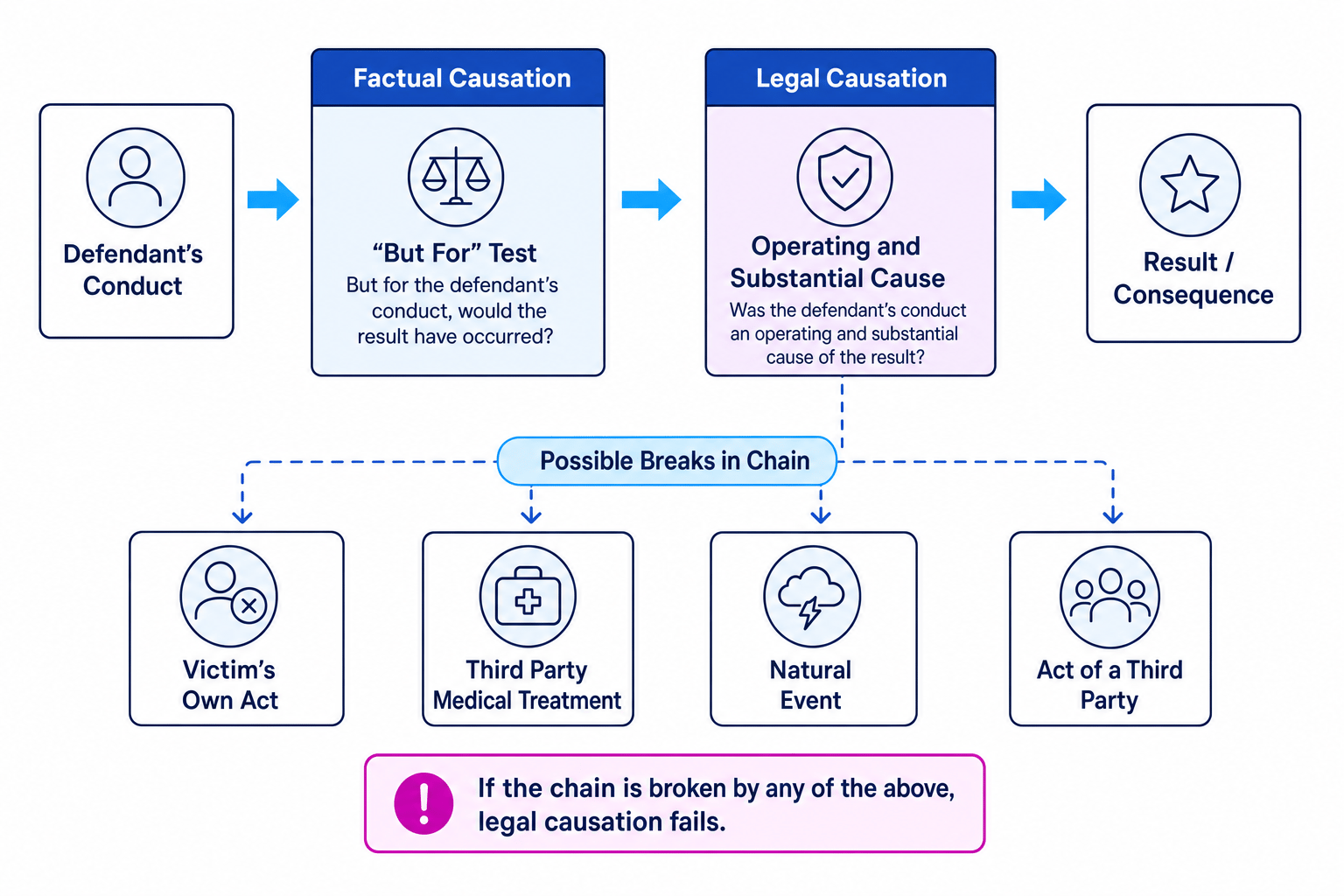
For consequence crimes, the prosecution must prove both factual causation and legal causation. Factual causation asks whether the result would have happened “but for” the defendant’s conduct. Legal causation asks whether the defendant’s conduct was sufficiently connected to the result in law.
Factual causation: the “but for” test
In R v White (1910), the defendant put poison in his mother’s drink, but she died of a heart attack before the poison took effect; he was not the factual cause of death because she would have died anyway.
The question is: but for the defendant’s conduct, would the result have occurred when it did?
Legal causation: operating and substantial cause
The defendant’s conduct need not be the only cause, but it must be more than a minimal cause.
In R v Smith (1959), a soldier’s stab wound remained an operating and substantial cause of death despite poor medical treatment. In R v Cheshire (1991), negligent medical treatment did not break the chain because the original injury was still a significant cause.
A novus actus interveniens means a “new intervening act” that breaks the chain of causation. Possible breaks include:
- Victim’s own act: In R v Roberts (1971), a victim jumped from a moving car to escape sexual advances; this was foreseeable and did not break the chain. In R v Williams and Davis (1992), the victim’s reaction must be reasonably foreseeable.
- Medical treatment: In R v Jordan (1956), palpably wrong treatment broke the chain because the original wound had largely healed. This is rare.
- Third-party intervention: In R v Pagett (1983), police shooting the defendant’s hostage did not break the chain because their response was caused by the defendant’s dangerous conduct.
- Victim’s characteristics: In R v Blaue (1975), the victim refused a blood transfusion for religious reasons; the defendant had to take the victim as found, so the chain was not broken.
Applying the causation chain
-
Issue: D stabs V. At hospital, doctors make a delay in treatment and V dies. Because death is the prohibited result, causation must be proved.
-
Factual causation: Applying R v White (1910), ask whether V would have died when they did but for the stabbing. If the stab wound caused the need for treatment and death followed from it, factual causation is satisfied.
-
Legal causation: Applying R v Smith (1959) and R v Cheshire (1991), ask whether the stab wound was still an operating and substantial cause. Ordinary medical delay will usually not break the chain.
-
Possible break: Only if the treatment is so independent and “palpably wrong”, as in R v Jordan (1956), is the chain likely to break.
-
Conclusion: On normal facts, D remains the legal cause of V’s death.
2. Mens rea: the fault element
Fault
Fault means the level of blameworthiness required for the offence. Different offences require different levels of mens rea. The most important are intention, recklessness, negligence and strict liability.
Intention
Direct intention means the defendant’s aim or purpose. In R v Mohan (1976), intention was described as a decision to bring about a consequence, so far as it lies within the defendant’s power.
Oblique intention applies where the result is not the defendant’s main aim, but is virtually certain. In R v Woollin (1998), the defendant threw his baby towards a pram, causing death; the jury may find intention if death or serious injury was a virtual certainty and the defendant appreciated that.
Subjective recklessness
Subjective recklessness means the defendant personally foresaw a risk and unreasonably took it.
In R v Cunningham (1957), the defendant tore a gas meter from a wall and gas injured a neighbour; recklessness required foresight of the relevant risk. In R v G (2003), two boys set fire to newspapers and did not foresee the spread of fire; the House of Lords confirmed that recklessness is subjective.
Choosing between intention and recklessness
-
Issue: D throws a glass near V to frighten them, but it hits V and causes injury. The question is whether D intended injury or was reckless as to injury.
-
Direct intention: If D’s aim was only to frighten V, direct intention to injure is hard to prove under R v Mohan (1976).
-
Oblique intention: If serious injury was virtually certain and D appreciated that, Woollin may allow the jury to find intention. If the glass was thrown near V rather than directly at them, virtual certainty may be doubtful.
-
Subjective recklessness: If D foresaw the risk that the glass might hit V and went ahead anyway, Cunningham and R v G support recklessness.
-
Conclusion: On these facts, recklessness is more likely than intention unless the injury was virtually certain and appreciated by D.
Negligence and gross negligence
Negligence is falling below the standard of the reasonable person. It is objective: the focus is not necessarily on what the defendant actually foresaw.
Gross negligence is negligence so serious that it becomes criminal. In R v Adomako (1994), an anaesthetist failed to notice a disconnected oxygen tube during surgery; gross negligence manslaughter requires a duty of care, breach, causation, and a breach so bad that it is criminal.
Strict liability
A strict liability offence is an offence where the prosecution does not need to prove mens rea for at least one element of the actus reus. The defendant may still need to perform the prohibited conduct voluntarily.
Courts use several methods to decide whether an offence is strict liability:
- Start with the presumption that mens rea is required.
- Read the statutory wording: words like “intentionally”, “knowingly” or “recklessly” suggest fault is required.
- Ask whether the offence is regulatory or truly criminal.
- Consider the penalty and social stigma.
- Ask whether strict liability would help enforce the purpose of the statute.
- Check whether Parliament included a due diligence defence.
In Sweet v Parsley (1970), a teacher let a farmhouse where cannabis was used without her knowledge; the court held mens rea was required because the offence carried real stigma. In Gammon (Hong Kong) Ltd v AG of Hong Kong (1985), the Privy Council set out factors for rebutting the presumption of mens rea, especially in regulatory offences. In B v DPP (2000), the court strongly protected the presumption of mens rea for serious offences involving age. In Alphacell v Woodward (1972), pollution escaping into a river was treated as strict liability in a regulatory context.
Testing whether an offence is strict liability
-
Issue: A statute makes it an offence to sell contaminated food, but does not use words such as “knowingly” or “recklessly”. The question is whether fault must be proved.
-
Presumption: Under Sweet v Parsley (1970), absence of mens rea words is not enough by itself. The court starts by presuming fault is required.
-
Regulatory purpose: Applying Gammon (1985), food safety is a public welfare area where strict liability may encourage higher standards and easier enforcement.
-
Conclusion: The offence is likely to be strict liability, especially if the statute includes a due diligence defence to protect careful traders.
Transferred malice
Transferred malice applies where the defendant has the required mens rea against one victim, but the actus reus occurs against another.
In R v Latimer (1886), the defendant aimed a belt at one person but injured another; the intention transferred because the same type of offence occurred against a different person.
But malice does not transfer between different types of harm. In R v Pembliton (1874), the defendant threw a stone intending to hit people but broke a window; intention to injure a person did not transfer to criminal damage to property.
Transferred malice shortcut
Ask: “Is it the same kind of offence, just against a different victim?” If yes, Latimer may apply. If the harm changes category, Pembliton limits transfer.
Coincidence of actus reus and mens rea
The coincidence rule says the actus reus and mens rea must exist at the same time.
Two key doctrines soften this rule:
- Continuing act: In Fagan v MPC (1969), the defendant accidentally drove onto a police officer’s foot, then deliberately refused to move; the act was continuing, so later mens rea could coincide with the ongoing actus reus.
- Single transaction: In Thabo Meli v R (1954), defendants assaulted a victim, thought he was dead, then threw him off a cliff where he actually died; the whole sequence was treated as one transaction.
Applying coincidence
-
Issue: D accidentally parks on a police officer’s foot, then realises and refuses to move. The issue is whether the later mens rea can match the earlier act.
-
Initial act: At the moment D first drove onto the foot, D may have lacked mens rea because it was accidental.
-
Continuing act: Under Fagan v MPC (1969), remaining on the foot is treated as a continuing act, not a completed past event.
-
Coincidence: Once D realises and deliberately refuses to move, the mens rea coincides with the ongoing actus reus.
-
Conclusion: Liability can be established despite the accidental beginning.
3. AO3 evaluation: how fair and effective are these rules?
The general elements of liability are mostly fit for purpose because they stop people being punished for pure accidents. Requiring actus reus, mens rea and causation supports the moral principle that criminal punishment should be based on blame.
They can also be fair because subjective recklessness, confirmed in R v G (2003), focuses on what the defendant actually foresaw. This avoids harsh liability for children or vulnerable defendants who did not appreciate the risk.
However, the law can be unfair or policy-driven. Strict liability improves enforcement in regulatory areas such as food safety or pollution, but it can punish people without personal fault. The courts try to balance principle and policy through Sweet v Parsley (1970) and Gammon (1985).
Omissions law also creates tension. The limited duty categories protect individual liberty by avoiding a broad duty to rescue, but cases such as Stone and Dobinson (1977) show that moral failure can become legally serious where responsibility has been assumed.
Causation rules are flexible and often effective, especially the thin skull rule in R v Blaue (1975), which protects vulnerable victims. But flexibility can reduce certainty because decisions about foreseeability and broken chains depend heavily on the facts.
In the exam
-
Identify the offence and split your answer into actus reus, mens rea, and coincidence.
-
For consequence crimes, always run factual causation first, then legal causation, then possible breaks in the chain.
-
For omissions, do not say “there is a duty to help” generally; name the specific duty category and authority.
-
For AO3, tie your evaluation to a rule or case: fairness, effectiveness, policy, moral blame and certainty are stronger when anchored in authority.
Check yourself
- What is the difference between a conduct crime and a consequence crime?
- When can an omission form the actus reus of an offence?
- How do Fagan v MPC (1969) and Thabo Meli v R (1954) soften the coincidence rule?