Non-fatal offences against the person
What you'll learn
- How assault and battery work under s39 Criminal Justice Act 1988.
- How s47, s20 and s18 Offences Against the Person Act 1861 increase in seriousness.
- The actus reus and mens rea for each offence, with key cases.
- How to apply the offences to scenarios and add short AO3 evaluation.
The basic building blocks
Actus reus and mens rea
Actus reus means the external element of the offence: what D did, caused, or failed to do. Mens rea means the mental element: D’s intention, recklessness, or other required state of mind.
Most non-fatal offences are built from two ideas:
- What happened to V? A threat, touching, actual bodily harm, a wound, or grievous bodily harm.
- What did D intend or foresee? The more serious offences usually require a higher level of blameworthiness.
Recklessness
For these offences, recklessness is usually subjective recklessness: D realised there was a risk and went on to take it. In R v Cunningham (1957), D ripped a gas meter from a wall; “maliciously” required intention or foresight of the relevant risk.
The offences form a ladder: as you move upwards, the harm and/or the required mens rea becomes more serious.
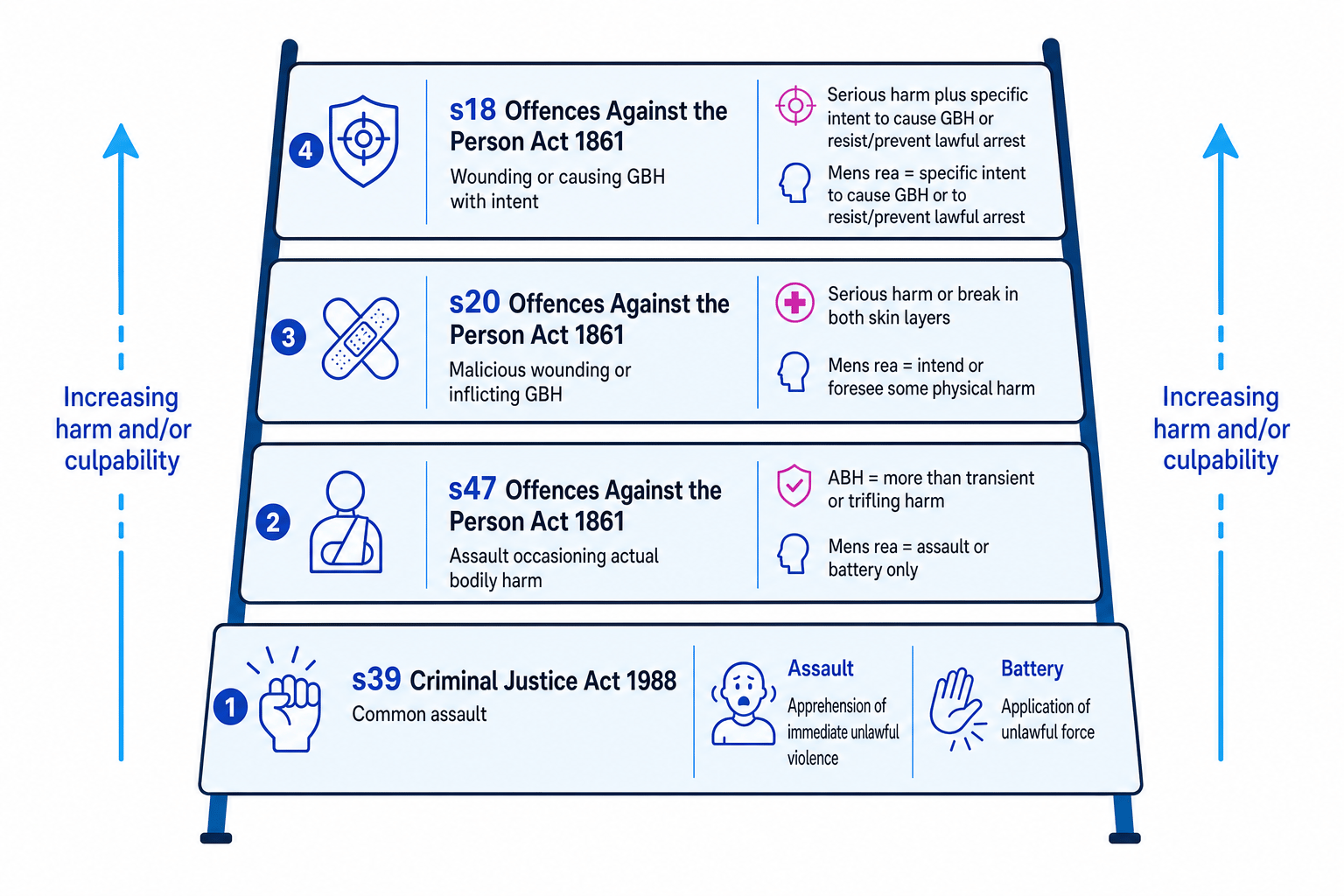
Common assault under s39 Criminal Justice Act 1988
Section 39 Criminal Justice Act 1988 covers common assault, which includes two separate common law offences:
- assault: causing V to apprehend immediate unlawful personal violence;
- battery: applying unlawful force to V.
Common assault does not require injury
Assault can be complete with no touching at all. Battery can be complete with even slight unlawful touching. Injury is not required for either.
Assault
Assault
Assault is intentionally or recklessly causing another person to apprehend immediate unlawful personal violence.
Actus reus of assault
The actus reus is that D causes V to apprehend immediate unlawful personal violence. “Apprehend” means V anticipates or realises violence may happen; V does not have to be terrified.
Key authorities:
- R v Lamb (1967): D pointed a revolver at V, but V did not realise it might fire; there was no assault because V did not apprehend violence.
- Tuberville v Savage (1669): threatening words can be cancelled by accompanying words; words may prevent an apparent threat from being assault.
- R v Ireland (1997): silent phone calls can amount to assault if they cause V to fear immediate violence.
- R v Constanza (1997): letters and threatening behaviour could be assault; “immediate” includes fear of violence in the immediate future, not only the next second.
Mens rea of assault
D must intend or be reckless as to causing V to apprehend immediate unlawful personal violence. R v Venna (1976) confirms intention or recklessness is enough for the mental element of common assault offences.
Deciding whether a threat is assault
-
D raises a bottle, walks towards V and says, “I’m going to smash you now.” V steps backwards. This points to apprehension of immediate unlawful personal violence.
-
The words do not cancel the threat, unlike Tuberville v Savage. The movement towards V and the word “now” make the threat immediate.
-
D at least foresees that V may expect violence, and probably intends that reaction. This satisfies the mens rea.
-
D is likely liable for assault under s39 Criminal Justice Act 1988.
Battery
Battery
Battery is the intentional or reckless application of unlawful force to another person.
Actus reus of battery
The actus reus is the application of unlawful force. The force can be very slight, and it can be direct or indirect.
Key authorities:
- Collins v Wilcock (1984): any touching beyond ordinary everyday contact can be battery; normal jostling in daily life is usually impliedly consented to.
- Fagan v Metropolitan Police Commissioner (1969): D accidentally drove onto a police officer’s foot but then deliberately left the car there; battery can be a continuing act.
- DPP v K (1990): D put acid in a hand dryer; indirect application of force can be battery.
Mens rea of battery
D must intend or be reckless as to applying unlawful force. D does not need to intend injury.
Assault and battery are different
In everyday speech, “assault” often means hitting someone. In law, assault is about apprehension of violence; battery is about unlawful physical contact.
Distinguishing everyday contact from battery
-
If D lightly brushes V’s shoulder on a crowded train, Collins v Wilcock suggests this may be ordinary everyday contact, so not unlawful force.
-
If D angrily shoves V in the chest to get past, the force goes beyond ordinary social contact and is unlawful.
-
Because D deliberately shoves V, D intends the application of force.
-
D is likely liable for battery under s39 Criminal Justice Act 1988.
Section 47: assault occasioning actual bodily harm
Section 47 Offences Against the Person Act 1861 creates the offence of assault occasioning actual bodily harm, usually called ABH.
Actual bodily harm
Actual bodily harm is injury that is more than “transient or trifling”. In R v Miller (1954), ABH was described as harm interfering with health or comfort.
Actus reus of s47
The actus reus has three parts:
- D commits an assault or battery.
- That assault or battery occasions, meaning causes, harm.
- The harm amounts to ABH.
ABH can include physical injuries such as bruising, cuts or loss of consciousness. In R v Chan-Fook (1994), the court said psychiatric injury can be ABH, but mere fear, distress or panic is not enough. In DPP v Smith (2006), cutting off a substantial amount of V’s hair was capable of being ABH.
Mens rea of s47
The mens rea is only the mens rea for the original assault or battery. D does not need to foresee or intend ABH.
In R v Savage; DPP v Parmenter (1991), Savage threw beer over V and the glass cut V’s wrist; Parmenter injured his baby by rough handling. The House of Lords confirmed that for s47, D only needs intention or recklessness as to assault or battery.
Do not add extra mens rea to s47
For s47, do not say D must foresee ABH. The prosecution only needs the mens rea for assault or battery, plus proof that ABH was caused.
Applying s47 ABH
-
D intentionally pushes V during an argument. That is a battery because D deliberately applies unlawful force.
-
V falls and suffers heavy bruising and a chipped tooth. These injuries are more than transient or trifling, so they are likely ABH.
-
The push causes the injuries because they flow directly from V falling. There is no obvious break in causation.
-
D need not foresee the chipped tooth. Since D intended the battery, s47 is likely satisfied.
Section 20: malicious wounding or inflicting GBH
Section 20 Offences Against the Person Act 1861 covers maliciously wounding or inflicting grievous bodily harm.
Wounding and grievous bodily harm
A wound is a break in the continuity of the whole skin, meaning both skin layers are broken. Grievous bodily harm, or GBH, means “really serious harm”: DPP v Smith (1961).
Actus reus of s20
D must either:
- wound V; or
- inflict GBH on V.
In C v Eisenhower (1984), internal rupturing of blood vessels in the eye was not a wound because the whole skin was not broken. In R v Bollom (2004), the seriousness of harm can be judged in light of V’s age and condition; injuries to a baby may be more serious than the same injuries to an adult. In R v Burstow (1997), “inflict” was interpreted broadly, so serious psychiatric illness can amount to GBH if properly proved.
Mens rea of s20
D must act maliciously. This means D intends or subjectively foresees the risk of some physical harm, not necessarily serious harm. In R v Mowatt (1968), D only had to foresee some physical harm, not GBH.
Section 18: wounding or causing GBH with intent
Section 18 Offences Against the Person Act 1861 is the most serious non-fatal offence in this ladder.
Actus reus of s18
The actus reus is similar to s20: D must unlawfully wound V or cause GBH to V.
Mens rea of s18
The key difference is the much higher mens rea. D must have:
- intent to cause GBH; or
- intent to resist or prevent lawful arrest, with the required maliciousness as to the injury.
Specific intent
Specific intent means recklessness is not enough. The prosecution must prove D had the required intention.
In R v Belfon (1976), D slashed V with a razor. The court held that for s18, foresight or recklessness is not enough for the main GBH intent limb; the prosecution must prove specific intent to cause GBH. R v Morrison (1989) shows the separate arrest-resistance route, where D injured a police officer while resisting arrest.
Intent to wound is not automatically s18
For the main s18 limb, intending a cut or wound is not enough unless it also proves intent to cause GBH. If D only foresees some harm, s20 is usually the better fit.
Choosing between s20 and s18
-
D swings a broken bottle near V’s face, realising it might cut V. The glass causes a deep cut breaking both skin layers. This is a wound.
-
If D only foresaw some physical harm, R v Mowatt supports s20 because recklessness as to some harm is enough.
-
If D deliberately stabbed towards V’s face saying, “I’ll put you in hospital,” a jury may infer intent to cause really serious harm. That points to s18 under R v Belfon.
-
The same injury can therefore be charged differently depending on D’s proven mens rea.
Quick comparison
| Offence | Actus reus | Mens rea |
|---|---|---|
| Assault, s39 Criminal Justice Act 1988 | Causing V to apprehend immediate unlawful personal violence | Intention or recklessness as to causing apprehension |
| Battery, s39 Criminal Justice Act 1988 | Applying unlawful force to V | Intention or recklessness as to applying unlawful force |
| s47 OAPA 1861 | Assault or battery causing ABH | Mens rea for assault or battery only |
| s20 OAPA 1861 | Wounding or inflicting GBH | Intention or recklessness as to some physical harm |
| s18 OAPA 1861 | Wounding or causing GBH | Specific intent to cause GBH, or intent connected to resisting/preventing lawful arrest |
AO3 evaluation: is the law satisfactory?
The law is partly fit for purpose because it creates a ladder of seriousness: threats and minor touching sit at the bottom, while intentional serious injury is punished most severely.
However, the Offences Against the Person Act 1861 is often criticised as out of date. Words like “maliciously”, “occasioning” and “inflict” are old-fashioned and can confuse students, juries and even lawyers.
There are also fairness concerns. Section 47 is a constructive liability offence: D may be liable for ABH even though D only intended or foresaw a minor assault or battery. Section 20 can also feel harsh because D need only foresee some physical harm, not GBH.
On the other hand, this may be effective from a policy perspective: people who use unlawful violence take the risk that more serious harm will result. A modern statute could improve fair labelling by using clearer language and matching each offence more closely to D’s level of fault.
In the exam
-
Start with the likely offence, then prove actus reus and mens rea separately using authority.
-
For injury offences, classify the harm carefully: ABH, wound, or GBH.
-
Always check the mental element: s47 needs only assault/battery mens rea; s20 needs foresight of some physical harm; s18 needs specific intent.
Check yourself
- Why can silent phone calls amount to assault?
- What is the key mens rea difference between s20 and s18?
- Why is s47 sometimes criticised as unfair?