What you'll learn
- How sociologists define power, politics, authority and the state.
- The main explanations of political power: functionalist, Marxist, neo-Marxist, Weberian, pluralist, elite and postmodernist.
- How to apply these theories to contemporary UK politics, including voting, pressure groups, lobbying, devolution and voter ID.
- How to evaluate theories for essay answers using AO1, AO2 and AO3.
Starting points: power, politics and the state
Before comparing theories, get the core vocabulary secure.
Power, politics and the state
Power means the ability to get others to do something, or to shape what happens, even when there is opposition. Politics is the process through which groups make, influence and contest decisions about society. The state is the set of institutions claiming legitimate authority over a territory, such as Parliament, the government, courts, police, civil service and local authorities.
Sociologists are interested in who has power, how they keep it, and whether ordinary people can genuinely influence political decisions.
A useful extra distinction is authority, which means power seen as rightful or legitimate. Weber argued that modern states rely heavily on rational-legal authority: people obey rules because they are attached to offices, laws and procedures, not just to individuals.
The key question
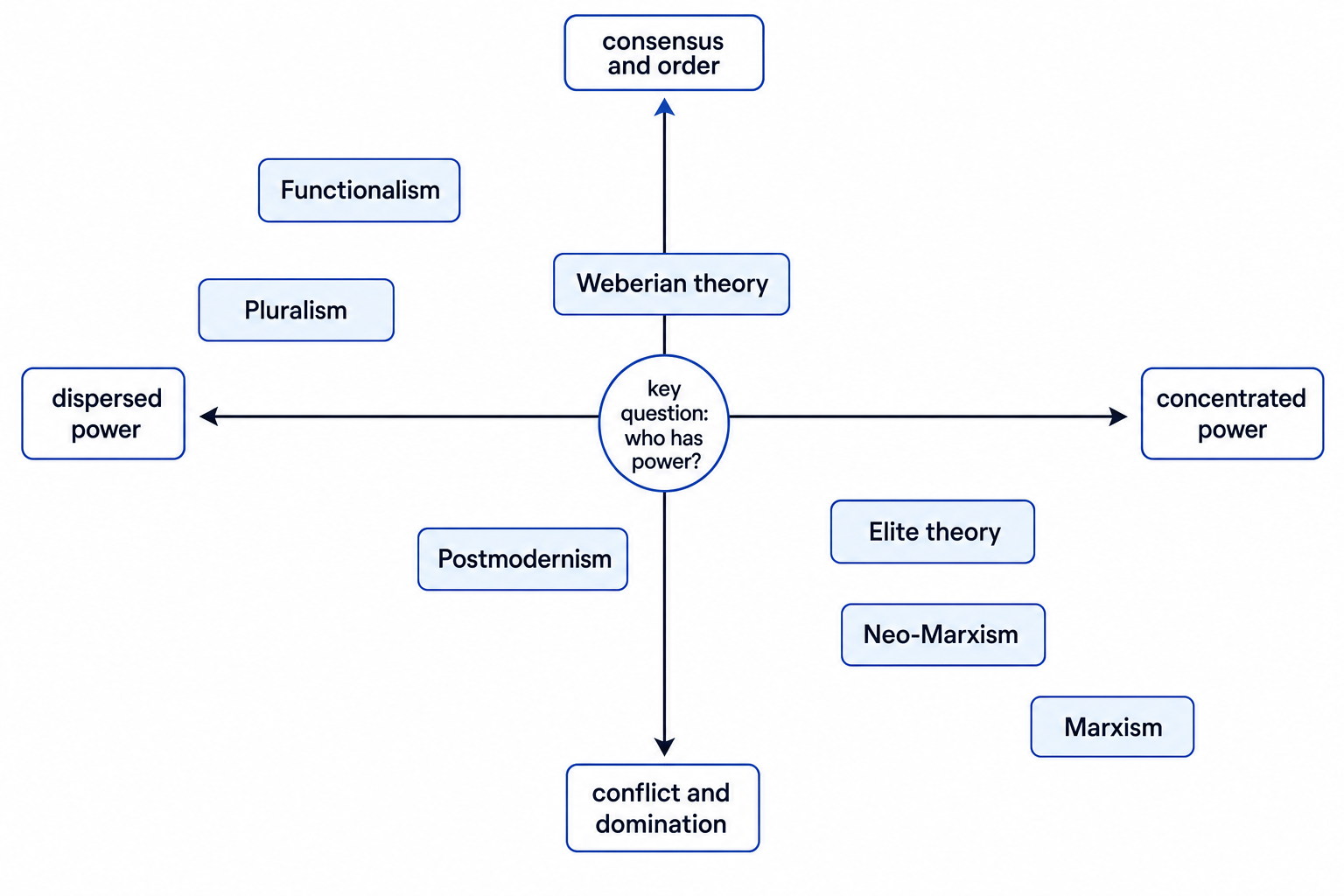
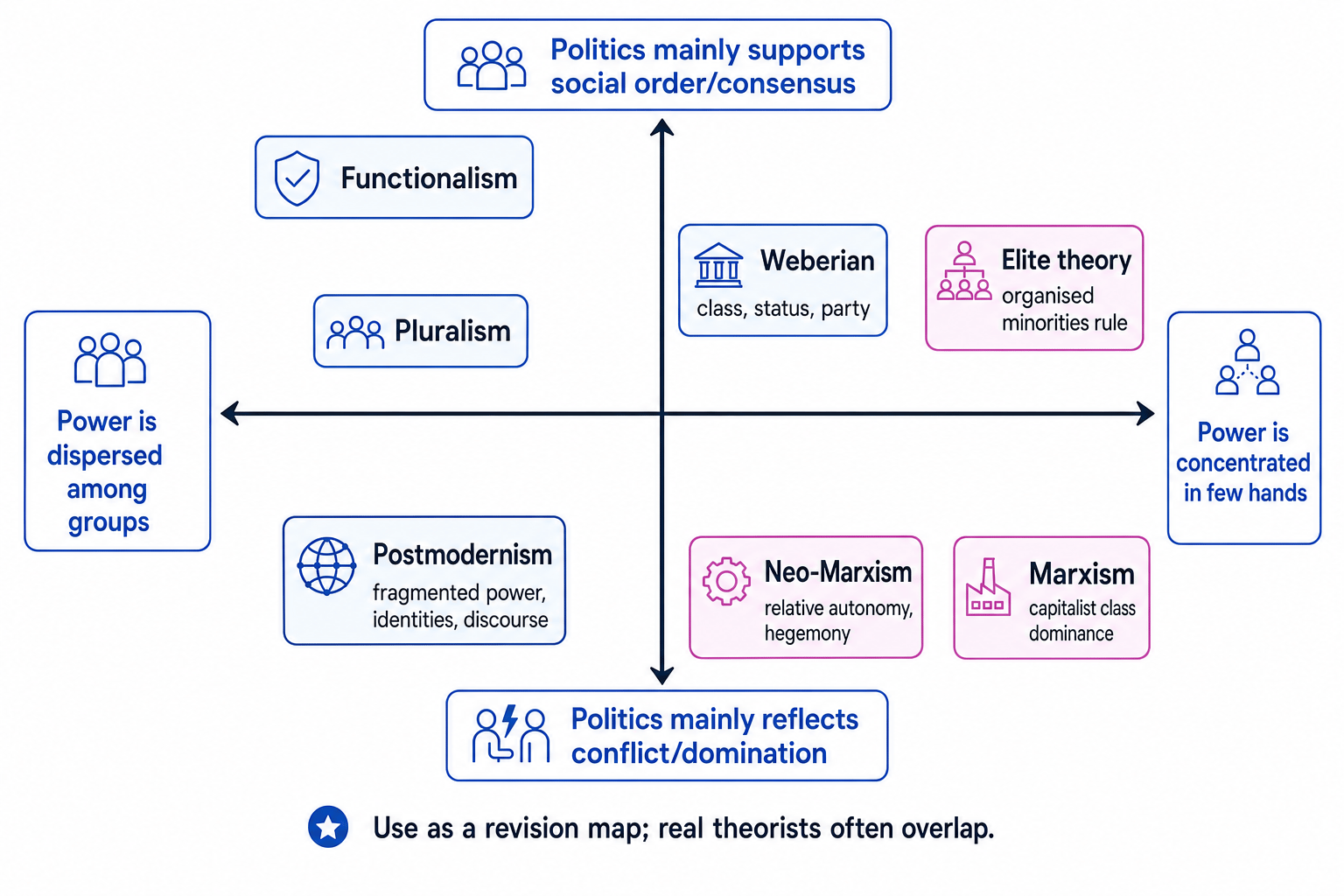
Every theory of politics answers one big question differently: is political power widely shared, or is it concentrated among privileged groups?
The theories below can be mapped by asking whether they see politics as mainly about consensus and order or conflict and domination, and whether power is dispersed or concentrated.
Lukes: three dimensions of power
Although not a full political theory on its own, Steven Lukes is very useful for evaluation.
Lukes' dimensions of power
Lukes argued that power can operate through decision-making on visible issues, non-decision-making by keeping issues off the agenda, and ideological power by shaping what people see as normal, possible or desirable.
For example, power is visible when Parliament votes on a law. It is less visible when a topic never reaches Parliament. It is deepest when people accept inequality as “just the way things are”.
Reading power in voter ID policy
-
Decision-making power: identify the visible political decision. The Elections Act 2022 introduced photographic voter ID for UK parliamentary elections and some local elections.
-
Agenda-setting power: ask what was emphasised or excluded. Supporters focused on electoral integrity; critics argued that evidence of personation fraud was limited and that barriers for poorer, younger, disabled and minority ethnic voters received less attention.
-
Ideological power: consider what assumptions are normalised. The policy may encourage the idea that voting security is mainly an individual documentation issue, rather than a wider problem of political disengagement, mistrust or unequal access.
Functionalist explanations
Functionalists see society as a system of parts working together to maintain stability. In politics, the state helps coordinate society, make collective decisions and manage conflict.
Parsons argued that political institutions help society achieve collective goals. For functionalists, elections, laws, parties and citizenship can integrate people into a shared national community. Political socialisation through families, schools and media teaches people democratic values such as voting, tolerance and respect for law.
AO2 examples include general elections, local councils, devolution, the Human Rights Act 1998 and the Equality Act 2010. These can be seen as mechanisms for representation, rights and social order.
AO3 evaluation: functionalism can underestimate inequality. If wealthier groups have better access to education, media influence, lobbying and political networks, then politics may not simply express shared values. Functionalism also struggles to explain low turnout, distrust in politicians and protest movements such as climate activism or anti-austerity campaigns.
Marxist explanations
Marxists see politics as rooted in capitalism, an economic system based on private ownership of the means of production and wage labour.
Bourgeoisie and proletariat
In Marxist theory, the bourgeoisie are the capitalist class who own major economic resources. The proletariat are the working class, who sell their labour for wages.
Marx and Engels argued that the state tends to serve the interests of the ruling class. A famous Marxist idea is that the state acts as a “committee” for managing the common affairs of the bourgeoisie.
This does not mean every politician is personally corrupt. It means the state protects the conditions capitalism needs: private property, profit, labour discipline and markets.
AO2 examples might include debates about corporate lobbying, party donations, privatisation, tax policy, trade union law, or government support for banks during financial crises. Marxists would ask: who benefits materially?
AO3 evaluation: Marxism is powerful for explaining links between economic inequality and political influence. However, it can be accused of economic determinism: reducing politics too much to class. It may also underplay real reforms won through democracy, such as the NHS, minimum wage legislation and legal protections for workers.
Do not make Marxism too simple
Avoid writing “Marxists say only rich people have power.” A stronger answer explains how economic power shapes political agendas, state priorities and ideology, while still recognising that governments sometimes make concessions to maintain legitimacy.
Neo-Marxist explanations
Neo-Marxists update Marxism by paying more attention to culture, ideology and the relative independence of the state.
Gramsci introduced the idea of hegemony, meaning leadership through consent. The ruling class does not rely only on force; it wins support by making its worldview seem like common sense. Schools, media, religion and political language can all help secure consent.
Poulantzas argued that the state has relative autonomy. This means governments are not simply controlled directly by capitalists, but the state usually protects the long-term stability of capitalism.
Miliband’s study The State in Capitalist Society (1969) argued that state elites often come from privileged class backgrounds, producing shared assumptions with business and professional elites.
AO2 examples include media framing of welfare, “hard-working taxpayers”, national economic competitiveness, or the idea that there is “no alternative” to market-based policies. Neo-Marxists would analyse the culture surrounding politics, not just parliamentary votes.
AO3 evaluation: neo-Marxism is stronger than simple Marxism because it explains consent, culture and complexity. However, critics argue it can be difficult to falsify: almost any policy can be interpreted as serving capitalism in the long run.
Weberian explanations
Weber gave a more multi-dimensional view of power. He did not reduce politics to class alone.
Class, status and party
For Weber, class refers to economic position, status refers to social honour or prestige, and party refers to organised groups seeking power, such as political parties, pressure groups and movements.
Weber also identified three types of authority:
- Traditional authority: obedience based on custom, such as monarchy.
- Charismatic authority: obedience based on devotion to an inspiring leader.
- Rational-legal authority: obedience based on formal rules and offices.
AO2 examples include the UK monarchy as a source of traditional authority, charismatic leadership in election campaigns, and rational-legal authority in Parliament, courts, local government and the civil service.
AO3 evaluation: Weber is useful because modern politics involves class, identity, bureaucracy, parties, status and leadership. However, Weberian theory may describe forms of power more clearly than it explains why some groups consistently dominate others.
Weber memory hook
For Weber, remember CSP: class, status and party. This helps you avoid writing as if all power is only about money.
Pluralist explanations
Pluralists argue that power is dispersed across many competing groups. No single elite permanently dominates because different groups win on different issues.
Dahl’s study Who Governs? (1961) examined New Haven in the USA and argued that decision-making was spread across different groups. He used the term polyarchy to describe modern democracy: not perfect rule by all people, but competition between organised groups.
In UK politics, pluralists point to elections, pressure groups, petitions, protest, judicial review, free media, devolution and civil society. Groups such as trade unions, business organisations, environmental campaigns, professional associations and charities can all influence policy.
AO2 examples include campaigns by the British Medical Association, Shelter, Stonewall, Extinction Rebellion, the National Farmers’ Union or trade unions. The Freedom of Information Act 2000 and parliamentary select committees can also be used as evidence of accountability.
AO3 evaluation: pluralism may exaggerate equality of access. Some groups have more money, insider contacts, expertise and media access than others. Pressure groups representing business interests often have better resources than groups representing poorer citizens.
Elite theories
Elite theorists argue that a small minority tends to rule, whatever the official democratic system looks like.
Pareto and Mosca argued that all societies are ruled by organised minorities. Michels developed the iron law of oligarchy, claiming that even democratic organisations become dominated by leaders and officials because organisation requires expertise and control of information.
C. Wright Mills, in The Power Elite (1956), argued that major decisions in the USA were dominated by interconnected political, military and corporate elites.
AO2 UK examples include the over-representation of privately educated and Oxbridge-educated individuals in parts of Parliament, the senior civil service, judiciary and media. You could also discuss the House of Lords, lobbying, party donors, think tanks, or the “revolving door” between government and business.
AO3 evaluation: elite theory highlights real inequalities in access and influence. However, it can underplay divisions within elites and moments when public pressure changes policy, such as U-turns after protest, media exposure or electoral threat.
Comparing pluralist and elite views of pressure groups
-
Apply the pluralist view: a pressure group shows democracy in action because citizens organise around shared interests and compete to influence policy.
-
Apply the elite view: influence depends on resources, insider access and professional expertise, so wealthy or well-connected groups are more likely to shape decisions.
-
Evaluate using evidence: compare an outsider protest group with a business lobby or professional association. If both can influence policy, pluralism is supported; if access is strongly unequal, elite theory is stronger.
Postmodernist explanations
Postmodernists reject single “grand narratives” such as “class controls everything” or “democracy disperses power fairly”. They argue that power is fragmented, fluid and tied to culture, identity and discourse.
Foucault is especially important. He argued that power is not only held by the state or ruling class. Power operates through discourse, meaning systems of knowledge and language that define what counts as normal, true or deviant. Power is found in institutions such as schools, prisons, hospitals, welfare offices and surveillance systems.
AO2 examples include online political identities, social media campaigning, algorithmic targeting, culture-war debates, surveillance, Prevent policy, data collection and the political use of categories such as “citizen”, “migrant”, “taxpayer”, “benefit claimant” or “extremist”.
AO3 evaluation: postmodernism is useful for understanding media-saturated politics, identity politics and surveillance. However, critics argue it can be too vague and may underplay material inequalities of class, wealth and ownership.
Research evidence and methods in politics
For Component 3 essays, you can strengthen evaluation by asking how claims about power are researched.
Sociologists use official statistics from the Electoral Commission, turnout data, donation records, parliamentary records, opinion polls, British Social Attitudes, the British Election Study, interviews, content analysis and case studies.
Methodological evaluation matters:
- Practical issues: elite interviews are hard to access; donation and lobbying data may be incomplete.
- Ethical issues: researching activists or political minorities may involve confidentiality and risk of harm.
- Theoretical issues: official statistics may be reliable but not valid for motives; qualitative interviews may reveal meanings but be harder to generalise.
Evidence is never neutral
A turnout statistic can show who voted, but not fully why they voted or abstained. To explain political power, combine patterns with meanings.
Bringing the theories together
A strong essay does not simply list perspectives. It compares them.
Functionalists and pluralists are more optimistic about democratic integration. Marxists, neo-Marxists and elite theorists stress domination and inequality. Weberians offer a flexible middle ground by analysing class, status, parties, bureaucracy and authority. Postmodernists shift attention towards discourse, identity, surveillance and fragmented power.
Use contemporary UK examples to show application: voter ID, devolution, Brexit, party funding, lobbying, protest movements, social media campaigns, trade union action, and unequal political participation by class, age, gender and ethnicity.
In the exam
-
Start with the debate: say whether the question is mainly about dispersed democratic power or concentrated power.
-
Use theory plus example: for each paragraph, link a named theorist to a concrete UK example, such as lobbying, elections, pressure groups, devolution or voter ID.
-
Evaluate directly: compare perspectives, question the evidence, and consider whether the theory still fits contemporary politics.
Check yourself
- How would a pluralist and an elite theorist explain the influence of pressure groups differently?
- What does Gramsci mean by hegemony, and how could it apply to political media language?
- Why might official turnout statistics be reliable but limited for understanding political disengagement?