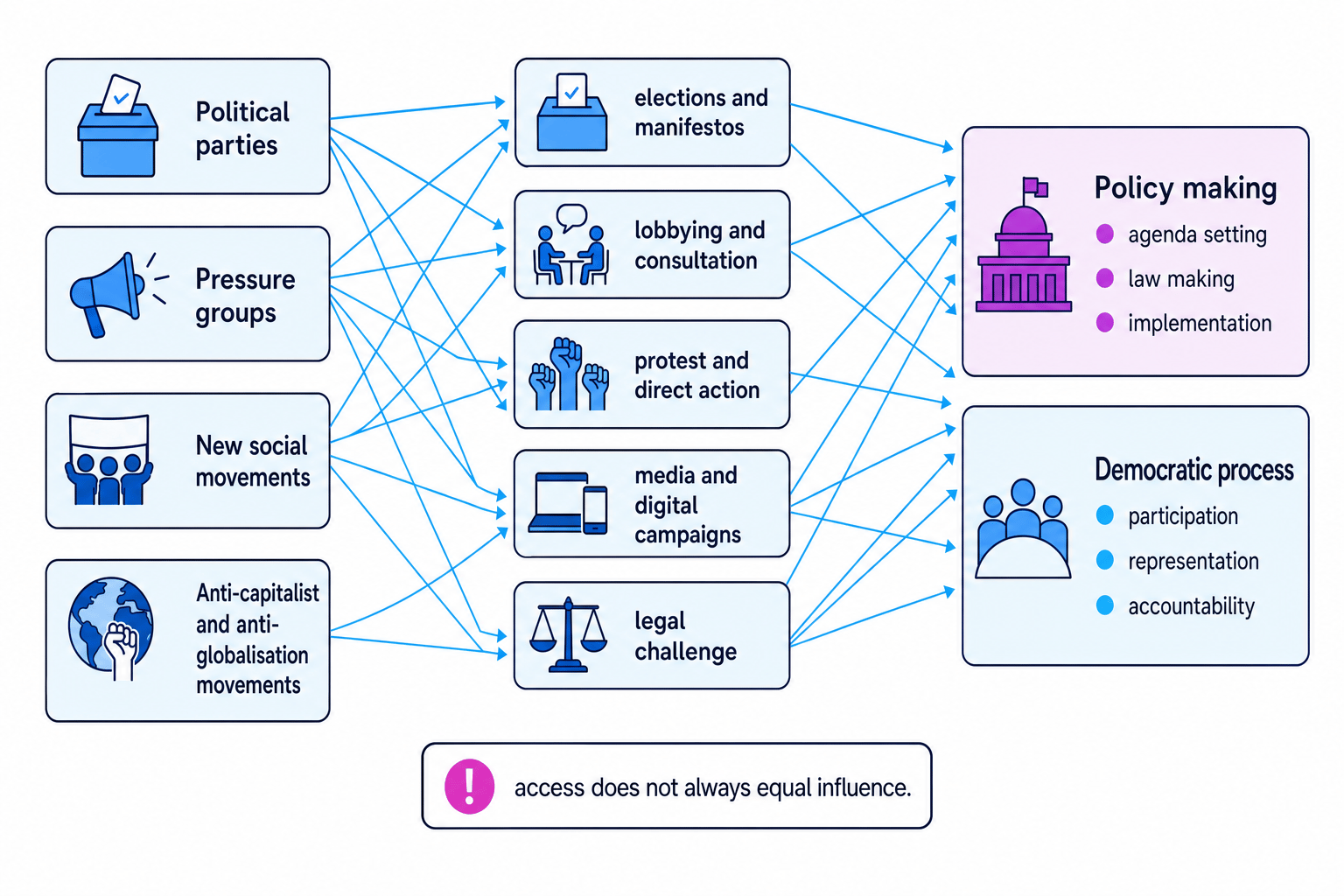
What you'll learn
- What political parties, pressure groups, new social movements, and anti-capitalist / anti-globalisation movements do.
- How these organisations influence policy making and the democratic process.
- How to evaluate whether they strengthen democracy or reproduce inequality.
- How to apply sociological theory and UK examples in essay-style answers.
Starting point: politics is wider than Parliament
In sociology, power means the ability to get things done, even when others resist. Weber defined power as the chance of carrying out your will despite opposition. In the Politics option, you should keep asking: who has power, how is it organised, and whose interests are represented?
Political organisation
A political organisation is a collective group that tries to influence who holds power, what policies are made, or how decision-makers are held accountable. Some organisations seek elected office; others influence from outside government.
A policy is a plan or course of action adopted by government, such as climate law, welfare reform, policing powers, or equality legislation. Policy making includes setting the agenda, drafting proposals, passing laws, implementing decisions, and evaluating outcomes.
A democratic process is the set of ways citizens participate in politics, choose representatives, debate issues, and hold powerful people or institutions to account. This includes elections, campaigns, petitions, protest, consultation, media debate, and legal challenge.
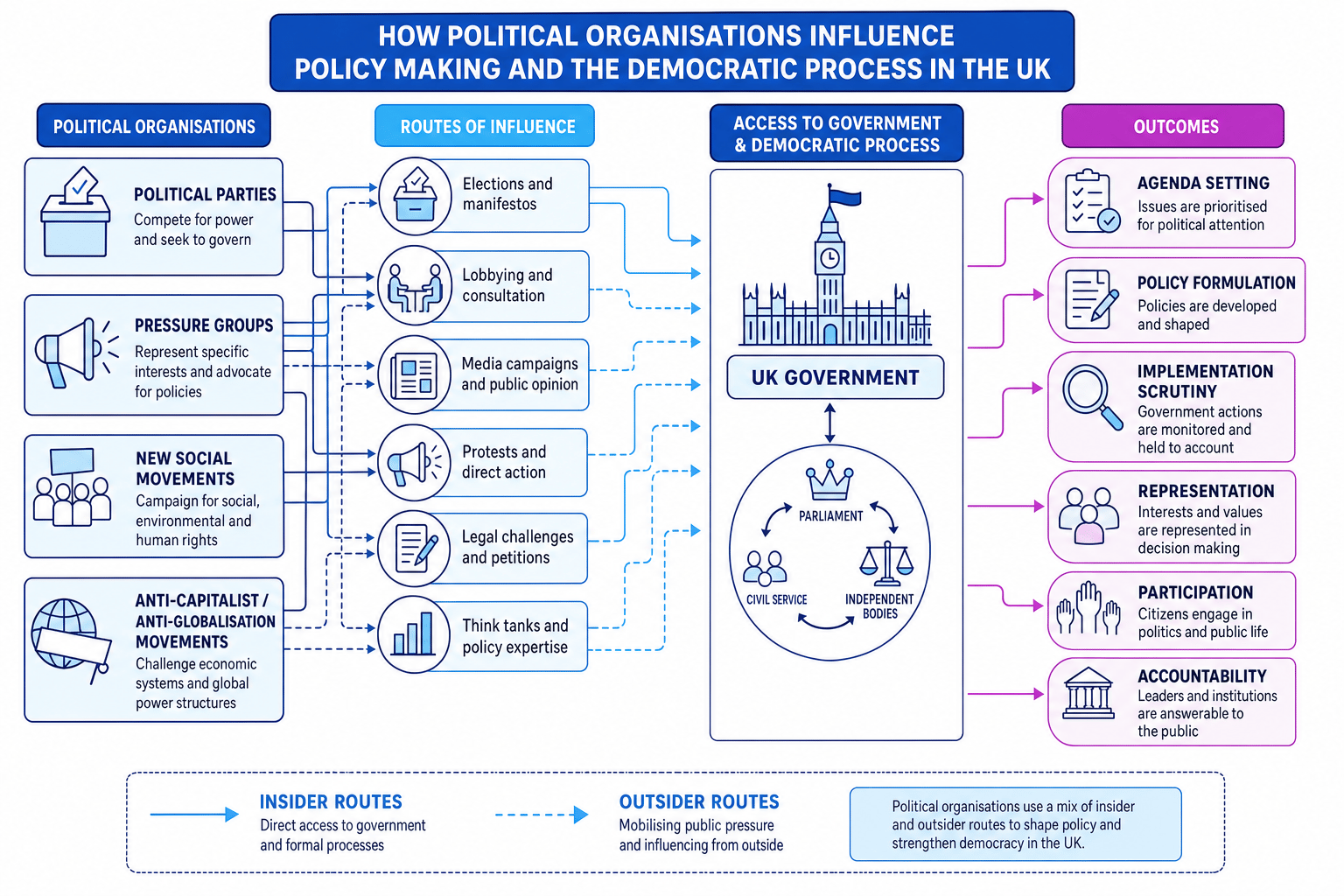
The diagram below shows the main routes through which political organisations can influence the UK political system.
The big sociological question
Political organisations can widen democracy by giving people a voice, but they can also reproduce social stratification — structured inequality between groups — if wealthy, professional, or well-connected interests gain more influence than others.
Political parties: competing to govern
A political party is an organisation that seeks to win elections, form government, and implement policies. UK examples include Labour, the Conservatives, the Liberal Democrats, the SNP, Plaid Cymru, the Green Party, and Reform UK.
Parties have several roles:
- Representation: they claim to speak for social groups, regions, nations, classes, or values.
- Policy formation: they create manifestos, which are public programmes of proposed policies.
- Political socialisation: they help people form political identities, such as “left-wing”, “conservative”, “nationalist”, “green”, or “liberal”.
- Recruitment of leaders: they select candidates and train future ministers.
- Accountability: voters can reward or punish parties at elections.
Pluralists such as Dahl argue that parties help democracy because voters can choose between competing programmes. However, elite theorists question how open this competition really is. Michels’ “iron law of oligarchy” suggests that large organisations tend to become dominated by leaders and officials, even if they claim to be democratic.
AO2 examples matter here. A party manifesto can shape policy if the party wins power. Devolution also matters: the SNP and Plaid Cymru connect party politics to national identity in Scotland and Wales. However, the UK’s first-past-the-post electoral system can distort representation because a party may win many seats without winning a majority of votes.
Parties are not the same as pressure groups
A political party tries to win office and govern. A pressure group tries to influence those in office without becoming the government itself.
Pressure groups: influencing without governing
A pressure group is an organisation that tries to influence government policy without standing candidates for general governmental power.
There are two main types:
| Type | Meaning | UK examples |
|---|---|---|
| Sectional pressure group | Represents a specific group of people | British Medical Association, National Education Union, National Farmers’ Union |
| Cause pressure group | Campaigns for an issue or value | Greenpeace, Liberty, Shelter, Stonewall |
Pressure groups may also be insider groups, meaning they have regular access to government consultation, or outsider groups, meaning they rely more on public campaigns, protest, media pressure, and petitions. Wyn Grant’s distinction between insider and outsider groups is useful for essays.
Pluralists see pressure groups as healthy because they let citizens participate between elections. For example, disability rights groups, trade unions, and housing charities can bring lived experience into policy debate. Marxists and elite theorists are more sceptical: business groups, wealthy donors, and professional associations often have better access, more expertise, and stronger networks.
Tracing pressure-group influence
- Classify the organisation. Shelter is a cause pressure group because it campaigns on housing and homelessness rather than seeking to govern.
- Identify its route of influence. It may use insider methods, such as giving evidence to committees, and outsider methods, such as media campaigns about insecure private renting.
- Link this to policy making. The group can help set the agenda and shape the details of proposed renting reforms by supplying research, case studies, and public pressure.
- Evaluate the claim. Influence is hard to prove directly because landlords’ organisations, party priorities, Treasury concerns, and media framing may also shape the final policy.
Access is not the same as influence
A group may meet ministers or appear in consultations, but that does not prove it caused a policy change. In evaluation, separate visibility, access, and actual policy impact.
New social movements: identity, culture, and quality of life
New social movements are looser, often decentralised networks that campaign around identity, recognition, the environment, peace, human rights, or quality of life. They are “new” because they are less focused on traditional workplace class politics and more focused on culture, identity, and lifestyle.
Theorists such as Touraine, Melucci, and Offe argue that new social movements are a feature of post-industrial societies. Inglehart links them to postmaterialist values, meaning concerns that go beyond basic economic security, such as equality, self-expression, and environmental protection.
UK examples include environmental activism, feminist campaigns, LGBTQ+ rights campaigns, disability rights activism, Black Lives Matter UK, and campaigns linked to #MeToo. These movements can influence policy by changing public language, reshaping identities, and putting issues onto the agenda. Equality legislation, such as the Equality Act 2010, did not appear from nowhere; it reflects decades of campaigning around gender, sexuality, disability, race, and discrimination.
Analysing a new social movement
- Classify Extinction Rebellion as a new social movement because it is decentralised, uses direct action, and focuses on climate risk rather than winning elections.
- Apply it to policy making. Its protests helped push climate change into mainstream debate, alongside scientific evidence and longer-running environmental pressure.
- Link it to democracy. It increases participation by involving people outside party politics, especially younger activists.
- Evaluate it. Disruptive protest can attract attention, but it can also create public backlash and lead to stronger public order laws, such as the Public Order Act 2023.
Use the identity link
For AO2 and AO3, connect new social movements to culture and identity: they do not just ask for laws; they challenge how society labels people, values groups, and defines “normal”.
Anti-capitalist and anti-globalisation movements
Capitalism is an economic system based on private ownership, profit, wage labour, and market competition. Globalisation means the growing interconnectedness of economies, cultures, technologies, and political institutions across national borders.
Anti-capitalist movements challenge capitalism itself. Anti-globalisation movements usually challenge neoliberal globalisation — market-led global policies linked to privatisation, deregulation, free trade, and corporate power — rather than opposing all global connections. Many activists prefer the term global justice movement.
Examples include protests against the World Trade Organization, Occupy London in 2011, UK Uncut’s campaigns against austerity and tax avoidance, and wider campaigns against debt, sweatshop labour, corporate power, and climate injustice. Naomi Klein’s work on brands and corporate globalisation is often linked to this tradition. Wallerstein’s world-systems theory is also useful because it argues that global capitalism creates unequal relationships between core, semi-peripheral, and peripheral regions.
These movements influence democracy differently from parties. They often struggle to create direct law changes because they challenge very powerful institutions: corporations, financial markets, trade agreements, and international bodies. However, they can be important in agenda setting, especially around inequality, tax justice, austerity, and the power of multinational corporations.
The main sociological debate
| Perspective | View of political organisations | Evaluation angle |
|---|---|---|
| Pluralism | Many groups compete, so power is dispersed. | Too optimistic if some groups have far more money, media access, and expertise. |
| Elite theory | A small group dominates major decisions. Mills argued a “power elite” links politics, business, and the military. | Can understate real conflicts between elites and the successes of grassroots campaigns. |
| Marxism | The state tends to protect capitalist interests. Miliband argued that elite backgrounds and institutions shape state power. | Useful for analysing corporate lobbying, but not all policy simply serves capital. |
| Feminism and anti-racism | Organisations can challenge patriarchal and racist power structures. | Movements may still reproduce exclusions if leadership is middle-class, white, male, or able-bodied. |
A strong essay does not simply say “pressure groups are good” or “parties are bad”. It weighs up which organisation, which route of influence, which social group benefits, and what evidence shows actual impact.
A quick research-methods link
Sociologists can study political organisations using documents, interviews, official records, media analysis, and observation of campaigns. Each method has limits. Donation data from the Electoral Commission is useful, but informal influence and “revolving door” networks are harder to measure. Interviews with activists may give valid insight into meanings and motivations, but access to ministers, lobbyists, or corporate actors can be difficult. Ethically, researchers must consider confidentiality, especially when studying protest, policing, or whistleblowing.
In the exam
- Start by identifying the organisation type: party, pressure group, new social movement, or anti-capitalist / anti-globalisation movement.
- Apply it to a clear UK example and explain the route of influence: elections, lobbying, protest, media, consultation, legal action, or digital campaigning.
- Evaluate using power and stratification: ask who gets access, whose voice is missing, and whether the organisation changes policy or mainly changes public debate.
Check yourself
- How is a political party different from a pressure group?
- Why might pluralists and Marxists disagree about pressure groups?
- In what ways can new social movements influence democracy without winning elections?