What you'll learn
- How sociologists identify patterns of inequality in health, education, employment and poverty.
- Why inequalities are often linked, so disadvantage in one area can reinforce disadvantage in another.
- How to apply theories such as Weber, Marx, Wallerstein, Sen, Bourdieu and feminism.
- How to evaluate evidence using research-methods ideas like validity, reliability and representativeness.
What are “patterns of inequality”?
A pattern is a repeated trend or relationship. In sociology, you are not just listing facts; you are asking: who is advantaged, who is disadvantaged, where, and why?
Inequality
Inequality means an unequal distribution of valued resources, opportunities or outcomes, such as income, healthcare, schooling, secure work, status or political power.
In World sociology, you look at inequality:
- between countries, such as differences between high-income and low-income states;
- within countries, such as inequalities by class, gender, ethnicity, region, disability or age;
- across global systems, such as trade, debt, migration and transnational corporations.
Life chances
Life chances, a term associated with Weber, means the opportunities people have to access valued things in life, such as health, education, income, housing and security.
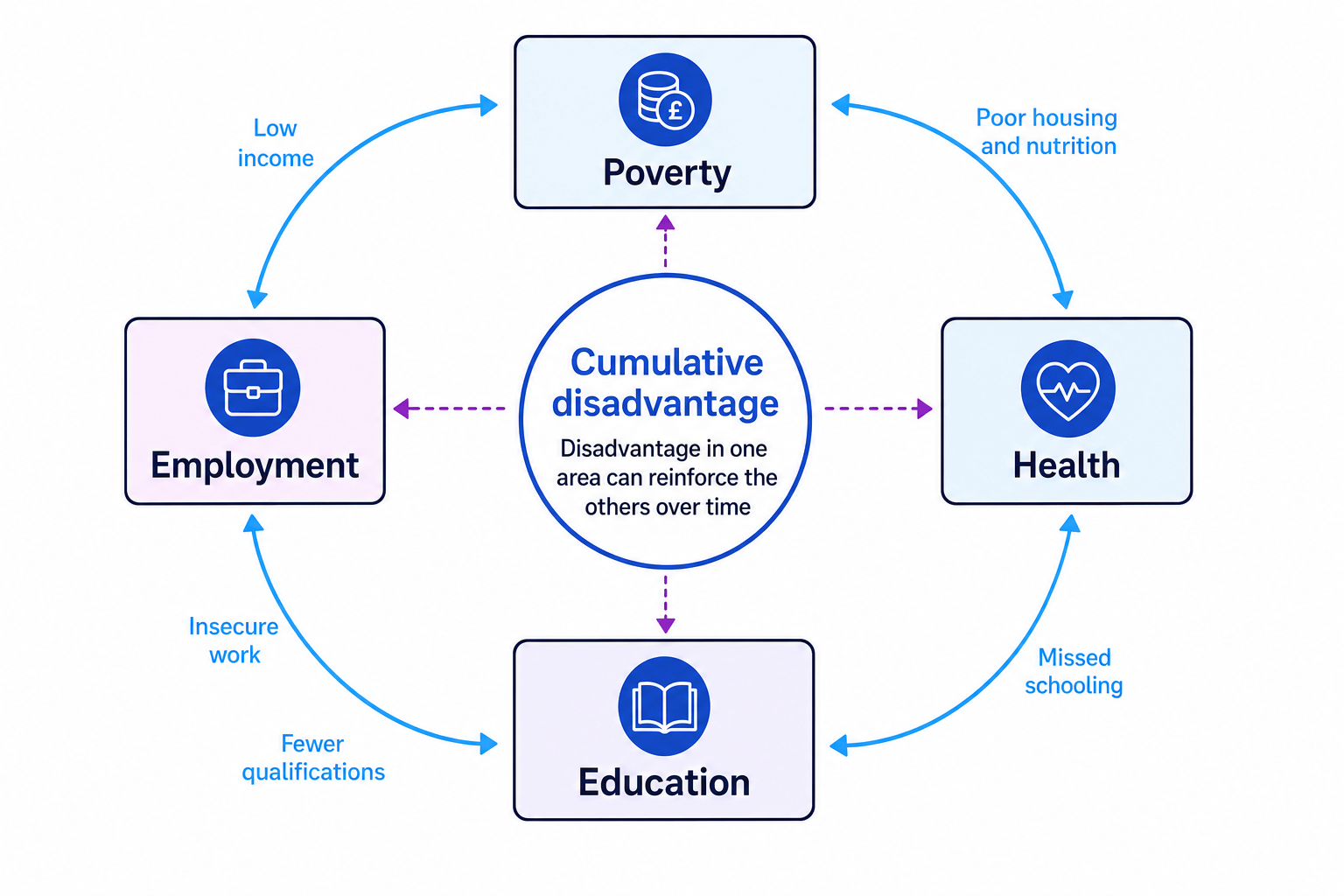
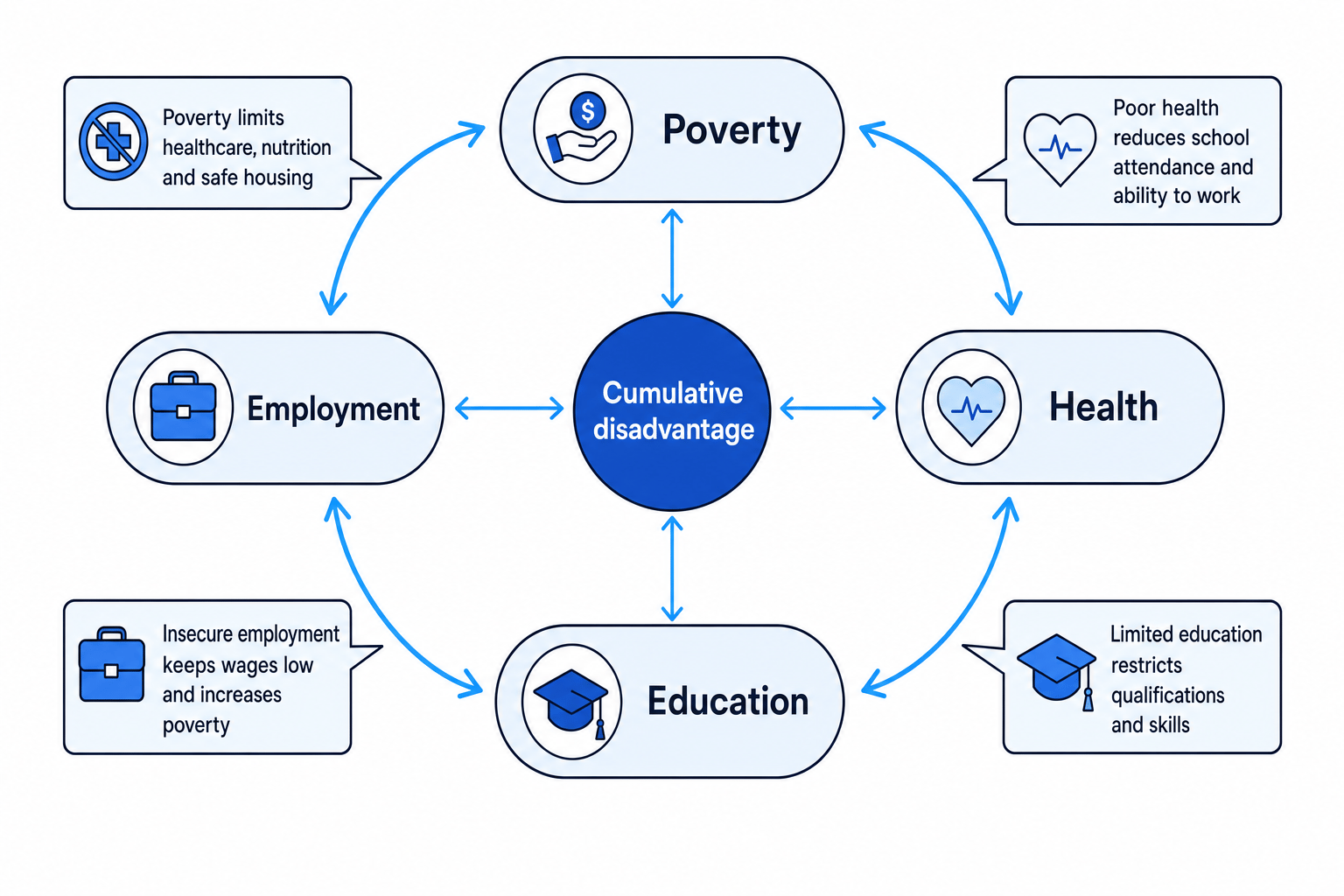
The key idea is that inequality is rarely isolated. Poverty affects health; health affects education; education affects employment; employment affects poverty.
Cumulative disadvantage
Inequalities often build up over time. A child born into poverty may face poorer nutrition, less stable schooling, fewer qualifications, insecure work and worse adult health.
Poverty inequality
Poverty means lacking the resources needed for an acceptable standard of living. Sociologists usually distinguish between several forms.
Absolute poverty means lacking the basics needed for physical survival, such as food, clean water, shelter and basic healthcare. The World Bank uses an international poverty line, often expressed as a daily income threshold, to compare extreme poverty globally.
Relative poverty means being poor compared with the normal living standards of a particular society. In the UK, relative poverty is often measured by whether a household income falls below 60 percent of median income.
Multidimensional poverty means disadvantage across several areas at once, such as poor housing, low education, poor health, unsafe work and limited political voice. This links closely to Amartya Sen’s capability approach, which argues that development should be judged by what people are actually able to do and become, not only by income.
Patterns to know
Globally, poverty is more common in parts of sub-Saharan Africa, South Asia and conflict-affected states, though there is huge variation within these regions. Within richer countries, poverty often affects children, single-parent households, disabled people, some minority ethnic groups, insecure workers and those living in deprived areas.
In the UK, examples include food bank use, child poverty, rough sleeping and regional inequalities between wealthier areas of London and parts of the North East, Wales or coastal towns. These examples help you show AO2 application without forgetting the global focus.
Choosing the best poverty concept
Imagine a source says: “A family has enough food to survive, but cannot afford internet access, school trips, heating, or transport to work.”
- The family is probably not in absolute poverty, because the statement says they can meet basic survival needs.
- They may be in relative poverty, because they cannot afford things considered normal for participation in their society.
- They may also experience multidimensional poverty, because the disadvantage affects education, work, social participation and living conditions, not only income.
Only comparing rich and poor countries
Do not treat global inequality as simply “rich countries versus poor countries”. There are wealthy elites in poorer countries and serious deprivation within richer countries.
Health inequality
Health inequality means unequal chances of illness, disability, early death or access to healthcare. Indicators include life expectancy, infant mortality, maternal mortality, disease rates, malnutrition and access to vaccines, sanitation and safe housing.
A major pattern is the social gradient in health: as social position improves, health outcomes usually improve too. Wilkinson and Pickett argue that more unequal societies tend to have worse social outcomes, including poorer health, because inequality produces stress, insecurity and lower social trust.
Health inequalities are shaped by:
- material factors, such as income, housing, food, sanitation and safe working conditions;
- cultural and socialisation factors, such as diet, health knowledge, smoking norms or trust in medical institutions;
- power factors, such as whether governments fund healthcare, regulate pollution or protect workers.
AO2 examples include COVID-19 mortality differences, vaccine inequality between rich and poorer countries, and UK life expectancy gaps between deprived and affluent areas.
Evaluating health data
Official health statistics can be useful because they are large-scale and often reliable. However, they may lack validity if deaths are under-recorded, if people cannot access doctors, or if countries classify illness differently. Conflict zones and informal settlements are especially difficult to measure accurately.
Education inequality
Education inequality means unequal access to schooling, qualifications, literacy, digital resources and high-quality teaching.
Globally, patterns include unequal school enrolment, gender gaps in some countries, poorer provision in rural areas, and disruption caused by war, child labour or displacement. Education inequality is also linked to the digital divide, which means unequal access to devices, internet connection and digital skills.
Bourdieu helps explain why education advantages some groups. He used the idea of cultural capital, meaning the knowledge, language, tastes and behaviours that schools reward. Middle-class families often have more resources to support educational success.
Modernisation theorists, such as Rostow, tend to see education as essential for development because it creates skilled workers, modern values and economic growth. However, dependency and Marxist writers argue that education can also reproduce inequality by training workers for low-paid roles in the global economy.
Linking education to wider inequality
Suppose a rural girl leaves school early because her family cannot afford transport and needs her unpaid care work at home.
- The immediate issue is education inequality, because her access to schooling is restricted.
- The cause is also poverty and gender inequality, because household income and expectations about care work shape her choices.
- The likely long-term effect is employment inequality, because fewer qualifications may limit access to secure, better-paid work.
Use both access and outcomes
For education, do not only write about whether children attend school. Also consider attendance, completion, literacy, exam success, curriculum quality and whether qualifications lead to real opportunities.
Employment inequality
Employment inequality means unequal access to paid work, secure contracts, safe conditions, promotion, wages and employment rights.
A key distinction is between the formal economy, where work is registered, taxed and regulated, and the informal economy, where work is casual, unprotected or unrecorded. Many people globally work in informal jobs, including street vending, domestic labour, agricultural work or gig-style work.
Guy Standing uses the term precariat for workers facing insecurity, unstable income and weak employment rights. This can apply to zero-hours contracts in the UK, migrant labour in agriculture, or factory workers in global supply chains.
Employment inequality is also gendered. Feminist sociologists argue that women are often concentrated in lower-paid care, service or informal work, while unpaid domestic labour is ignored in many economic measures. Walby links this to patriarchy, meaning a system of male power that disadvantages women across institutions.
Global employment patterns
World-systems theory, associated with Wallerstein, divides the world economy into core, semi-periphery and periphery. Core countries often control finance, technology and high-profit industries, while peripheral countries are more likely to supply cheap labour and raw materials. This helps explain why employment can be available but still exploitative.
How the theories explain the patterns
Weberian view
Weber sees inequality as multi-dimensional. Class affects market position, status affects social honour, and party affects political power. This is useful because health, education and employment are not shaped by income alone; ethnicity, gender, citizenship and political influence also matter.
Marxist and dependency views
Marxists focus on capitalism and exploitation. In global sociology, Frank’s dependency theory argues that poorer countries are kept dependent because richer countries and corporations extract resources, labour and profit. This helps explain why poverty can continue even when poorer countries are connected to global trade.
Evaluation: this approach is strong on power and exploitation, but it can underplay internal factors such as corruption, conflict, government policy or local elites.
Modernisation view
Modernisation theory argues that poorer societies can develop by adopting industrialisation, education, science, democracy and market systems. It is useful for explaining why schooling, health systems and infrastructure matter.
Evaluation: critics say it can be ethnocentric because it treats Western development as the model for everyone. It may also blame poorer countries for inequality while ignoring colonialism, debt and unequal trade.
Feminist and intersectional views
Feminists show that global inequality is gendered through unpaid care, violence, restricted education, unequal inheritance rights and labour-market discrimination. Intersectionality means inequalities overlap, so a poor rural disabled woman may face different barriers from a wealthy urban man in the same country.
Research-methods issues
Sociologists use data from organisations such as the UN, World Bank, World Health Organization, UNESCO, International Labour Organization, national censuses and surveys.
This evidence is helpful for comparing countries, but you should evaluate it.
- Practical issues: some countries lack funding, trained researchers or reliable records.
- Ethical issues: researching poverty, conflict or health may involve vulnerable groups, so confidentiality and harm matter.
- Theoretical issues: positivists may value large-scale statistics for reliability, while interpretivists may argue that statistics miss lived experience and meaning.
Statistics are not neutral
A statistic can look precise but still be socially constructed. Definitions of unemployment, poverty, disability or literacy vary between countries, so comparisons need caution.
Bringing it together in essays
A strong essay paragraph should move from pattern to evidence/example to explanation to evaluation.
For example: “Health inequality is linked to poverty because poorer groups are more exposed to poor housing, insecure work and limited healthcare. This can be illustrated through global vaccine inequality or UK regional life expectancy gaps. A Weberian view explains this as unequal life chances, while a Marxist view would stress how economic power shapes access to resources. However, health statistics may be incomplete in poorer or conflict-affected states, so evidence must be evaluated.”
In the exam
- Identify the pattern clearly: say whether inequality is about health, education, employment, poverty, or a link between them.
- Apply it with a concrete example, such as gendered schooling, informal work, vaccine inequality, food poverty or regional health gaps.
- Evaluate using theory and methods: compare perspectives and question how valid, reliable or representative the evidence is.
Check yourself
- How can poverty create further inequality in health, education and employment?
- What is the difference between absolute, relative and multidimensional poverty?
- How would a modernisation theorist and a dependency theorist explain global education or employment inequality differently?