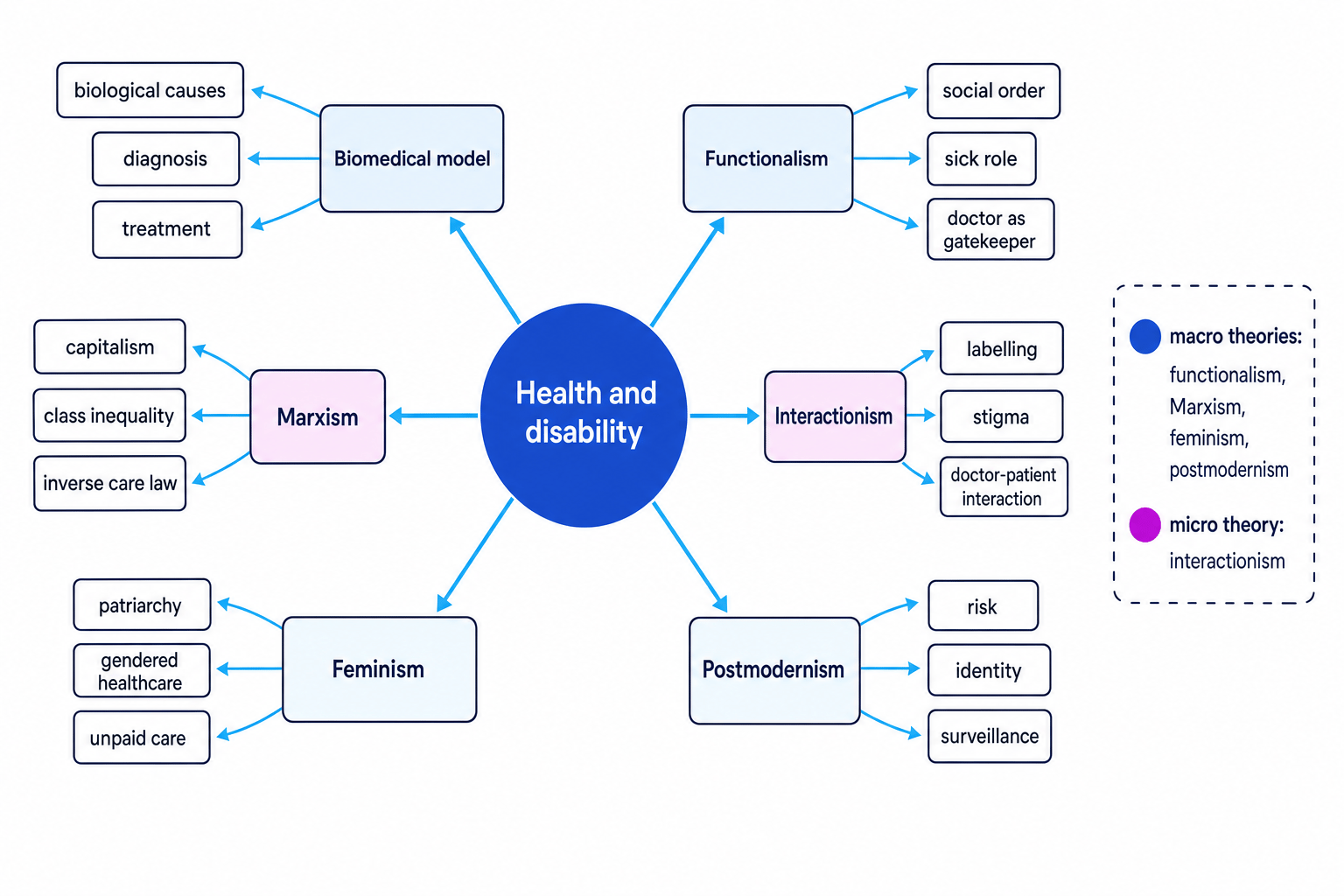
What you'll learn
- How the biomedical model explains illness and disability, and why sociologists criticise it.
- The main sociological theories: functionalist, Marxist, interactionist, feminist and postmodernist.
- How to apply these theories to contemporary UK examples such as the NHS, health inequalities, diagnosis and disability rights.
- How to evaluate theories using AO3: comparison, evidence, methods and real-world limitations.
Starting point: health and disability are social as well as medical
In everyday life, people often talk about health as if it is purely biological: you are either ill or well because of what is happening inside your body. Sociology does not deny biology, but it asks a wider question: who gets ill, who is labelled ill, who receives care, and whose bodies are treated as “normal”?
Core terms
- Health means physical, mental and social wellbeing, not just the absence of disease.
- Disease means a biological or pathological condition, such as cancer or flu.
- Illness means the lived experience of feeling unwell and being treated as unwell by others.
- Impairment means a physical, sensory, cognitive or mental difference in the body or mind.
- Disability means the disadvantage and exclusion created when society is not organised for people with impairments.
A key distinction is between the medical model of disability, which sees disability as an individual problem located in the body, and the social model of disability, associated with writers such as Oliver, which argues that society disables people through barriers such as inaccessible buildings, inflexible work and stigma.
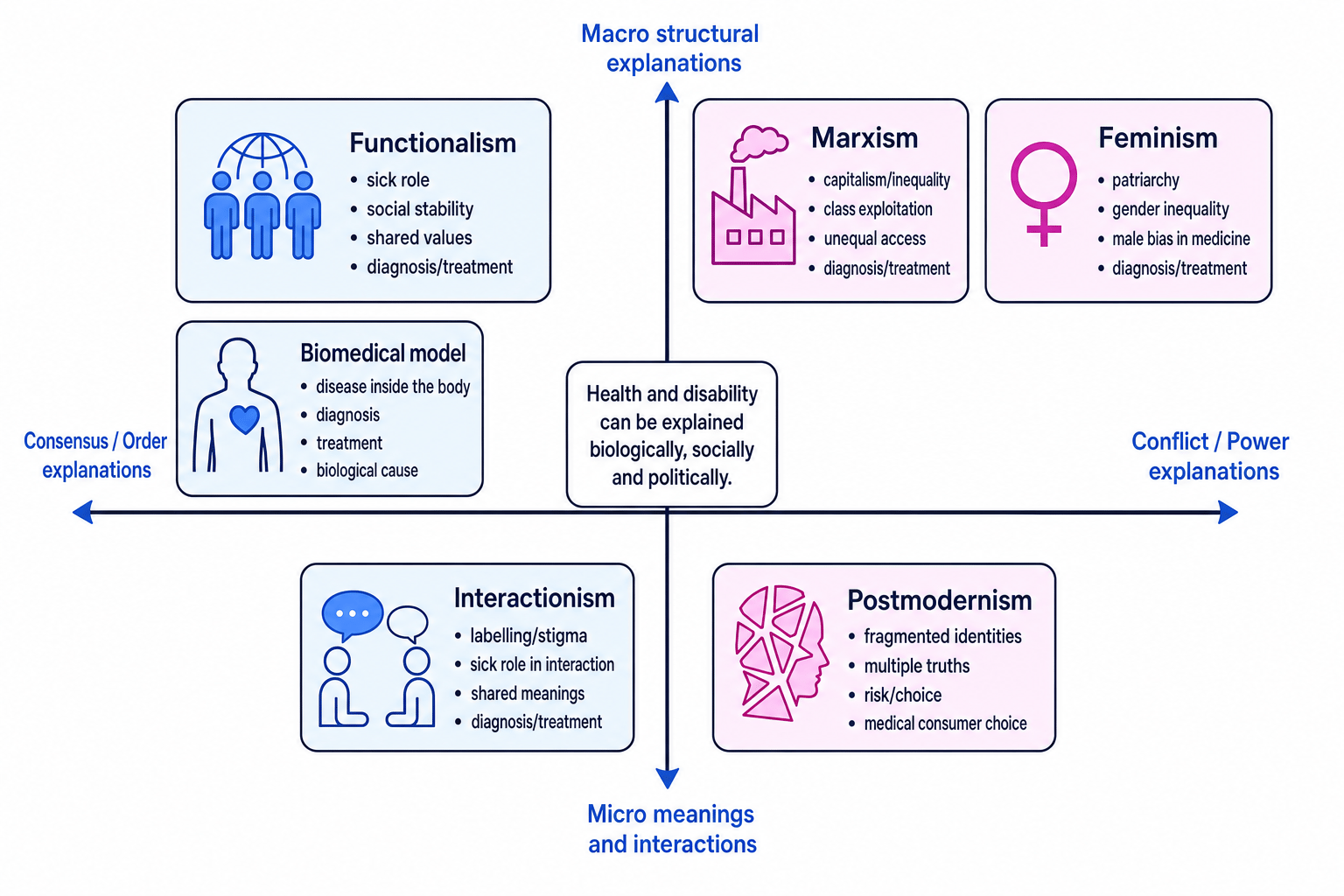
The diagram below gives you a “map” of the theories. Notice that some theories focus on large-scale structures such as capitalism or patriarchy, while others focus on meanings, labels and identity.
The sociological move
For essays, do not simply describe illness. Keep asking: how are health and disability shaped by socialisation, culture, identity, power and stratification?
The biomedical model
The biomedical model is the dominant medical way of understanding health. It sees illness as caused by biological problems inside the body, such as infection, injury, genetics or organ malfunction. The solution is diagnosis and treatment by medical professionals.
In the UK, the biomedical model underpins much of the NHS: GP consultations, blood tests, scans, medication, surgery, vaccination programmes and cancer screening all rely on scientific diagnosis and evidence-based treatment.
Biomedical model
The biomedical model explains illness and disability mainly through biological causes and treats doctors as experts who diagnose and treat problems located in the individual body.
Strengths of the biomedical model
The biomedical model is powerful because it has produced major improvements in survival and quality of life. Antibiotics, anaesthetics, vaccines, insulin, chemotherapy and surgery are obvious examples. It is also often reliable, because doctors can use standardised tests and clinical guidelines.
Sociological criticisms
Sociologists argue that the biomedical model can be too narrow. It may ignore social determinants of health, meaning the social conditions that shape health chances, such as income, housing, education, employment, ethnicity, gender and environment.
It can also encourage medicalisation, where more areas of life become defined as medical problems needing professional treatment. Writers such as Illich criticised modern medicine for creating dependency and sometimes causing harm, known as iatrogenesis.
Applying the biomedical model to diabetes
- Identify the biological explanation: diabetes is understood as a problem with insulin production or insulin use, affecting blood glucose regulation.
- Apply the medical response: the patient may receive blood tests, medication, insulin, diet advice and regular monitoring from health professionals.
- Add sociological evaluation: class, ethnicity, food poverty, work patterns and access to green space may affect both the risk of diabetes and the ability to manage it.
Biomedical is not the same as functionalist
The biomedical model is a medical explanation of disease. Functionalism is a sociological theory about how illness affects social order and social roles.
Functionalist explanations
Functionalism is a consensus theory. A consensus theory argues that society is held together by shared values and institutions that generally work together to maintain order.
Functionalists see health as important because society needs people to perform their roles: workers need to work, parents need to care, students need to study. If too many people are ill, social life becomes disrupted.
The key functionalist thinker here is Parsons. In 1951, he introduced the idea of the sick role.
Sick role
The sick role is Parsons’ idea that society gives ill people temporary rights, such as exemption from normal duties, but also duties, such as wanting to get better and seeking professional medical help.
The sick role
Parsons argued that sick people have two main rights:
- They are not personally blamed for being ill.
- They may be excused from normal responsibilities.
But they also have two obligations:
- They should want to recover.
- They should seek competent medical help and cooperate with doctors.
This makes doctors important gatekeepers, because they decide whether someone is legitimately ill. For example, a GP may provide a fit note for work or refer a patient to a specialist.
Evaluation of functionalism
Functionalism works best for short-term, acute illness, such as flu or a broken leg. It is weaker for chronic illness, mental illness and disability, where “getting better” may not be possible or may not be the person’s main goal.
It can also be criticised for assuming that doctors are neutral and that patients are passive. Interactionists and feminists challenge this by showing that diagnosis can involve negotiation, stigma and unequal power.
Using the sick role
- Apply the rights: someone recovering from surgery may be excused from work and household duties because others accept that they are legitimately ill.
- Apply the obligations: they are expected to attend follow-up appointments, take medication and try to recover.
- Evaluate the fit: the model is less useful for a disabled person who is not “temporarily sick” but needs society to remove barriers and provide long-term inclusion.
Marxist explanations
Marxism is a conflict theory. A conflict theory argues that society is shaped by inequality, exploitation and struggles between groups. Marxists focus especially on capitalism, a system where a small owning class profits from the labour of the working class.
Marxists argue that health and disability are linked to class inequality in three main ways.
First, capitalism can produce illness through poor working conditions, stress, pollution, low pay and insecure housing. This links to evidence such as the Black Report in 1980, which showed persistent class inequalities in health in Britain.
Second, healthcare may reproduce inequality. Tudor Hart’s inverse care law argued that those who need medical care most are often least likely to receive good care.
Third, medicine can support capitalist ideology by treating illness as an individual problem rather than asking why society creates unhealthy conditions. Marxists such as Navarro, Doyal and Waitzkin connect health to power, profit and inequality.
Marxism and disability
Materialist disability theorists such as Oliver argue that capitalism values people mainly as workers. Disabled people may be excluded because workplaces, transport systems and education are organised around a narrow idea of the “productive” body.
This links strongly to power and stratification: disability is not only about impairment, but about unequal access to employment, income, housing, transport and political voice.
Explaining a class health pattern
- Start with the pattern: people in more deprived areas often have lower life expectancy and higher rates of long-term illness.
- Use a material explanation: poorer housing, insecure work, lower income, pollution and stress can increase exposure to illness.
- Add an institutional explanation: access to high-quality care may be harder where GP shortages, transport costs or long waiting lists affect poorer communities.
- Evaluate with another view: a biomedical explanation may explain the disease mechanism, but Marxism explains why risk and treatment are unequally distributed.
Interactionist explanations
Interactionism is a micro-level theory. A micro-level theory focuses on small-scale social interactions, meanings and identities rather than large social structures.
Interactionists argue that illness and disability are partly shaped through labelling, where people, professionals or institutions define someone in a particular way. Becker’s labelling theory was developed in deviance studies, but it is useful for health because diagnosis can change how others treat a person.
Goffman used the term stigma to describe a socially discrediting attribute. Disability, mental illness, HIV status or visible difference may become stigmatised if others attach negative meanings to them.
Stigma
Stigma is a negative social label that marks someone as different, inferior or discredited in the eyes of others.
Interactionists also study the doctor-patient relationship. Freidson argued that doctors have professional power to define illness. However, patients are not always passive: they may negotiate, resist, search online, seek second opinions or join support communities.
Evaluation of interactionism
Interactionism is useful because it shows how diagnosis affects identity and everyday life. It is especially helpful for understanding mental health, hidden disabilities and chronic illness.
However, it can underplay structural inequalities. For example, stigma matters, but so do poverty, racism, sexism, inaccessible transport and NHS funding.
Analysing diagnosis as a label
- Identify the label: a young person receives a diagnosis of ADHD or autism.
- Show the positive effect: the label may provide explanation, school support, medication or reasonable adjustments.
- Show the negative effect: the label may also lead to stereotyping, lowered expectations or social exclusion.
- Evaluate: interactionism explains identity and stigma well, but Marxism or feminism may better explain unequal access to diagnosis and support.
Feminist explanations
Feminism is a conflict perspective focusing on patriarchy, meaning male power and gender inequality. Feminists argue that health and medicine have often been shaped by male-dominated institutions and assumptions.
Doyal, in What Makes Women Sick, argued that women’s health is affected by paid work, unpaid caring work, poverty, reproduction, domestic labour and male violence. Feminists also argue that women’s bodies have been heavily medicalised through pregnancy, childbirth, menstruation, contraception, menopause and cosmetic surgery.
In contemporary UK society, feminist arguments can be applied to issues such as delayed diagnosis of endometriosis, women’s heart attack symptoms being missed, maternity care inequalities and the gendered burden of unpaid care.
Feminists also study masculinity. Ideas of hegemonic masculinity, associated with Connell, may encourage men to avoid seeking help because they are socialised to appear strong and self-reliant. This connects health to socialisation, culture and identity.
Feminism and disability
Disabled women may face both ableism and sexism. For example, they may experience barriers to reproductive healthcare, employment, education, safety and independent living. This is an intersectional point: gender, disability, class, ethnicity and age can combine to shape health experiences.
Applying feminism to delayed diagnosis
- Identify the gender issue: a woman repeatedly reports severe pelvic pain but is told it is “normal” or anxiety-related.
- Link to patriarchal medicine: feminist theory argues that women’s pain has historically been dismissed or under-researched.
- Show the consequence: delayed diagnosis can affect work, education, relationships, fertility and mental health.
- Evaluate with balance: the biomedical model is still needed for diagnosis and treatment, but feminism explains why some symptoms may be taken less seriously.
Postmodernist explanations
Postmodernism argues that contemporary society is fragmented, diverse and uncertain. Instead of one shared truth about health, there are multiple sources of knowledge: doctors, online forums, influencers, charities, pharmaceutical companies, alternative therapies and patient communities.
Postmodernists argue that health has become part of identity and lifestyle. People are encouraged to monitor, improve and display their bodies through diets, fitness trackers, cosmetic procedures, wellness apps and genetic tests.
Writers such as Foucault are useful here. Foucault argued that modern societies use knowledge and surveillance to define what is normal and abnormal. His idea of the medical gaze suggests that medicine can turn people into cases, symptoms and bodies to be examined.
Beck’s idea of the risk society is also relevant: people are increasingly expected to manage risks to their own health, such as diet, smoking, alcohol, exercise and screening.
Postmodernism and disability
Postmodern ideas can help explain disability identity politics, online activism and the neurodiversity movement. Disabled people may reject purely medical labels and create alternative identities and communities.
However, postmodernism can overstate choice. Not everyone can choose private healthcare, specialist diets, gym memberships or digital health tools. Marxists would argue that class inequality still limits people’s options.
Interpreting fitness tracking
- Identify the postmodern feature: a person uses a smartwatch to track sleep, steps, heart rate and calories.
- Link to identity: health becomes part of a self-managed lifestyle project, where the body is constantly monitored and improved.
- Link to power: following Foucault, surveillance does not only come from doctors; people also monitor themselves.
- Evaluate: this captures modern health culture well, but it may ignore people who cannot afford devices or safe spaces to exercise.
Quick comparison for essays
| Theory | Main focus | Useful theorists | Strong AO2 examples | Key evaluation |
|---|---|---|---|---|
| Biomedical model | Biological causes, diagnosis, treatment | Medical professionals, NICE, NHS | Vaccination, surgery, medication, cancer screening | Can ignore social inequality and lived experience |
| Functionalism | Social order and the sick role | Parsons | Fit notes, GP gatekeeping, temporary illness | Weak for chronic illness and disability |
| Marxism | Capitalism, class and inequality | Marx, Navarro, Doyal, Waitzkin, Oliver | Health gaps by deprivation, unsafe work, private healthcare | Can be economically deterministic |
| Interactionism | Labels, meanings and stigma | Becker, Goffman, Freidson | Mental health labels, hidden disabilities, doctor-patient interaction | May underplay structure and inequality |
| Feminism | Patriarchy and gendered medicine | Doyal, Oakley, Connell | Endometriosis, maternity care, unpaid care, masculinity and help-seeking | Needs intersectionality and balance |
| Postmodernism | Choice, risk, identity and fragmented knowledge | Foucault, Beck, Giddens | Fitness trackers, online diagnosis, wellness culture, neurodiversity activism | May exaggerate freedom and consumer choice |
Building evaluation
A strong essay does not just say “this theory is outdated”. Compare theories: for example, the biomedical model explains how disease is treated, while Marxism explains why disease is unequally distributed.
Evidence and methods points
You can use official statistics, such as ONS data on life expectancy, disability and deprivation, to support arguments about health inequalities. These are often high in reliability because they are collected systematically.
However, official statistics may not show the full lived experience of illness or disability. Some conditions are underdiagnosed, and some groups may face barriers to accessing doctors. Qualitative research, such as interviews with disabled people or patients with chronic illness, may offer higher validity because it captures meanings, stigma and identity.
Forgetting disability
Do not write only about illness. The specification says health and disability, so include disability rights, barriers, stigma, the social model and disabled identity where relevant.
In the exam
- Start by defining the theory clearly, then apply it directly to health or disability rather than giving a generic theory summary.
- Use AO2 examples from contemporary UK society: NHS access, health inequalities, diagnosis, mental health, disability rights, gendered healthcare or digital health.
- Evaluate by comparison: ask what the theory explains well, what it ignores, and which other perspective gives a stronger explanation.
Check yourself
- How does Parsons’ sick role explain the social management of illness?
- Why might Marxists argue that health inequalities are produced by capitalism?
- How do interactionist and feminist explanations differ in their view of medical power?