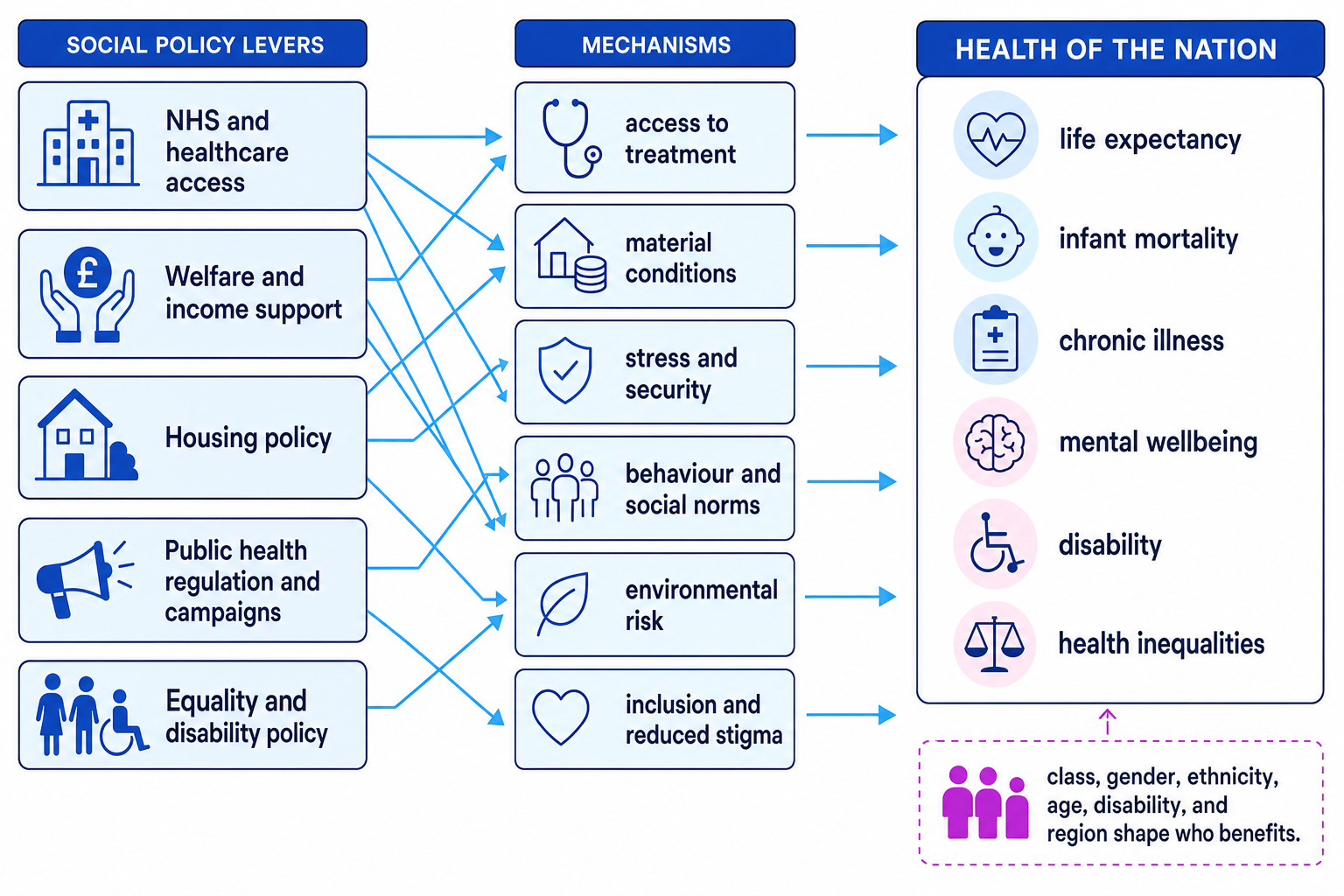
What you'll learn
- What sociologists mean by social policy and the health of the nation.
- How UK policies such as the NHS, smoking legislation, welfare reform and public health campaigns affect health.
- How to apply theories such as functionalism, Marxism, feminism, Foucault and Marmot.
- How to evaluate policy impact using evidence, inequalities and research-methods thinking.
1. Starting point: what is a social policy?
A social policy is a government decision, law, programme or set of guidelines designed to deal with social issues. In health, this includes obvious policies such as NHS funding, but also less obvious ones: housing rules, welfare benefits, education, employment rights, food regulation and disability rights.
Social policy
A social policy is a state action or rule intended to shape people’s welfare, behaviour, opportunities or access to services.
When sociologists talk about the health of the nation, they mean the overall pattern of health across the population: life expectancy, infant mortality, rates of illness, mental wellbeing, disability, and inequalities between groups.
Public health
Public health means preventing illness and improving health at population level, rather than only treating individuals after they become ill.
This topic is not just about whether policies “work”. It is about who benefits, who is left out, and how power and stratification shape health outcomes.
2. How policy can affect health
Policies usually affect health through several pathways. Some act directly, like vaccination programmes. Others act indirectly, like increasing income, improving housing, or changing cultural norms around smoking and diet.
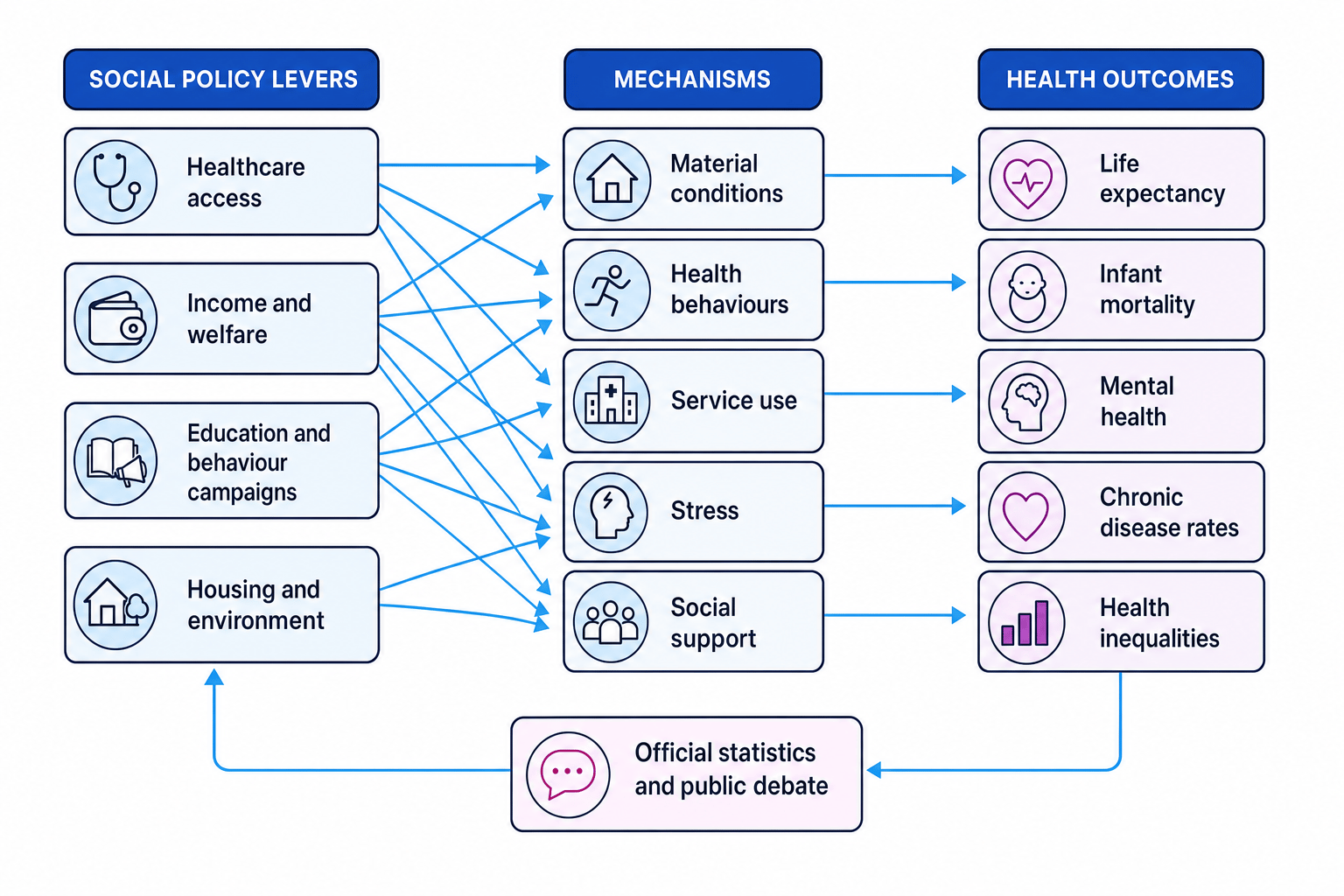
Policy works through mechanisms
A strong answer explains the mechanism: how a policy changes material conditions, behaviour, access to services, stress, social support or environmental risk.
Applying the pathway to the smoking ban
-
Identify the policy: the 2007 smoke-free legislation banned smoking in enclosed public places and workplaces in England, with similar laws across the UK.
-
Link it to mechanisms: it reduced exposure to second-hand smoke, changed workplace environments, and helped re-socialise smoking as less acceptable in public life.
-
Link it to health outcomes: lower smoke exposure should reduce respiratory and cardiovascular risks, while changing norms may contribute to lower smoking rates over time.
-
Add evaluation: the policy is more powerful than a simple awareness campaign because it changes the environment, but smoking remains more common in deprived groups, so it does not remove class-based health inequality on its own.
3. The NHS and access to healthcare
The National Health Service, created in 1948 after the Beveridge Report, is a major example of universalist social policy: it is intended to be available to everyone, funded mainly through taxation, and free at the point of use.
Universalism
Universalism means a policy or service is available to all citizens as a right, rather than only to selected groups judged to be in need.
From a functionalist perspective, the NHS helps society run smoothly by treating illness, returning people to work and supporting social stability. Parsons’ idea of the sick role suggests that society permits people to step back from normal duties when ill, but expects them to seek help and try to recover. The NHS supports this by providing legitimate medical treatment.
AO2 examples include GP services, emergency care, cancer screening, maternity services, vaccination programmes and mental health services. These can improve national health by detecting illness earlier and reducing deaths from treatable conditions.
However, access is not equal. Tudor Hart’s inverse care law argues that those who most need medical care are often least likely to receive good care, especially where services are shaped by market pressures. People in deprived areas may face longer waits, fewer GP appointments, poorer transport links, or lower confidence dealing with professionals.
Treating the NHS as automatically equal
Do not simply write “the NHS is free, so everyone has equal healthcare.” Free access reduces barriers, but class, ethnicity, gender, disability, region, language and digital exclusion can still affect access and outcomes.
The Health and Social Care Act 2012 is often used in evaluation. Supporters argued it could improve efficiency and patient choice; critics argued it encouraged marketisation, fragmentation and private-sector involvement. A Marxist might argue that healthcare policy can protect the workforce while still leaving capitalist inequalities untouched.
4. Public health campaigns and behaviour change
Some policies target behaviour and culture. Examples include:
- The Health of the Nation White Paper, 1992, which set targets for areas such as heart disease, cancers, mental illness, accidents and sexual health.
- Saving Lives: Our Healthier Nation, 1999, which continued target-setting under New Labour.
- Change4Life, launched in 2009, which encouraged healthier eating and exercise.
- Tobacco policies such as advertising restrictions, plain packaging and the smoking ban.
- The Soft Drinks Industry Levy, introduced in 2018, often called the sugar tax.
These policies show how the state can influence socialisation: people learn what counts as normal, risky, responsible or irresponsible health behaviour. For example, anti-smoking policies did not just inform people; they helped change the cultural identity of smoking from glamorous to risky and antisocial.
Foucault’s idea of governmentality is useful here. He argued that modern power often works by encouraging people to monitor and discipline themselves. Health campaigns can create citizens who count calories, track steps, avoid risks and feel personally responsible for health.
This can be positive, but it can also lead to victim-blaming. If policy focuses only on individual lifestyle, it may ignore poverty, insecure work, poor housing, food deserts and stress. Bourdieu’s ideas about capital are relevant: middle-class people may have more economic, cultural and social resources to act on health advice.
5. Welfare, poverty and the social determinants of health
The social determinants of health are the wider social conditions that shape health: income, housing, education, employment, environment, discrimination and social support.
Social determinants of health
The social determinants of health are the social and economic conditions in which people are born, grow, live, work and age, and which influence their chances of illness or wellbeing.
This is where policies outside the NHS become crucial. Benefits, minimum wage laws, social housing, school meals, Sure Start centres, childcare, employment rights and local authority services can all affect health.
The Black Report (1980) found major class inequalities in health and argued that material deprivation was a key cause. The Acheson Report (1998) also emphasised poverty and inequality. Marmot’s Fair Society, Healthy Lives review (2010) argued for proportionate universalism: support should be available to everyone, but with extra intensity for those with greater need.
Health inequality is socially patterned
Illness is not randomly distributed. It follows patterns of class, gender, ethnicity, disability, age and region, so policy evaluation must ask whether inequalities narrow or widen.
AO2: New Labour policies such as Sure Start, tax credits and targets to reduce health inequalities can be applied as attempts to address early childhood and poverty. In contrast, post-2010 austerity, welfare reform, local authority cuts and pressures on social care are often evaluated as worsening the social determinants of health. Marmot’s 2020 review argued that improvements in life expectancy had stalled and inequalities had widened.
From a Marxist perspective, this suggests that health policy cannot fully overcome inequality while wealth and power remain unequally distributed. A social democratic view is more optimistic: redistribution, public services and regulation can reduce health gaps.
6. Disability, mental health and equality policy
Because this topic sits within Health and disability, remember that policy also shapes whether disabled people can access healthcare, work, education and community life.
The social model of disability, associated with writers such as Mike Oliver, argues that people are disabled by social barriers, not simply by impairments. For example, inaccessible buildings, poor transport, stigma and lack of reasonable adjustments can damage health and independence.
Policies such as the Equality Act 2010, the Care Act 2014, mental health strategies and NHS accessibility standards can improve inclusion. However, Goffman’s work on stigma reminds us that legal rights do not automatically remove negative labels. Disabled people may still face discrimination, benefit assessment stress, underemployment or poor-quality care.
Feminists also point out that health and care policies often rely on unpaid caring labour, much of it done by women. Doyal argued that women’s health is shaped by patriarchy, paid work, unpaid care and medical assumptions about female bodies.
7. Contemporary example: COVID-19
COVID-19 is a useful AO2 example because it shows both the power and limits of policy.
Lockdowns, vaccination, furlough and public health messaging were intended to protect life and reduce pressure on the NHS. Vaccination policy clearly reduced severe illness for many people. Furlough helped protect incomes, which also matters for health.
But the impact was unequal. Key workers, people in overcrowded housing, disabled people, older people in care homes, and some minority ethnic groups faced higher risks. This supports the view that health policies interact with existing inequalities in work, housing, age, disability and ethnicity.
8. How to evaluate whether a policy improved health
In essays, avoid claiming that one policy caused a change unless you can explain the evidence. Sociologists use official statistics, surveys, interviews and evaluations, but each has limits.
Official statistics from bodies such as the ONS, NHS England, Public Health Scotland or the Office for Health Improvement and Disparities are useful because they cover large populations and show trends over time. However, they may be affected by changing definitions, under-reporting, diagnostic practices or differences in who seeks help.
Evaluating a claim about policy impact
-
Start with the outcome: if life expectancy rises after a policy, this may suggest improvement, but it does not prove the policy caused it.
-
Compare groups: ask whether the improvement happened equally across class, region, gender, ethnicity and disability, or whether advantaged groups benefited more.
-
Consider alternative explanations: changes in employment, housing, medical technology, education or wider economic conditions may also affect health.
-
Make a balanced judgement: a strong answer says the policy may have contributed, but its impact depends on funding, take-up, enforcement and wider inequality.
A simple essay chain
Use this chain: policy → mechanism → group affected → health outcome → evaluation. This keeps your answer sociological rather than descriptive.
In the exam
-
Name specific policies, such as the NHS, smoking ban, Health of the Nation, Sure Start, Equality Act 2010, austerity, or the Soft Drinks Industry Levy.
-
Explain the mechanism: show how the policy affects access, behaviour, income, housing, stress, stigma or social support.
-
Apply stratification: discuss class, gender, ethnicity, age, disability and region rather than writing about “people” in general.
-
Evaluate with theory and evidence: compare functionalist, Marxist, feminist, interactionist and Foucauldian views, and use studies such as Black, Acheson, Tudor Hart and Marmot.
Check yourself
- How can a policy outside the NHS, such as housing or welfare, affect national health?
- Why might a public health campaign reduce illness but still be criticised for victim-blaming?
- How would you use Marmot or Tudor Hart to evaluate the claim that UK healthcare is equal?