What you'll learn
- What political participation means beyond just voting.
- The main UK trends in turnout, party membership, protest and online activism.
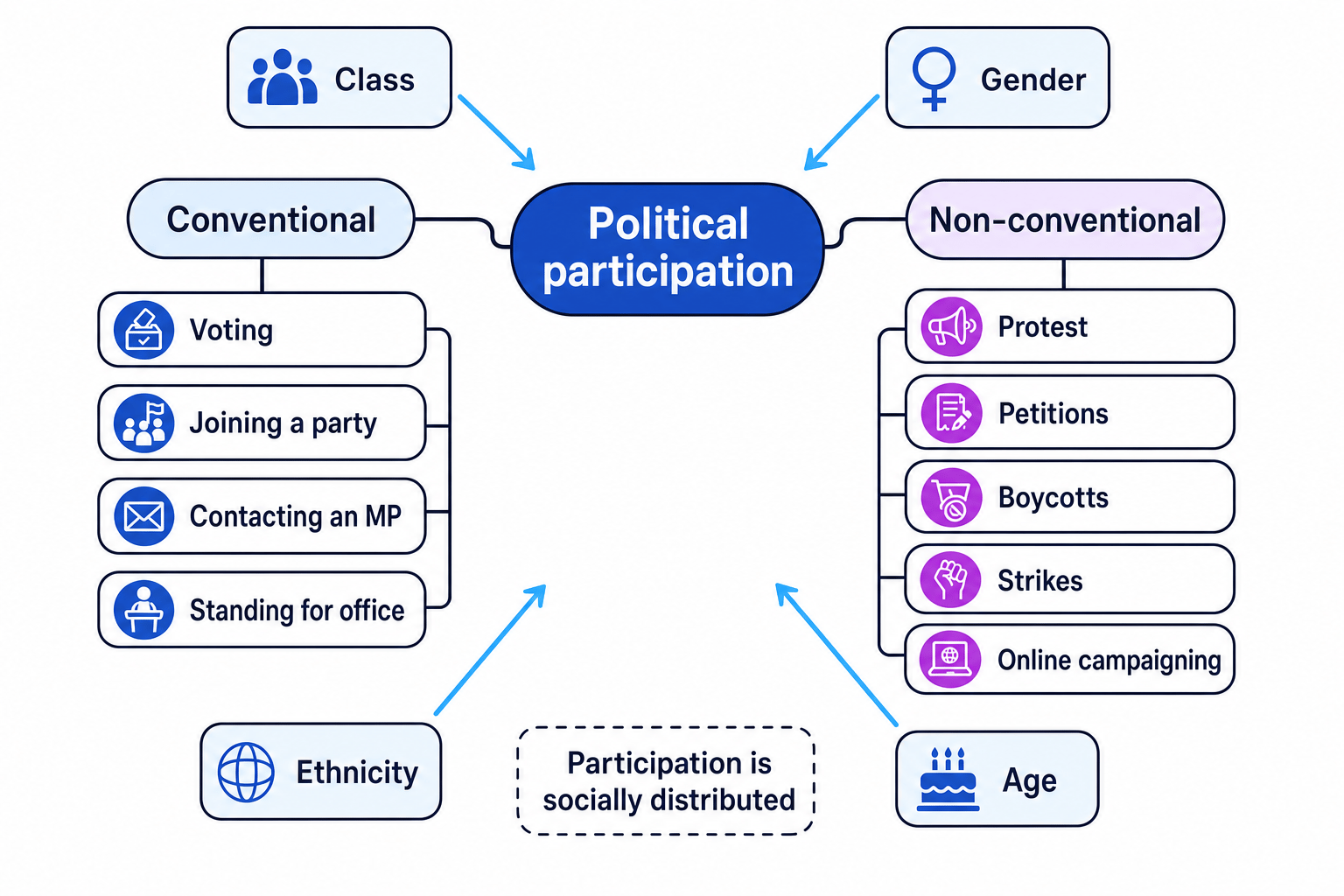
- How participation is socially distributed by class, gender, ethnicity and age.
- How to build AO1, AO2 and AO3 into essay-style answers.
1. The basic question: who takes part?
In a democracy, everyone may have formal political rights, but people do not participate equally. Sociology asks: whose voices are heard, whose are ignored, and why?
This topic sits very clearly within power and stratification. If some groups vote, lobby and campaign more than others, they may have more influence over laws, resources and public debate.
Core terms
- Political participation means any activity aimed at influencing political decisions, political leaders, public policy or public debate.
- Social distribution means the way something varies between social groups, such as class, gender, ethnicity and age.
- Turnout means the proportion of the electorate who vote in an election.
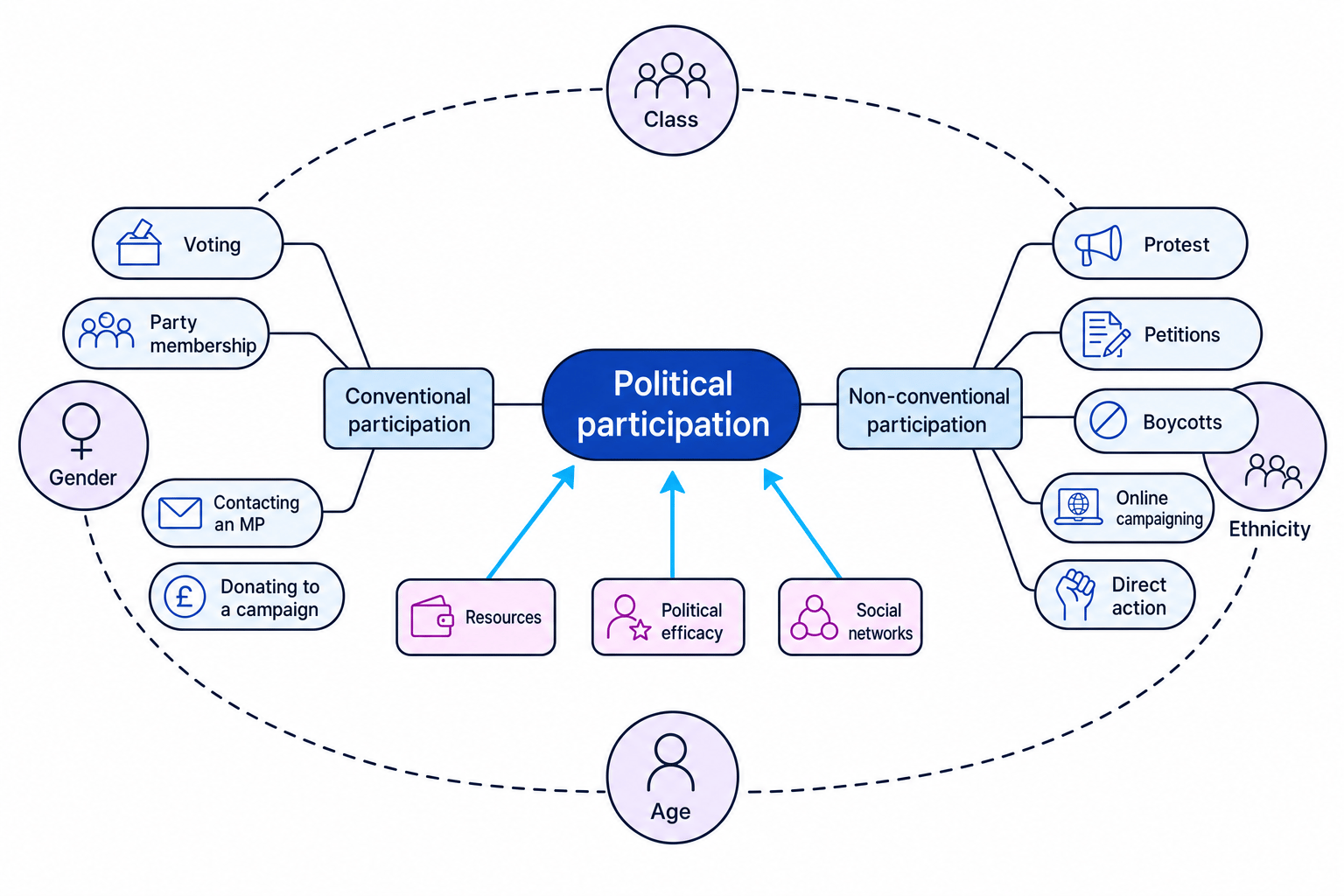
- Conventional participation means using established political channels, such as voting, joining a party or contacting an MP.
- Non-conventional participation means taking political action outside routine institutions, such as protest, boycotts, petitions or online campaigning.
- Political efficacy means the belief that you understand politics and can influence it.
Political participation is broader than putting a cross on a ballot paper. A young person joining a climate strike, a pensioner writing to an MP, a trade union organising a strike ballot, and a community group campaigning about housing are all politically active.
The big takeaway
Formal equality does not automatically produce equal participation. Social inequalities in resources, confidence, networks and identity shape who takes part in politics.
2. How sociologists measure political participation
For Eduqas, you need to be comfortable using evidence, not just describing opinions. Sociologists use:
- Official statistics, such as turnout figures from the Electoral Commission.
- Survey data, such as the British Election Study or Ipsos polling.
- Membership figures, for political parties, trade unions or pressure groups.
- Qualitative research, such as interviews with young people, activists or non-voters.
- Digital traces, such as petition signatures or social media campaign activity.
Each method has strengths and limits. Official turnout data is fairly reliable, but it does not tell us exactly why people voted or abstained. Surveys can link participation to age, class, gender and ethnicity, but people may over-report voting because it is seen as socially responsible.
Reading a participation pattern
-
Identify the form of participation. If a source says professional and managerial groups are more likely to vote, it is describing conventional electoral participation.
-
Identify the social distribution. The pattern is class-based because participation varies by occupational class, income or education.
-
Apply a sociological explanation. Verba, Schlozman and Brady’s civic voluntarism model would point to unequal resources: people with more time, money, civic skills and political confidence are more likely to participate.
-
Evaluate the evidence. If the data comes from a survey, turnout may be over-reported. If it only measures voting, it may miss working-class protest, trade union action or local campaigning.
AO1, AO2, AO3 chain
A strong paragraph usually moves from concept or study, to UK example, to evaluation: “This pattern can be explained by… This is shown by… However…”
3. Overall UK trends
Voting turnout has fluctuated
UK general election turnout was high in much of the post-war period, fell sharply by 2001, recovered somewhat in elections such as 2017 and 2019, and was around 60% in 2024. So the trend is not a simple collapse, but there is evidence of weaker attachment to formal electoral politics than in the mid-twentieth century.
Party membership has declined long term
In the 1950s, the main UK parties were mass-membership organisations. Since then, party membership has generally declined, although there have been temporary surges, such as Labour under Jeremy Corbyn, the SNP after the 2014 Scottish independence referendum, and issue-based mobilisation around Brexit.
This links to partisan dealignment, meaning a weakening of long-term loyalty to political parties.
Issue-based and digital participation have grown
Many people now participate through:
- online petitions
- social media campaigns
- consumer boycotts
- climate activism
- anti-racism campaigns
- local housing or health campaigns
- protest movements
Norris argues that citizens may not be simply apathetic; they may be critical citizens who distrust traditional institutions but still care about democratic issues. Giddens and Beck also suggest that late-modern politics increasingly involves identity, lifestyle, risk and single-issue campaigns.
Non-voting does not always mean apathy
A person who does not vote may still be politically active through protest, petitions, mutual aid, trade union activity or online campaigning. Always ask: what kind of participation is being measured?
4. Social class and participation
Class remains one of the clearest patterns in political participation.
People in higher social classes, especially those with higher income and education, are more likely to vote, donate, contact representatives and join organisations. Working-class people are more likely to face barriers such as insecure work, low income, unstable housing, lower trust in politicians and fewer connections to people who are already politically active.
Verba, Schlozman and Brady explain this through the civic voluntarism model: people participate when they have resources, motivation and recruitment through networks. Bourdieu would add that middle-class people often have more cultural capital, meaning knowledge, confidence and language that make formal politics feel accessible.
AO2 examples include the effect of housing instability on electoral registration, the decline of trade union membership in some sectors, and concerns that voter ID requirements introduced under the Elections Act 2022 may affect groups who are less likely to hold accepted photo ID.
However, class does not work in a simple old-fashioned way. Traditional class voting has weakened. Labour no longer automatically wins all working-class voters, and Conservatives no longer rely only on the middle class. The 2019 “red wall” result showed that age, region, education, Brexit identity and national identity can cut across class.
Applying class to a turnout gap
-
Start with resources. If higher-income groups vote more, link this to time, money, stable housing, access to information and confidence in institutions.
-
Add political efficacy. Lower-income groups may feel that politicians do not listen to “people like us”, reducing external political efficacy.
-
Use a UK application. A young worker in private rented housing may move address often, making registration harder, while an older homeowner may be easier for parties to contact and mobilise.
-
Evaluate the claim. Lower turnout does not prove working-class people are uninterested; it may show alienation from formal politics while ignoring protest, union action or community campaigns.
5. Gender and participation
Historically, women were excluded from formal politics. The Representation of the People Acts of 1918 and 1928 were crucial in extending the vote to women. Today, turnout differences between men and women are much smaller than in the past.
Feminist sociologists argue that political participation is shaped by patriarchy, meaning social structures that privilege men and masculinity. Walby’s work on patriarchy is useful here: women’s participation may be affected by unpaid caring responsibilities, gendered socialisation, harassment, lack of representation and the historic association of politics with male public life.
AO2 examples include:
- record numbers of women MPs in recent parliaments, with women making up around 40% of the House of Commons after the 2024 election
- campaigns around childcare, equal pay, abortion rights and violence against women
- the WASPI campaign on women’s state pension age
- feminist activism linked to #MeToo and Reclaim the Night
Gender patterns vary by form of participation. Men have often been more visible in formal leadership positions, while women have been highly active in community campaigns, petitions, welfare activism and feminist movements.
AO3: do not treat women as one single group. Gender intersects with class, ethnicity, age, disability and sexuality. Crenshaw’s idea of intersectionality is useful because it shows how inequalities overlap. A middle-class white woman, a young Muslim woman and an older working-class woman may experience politics very differently.
6. Ethnicity and participation
Ethnicity is a major factor in political participation, but it must be handled carefully. Minority ethnic groups in the UK are diverse in terms of class, religion, migration history, citizenship, region and generation.
Some minority ethnic citizens face barriers to participation, including racism, language barriers, lower trust in institutions, under-registration, socioeconomic disadvantage and experiences of exclusion. At the same time, minority ethnic communities can have strong political networks through religious organisations, community groups, anti-racist campaigns and local mobilisation.
AO2 examples include:
- Black Lives Matter protests in the UK after 2020
- campaigns linked to the Windrush scandal
- mobilisation around Islamophobia, antisemitism and hate crime
- increasing ethnic minority representation in Parliament, with the 2024 House of Commons containing a record number of minority ethnic MPs
Historically, many minority ethnic voters have supported Labour, partly because of Labour’s links with anti-racist legislation, trade unions and urban multicultural areas. But this pattern is not fixed. Ethnic minority voting varies by class, religion, generation, region and political issue.
Treating ethnicity as one group
Avoid writing “ethnic minorities are less likely to participate” as if all groups are the same. A stronger answer says which form of participation is being discussed, recognises diversity, and considers class, age, religion and migration history.
Methodologically, ethnicity can be hard to study. Surveys may have small samples for specific groups, categories may be too broad, and official data often cannot show why people participated. Interpretivist interviews can add validity by exploring lived experiences of racism, belonging and political trust.
7. Age and participation
Age is one of the strongest predictors of voting. Older people are generally more likely to vote in UK general elections, while younger people are often less likely to take part in formal electoral politics.
There are three useful explanations:
- A life-cycle effect means people participate more as they get older, settle, buy homes, have families and develop stable routines.
- A cohort effect means different generations are socialised differently; younger cohorts may have weaker party loyalty and more individualised political identities.
- A period effect means a major event, such as Brexit, Covid-19, the cost-of-living crisis or war, temporarily changes participation across age groups.
Young people are not necessarily politically apathetic. Marsh, O’Toole and Jones found that young people may be alienated from formal party politics while still caring about issues. This fits examples such as climate strikes, anti-racist activism, rent campaigns, LGBTQ+ rights campaigns and online petitions.
AO2 is especially strong here in Wales: 16- and 17-year-olds can vote in Senedd and local elections, though not UK general elections. This allows you to discuss how policy can widen formal participation.
Comparing explanations for youth participation
-
Use a life-cycle explanation. Younger adults may vote less because they move address more often, have less stable employment and are less targeted by parties.
-
Use a cohort explanation. Younger generations may be less attached to Labour or Conservative identities and more drawn to issue-based politics, such as climate or housing.
-
Use a period explanation. A major event like the Brexit referendum can sharply increase political interest among young people, even if the effect does not last equally for all.
-
Evaluate the label “apathetic”. If young people protest, organise online and sign petitions, then low turnout may show distrust of institutions rather than lack of political concern.
8. Bringing the factors together
The best answers do not simply list class, gender, ethnicity and age separately. They show how they overlap.
For example, a young working-class minority ethnic woman may face different barriers from an older middle-class white man. This is where intersectionality helps: political participation is shaped by combined inequalities, not one identity at a time.
This also links to socialisation, culture and identity. Families, schools, peer groups, workplaces, media and online spaces teach people whether politics feels relevant, trustworthy and “for people like us”.
Finally, remember Weber’s view of power: power is the ability to get your will carried out even when others resist. Unequal participation matters because it affects whose interests parties notice, whose problems become policy issues, and whose voices are treated as legitimate.
In the exam
-
Define the form of participation first: voting, party membership, protest, petitioning, contacting politicians or online activism.
-
Use at least one named concept or study, such as Verba et al., Bourdieu, Norris, Putnam, Walby, Crenshaw or Marsh et al.
-
Apply your point to contemporary UK society, such as voter ID, youth climate activism, women’s representation, Black Lives Matter, Wales votes at 16, or 2024 turnout.
-
Evaluate by questioning the evidence, comparing groups, and showing that class, gender, ethnicity and age often intersect.
Check yourself
- Why might older people be more likely to vote, but younger people more visible in protest politics?
- How can class affect political participation through resources, confidence and social networks?
- Why is it a mistake to treat “ethnic minority participation” as one single pattern?