What you'll learn
- How theories of crime and deviance shape what governments see as “the problem”.
- How different explanations lead to different policies: punishment, prevention, rehabilitation, welfare, surveillance or victim protection.
- How to evaluate whether theory really influences policy, using UK examples.
- How to build AO1, AO2 and AO3 into essay-style answers.
Start with the basics: what is social policy?
In Sociology, social policy means the plans, laws, spending decisions and institutional practices used by governments and agencies to deal with social issues. In crime and deviance, this includes policing, sentencing, prisons, probation, youth justice, victim support, CCTV, anti-terrorism strategies and crime-prevention schemes.
Social policy
A social policy is a government or organisational response to a social problem, often involving laws, funding, services, regulation or official guidance.
A theory is an organised explanation. A theory of crime does not just say “crime exists”; it suggests why crime happens, who is most affected, and what should be done about it.
For this topic, the key move is:
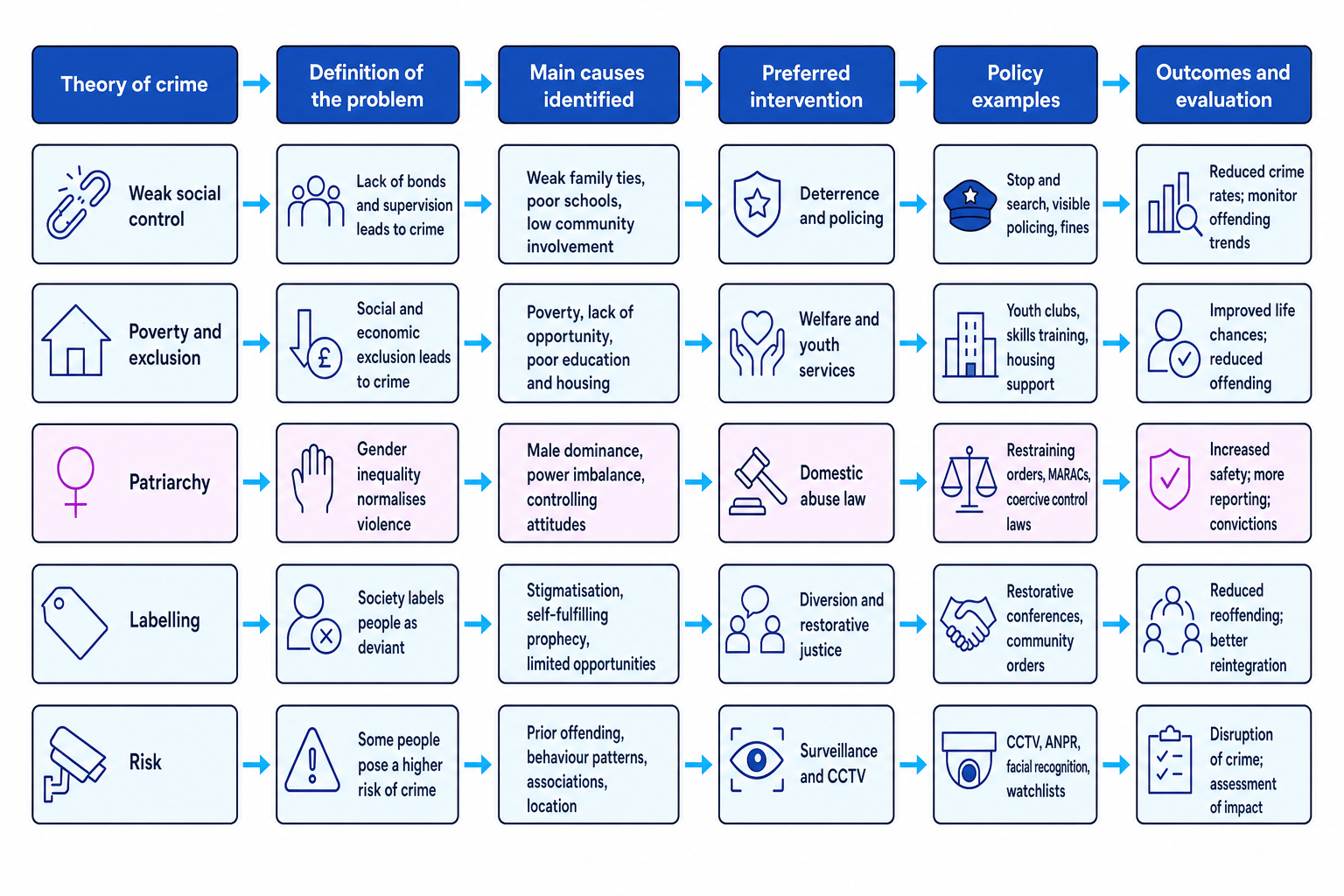
theory of crime → explanation of causes → preferred policy response → evaluation of consequences
Theory shapes the problem
Theories influence social policy because they define what counts as the main problem: weak social control, poverty, capitalism, patriarchy, labelling, risk, or lack of deterrence.
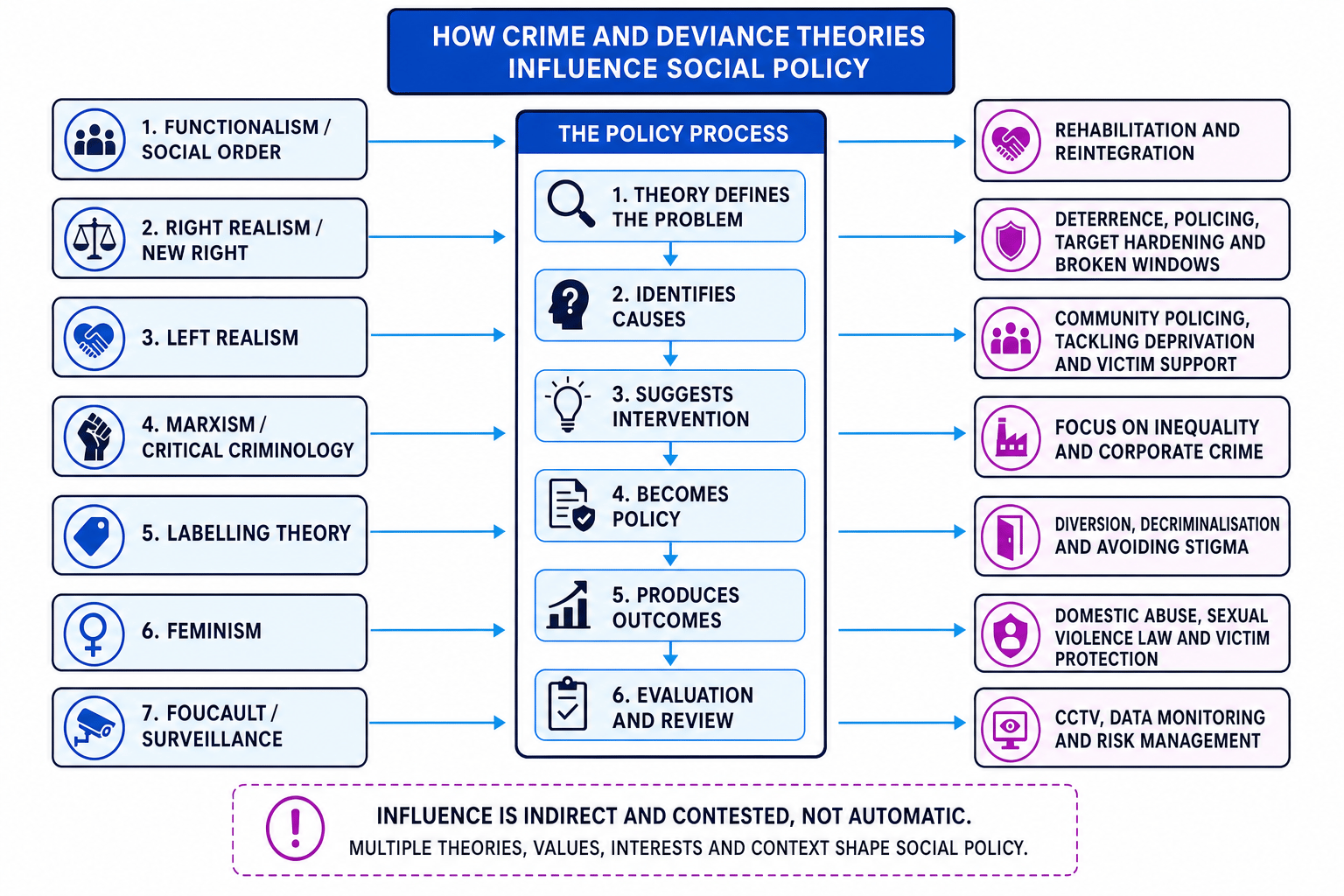
How theory becomes policy
Theory rarely “turns into” policy in a simple, automatic way. Politicians are also influenced by public opinion, media pressure, budgets, moral panics, think tanks, civil servants, campaign groups and official statistics.
Still, theory matters because it provides a policy logic. If crime is explained as rational choice, governments may increase deterrence. If crime is explained as deprivation, they may invest in youth services. If crime is explained as patriarchy, they may reform domestic abuse and sexual violence law.
Assuming direct influence
Avoid writing as if a sociologist personally created a policy. It is safer to say a theory “supports”, “legitimates”, “informs” or “is reflected in” a policy.
Tracing ASBOs from theory to evaluation
-
Define the policy problem. Anti-Social Behaviour Orders, introduced by the Crime and Disorder Act 1998, treated anti-social behaviour as a visible form of disorder that could damage communities.
-
Link to a theory. This reflects right realist and broken windows thinking: if low-level disorder is not controlled, it may encourage more serious crime by weakening informal social control.
-
Identify the policy response. The state used civil orders, restrictions and possible punishment for breach, aiming to deter behaviour and reassure local communities.
-
Add a contrasting interpretation. Labelling theorists would argue ASBOs risked stigmatising young, working-class people and creating a deviant identity.
-
Evaluate the influence. ASBOs show theory influencing policy, but not in a pure form: New Labour also combined “tough on crime” policies with attempts to tackle social exclusion.
Consensus theories: social order and integration
Consensus theories assume society is based on shared norms and values. Norms are informal rules about expected behaviour; values are beliefs about what is important.
Functionalism
Functionalism sees society as a system whose parts work together. Durkheim argued that crime is inevitable because not everyone can be equally committed to shared norms. Crime can even be functional by reminding society of moral boundaries.
Durkheim also used the idea of anomie, meaning normlessness or weakened moral regulation. Merton developed this into strain theory, arguing that crime can occur when people are encouraged to want success but lack legitimate opportunities to achieve it.
Policy links include:
- rehabilitation and reintegration of offenders;
- education and socialisation into shared values;
- community programmes to strengthen social bonds;
- welfare or opportunity-based policies to reduce strain.
For AO2, you could link this to youth offending teams, probation work, restorative justice, education programmes in prisons, or early intervention schemes.
AO3: functionalism can be criticised for underplaying power and stratification. It may treat laws as if they benefit everyone equally, while Marxists and feminists argue laws often protect the interests of powerful groups.
Right realism and New Right explanations
Right realism argues that crime is a real problem, especially for ordinary communities, and that policy should focus on practical control. It is linked to the New Right, a political approach stressing individual responsibility, discipline and limited welfare dependency.
Key ideas include:
- rational choice theory: offenders weigh up costs and benefits;
- deterrence: crime falls if punishment is likely, swift and serious;
- target hardening: making crime more difficult, such as locks, CCTV and security design;
- broken windows theory: Wilson and Kelling (1982) argued visible disorder can encourage further crime if ignored;
- Murray’s idea of an underclass, suggesting welfare dependency weakens family and work discipline.
Policy examples include more visible policing, longer sentences, CCTV, neighbourhood watch, “zero tolerance” policing, stop and search, Public Spaces Protection Orders and prison expansion.
AO3: right realism is influential because it gives governments clear, immediate policies. However, critics argue it focuses on street crime while neglecting corporate crime, state crime and the social causes of offending. Stop and search also raises issues of race, class and police power, especially after the Macpherson Report (1999) identified institutional racism in the Metropolitan Police after the murder of Stephen Lawrence.
Left realism: taking crime seriously, but socially
Left realism, associated with Lea and Young (1984), agrees that crime is a real problem, especially for working-class victims. However, it explains crime through relative deprivation, marginalisation and subculture.
Relative deprivation means feeling deprived compared with others, even if living standards have improved. Marginalisation means lacking power, representation or a political voice.
Left realists use the square of crime: offender, victim, state and public. Good policy must consider all four.
Policy links include:
- community policing;
- multi-agency partnerships;
- victim support;
- tackling poverty and exclusion;
- youth services and employment programmes;
- local consultation with communities.
The Crime and Disorder Act 1998 reflected some left realist thinking by requiring local authorities and police to work together in Crime and Disorder Reduction Partnerships.
AO3: left realism is useful because it combines victim concern with social causes. However, Marxists may say it is too reformist because it tries to improve the existing system rather than challenge capitalism itself.
Right versus left realism
Right realism tends to ask, “How can we make crime less rewarding?” Left realism tends to ask, “Why do some communities experience both more offending and more victimisation?”
Interactionism and labelling theory
Interactionism focuses on meanings created through social interaction. Labelling theory argues that deviance is not just about the act itself, but about how others react to it.
Becker (1963) argued that deviance is created by social groups making rules and applying labels to outsiders. A label is a social judgement, such as “criminal”, “troublemaker” or “gang member”. If someone internalises the label, it can lead to secondary deviance, meaning further deviance caused by the reaction to the original act.
Cohen (1972) studied moral panics around Mods and Rockers. A moral panic is an exaggerated social reaction to a group seen as a threat to society’s values.
Policy implications include:
- diversion away from formal courts;
- cautions rather than prosecution for minor offences;
- avoiding unnecessary criminal records;
- decriminalisation of some acts;
- restorative justice, where offenders repair harm rather than simply being punished.
AO3: labelling theory is strong for showing unintended consequences. A policy designed to control deviance may amplify it. However, it can be criticised for not explaining the original causes of crime or the real harm suffered by victims.
Marxism and critical criminology
Marxism explains society through capitalism, class inequality and conflict between the ruling class and working class. Marxists argue that law and criminal justice often reflect the interests of powerful groups.
Chambliss argued that laws are shaped by ruling-class interests. Pearce highlighted the seriousness of corporate crime, such as unsafe products, financial fraud and environmental harm.
Policy implications are more radical:
- reduce poverty and inequality;
- regulate corporations more strictly;
- investigate tax avoidance, fraud and unsafe workplaces;
- challenge selective law enforcement;
- focus on harms caused by powerful organisations, not only street crime.
AO2 examples include Health and Safety Executive regulation, Serious Fraud Office investigations, corporate manslaughter law and debates about under-policing of white-collar crime.
AO3: Marxism is powerful for the theme of power and stratification, but it has less direct influence on mainstream UK crime policy because it challenges the interests of powerful institutions. It may also underestimate crimes within working-class communities that victims want addressed urgently.
Feminism: patriarchy, victimisation and law reform
Feminism explains crime and criminal justice through patriarchy, meaning male power and female subordination. Feminist criminologists such as Heidensohn, Smart, Walklate and Dobash and Dobash showed how women’s victimisation was often ignored, minimised or blamed on victims.
Policy influence has been significant in areas such as:
- domestic abuse law and support services;
- rape law reform and consent education;
- specialist domestic violence courts;
- coercive control becoming an offence under the Serious Crime Act 2015;
- Domestic Abuse Act 2021;
- Clare’s Law, formally the Domestic Violence Disclosure Scheme;
- Violence Against Women and Girls strategies.
AO3: feminist research has had real policy impact because it used victim testimony, campaigning and qualitative evidence to expose hidden harms. However, implementation remains a problem: underreporting, low rape conviction rates and unequal access to support show that legal change does not automatically transform culture.
Foucault, surveillance and risk
Foucault (1977) argued that modern societies control people through surveillance, discipline and self-monitoring. His image of the panopticon describes a prison design where prisoners behave because they might be watched.
Modern policy increasingly uses risk management: identifying people, places or behaviours seen as risky before harm occurs. Garland (2001) describes a “culture of control”, where governments combine punishment with managerial prevention.
Policy examples include:
- CCTV;
- electronic tagging;
- data-led policing;
- Multi-Agency Public Protection Arrangements for high-risk offenders;
- Prevent, the UK counter-terrorism safeguarding strategy;
- school, border and online monitoring.
AO3: surveillance may prevent harm, but it raises ethical issues around privacy, consent, bias and unequal targeting. It also connects to identity: some groups may experience themselves as constantly suspected or monitored.
The role of evidence and research methods
Policies are often justified through “evidence-based policy”. This means using data and research to decide what works.
Key sources include:
- police recorded crime, which is useful but affected by reporting and recording practices;
- the Crime Survey for England and Wales, a victim survey that captures some unreported crime;
- Office for National Statistics data, including deprivation indices;
- qualitative interviews with victims, offenders, police or support workers.
Methodological evaluation matters. Official statistics may be reliable because they are collected regularly, but they may lack validity if they miss hidden crimes such as domestic abuse, hate crime or corporate crime. Qualitative research may be high in validity because it captures lived experience, but it can be costly, time-consuming and less representative.
Practical issues include funding, access and sampling frames. Ethical issues include confidentiality, informed consent and harm, especially when researching victims of violence. Theoretical issues include the positivist preference for measurable patterns and the interpretivist focus on meaning and experience.
Pulling it together for essays
A strong answer does not just list theories. It explains how each theory creates a different policy direction.
For example, knife crime could be explained through:
- right realism: weak deterrence, need for policing and target hardening;
- left realism: deprivation, marginalisation and lack of youth opportunities;
- labelling theory: gang labels and police attention may amplify deviance;
- Marxism: inequality and exclusion under capitalism;
- feminism: masculine identity and violence;
- surveillance theory: data-led policing and risk mapping.
The best AO3 point is that policy is often a mixture. New Labour’s slogan “tough on crime, tough on the causes of crime” combined right realist control with left realist concern about social exclusion.
In the exam
-
Start each paragraph with a clear theory, then link it to a specific policy example such as ASBOs, CCTV, domestic abuse law, youth justice or community policing.
-
Build AO3 by comparing perspectives: for example, right realism supports deterrence, while labelling theory warns that punishment can create further deviance.
-
Use evidence carefully: mention official statistics or victim surveys, but evaluate reliability, validity, representativeness and the dark figure of crime.
Check yourself
- How would a right realist and a left realist explain the same policy differently?
- Why might labelling theory criticise policies designed to control anti-social behaviour?
- Which policies show feminist influence on UK responses to crime and victimisation?