What you'll learn
- The difference between crime, deviance and social construction.
- How the main theories explain crime: functionalist, sub-cultural, Marxist, neo-Marxist, feminist, interactionist, realist and postmodernist.
- How to apply theories to contemporary UK examples such as stop and search, youth violence, corporate crime and cybercrime.
- How to build AO3 evaluation by comparing perspectives and questioning evidence.
Start here: crime, deviance and social construction
Before you learn the theories, you need the basic distinction.
Crime and deviance
- Crime is behaviour that breaks the criminal law and can be formally punished by the state.
- Deviance is behaviour that breaks social norms: the informal rules about what is seen as normal, acceptable or respectable.
- Social construction means that definitions of crime and deviance are created by societies, not fixed by nature.
For example, cannabis possession, homosexuality, domestic violence and online abuse have all been understood differently across time and place. This matters because many theories are not just asking “Why do people offend?” They are also asking “Who has the power to define certain behaviour as criminal?”
Mapping the theories
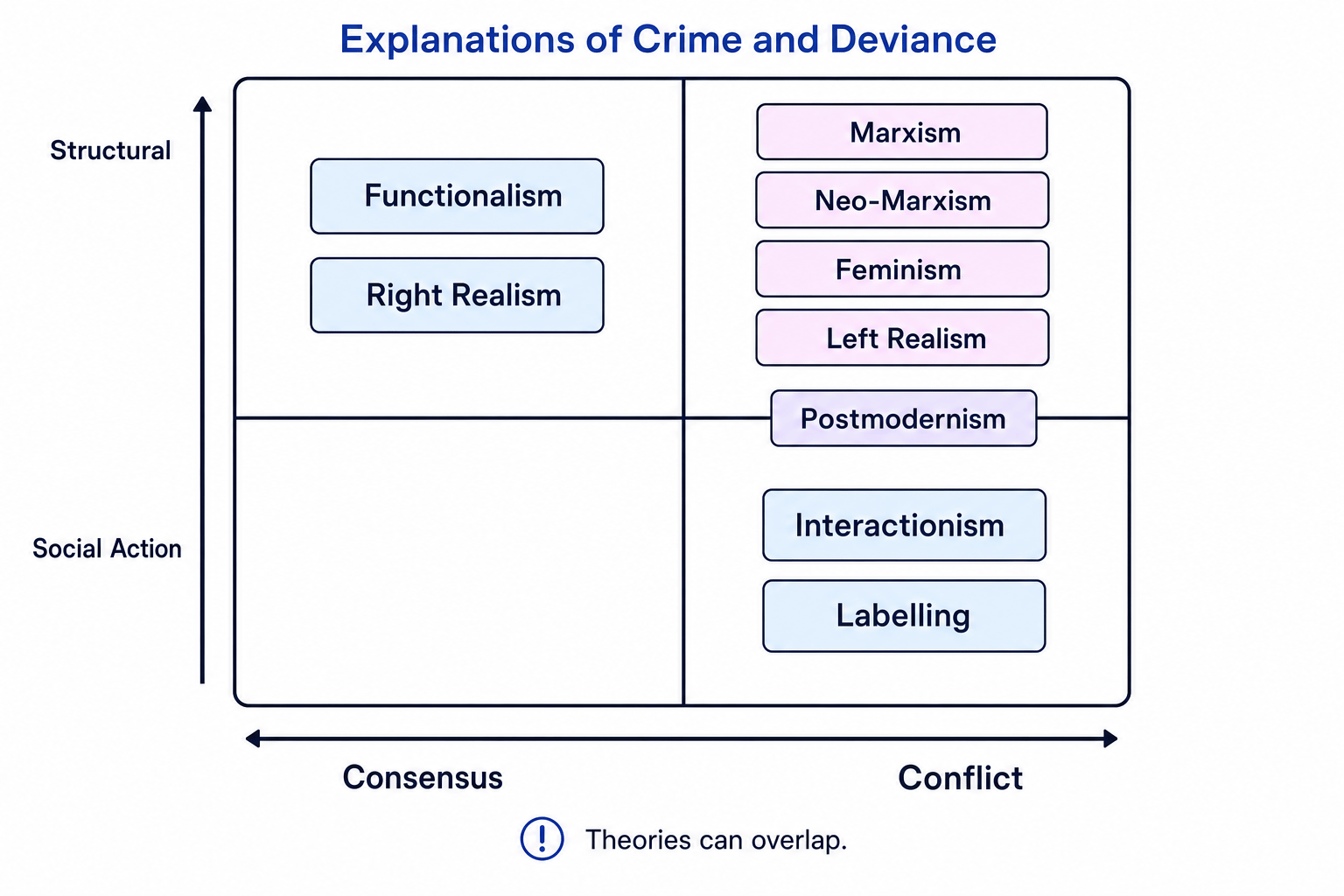
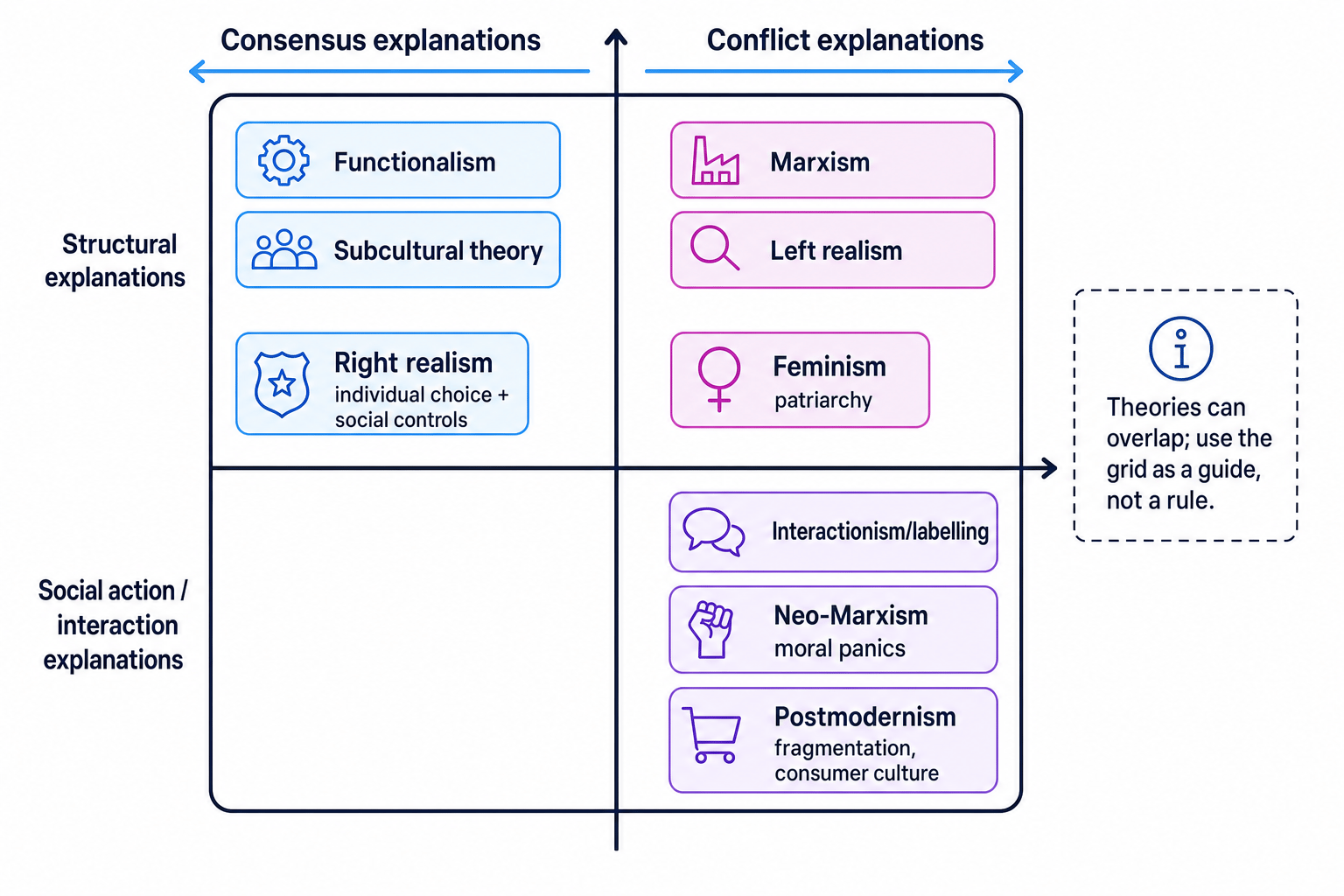
A useful way to organise the topic is to ask two questions:
- Is the theory mainly consensus or conflict?
- Consensus theories see society as broadly sharing values.
- Conflict theories see society as shaped by inequality and power struggles.
- Is the theory mainly structural or social action?
- Structural theories focus on large-scale forces such as capitalism, patriarchy, poverty or socialisation.
- Social action theories focus on meanings, labels, interactions and choices.
This grid is a guide, not a rule: some theories overlap.
The big essay move
Strong answers do not just list theories. They compare what each theory thinks is the main cause of crime: weak socialisation, blocked opportunity, capitalism, patriarchy, labelling, rational choice, deprivation or postmodern consumer culture.
Evidence: a quick methods lens
In crime essays, evidence often comes from official statistics, police recorded crime, the Crime Survey for England and Wales, victim surveys, self-report studies and qualitative research.
Positivist approaches, such as some functionalist or realist work, often value large-scale patterns and statistics. Interpretivist approaches, such as interactionism, are more interested in meanings, labelling and lived experience.
Treating crime statistics as neutral facts
Police recorded crime does not simply measure “real crime”. It is affected by reporting rates, policing priorities, definitions of offences and the willingness of victims to contact authorities.
Functionalist explanations
Functionalists see society as based on shared norms and values. Durkheim argued that crime is normal and even useful in limited amounts.
Crime can perform functions:
- Boundary maintenance: punishment reminds people what society’s values are.
- Social change: deviance can challenge outdated norms.
- Adaptation: society adjusts when new behaviours become accepted.
Durkheim also used the term anomie, meaning a state of normlessness where social rules become unclear or weakened.
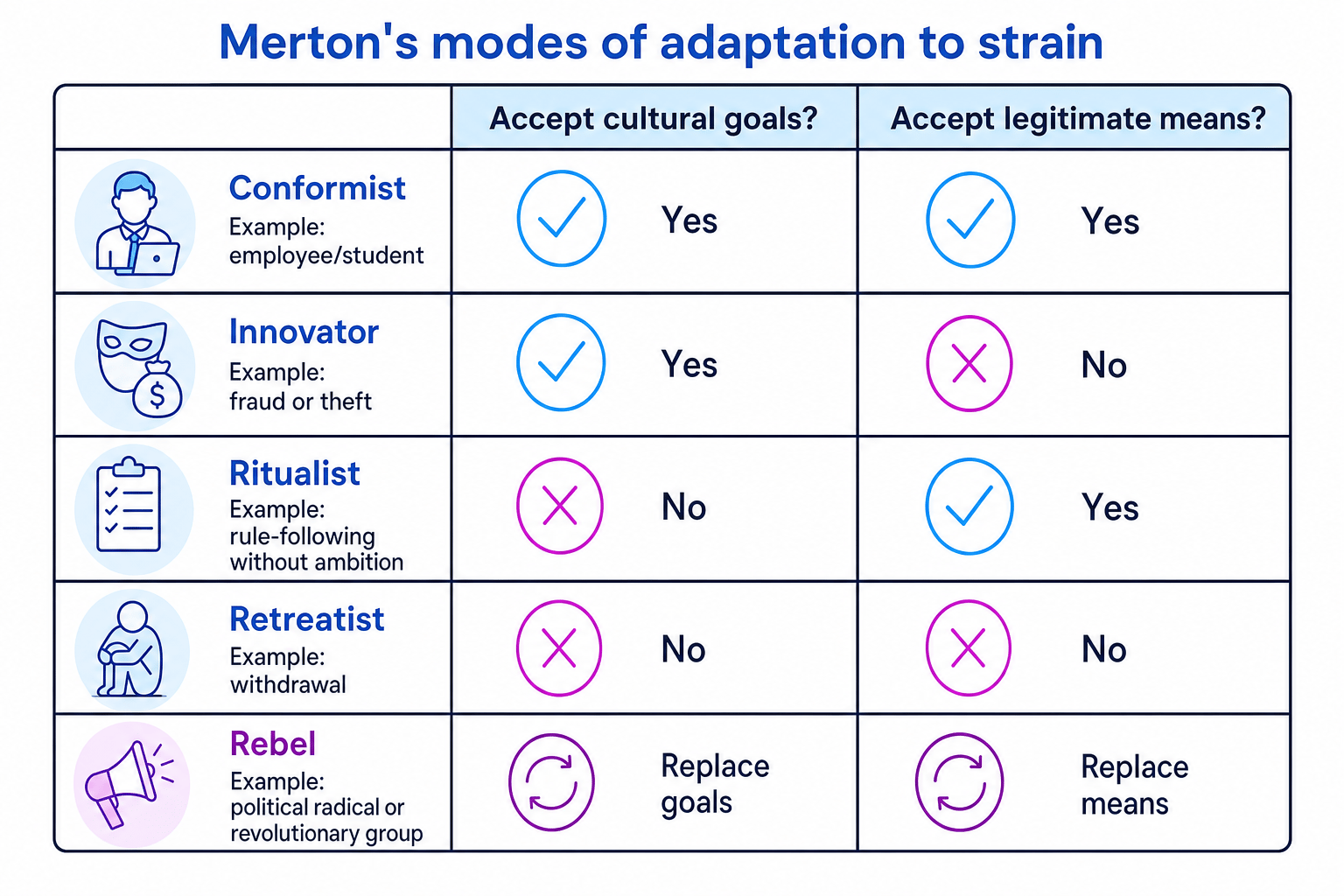
Merton developed this into strain theory. He argued that societies such as the USA, and arguably the UK, encourage people to pursue cultural goals like wealth and status, but not everyone has equal access to legitimate means such as education, secure jobs and social networks.
Applying Merton to county lines recruitment
- Identify the cultural goal: young people may be encouraged by consumer culture to seek money, status, branded goods and respect.
- Identify the blocked legitimate means: school exclusion, poverty, unstable housing or lack of local employment may reduce access to legal routes to success.
- Apply Merton’s category: if the person accepts the goal of success but uses illegal means, this is innovation.
- Add evaluation: Merton helps explain pressure towards acquisitive crime, but he cannot fully explain why many deprived young people do not offend, or why powerful people commit corporate crime.
Evaluating functionalism
Functionalism is useful because it links crime to socialisation, shared values and the structure of opportunity. However, it can overstate value consensus. Marxists and feminists argue that laws often reflect the interests of powerful groups, not society as a whole.
Sub-cultural explanations
Sub-cultural theories explain crime through group norms that differ from mainstream society. A subculture is a group with values and behaviour patterns distinct from wider society.
Cohen argued that working-class boys may experience status frustration when they fail to gain respect through school success. They may form delinquent subcultures where anti-school behaviour, vandalism or toughness bring status.
Cloward and Ohlin developed this by arguing that access to illegitimate opportunity also varies. Some areas provide criminal networks; others produce conflict subcultures or retreatist drug subcultures.
AO2 application: this can be linked to youth gangs, school exclusion, peer status, and local areas where criminal opportunities are more visible than secure employment.
AO3 evaluation: sub-cultural theories can be criticised for focusing too much on working-class boys and ignoring female offending, middle-class deviance, cybercrime and corporate crime. They can also sound deterministic if they imply that poverty automatically produces crime.
Marxist explanations
Marxists see crime as rooted in capitalism, a class system based on private ownership and profit. They argue that capitalism is criminogenic, meaning it creates conditions that encourage crime.
Key Marxist points:
- Poverty and inequality may push some working-class people towards survival crime.
- Consumer culture encourages desire for goods that not everyone can afford.
- Corporate and white-collar crime can cause huge harm but is often treated less harshly.
- The law and criminal justice system may focus more on street crime than crimes of the powerful.
Chambliss argued that laws often protect private property and ruling-class interests. Pearce and Box highlighted corporate crime and the way powerful offenders may avoid the stigma attached to street criminals.
AO2 application: examples include fraud, tax evasion, unsafe working conditions, environmental offences by companies, and unequal outcomes in policing and sentencing.
AO3 evaluation: Marxism is strong on power and stratification, especially class inequality. However, it may underplay crimes that do not obviously benefit capitalism, such as domestic violence, hate crime or expressive violence. Left realists also argue that Marxists sometimes neglect working-class victims of street crime.
Neo-Marxist explanations
Neo-Marxists combine Marxist concerns about capitalism with interactionist ideas about labelling and meaning.
Taylor, Walton and Young argued in The New Criminology that a full explanation should consider both the wider capitalist structure and the choices and meanings of offenders.
Hall et al. in Policing the Crisis argued that the 1970s “mugging” panic in Britain reflected a crisis of capitalism, racism and state control. Media coverage helped create a moral panic, where a group is exaggerated as a threat to social order.
AO3 evaluation: neo-Marxism is useful because it links class, race, policing and media power. However, studies of moral panic can be historically specific, and critics argue that the approach may sometimes read too much political intention into media and policing.
Feminist explanations
Feminist theories argue that crime and criminal justice must be understood through patriarchy, a system of male power over women.
Key ideas include:
- Heidensohn argued that women are controlled in the home, workplace and public spaces, reducing opportunities for offending but increasing vulnerability.
- Carlen argued that some women offend when the “class deal” and “gender deal” fail to provide security or respect.
- Messerschmidt linked some male crime to attempts to prove masculinity.
- Connell’s idea of hegemonic masculinity helps explain why violence, dominance and risk-taking may become part of male identity for some groups.
AO2 application: feminist theory applies to domestic abuse, sexual violence, coercive control, online harassment, rape attrition, and the gendered fear of crime in public spaces.
AO3 evaluation: feminism is powerful for showing how crime is gendered, but different feminist perspectives disagree. Some focus on patriarchy; others stress intersectionality, where gender combines with class, ethnicity, age, sexuality and disability.
Gender is not just about women
In crime essays, use feminism to analyse both women’s victimisation and men’s offending, especially how masculinity is socially constructed.
Interactionist explanations: labelling
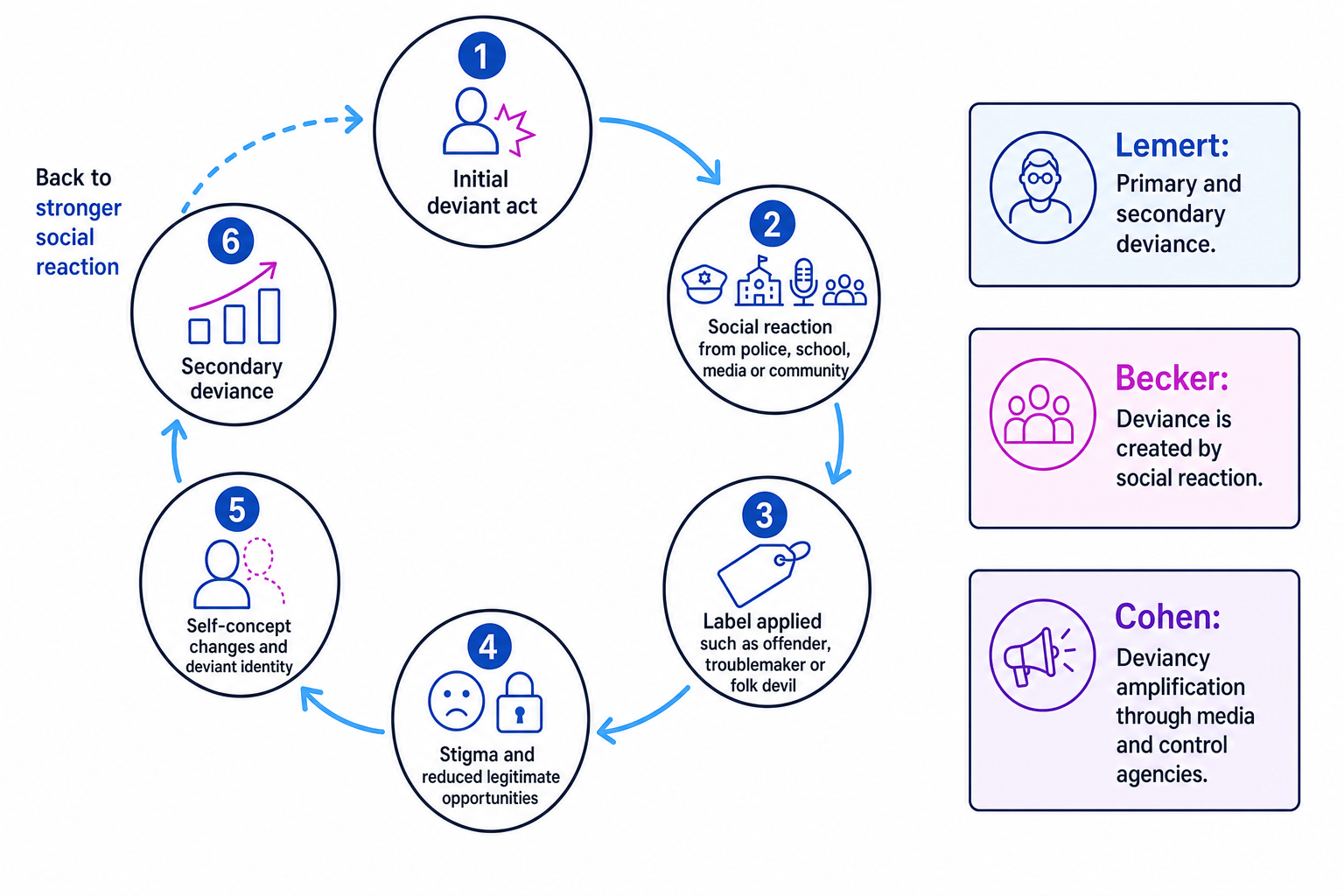
Interactionists focus on meanings and social reactions. Becker famously argued that deviance is not just the act itself; deviance is created when society labels an act or person as deviant.
Important terms:
- Moral entrepreneurs: people or groups with the power to create or enforce rules.
- Primary deviance: an initial act that may not affect someone’s identity.
- Secondary deviance: further deviance that develops after a label becomes part of someone’s self-concept.
- Stigma, from Goffman, means a spoiled identity that marks someone as socially discredited.
Applying labelling to stop and search
- Start with the social reaction: if young men in particular ethnic or class groups are repeatedly stopped and searched, they may be treated as suspicious before any conviction.
- Link to labelling: repeated police attention can attach labels such as “troublemaker” or “gang member”.
- Explain the consequence: stigma may reduce trust in police and weaken legitimate opportunities, increasing the risk of secondary deviance.
- Evaluate the claim: labelling theory explains criminalisation well, but it does not fully explain the original causes of harmful behaviour or why some people resist labels.
Cicourel also showed that justice is negotiated: police and youth officers may interpret similar behaviour differently depending on class, ethnicity, family background or appearance.
Right realism
Right realism argues that crime is a real problem that needs practical control. It is associated with thinkers such as Wilson, Kelling, Murray and Clarke.
Key ideas:
- Crime may result from weak social control, poor socialisation and an “underclass”.
- Offenders may make rational choices if rewards seem greater than risks.
- Broken windows theory argues that visible disorder can encourage more serious crime if not tackled.
Policy links include CCTV, target hardening, zero-tolerance policing, harsher sentencing and situational crime prevention.
AO3 evaluation: right realism is influential in policy, but critics argue it can blame the poor, ignore corporate crime and overlook structural causes such as inequality. Situational prevention may also displace crime rather than reduce it.
Left realism
Left realism, linked to Lea and Young, agrees that crime is a real issue, especially for working-class communities. However, it explains crime through:
- Relative deprivation: feeling unfairly deprived compared with others.
- Marginalisation: lacking power or political voice.
- Subculture: group responses to deprivation and exclusion.
Left realists use the square of crime: offender, victim, state and public. They argue that policy should combine fair policing with tackling inequality, improving local services and supporting communities.
AO3 evaluation: left realism is strong because it takes victims seriously while keeping a focus on inequality. However, Marxists argue it pays too much attention to street crime and not enough to corporate or state crime.
Postmodernist explanations
Postmodernist theories argue that late modern society is fragmented, media-saturated and consumer-driven. Crime may be expressive, emotional or identity-based, not only caused by poverty.
Examples include:
- Katz on the “seductions of crime”: crime can feel exciting or meaningful.
- Lyng on edgework: voluntary risk-taking at the boundary between order and chaos.
- Bauman on consumer society, where exclusion from consumption can create resentment.
- Foucault on surveillance and disciplinary power, useful for thinking about CCTV, prisons, schools and digital monitoring.
AO2 application: cybercrime, trolling, online fraud, identity theft, image-based abuse and consumer-status crimes fit well with postmodern concerns.
AO3 evaluation: postmodernism is useful for new forms of crime, but it can be vague. Feminists, Marxists and realists argue that it may underplay enduring inequalities of class, gender and ethnicity.
Pulling theories into essays
A strong Eduqas paragraph usually does four things:
- AO1: name the theory, concept and sociologist accurately.
- AO2: apply it to a concrete example, item or contemporary UK issue.
- AO3: evaluate it using another theory, evidence issue or limitation.
- Link back to the question using the language of cause, power, socialisation, identity or inequality.
In the exam
- Build comparison into every paragraph: for example, contrast Merton’s blocked opportunity with Becker’s labelling, or Marxist class power with feminist patriarchy.
- Use contemporary examples carefully: stop and search, domestic abuse, corporate fraud, county lines and cybercrime can all be applied, but always link them directly to the theory.
- Add methods evaluation where relevant: question whether evidence comes from official statistics, victim surveys, self-report studies or qualitative research, and consider reliability, validity and representativeness.
Check yourself
- How would Merton and Becker explain the same act of youth offending differently?
- Which theories focus most clearly on power and stratification?
- Why might police recorded crime be less valid for some offences than the Crime Survey for England and Wales?