What you'll learn
- How crime differs from deviance, and why they often overlap.
- What sociologists mean when they say crime and deviance are social constructs.
- How power, socialisation, culture and identity shape definitions of wrongdoing.
- How the media can create moral panics and influence public attitudes, policing and policy.
Start with the basics: norms, values and sanctions
Before you can understand crime and deviance, you need three core ideas.
Norms, values and sanctions
Values are general beliefs about what is important or desirable, such as fairness, respect or individual freedom. Norms are the expected rules of behaviour in a society or group, such as queuing or speaking politely to teachers. Sanctions are reactions to behaviour: positive sanctions reward conformity, while negative sanctions punish or discourage rule-breaking.
You learn norms and values through socialisation, which means the lifelong process of learning the culture of your society. Family, school, peers, religion, work and the media all help teach you what counts as “normal”.
This is already a clue: if different societies teach different norms, then definitions of “deviant” behaviour can vary.
The starting point
Crime and deviance are not just about what people do. They are also about how other people, institutions and cultures define and react to what people do.
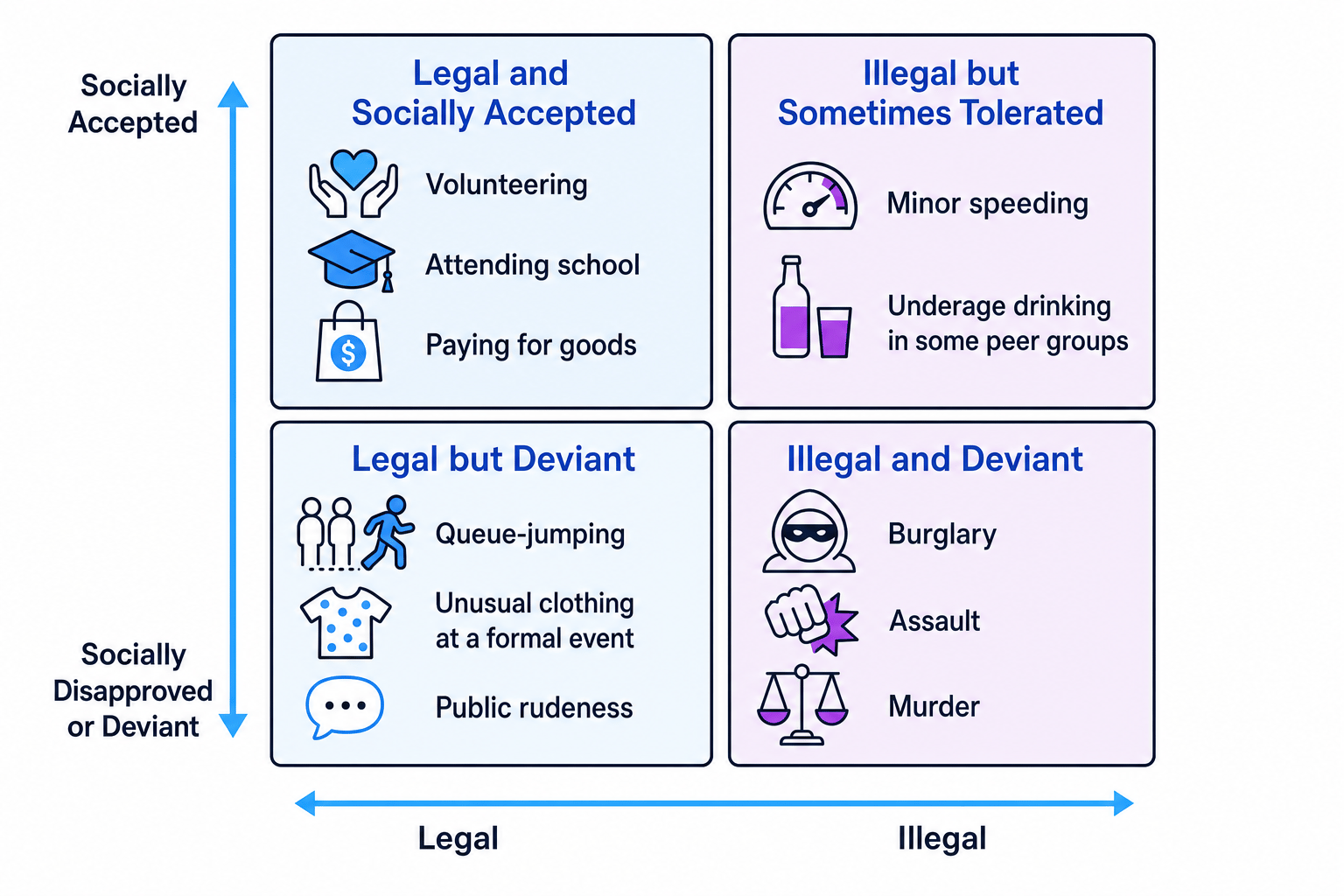
Crime and deviance: similar, but not the same
Crime
Crime is behaviour that breaks the formal criminal law of a society and can be punished by agencies of social control such as the police, courts and prisons.
Deviance
Deviance is behaviour that goes against the norms, values or expectations of a social group or society. It may be disapproved of, mocked, punished or labelled as “strange”, even if it is not illegal.
So, crime depends on law, while deviance depends on social norms. Sometimes the same act is both criminal and deviant, such as burglary. But not always.
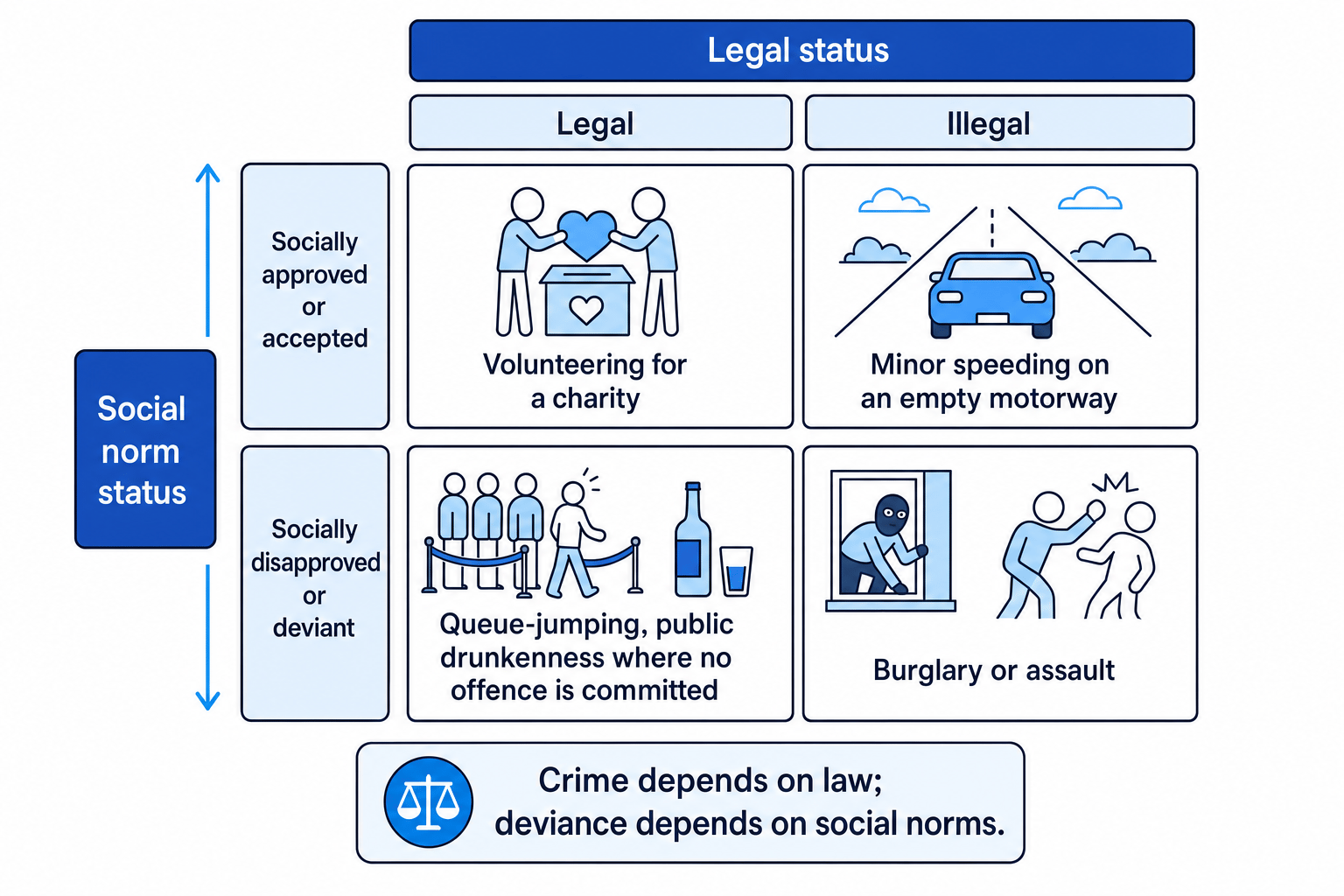
Four possible combinations
| Type of behaviour | Example |
|---|---|
| Legal and socially accepted | Volunteering, attending school, paying for goods |
| Illegal but sometimes tolerated | Minor speeding, underage drinking among some peer groups |
| Legal but deviant | Queue-jumping, unusual clothing in a formal setting, public rudeness |
| Illegal and deviant | Murder, assault, burglary |
Using crime and deviance as synonyms
Do not write as if all deviance is criminal or all crime is seen as deviant. A strong answer separates the legal question from the norms question.
Classifying cannabis possession
Imagine a young adult possesses cannabis at a private party.
- Apply the law first: cannabis possession is illegal in the UK under the Misuse of Drugs Act 1971, so the behaviour is a crime.
- Apply the norms of the group: among some friendship groups it may be seen as ordinary or low-risk, while among parents, teachers or employers it may be strongly disapproved of.
- Reach a sociological judgement: the same act can be clearly criminal but only deviant in some social contexts, showing that deviance depends on social reaction as well as behaviour.
What does “social construct” mean?
Social construct
A social construct is an idea, category or label that is created and given meaning by society, rather than being fixed naturally or biologically.
Calling crime and deviance “social constructs” does not mean harmful acts are imaginary. Violence, theft and abuse have real victims. It means that societies decide:
- which behaviours count as crimes;
- which behaviours are treated as normal, immoral or dangerous;
- which people are labelled as “deviant”;
- how seriously different forms of harm are treated.
For example, male homosexuality was partly decriminalised in England and Wales in 1967. The behaviour did not suddenly change, but the legal and moral definition changed. Marital rape was only legally recognised as rape in England and Wales in 1991. Again, the harm existed before, but the law and dominant social attitudes had not defined it in the same way.
Social construction is about change
If definitions vary across time, place and social group, sociologists treat them as socially constructed rather than naturally fixed.
Using legal change as evidence
Take the example of marital rape becoming recognised in law in 1991.
- Compare the same behaviour across time: forced sex within marriage existed before and after 1991, so the behaviour itself was not new.
- Identify the change in definition: the legal system changed from treating marriage as limiting prosecution to recognising the wife’s independent consent.
- Link to power and culture: feminist campaigning and changing gender norms challenged patriarchal assumptions about husbands’ rights and women’s bodies.
- Evaluate carefully: the example proves definitions change, but it does not mean the harm was not real before the law changed.
Why power matters
Definitions of crime and deviance are not created equally by everyone. Some groups have more power to make rules, enforce rules and shape public opinion.
Functionalist view: crime marks society’s boundaries
Durkheim argued that crime is normal in all societies because not everyone can be equally committed to shared norms. When people react against crime, they reaffirm the moral boundaries of society. For example, public anger after a murder can strengthen shared values about the sanctity of life.
AO3 evaluation: functionalists are useful for explaining why societies react to deviance, but they can overstate consensus. In unequal societies, people may not agree on whose behaviour is really harmful.
Marxist view: law reflects class power
Marxists argue that laws often protect the interests of the powerful. Property crimes by working-class people may be heavily policed, while corporate crimes, tax avoidance or unsafe working practices may receive less media attention or weaker punishment.
Chambliss argued that law creation and enforcement are influenced by ruling-class interests. Hall et al. in Policing the Crisis (1978) argued that media and state concern about “mugging” helped distract attention from wider economic and political crisis.
AO3 evaluation: Marxism is strong on power and stratification, but not every law obviously benefits capitalism. Laws against domestic violence, discrimination and unsafe workplaces can also protect less powerful groups.
Feminist view: definitions reflect patriarchy
Feminists focus on how male power has shaped definitions of crime and deviance. Historically, violence against women, sexual harassment and domestic abuse were often minimised or treated as private matters. More recent policies, such as the Domestic Abuse Act 2021, show changing definitions of harm and control.
AO3 evaluation: legal reform matters, but feminists would argue that enforcement and everyday culture may lag behind. A behaviour can be illegal while victims still face disbelief, stigma or low conviction rates.
Interactionist view: deviance is created through labelling
Becker (1963) argued that “deviance is not a quality of the act” but a result of how others react to it. Powerful groups create rules, and people become deviant when they are successfully labelled as outsiders.
This links to identity. If someone is repeatedly treated as a troublemaker, criminal or “problem youth”, the label may affect how they see themselves and how others treat them.
The role of the media
Media
The media are institutions and platforms that communicate messages to large audiences, including newspapers, television, radio, film, websites and social media.
The media do not simply reflect crime and deviance. They can help construct them by selecting which stories to cover, how to frame them, which groups to blame and which solutions to present.
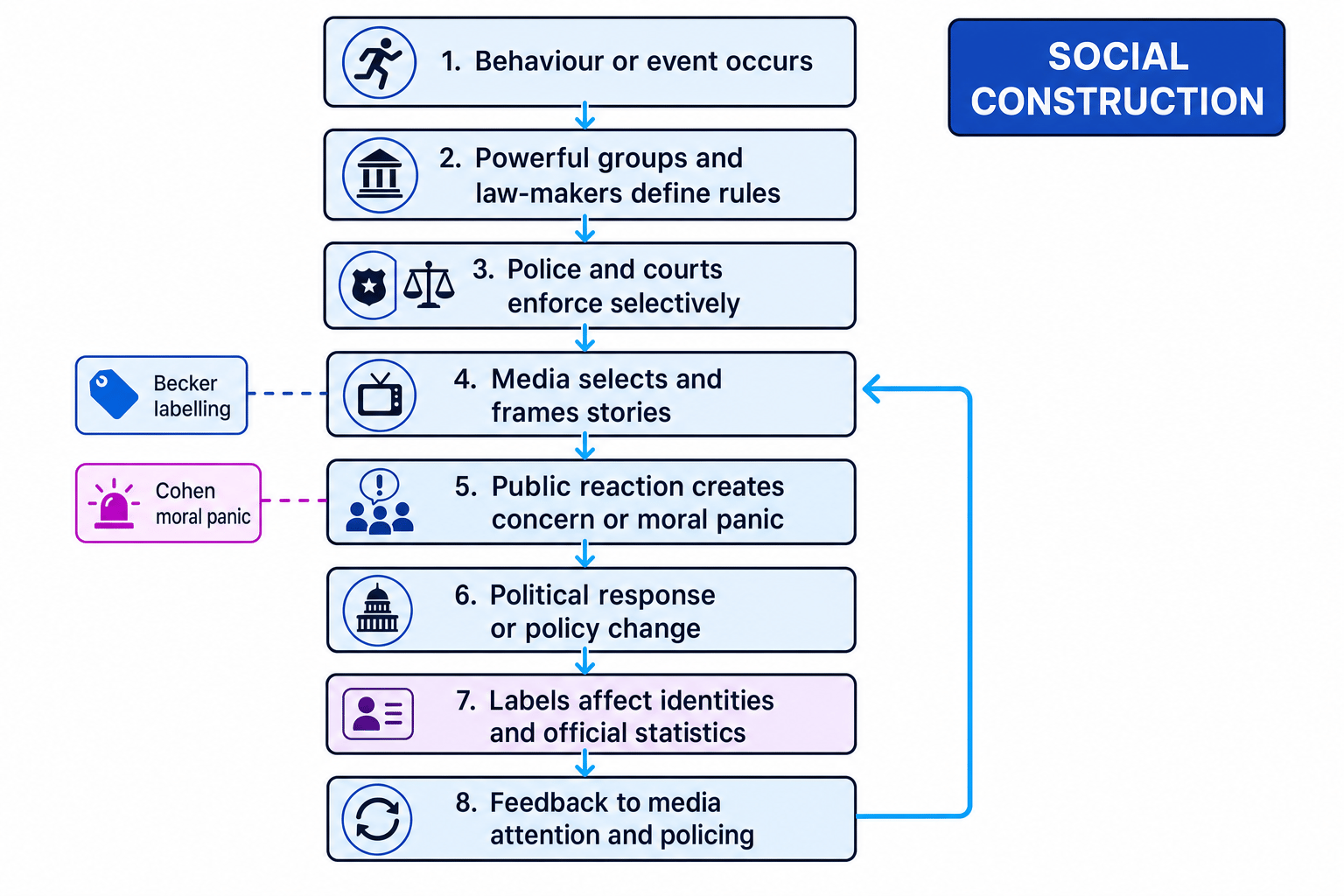
Selection and framing
Media organisations choose stories using news values, such as drama, violence, novelty, conflict and personalisation. This means rare but shocking crimes may receive more attention than common but less dramatic harms.
For example, knife crime is a serious issue, but intense reporting can make audiences overestimate how likely they personally are to be victims. Meanwhile, corporate crime, environmental harm or financial fraud may be less visible, even when the social cost is high.
Moral panics and folk devils
Moral panic
A moral panic is an exaggerated social reaction to a group or behaviour that is presented as a serious threat to society’s values and safety.
Cohen (1972) studied media coverage of the Mods and Rockers in the 1960s. He argued that the media turned youth groups into folk devils, meaning groups portrayed as symbols of danger or moral decline. This can lead to deviancy amplification, where attempts to control deviance make the problem appear worse or even encourage further deviance.
Applying moral panic to anti-social behaviour
Imagine newspapers repeatedly describe teenagers gathering outside shops as “feral gangs”.
- Identify the folk devil: young people in public spaces are presented as a threatening group, not just individuals behaving differently.
- Analyse the framing: words such as “feral” or “out of control” suggest moral decline and danger, even if the behaviour includes ordinary socialising.
- Connect to social control: public concern may encourage more policing, dispersal orders or local restrictions.
- Consider amplification: teenagers who feel unfairly targeted may distrust police or adopt the deviant identity being placed on them.
- Evaluate the claim: some behaviour may genuinely harm residents, so the best answer balances media exaggeration with real victim experiences.
Good AO2 examples
Useful UK examples include media coverage of knife crime, county lines, anti-social behaviour, benefit fraud, online abuse, dangerous dogs, protest policing and violence against women and girls.
Methods link: crime statistics are constructed too
Official crime statistics are not a perfect mirror of crime. They depend on what the law defines as criminal, whether victims report incidents, whether police record them and how agencies classify them.
The Crime Survey for England and Wales can reveal some unreported victimisation, so it may have higher validity for certain offences than police recorded crime. However, it also has limits, such as excluding some groups or relying on memory and willingness to disclose.
This is important for Eduqas because it links theory to methods:
- Positivists may value large-scale crime data for patterns and trends.
- Interpretivists ask how meanings, labels and reporting decisions shape those data.
- Media attention can increase reporting or policing, making recorded crime rise even if actual behaviour has not increased.
Bringing it together for essays
A strong paragraph usually does four things:
- Defines the concept precisely.
- Applies it to a real example.
- Links it to a named theory or study.
- Evaluates it using power, evidence, methods or an alternative perspective.
For this topic, keep returning to the central idea: definitions of crime and deviance are shaped by law, norms, power, culture, socialisation, identity and media representation.
In the exam
- Separate crime from deviance first: state whether you are discussing law, social norms, or both.
- Use named sociologists: Becker for labelling, Cohen for moral panics, Durkheim for boundary maintenance, Marxists or feminists for power.
- Apply to contemporary UK society: use examples such as cannabis, knife crime reporting, domestic abuse law, online harms or anti-social behaviour.
- Evaluate the “social construct” claim: acknowledge that definitions change, but avoid implying that harm and victimisation are not real.
Check yourself
- Can you explain one behaviour that is criminal but not always seen as deviant?
- How would Becker explain the creation of a deviant identity?
- What role can the media play in creating a moral panic?