What you'll learn
- How sociologists define health, illness, disease, impairment and disability.
- Why these categories are seen as socially constructed, not just biological facts.
- How medicalisation and professional power shape people’s identities and life chances.
- How UK health policies affect the role of doctors, nurses, therapists and other health professionals.
1. Start with the core vocabulary
In everyday speech, people often use “health”, “illness” and “disability” as if they are obvious. Sociology slows this down: it asks who defines these terms, whose interests are served, and what consequences follow.
Core terms
- Health: often defined as physical, mental and social wellbeing. The World Health Organization (1948) famously defined it as more than just the absence of disease.
- Disease: a condition identified through medical knowledge, such as infection, cancer or diabetes.
- Illness: the person’s lived experience of feeling unwell or not being able to function as usual.
- Sickness: the social status of being recognised by others as ill, for example being allowed time off school or work.
- Impairment: a physical, sensory, cognitive or mental difference or limitation.
- Disability: disadvantage or restriction caused by social barriers, such as inaccessible transport, stigma or inflexible workplaces.
Blaxter (1990) found that people define health in different ways: as not being ill, as being able to carry out normal activities, or as having energy and resilience. This matters because definitions of “good health” are shaped by culture, age, gender, class and social expectations.
2. Social construction: not “made up”, but socially given meaning
A social construction is an idea or category that is created and maintained through social processes: language, culture, institutions, professional knowledge, law and everyday interaction.
Saying health and illness are socially constructed does not mean pain, disease or impairment are imaginary. It means that societies decide what counts as “normal”, what needs treatment, who is blamed, and who receives support.
Social construction
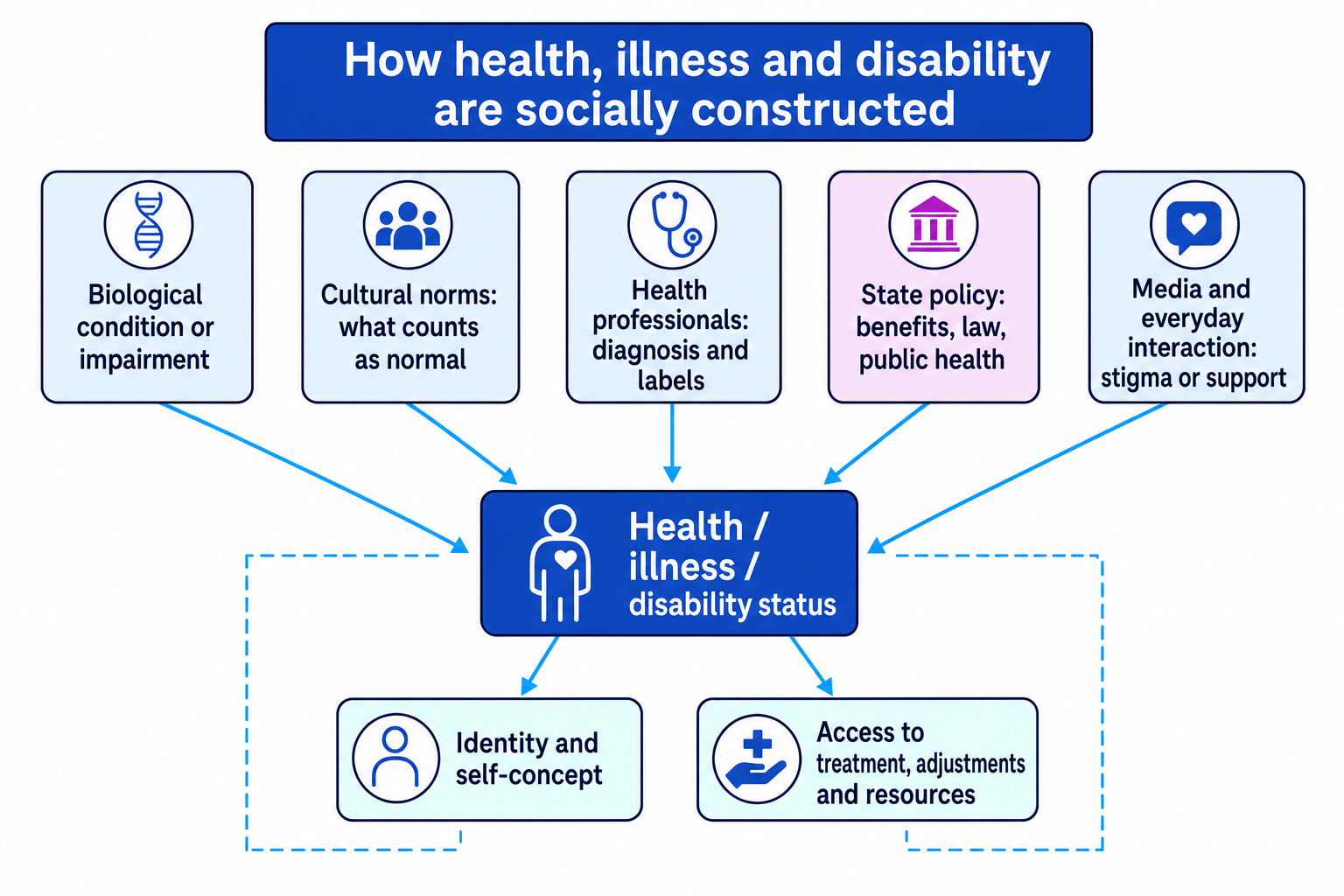
Biology may provide the condition, but society shapes its meaning, label and consequences.
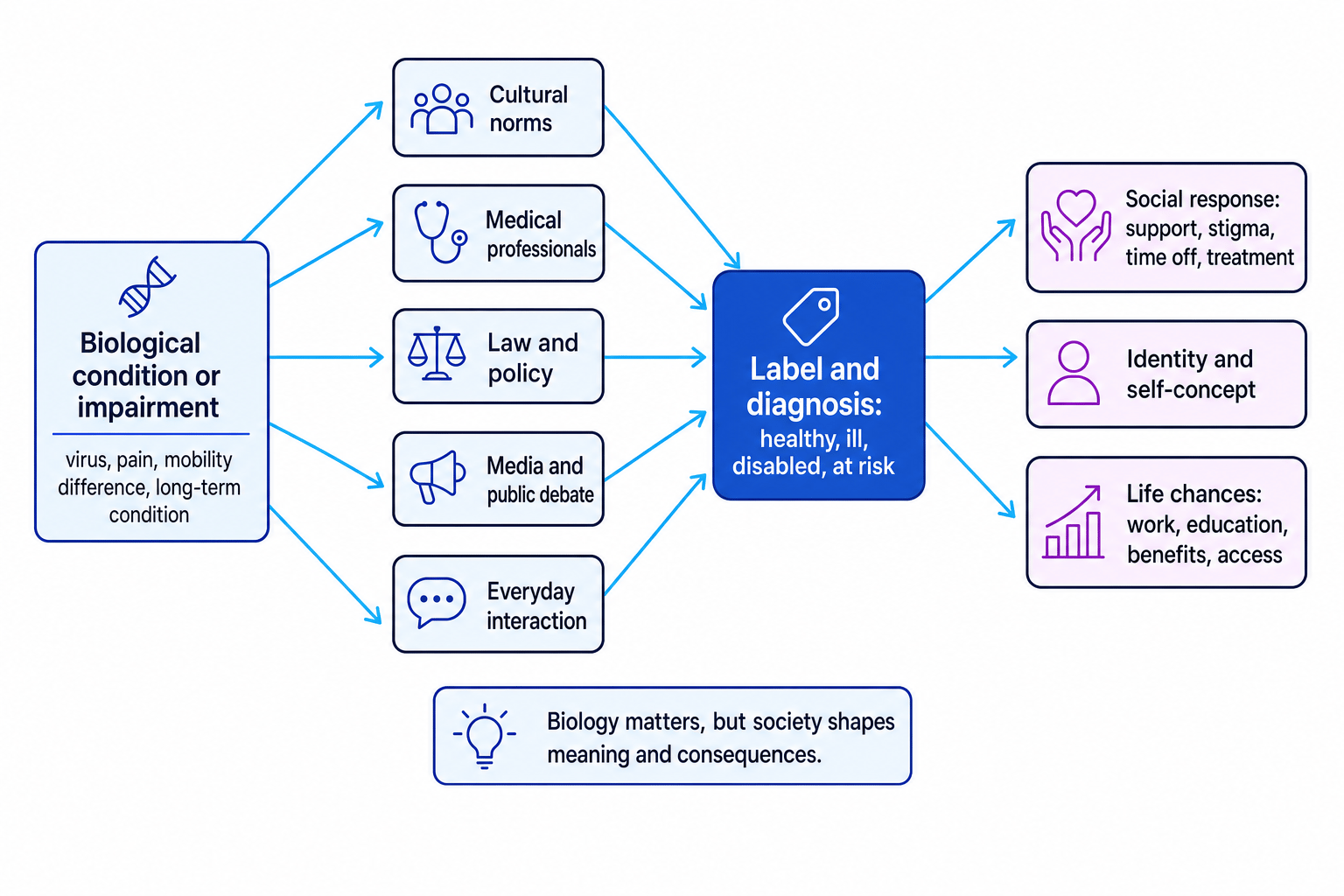
The diagram below summarises how a biological condition becomes a social status through cultural norms, professional diagnosis, policy and everyday reactions.
For AO2, use contemporary UK examples. Mental health awareness campaigns have made anxiety and depression more speakable than in previous generations. Long COVID became recognised partly through patients, doctors, research and media pressure. At the same time, some conditions remain stigmatised or doubted, especially when symptoms are invisible.
Applying social construction to obesity
- Start with the biological element: obesity may involve body weight, metabolism, health risks and medical measurement.
- Add cultural meaning: in some settings it is treated as a failure of self-control, while in others body size is less morally judged.
- Add institutional power: GPs, public health campaigns, calorie labelling and weight-management services help define obesity as a medical and policy issue.
- Evaluate the construction: medical recognition may improve treatment, but it can also individualise problems linked to poverty, food deserts, work patterns and advertising.
Social construction does not mean fake
Do not write as if sociologists deny biological reality. The stronger answer is: biology matters, but society decides how conditions are interpreted, labelled and responded to.
3. Illness as a social role: Parsons
Parsons (1951), a functionalist sociologist, argued that illness can threaten social order because it stops people performing expected roles, such as worker, parent or student. He described the sick role: society gives ill people certain rights, but also expects certain duties.
The sick person is usually not blamed for being ill and may be excused from normal responsibilities. However, they are expected to want to recover and to seek competent medical help. Doctors act as gatekeepers, deciding whether the person is legitimately sick.
Testing the sick role against chronic illness
- Apply Parsons to flu: the person is temporarily excused from work or school and is expected to rest, recover and return to normal roles.
- Compare this with diabetes or chronic pain: recovery may not be possible, so the idea of “getting better” is too simple.
- Draw the AO3 point: Parsons is useful for short-term illness, but weaker for long-term conditions, disability and contested illnesses.
AO3 evaluation: Parsons assumes broad agreement between patients, doctors and society. Interactionists argue that illness labels can be negotiated and contested. Conflict theorists add that class, gender and ethnicity affect whether people are believed, treated quickly or blamed for their condition.
4. Medicalisation and professional power
Medicalisation
Medicalisation is the process where human experiences or social problems come to be defined and treated as medical issues.
Examples include childbirth, menopause, ADHD, addiction, grief, obesity and some forms of anxiety. Medicalisation can be helpful: it may reduce blame, provide treatment and give people access to adjustments. But it can also expand professional control over everyday life.
Zola (1972) argued that medicine had become a major institution of social control. Illich (1976) criticised modern medicine for creating iatrogenesis, meaning harm caused by medical treatment or by over-dependence on medical experts. Conrad (2007) showed that medicalisation is driven not only by doctors, but also by pharmaceutical companies, patient groups, media and consumers.
Foucault (1973) used the idea of the medical gaze: professionals are trained to view the body through clinical categories, sometimes separating the “case” from the whole person. Freidson (1970) argued that doctors gained professional dominance, meaning high status, specialist knowledge and control over diagnosis and treatment.
Analysing medicalisation of ADHD
- Identify the behaviour being medicalised: difficulty concentrating, impulsivity and hyperactivity may be defined as symptoms of ADHD.
- Look at the institutions involved: schools, parents, GPs, psychiatrists and diagnostic manuals all help shape whether behaviour is treated as medical.
- Consider benefits: diagnosis may give access to medication, classroom support and reduced moral blame.
- Consider criticisms: it may pathologise children’s behaviour while ignoring school pressure, poverty, trauma or narrow ideas of “normal” behaviour.
5. Disability: medical model and social model
The medical model of disability sees disability mainly as a problem within the individual body or mind. The solution is treatment, cure, rehabilitation or professional care.
The social model of disability, associated with Oliver (1990) and the disabled people’s movement, separates impairment from disability. It argues that society disables people through barriers: stairs without ramps, lack of British Sign Language provision, inaccessible websites, discrimination and low expectations.
| Question | Medical model | Social model |
|---|---|---|
| Where is the problem located? | In the individual body or mind | In social barriers and unequal power |
| Main solution | Treatment or cure | Accessibility, rights and social change |
| Key focus | Professional expertise | Disabled people’s voices and inclusion |
Goffman (1963) is useful here because his concept of stigma shows how labels can damage identity. A person may be treated as “less capable” because others respond to the label, not the person’s actual abilities.
AO2 policy link: the Equality Act 2010 defines disability legally and requires “reasonable adjustments” in workplaces, education and services. This reflects some social model thinking because it places duties on institutions, not just individuals.
AO3 evaluation: Shakespeare (2006) argues that the social model is politically powerful, but can underplay the real pain, fatigue or limitation some impairments involve. A balanced answer should recognise both social barriers and embodied experience.
6. Health policy and the changing role of health professionals
Health professionals include doctors, nurses, midwives, psychiatrists, occupational therapists, physiotherapists, public health workers and social care professionals. Their role is shaped by policy, not just by medical science.
The creation of the NHS in 1948 expanded access to healthcare and strengthened the role of professionals as providers of state-funded care. More recent policies have shifted professionals towards prevention, risk management and multi-agency working.
Examples include:
- NICE guidelines: standardise treatment decisions, increasing consistency but limiting professional autonomy.
- Public health policies such as the 2007 smoking ban and the Soft Drinks Industry Levy 2018: make professionals part of prevention and lifestyle advice.
- Equality Act 2010 and Care Act 2014: push professionals to consider wellbeing, accessibility and support needs beyond narrow medical treatment.
- Fit notes and disability benefit assessments: involve professionals in judging work capacity, which can be controversial because it links health to welfare entitlement.
Methods link
Official statistics on illness and disability can look objective, but they depend on definitions, diagnosis and reporting. Interviews with patients may give higher validity about lived experience, while official data may be more reliable for tracking broad patterns.
AO3: Policies can improve rights and reduce inequality, but they can also increase surveillance. A Marxist or Foucauldian answer might argue that modern health policy encourages people to monitor their bodies, manage risks and remain productive workers. Tudor Hart’s “inverse care law” (1971) is also useful: those who most need healthcare may have the least access to high-quality care.
In the exam
- Define the key concept first: health, illness, disability, social construction or medicalisation.
- Apply it to a concrete example, such as mental health, obesity, ADHD, long COVID, disability access or NHS policy.
- Evaluate by comparing perspectives: functionalism, interactionism, feminism, Marxism, Foucault or the social model of disability.
- Link back to power and stratification: ask who has authority to label, who is believed, and who gains or loses resources.
Check yourself
- What is the difference between disease, illness and sickness?
- How does medicalisation show the power of health professionals?
- Why might the social model of disability be both useful and limited?