What you'll learn
- How crime and deviance appear to be distributed by social class, gender, ethnicity and age.
- Why official statistics do not simply “show who commits crime”.
- Key sociological explanations, including strain theory, Marxism, feminism, labelling theory and subcultural theory.
- How to evaluate patterns using power, socialisation, culture, identity and research methods.
Starting point: what does “social distribution” mean?
Social distribution of crime and deviance
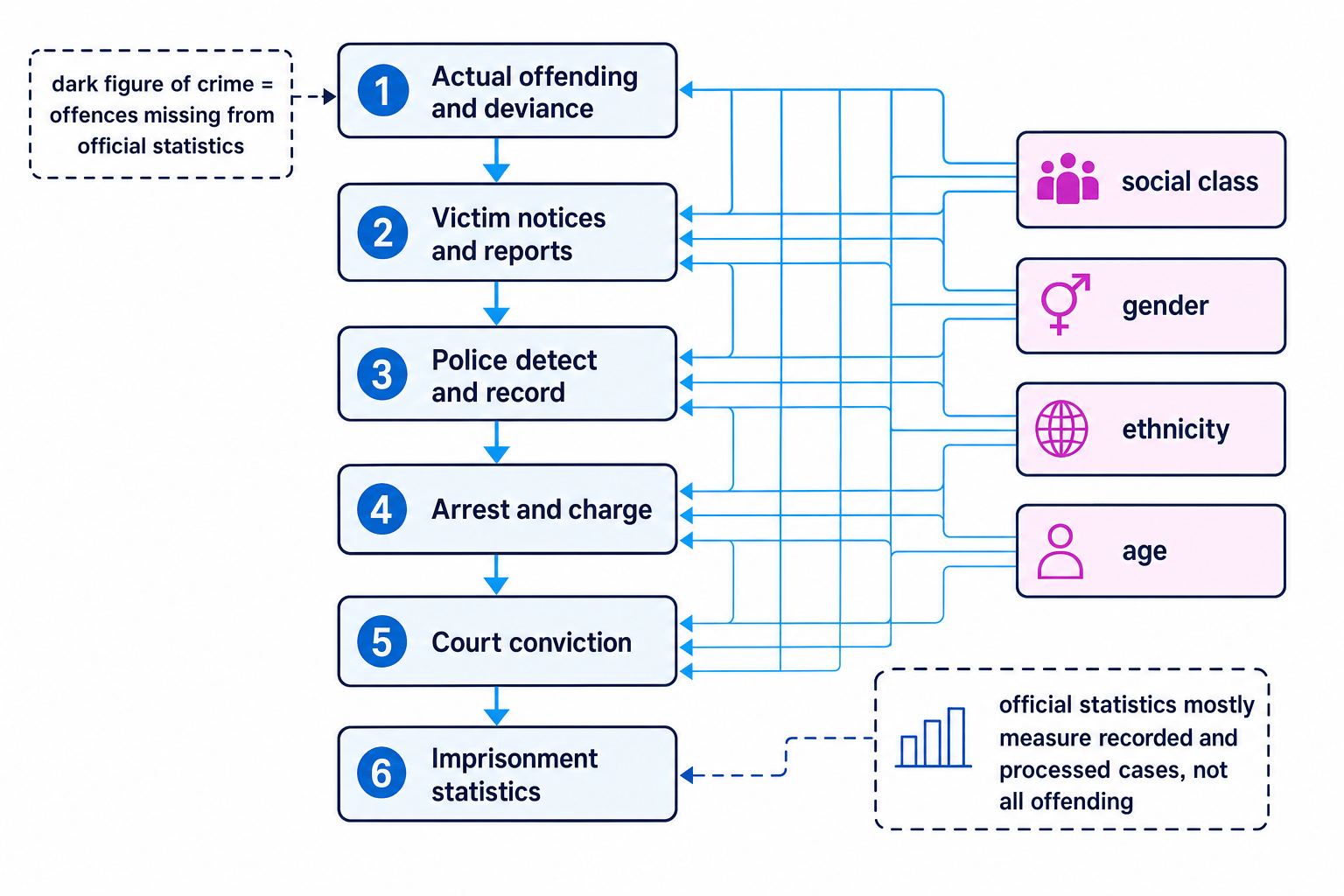
The social distribution of crime and deviance means the pattern of who is more or less likely to be recorded as offending, victimised, suspected, stopped, arrested, convicted or imprisoned across social groups such as class, gender, ethnicity and age.
A key word here is recorded. Sociologists are not only interested in who commits crime, but also in who is noticed, reported, policed, prosecuted and punished.
Crime and deviance
A crime is behaviour that breaks the criminal law. Deviance is behaviour that goes against social norms, meaning the informal rules and expectations of a society or group.
So, for this topic, you need to avoid treating crime statistics as a perfect mirror of reality. They are useful, but they are shaped by reporting behaviour, police priorities, legal definitions and social power.
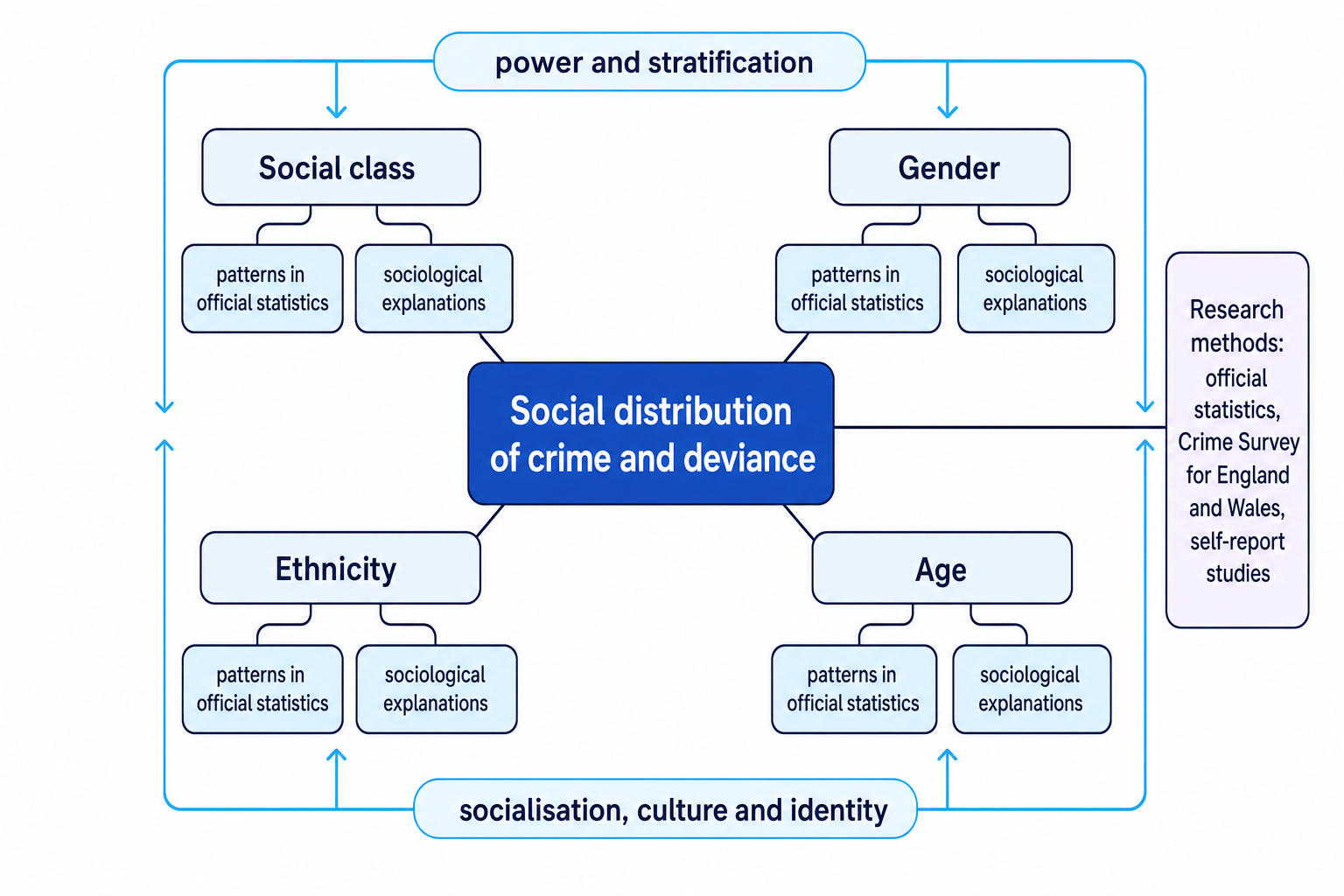
This topic is easiest if you hold four factors together: class, gender, ethnicity and age. Each factor affects both actual opportunities for crime and the way people are labelled by agencies of social control.
The big idea
Patterns of crime are not just about individual choices. They are also shaped by socialisation, inequality, policing, labelling and access to power.
The evidence: where do crime patterns come from?
Official statistics
Official crime statistics
Official statistics are numerical data collected by the state, such as police-recorded crime, court statistics, prison data and Ministry of Justice figures.
Official statistics often show clear patterns: men, young people, working-class people and some minority ethnic groups are over-represented at different stages of the criminal justice system.
However, these statistics depend on whether an offence is detected, reported and recorded. This means they may be affected by the dark figure of crime.
Dark figure of crime
The dark figure of crime refers to crime that happens but does not appear in official statistics because it is not reported, detected or recorded.
The Crime Survey for England and Wales, often shortened to CSEW, is a victimisation survey. It asks people about their experiences of crime, including some crimes not reported to police. Self-report studies ask people to admit their own offending. These can reveal different patterns from official statistics.
Interpreting a crime pattern
Imagine a source says: “Young working-class males are over-represented in police-recorded street robbery.”
- Identify what the statistic actually measures: it measures police-recorded street robbery, not all robbery and not all crime.
- Apply a sociological explanation: Merton’s strain theory could argue that blocked access to legitimate success may push some people towards illegitimate means.
- Add a methodological evaluation: the pattern may partly reflect police patrols and stop-and-search in deprived urban areas, so it could show both offending patterns and selective enforcement.
Taking statistics at face value
Do not write as if official statistics automatically prove that one group is more criminal. Say they show who is recorded or processed by the criminal justice system, then discuss why.
Social class and crime
The pattern
Official statistics often show working-class people, especially those from deprived areas, as more likely to be convicted or imprisoned. Deprived neighbourhoods may also experience higher victimisation, meaning residents are more likely to be victims as well as suspects.
But this does not mean middle-class and upper-class crime is rare. It may be less visible. White-collar crime refers to crime committed by people in professional or business settings, such as fraud, tax evasion or insider trading. Corporate crime is crime committed by or on behalf of organisations, such as unsafe working conditions or environmental offences.
Explanations
Merton developed strain theory. He argued that societies encourage people to pursue culturally approved goals, such as wealth and success, but not everyone has equal access to legitimate means, such as good education and secure employment. Some may adapt through innovation, using illegitimate means to achieve accepted goals.
Marxists argue that capitalism creates inequality and that the law tends to protect the interests of the powerful. Chambliss argued that some laws reflect ruling-class interests. Snider suggested capitalist states are reluctant to enforce laws that seriously challenge profitable corporations.
Class and power
Working-class crime is often more visible and heavily policed, while middle-class and corporate crime may be more hidden, complex and less likely to lead to imprisonment.
Evaluation
Class-based explanations are useful because they connect crime to poverty, exclusion and inequality. For AO2, you could apply this to debates about food poverty, insecure work, housing estates, or the impact of austerity on deprived communities.
However, not all working-class people commit crime, and many middle-class people do. Left realist sociologists such as Lea and Young argue we should take working-class crime seriously because it often harms working-class victims most. This is a useful challenge to theories that focus only on labelling.
Gender and crime
The pattern
Official statistics consistently show males are more likely than females to be arrested, convicted and imprisoned, especially for violent and sexual offences. Women are more commonly associated in official data with lower-level offences, although this pattern varies by offence type.
Explanations
Functionalist and socialisation approaches argue that boys and girls may be taught different gender roles. Boys may be encouraged towards risk-taking, toughness and public space, while girls may be socialised into care, respectability and greater informal control.
Heidensohn argued that women are controlled more closely than men: at home, in public and at work. This can reduce opportunities for crime. Carlen, in her study of working-class women, argued that women may turn to crime when the “class deal” of paid work and the “gender deal” of family life fail to offer rewards.
Messerschmidt linked male crime to masculinity. Some men may use crime to “accomplish” masculinity, especially where legitimate status is blocked.
Applying gender socialisation
A question asks why young men are over-represented in violent crime.
- Link the pattern to gender identity: some boys are socialised to value toughness, dominance and risk-taking.
- Apply Messerschmidt: violence can become a way of performing masculinity when status through school or work is limited.
- Evaluate with feminism: this explains some male offending, but it must not imply all men are violent or ignore women’s offending and victimisation.
Evaluation
Feminist explanations are strong because they connect crime to patriarchy, meaning male dominance in social structures and culture. They also highlight women as victims of domestic abuse, sexual violence and harassment, which may be under-reported.
However, the “gender gap” in crime may be changing. Some argue women’s increased public role has created more opportunity for offending, though evidence for a simple “liberation causes crime” argument is mixed. It is better to say gender patterns are shaped by changing identities, opportunities, policing and reporting.
Ethnicity and crime
The pattern
In England and Wales, some minority ethnic groups are over-represented in stop and search, arrests and prison statistics. Black people, for example, have historically been disproportionately represented at several stages of the criminal justice system.
But ethnicity data must be handled very carefully. Ethnic categories are broad, and statistics may reflect policing practices, poverty, area, age profile and racism as well as offending.
Explanations
Labelling theorists argue that some groups are more likely to be stereotyped as suspicious. Becker argued that deviance is not simply the act itself, but the result of social reaction and labelling.
Hall et al., in Policing the Crisis, argued that the 1970s “mugging” panic connected race, crime and moral panic during a period of economic crisis. This helped justify tougher policing of Black communities.
The Macpherson Report into the Stephen Lawrence case described the Metropolitan Police as institutionally racist. The Lammy Review in 2017 also raised concerns about racial disproportionality in the criminal justice system.
Institutional racism
Institutional racism means discrimination built into the routines, assumptions and practices of organisations, even where individual members may not openly express racist beliefs.
Evaluation
Labelling and critical race perspectives are valuable because they show how power shapes who is seen as criminal. For AO2, you could apply this to debates about stop and search, county lines policing, knife crime media coverage or trust in the police.
However, you should avoid reducing all ethnic patterns to racism alone. Left realists argue that racism, unemployment and marginalisation can produce real differences in victimisation and offending in some areas. A balanced answer can say criminal justice bias and social inequality may interact.
Ethnicity paragraph shortcut
Use the phrase: “This may show disproportionality in criminal justice processing, not simply disproportionality in offending.”
Age and crime
The pattern
Crime statistics often show that younger people, especially teenagers and young adults, are more likely to be recorded as offenders. Young people are also more visible in public spaces, which can make them more likely to be stopped, challenged or labelled.
Explanations
Subcultural theories are useful here. Cohen argued that working-class boys may experience status frustration when they fail to gain respect through school. They may form delinquent subcultures where mainstream values are inverted, so rule-breaking brings status.
Cloward and Ohlin argued that young people’s deviance depends on access to illegitimate opportunity structures. For example, some neighbourhoods may offer routes into organised crime, while others produce conflict-based gangs.
Labelling theory also matters. If young people are repeatedly labelled as troublemakers, this can create a self-fulfilling prophecy, where they internalise the label and act accordingly.
Evaluation
Age patterns are convincing because youth is often a stage of identity formation, peer pressure and risk-taking. For AO2, think of media debates about anti-social behaviour, knife crime, gangs, youth justice and school exclusions.
But most young people do not commit serious crime, and many “grow out” of minor deviance. Over-policing young people may amplify deviance, as Cohen’s idea of a deviancy amplification spiral suggests: social reaction can make the problem worse.
Bringing the factors together
In essays, the strongest answers do not treat class, gender, ethnicity and age as separate boxes. They intersect.
Intersectionality
Intersectionality means that social divisions such as class, gender, ethnicity and age combine, so people’s experiences cannot be fully understood by looking at only one factor.
For example, a young working-class Black male may experience policing differently from an older middle-class White female. This does not mean every individual in a group has the same experience, but it shows how power and identity combine.
Best essay move
Compare patterns of offending with patterns of criminalisation. Offending asks who breaks rules; criminalisation asks who gets labelled, processed and punished.
Methods and evidence: how to evaluate the data
A strong Eduqas answer should include methods evaluation.
Official statistics are useful because they are large-scale, regularly collected and allow comparisons over time. This supports reliability, meaning consistency. But they may lack validity, meaning they may not measure the full reality of crime.
Victim surveys like the CSEW can uncover unreported crime, but they may exclude some groups, rely on memory, and miss crimes against businesses or “victimless” crimes. Self-report studies may reveal hidden offending, but people may lie, forget or exaggerate.
Evaluating official statistics
A source shows men are far more likely than women to be in prison.
- Use AO1: official prison statistics show the gender pattern in punishment and custody.
- Use AO2: apply this to offences such as serious violence, robbery and sexual offences, where men are heavily over-represented.
- Use AO3: evaluate that prison data show the end point of criminal justice processing, not all offending, because reporting, charging, conviction and sentencing decisions happen first.
In the exam
- Start with the pattern, but phrase it carefully: “official statistics suggest…” or “recorded crime shows…”.
- For each factor, add one explanation and one evaluation: for example, Merton for class, Heidensohn for gender, Hall et al. for ethnicity, Cohen for age.
- Keep linking to power: ask who is more visible, who is more policed, who is more likely to be believed, and whose crimes are easier to hide.
Check yourself
- Why is it risky to use official statistics as straightforward proof of who commits crime?
- How could gender socialisation help explain male over-representation in recorded crime?
- What is the difference between offending and criminalisation?