What you'll learn
- How sociologists explain social class, gender, ethnicity and age inequalities.
- The core ideas behind functionalist, New Right, Marxist, Weberian, feminist, postmodernist and racism theories.
- How to apply theories to contemporary UK examples such as pay gaps, wealth, racism, welfare and age inequality.
- How to evaluate perspectives for essay answers using AO1, AO2 and AO3.
First: what are inequality and stratification?
Sociologists are interested in why some groups have more money, status, security, health, education and political influence than others. These patterns are not random: they are often linked to social identities such as class, gender, ethnicity and age.
Inequality, stratification and life chances
- Social inequality means unequal access to resources, opportunities and rewards.
- Social stratification means society is organised into structured layers or hierarchies, with some groups above others.
- Life chances, a term associated with Weber, means the opportunities a person has for health, education, income, housing and general wellbeing.
- Power means the ability to get your way, shape decisions, or influence how society is organised.
The key issue is whether inequality is seen as necessary and fair, or as created by power and domination. You should keep linking explanations to the two big themes in sociology: socialisation, culture and identity, and power and stratification.
The main axes of inequality
Social class
Social class refers to people’s position in the economic structure, often linked to occupation, income, wealth, education and cultural advantages. Class inequality includes differences between, for example, owners and workers, professionals and routine workers, or property owners and renters.
Gender
Gender refers to socially constructed expectations about masculinity and femininity. Gender inequality includes unequal pay, domestic labour, political representation, violence against women and gendered expectations in families, education and work.
Ethnicity
Ethnicity refers to shared cultural identity, often linked to ancestry, language, religion, nationality or traditions. Ethnic inequality may involve racism, discrimination, racialised stereotypes, unequal policing, educational inequality and labour market disadvantage.
Age
Age inequality refers to unequal treatment or life chances based on age. This can affect young people, older people, or both — for example youth unemployment, age discrimination at work, pension inequality, or stereotypes about older people being dependent.
Mapping the theories
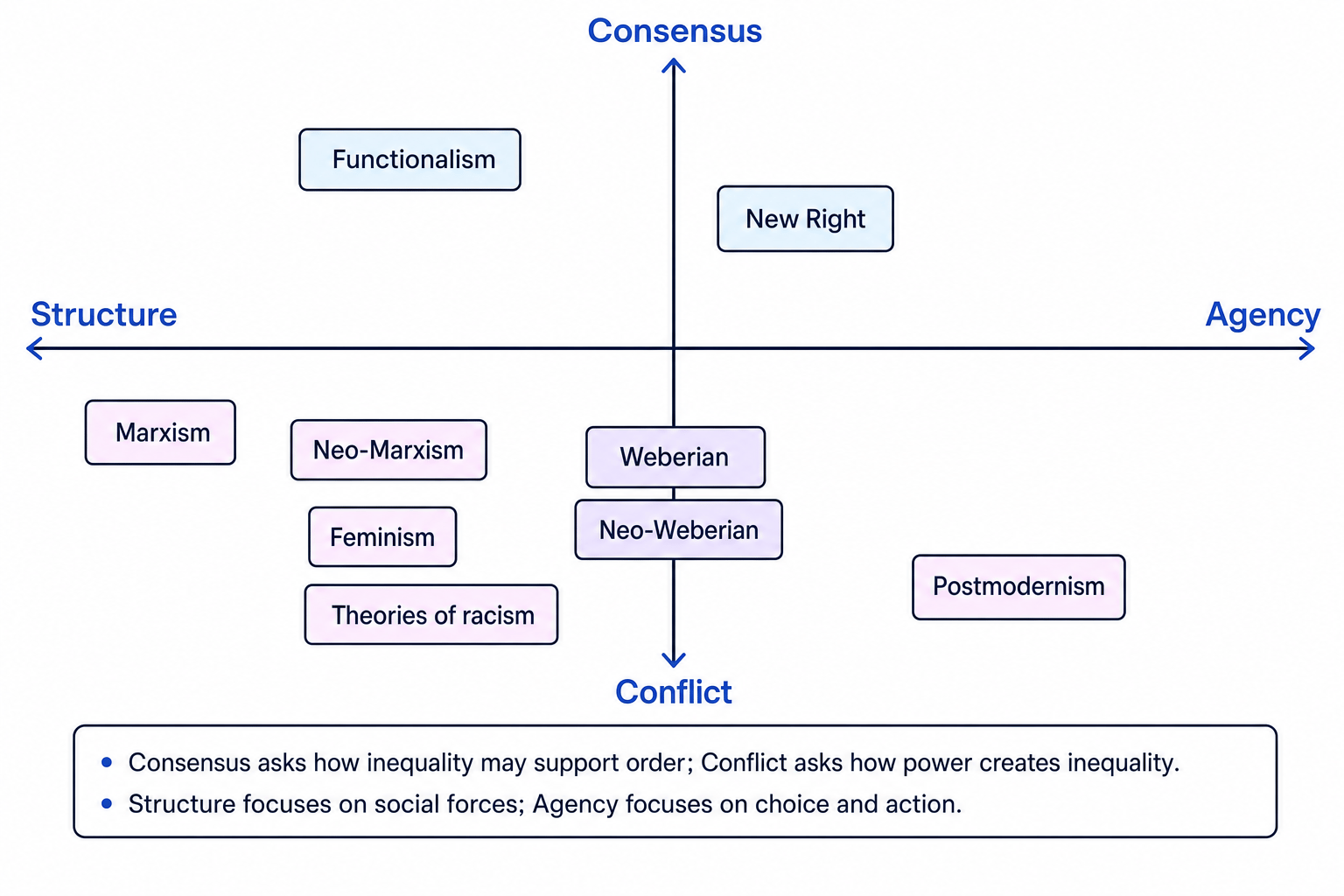
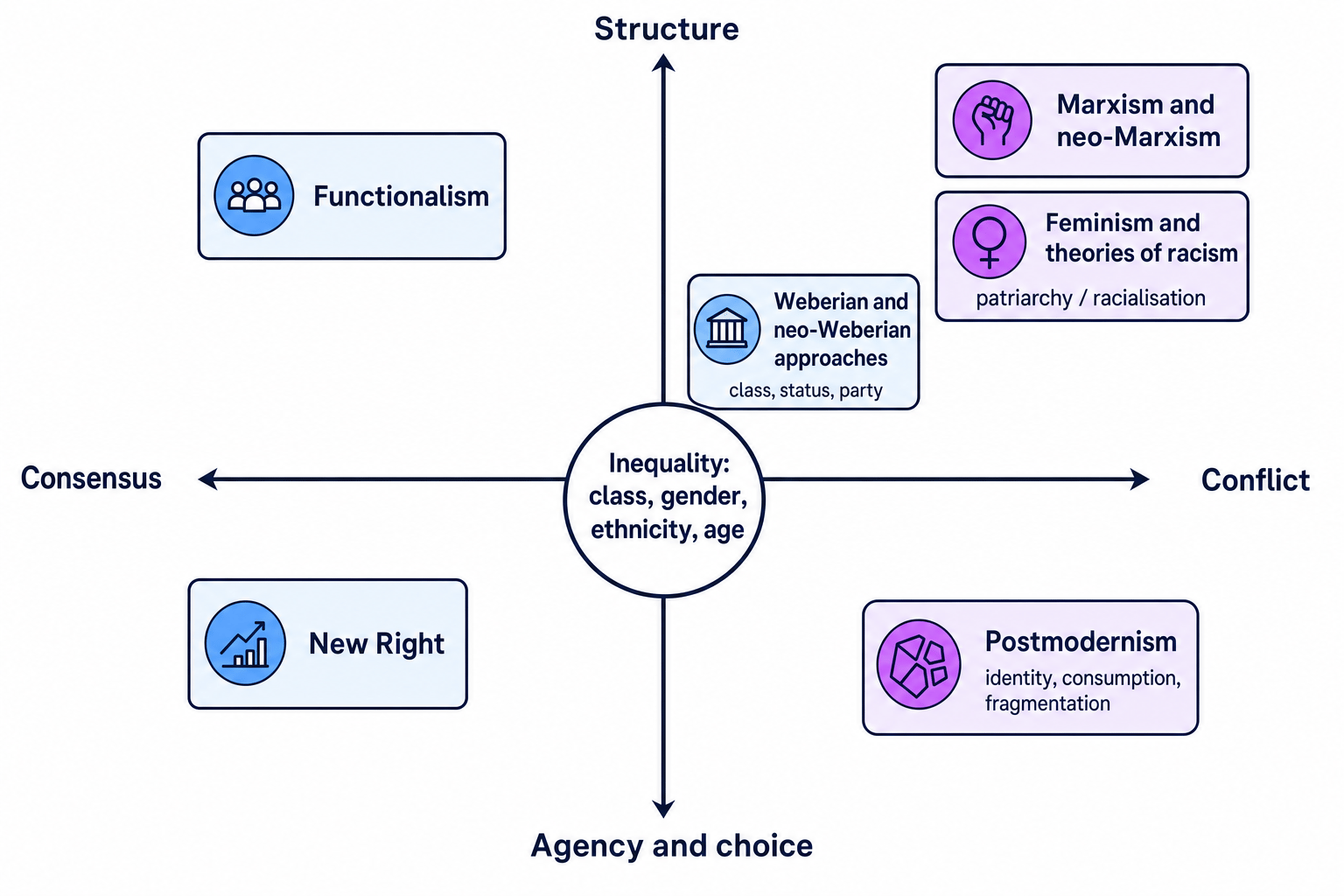
A useful way to organise the theories is to ask two questions: do they see society as based mainly on consensus or conflict, and do they emphasise social structures or individual choice?
The big divide
Consensus theories tend to see inequality as linked to social order, motivation or individual responsibility. Conflict theories see inequality as produced by unequal power between groups.
Functionalist explanations
Functionalists argue that society is like a system with different parts working together. Davis and Moore (1945) claimed stratification is necessary because important jobs require talent, training and responsibility. Higher rewards motivate people to work hard and fill these roles.
For example, functionalists might argue that doctors are paid more because their work is highly skilled and socially important. Education, in this view, helps allocate people to positions through merit.
AO2 application: In the UK, functionalists may point to exams, qualifications and professional training as ways people are sorted into different jobs.
AO3 evaluation: Tumin (1953) criticised Davis and Moore for assuming high pay always reflects importance. Care workers are socially vital but often low paid. Functionalism also underplays inherited wealth, private schooling, racism and sexism, which mean society is not fully meritocratic.
Do not confuse meritocracy with reality
A meritocracy is a society where people succeed through talent and effort. Functionalists often assume this exists, but many sociologists argue UK life chances are still strongly shaped by class, gender, ethnicity and age.
New Right explanations
The New Right is a conservative perspective that emphasises individual responsibility, free markets, competition and limited welfare. Thinkers such as Charles Murray (1984) argued that generous welfare can create dependency and an “underclass” separated from mainstream values of work and self-reliance.
AO2 application: New Right writers may interpret unemployment or poverty as linked to weak work incentives, family breakdown or welfare dependency. Debates around Universal Credit, “welfare reform” and “levelling up” can be linked here.
AO3 evaluation: Critics argue this can become victim-blaming. It often ignores low wages, insecure work, regional inequality, disability, childcare costs and discrimination. For example, the Joseph Rowntree Foundation has repeatedly shown that many people in poverty are in working households.
Marxist and neo-Marxist explanations
Marxism explains inequality through capitalism. Marx argued that capitalist society is divided between the bourgeoisie, who own the means of production, and the proletariat, who sell their labour. Inequality comes from exploitation: workers produce value, but owners take profit.
Marxists also argue that culture and socialisation help reproduce inequality. Schools, media and religion may spread ideas that make capitalism seem natural, fair or unavoidable.
Neo-Marxists update Marx’s ideas. Gramsci used the idea of hegemony, meaning rule through consent: dominant groups maintain power by shaping common sense. Althusser argued that institutions such as education and media act as ideological state apparatuses. Willis (1977) showed how working-class “lads” resisted school but still ended up in working-class jobs, reproducing class inequality.
AO2 application: Marxist ideas can be applied to wealth inequality, private education, insecure gig economy work, low-paid service jobs and the ability of wealthy groups to influence politics.
AO3 evaluation: Marxism is powerful for explaining class and capitalism, but it can be criticised for being economically deterministic. It may underplay gender, ethnicity, age and individual agency. However, neo-Marxists are more flexible because they include culture, ideology and identity.
Weberian and neo-Weberian explanations
Weber agreed that class matters, but he argued inequality is multidimensional. He identified three sources of inequality:
- Class: economic position and market situation.
- Status: social honour, prestige or respect.
- Party: political power and influence.
This means two people may have similar income but different status, or a group may use political power to protect its advantages.
Neo-Weberians developed this through ideas such as social closure, associated with Parkin. Social closure means groups restrict access to resources or opportunities. Professional groups may use qualifications, licensing and networks to keep wages and status high.
AO2 application: Doctors, lawyers and accountants can protect their position through credentials and professional bodies. Middle-class parents may use school catchment areas, tutoring and cultural knowledge to secure advantages for their children.
AO3 evaluation: Weberian theory is useful because it explains class, status and power together. It fits contemporary UK society better than a simple two-class model. However, Marxists argue it describes inequality more than it explains why capitalism creates it.
Feminist explanations
Feminism explains gender inequality through patriarchy, meaning male power and female subordination. Feminists disagree about the main cause, but they agree that gender inequality is socially produced, not natural.
Liberal feminists focus on equal rights and opportunities. They support reforms such as the Equal Pay Act 1970 and Equality Act 2010.
Marxist feminists argue women’s unpaid domestic labour benefits capitalism by reproducing the workforce. Ansley described women as absorbing men’s frustrations from capitalism.
Radical feminists see patriarchy as a deep system of male dominance, visible in violence against women, control of sexuality and gendered power in families.
Walby (1990) developed a useful theory of patriarchy with several structures, including paid work, household production, culture, sexuality, violence and the state.
Intersectional feminists, drawing on Crenshaw (1989), argue women do not all experience patriarchy in the same way. Class, ethnicity, sexuality, disability and age shape women’s life chances.
AO2 application: You can apply feminism to the gender pay gap, unequal childcare, women’s under-representation in senior politics and business, and violence against women and girls.
AO3 evaluation: Feminism explains gender power very effectively, but some versions can overgeneralise women’s experiences. Intersectionality improves this by showing how gender combines with class, ethnicity and age.
Theories of racism and ethnic inequality
Racism means beliefs, practices or structures that disadvantage people because of perceived racial or ethnic difference. Racialisation means the process of attaching racial meaning to a group, often through stereotypes.
Some theories focus on institutional racism, where organisations produce unequal outcomes even without openly racist individuals. The Macpherson Report (1999) used this concept after the police handling of the Stephen Lawrence case.
Barker (1981) described a “new racism” or cultural racism, where groups are presented as culturally incompatible rather than biologically inferior.
Marxists may argue racism divides the working class and provides capitalism with cheap labour. Hall et al. (1978) linked race, class and moral panic in Policing the Crisis, arguing that Black youth were scapegoated during a crisis of capitalism.
Weberians explain ethnic inequality through status exclusion and social closure. For example, employers, landlords or professional networks may exclude minority ethnic groups from opportunities.
AO2 application: Use examples such as ethnic pay gaps, unequal stop and search rates, housing discrimination, Islamophobia, antisemitism, or unequal health outcomes highlighted during COVID-19.
AO3 evaluation: Theories of racism are essential because class-only explanations miss racialised power. However, you should avoid treating minority ethnic groups as one single group. Official statistics are useful, but ethnic categories can be broad and may hide differences by class, gender, religion and migration history.
Age inequality
Age is also a basis of stratification. Ageism, a term associated with Butler (1969), means stereotyping or discriminating against people because of age.
Functionalists may see age roles as helping society run smoothly: childhood, adulthood and old age involve different expectations. Older functionalist theories such as disengagement theory argued that older people gradually withdraw from social roles.
Conflict and political economy approaches argue that age inequality is linked to capitalism and state policy. Phillipson argued that retirement and pensions can make older people economically dependent and less powerful.
AO2 application: UK examples include debates over the State Pension age, the “triple lock”, youth unemployment, tuition fees, unpaid internships, age discrimination in employment and intergenerational housing inequality.
AO3 evaluation: Age inequality changes over time. Some older people are wealthy homeowners with strong pensions, while others experience poverty and isolation. Similarly, young people are not all equally disadvantaged: class, ethnicity, gender and region matter.
Postmodernist explanations
Postmodernism argues that society is increasingly fragmented, diverse and shaped by choice, consumption and identity. Postmodernists are sceptical of “big stories” such as Marxism claiming one main cause of inequality.
Writers such as Bauman, Beck and Giddens suggest identity has become more reflexive and less fixed. Inequality may be experienced through lifestyles, risk, consumption and cultural identities rather than only through class.
AO2 application: Social media, consumer culture, hybrid ethnic identities, changing gender identities and flexible career paths can all support postmodern ideas.
AO3 evaluation: Postmodernism is useful for understanding identity and diversity, but it can exaggerate choice. Many inequalities remain highly structured: wealth, housing, racism, gendered violence and age-based poverty are not simply lifestyle differences.
Explaining a UK inequality pattern
Imagine an item says that women and some minority ethnic groups are over-represented in low-paid care, cleaning and hospitality work. You could build analysis like this:
- Identify the pattern as stratification because labour market position affects income, security, status and wider life chances.
- Apply a Marxist or neo-Marxist view: capitalism benefits from low-cost labour, while ideology can make poorly paid care or service work seem “natural” for certain groups.
- Add a Weberian layer: these workers may have weaker market power, while higher-status occupations use qualifications, networks and professional closure to protect rewards.
- Strengthen the answer with feminism and theories of racism: patriarchy and racialisation shape who is channelled into low-paid work, so class alone is not enough.
- Evaluate by noting that official statistics reveal patterns, but broad categories may hide differences within groups, such as by age, region, migration history or education.
Comparing perspectives quickly
| Perspective | Main explanation of inequality | Strongest for | Key criticism |
|---|---|---|---|
| Functionalism | Necessary role allocation and motivation | Social order and meritocracy | Ignores inherited privilege |
| New Right | Individual choices, markets and welfare dependency | Welfare debates | Can blame the poor |
| Marxism | Capitalist exploitation and class power | Class and wealth inequality | May underplay gender and ethnicity |
| Weberian | Class, status and party power | Multidimensional inequality | Can be more descriptive than explanatory |
| Feminism | Patriarchy and gendered power | Gender inequality | Some versions overgeneralise women |
| Theories of racism | Racialisation, institutional racism and exclusion | Ethnic inequality | Must avoid treating groups as uniform |
| Postmodernism | Fragmented identities and lifestyle differences | Identity and diversity | Can exaggerate individual choice |
Essay shortcut
A strong inequality essay usually compares at least two levels of explanation: economic structures such as capitalism, cultural processes such as socialisation and stereotypes, and institutional power such as law, education, policing or welfare policy.
In the exam
- Start with a clear theoretical claim, then apply it to a specific form of inequality: class, gender, ethnicity or age.
- Use named sociologists accurately — for example Davis and Moore, Tumin, Marx, Weber, Walby, Crenshaw, Hall or Macpherson.
- Evaluate by comparing perspectives: ask what each theory explains well, what it ignores, and whether contemporary UK evidence supports it.
Check yourself
- How would a functionalist and a Marxist explain class inequality differently?
- Why is intersectionality important when explaining gender or ethnic inequality?
- What does Weber add that is missing from a simple Marxist class model?