What you'll learn
- How police recorded crime, the British Crime Survey / Crime Survey for England and Wales, victim studies and self-report studies measure crime.
- Why sociologists talk about the dark figure of crime: crime that is hidden or not counted.
- How social policies, policing priorities and recording rules can change crime rates.
- How to evaluate crime statistics using validity, reliability, representativeness, and ideas about power and stratification.
Why measuring crime is sociological
At first, “measuring crime” sounds like a simple counting exercise: count the offences, publish the rate, compare areas or years.
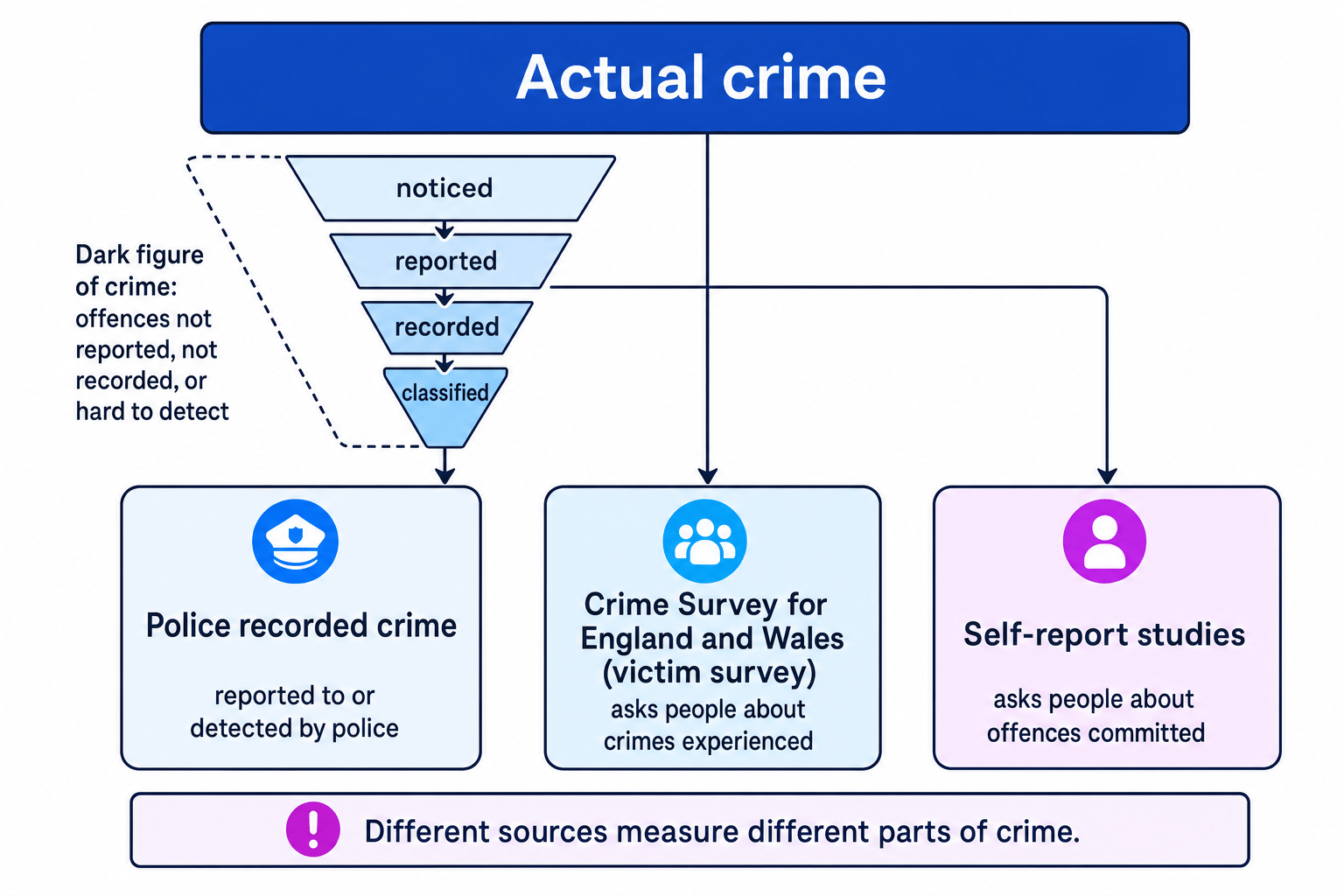
Sociologically, it is more complicated. A crime must usually be noticed, defined as criminal, reported, recorded, and classified before it appears in many official statistics. At each stage, decisions are shaped by socialisation, culture, identity, fear, trust in the police, and power.
Crime data
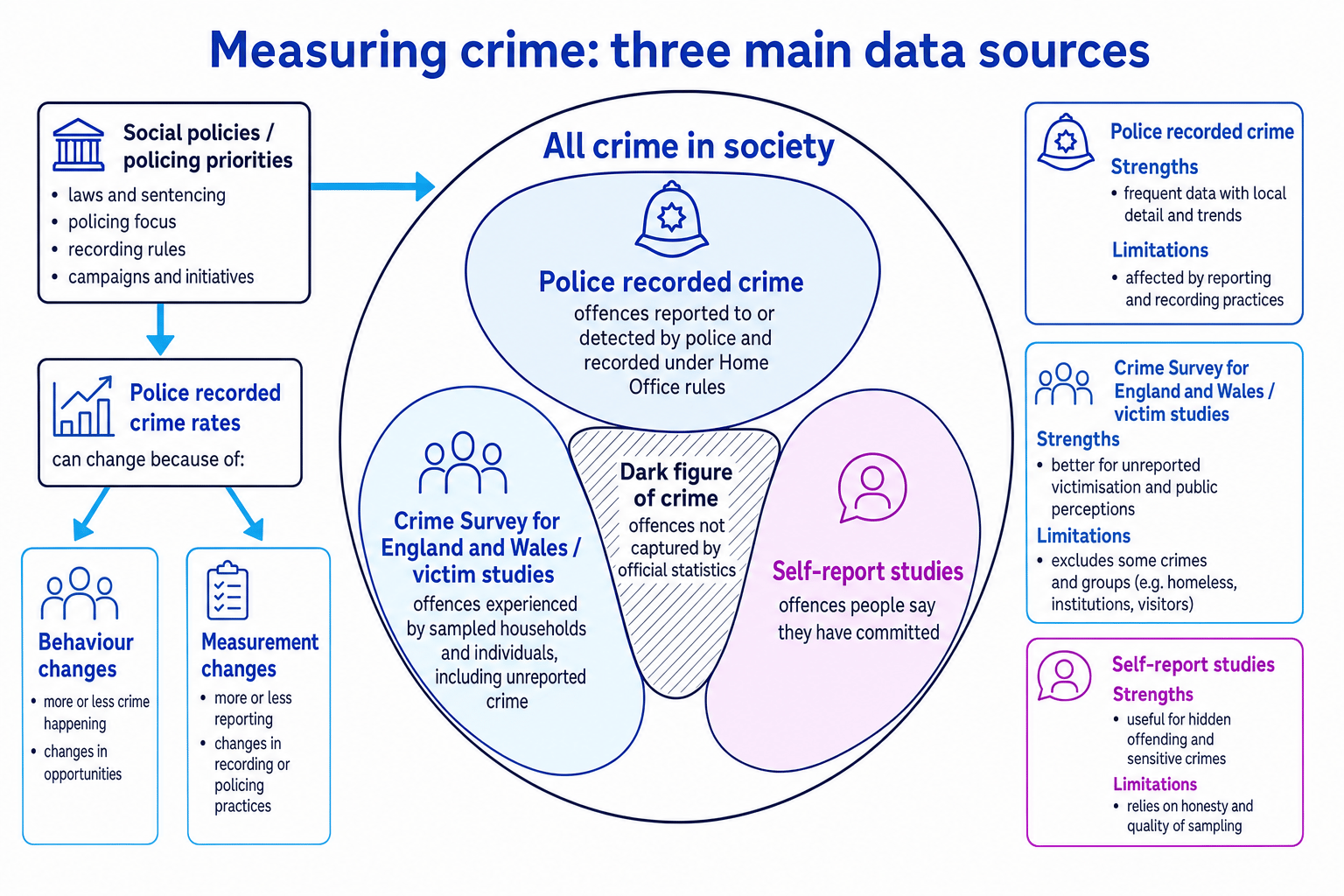
Crime data are records or survey answers used to estimate how much crime occurs, who is victimised, who offends, and how patterns change over time. Different sources measure different parts of crime.
The big idea
Crime rates are not just “facts about offending”; they are also shaped by how crime is reported, recorded, surveyed and governed.
The dark figure of crime
The dark figure of crime means offences that happen but do not appear in official police statistics. This can include crimes that victims never report, crimes the police do not record, and crimes that are difficult to detect, such as corporate crime, domestic abuse, sexual offences, cybercrime and benefit fraud.
Some crimes are hidden because victims feel shame, fear retaliation, depend on the offender, or believe the police will not help. This links to culture and identity: for example, ideas about masculinity may discourage men from reporting domestic abuse, while minority ethnic communities may have lower trust in the police due to experiences of discrimination.
It also links to power and stratification. Crimes of the powerful, such as environmental crime or financial crime, may be harder to detect and prosecute than street crimes committed by poorer groups.
Official government statistics
Official statistics are data collected or published by the state. In crime and deviance, the two most important official sources are:
- Police recorded crime
- The British Crime Survey, now called the Crime Survey for England and Wales or CSEW
Positivist sociologists often value official statistics because they appear to be large-scale, standardised and useful for identifying patterns. However, interpretivists argue that official statistics are socially constructed: they are produced through human decisions, institutional rules and social meanings.
Police recorded crime
Police recorded crime refers to offences reported to, detected by, or recorded by the police according to official recording rules, such as the Home Office Counting Rules and the National Crime Recording Standard.
Police statistics are useful because they are regular, detailed and can show local patterns. They can help governments and police forces allocate resources, for example by identifying areas with high recorded burglary, robbery or knife crime.
However, they do not measure all crime. They measure crime that reaches the police and is recorded by them.
Strengths of police statistics
Police recorded crime is useful because it:
- Is collected continuously and published regularly.
- Gives local detail, which can be useful for comparing neighbourhoods.
- Includes crimes that victim surveys may miss, such as homicide and many business crimes.
- Can show how policing priorities change, for example increased recording of hate crime or domestic abuse.
Limitations of police statistics
Police statistics are affected by:
- Reporting behaviour: victims may not report crime.
- Recording practices: police may record or classify incidents differently.
- Policing priorities: more patrols or stop and search can lead to more detected offences.
- Changes in law: new offences can increase recorded crime without behaviour necessarily changing.
- Institutional power: some groups are more likely to be monitored than others.
Cicourel argued that official statistics can reflect the assumptions and decisions of control agencies, not simply the real level of deviance. Labelling theorists such as Becker also remind us that deviance is not just an act; it is partly the result of social reaction and classification.
Interpreting a rise in recorded domestic abuse
Imagine police recorded domestic abuse rises after a new awareness campaign and improved recording rules.
- Compare possible explanations: the rise could mean more domestic abuse is happening, but it could also mean more victims are reporting or police are recording incidents more consistently.
- Apply social context: domestic abuse is often hidden due to fear, shame, financial dependence and family pressure, so campaigns can increase visibility without increasing the underlying behaviour.
- Evaluate the data source: police statistics are useful for showing increased demand on services, but they may have limited validity if you treat them as a direct measure of the true amount of domestic abuse.
- Reach a balanced conclusion: the rise is sociologically meaningful, but you should avoid claiming that offending definitely increased unless other evidence, such as survey data, supports it.
Treating police statistics as the crime rate
Police recorded crime is not the same as total crime. It is the amount of crime that is reported to or detected by the police and then recorded under official rules.
The British Crime Survey / Crime Survey for England and Wales
The British Crime Survey began in the 1980s and is now known as the Crime Survey for England and Wales. It is a large-scale victim survey, meaning it asks a sample of people about crimes they have experienced, including crimes they did not report to the police.
Victim study
A victim study asks people whether they have been victims of crime during a specific period. It is useful for estimating unreported crime and comparing police data with people’s experiences.
The CSEW is important because it can reveal the dark figure of crime. For example, if many people say they experienced theft or assault but did not report it, sociologists can question the completeness of police statistics.
Strengths of the CSEW and victim studies
Victim surveys are useful because they:
- Capture some unreported crime.
- Use a large sample, improving representativeness.
- Ask similar questions over time, helping comparisons.
- Provide information about fear of crime and victim characteristics.
This is useful for studying stratification. Victim surveys can show whether particular groups, such as young people, women, renters, poorer households or some minority ethnic groups, experience higher risks or higher fear of crime.
Limitations of victim studies
Victim studies still miss some crime. The CSEW has traditionally focused on people in private households, so it may underrepresent homeless people, people in institutions, students in halls, tourists and some very vulnerable groups. Some crimes have no direct individual victim to interview, such as drug trafficking or many corporate offences.
Victim surveys also rely on memory and willingness to disclose. Sensitive crimes, such as sexual violence, may still be underreported even in surveys.
Use the current name
In older textbooks and specification wording you may see British Crime Survey. In contemporary answers, write British Crime Survey, now the Crime Survey for England and Wales (CSEW).
Self-report studies
A self-report study asks people what offences they have committed, usually through questionnaires or interviews. These are especially useful for exploring hidden offending, minor deviance and patterns among groups who may not appear in police statistics.
Self-report study
A self-report study measures offending by asking individuals to disclose their own criminal or deviant behaviour.
Self-report studies can challenge stereotypes. For example, they may show that middle-class young people commit drug, alcohol or driving offences, even if working-class young people are more visible in police statistics. This supports the sociological point that official data may partly reflect policing and labelling, not just behaviour.
Strengths of self-report studies
Self-report studies can:
- Reveal offences not reported to police.
- Explore motivations and contexts.
- Compare hidden offending across class, gender, ethnicity and age.
- Test whether official statistics exaggerate the criminality of some groups.
Limitations of self-report studies
They depend heavily on honesty. Some people may exaggerate offending to appear tough; others may hide serious or embarrassing behaviour. Sampling can also be difficult, especially if researchers want to access serious offenders.
There are ethical issues too. Researchers must consider informed consent, confidentiality and the risk of harm, especially if participants disclose serious offences.
Choosing the best data source for youth offending
Suppose you want to research whether young people from different social classes commit similar levels of minor offending.
- Police statistics would show who is caught or recorded, but they may overrepresent groups who are more visible to police in public spaces.
- A victim survey would help with offences experienced by victims, but it would not directly tell you which young people committed them.
- A self-report study would be stronger for this question because it asks young people about their own behaviour, including hidden acts such as shoplifting, vandalism or drug use.
- The evaluation is that self-report data may be more valid for hidden offending, but reliability depends on honest answers and a well-designed sample.
Comparing the main sources
| Source | What it measures | Main strength | Main limitation |
|---|---|---|---|
| Police recorded crime | Crimes reported to, detected by and recorded by police | Regular, local, useful for policy | Affected by reporting, recording and policing priorities |
| CSEW / victim studies | Crimes people say they experienced | Captures some unreported victimisation | Misses some groups and crimes |
| Self-report studies | Crimes people say they committed | Reveals hidden offending | Depends on honesty and sampling |
The best sociological answers compare sources rather than simply listing them. For example, if police recorded robbery rises but the CSEW does not, this may suggest changes in reporting or recording. If both rise, it is stronger evidence that victimisation has increased.
Triangulation
Triangulation means using more than one research method or data source. In measuring crime, combining police data, victim surveys and self-report studies gives a fuller picture than relying on one source alone.
Social policy and changing crime rates
Contemporary social policies can affect crime rates in two different ways:
- They can change actual behaviour, by preventing or encouraging crime.
- They can change measurement, by altering reporting, recording, policing or legal definitions.
For example, the Crime and Disorder Act 1998 promoted local partnerships and anti-social behaviour policies. This may have changed both behaviour and enforcement. The Modern Slavery Act 2015 increased awareness and identification of modern slavery offences, potentially raising recorded figures. The Domestic Abuse Act 2021 and wider campaigns may encourage reporting of domestic abuse. The expansion of fraud and cybercrime measurement in the CSEW also changed what appears in national crime estimates.
Policing policy matters too. Increased use of stop and search may raise recorded drug offences because these crimes are often detected by police rather than reported by victims. This raises questions of power: if young Black men are disproportionately stopped, recorded crime may partly reflect unequal surveillance, not just unequal offending.
Separating behaviour change from measurement change
Imagine recorded drug possession offences rise in one city after police increase stop and search in nightlife areas.
- Identify the type of offence: drug possession is often police-discovered, so recorded levels are strongly affected by enforcement activity.
- Connect the policy to measurement: more stop and search creates more opportunities for police to find drugs, so recorded offences can rise even if drug use stays stable.
- Consider stratification: if searches focus on particular neighbourhoods or ethnic groups, recorded statistics may reflect unequal policing and social power.
- Evaluate with comparison: self-report studies or health data on drug use would help judge whether actual behaviour increased or whether detection increased.
Evaluation: how sociologists judge crime data
When evaluating crime statistics, use research-methods language carefully.
Reliability
Reliability means consistency. Police statistics may be less reliable if different forces record similar incidents differently. The National Crime Recording Standard was introduced to improve consistency, but inspections have still found variation.
Validity
Validity means measuring what you claim to measure. The CSEW may be more valid than police statistics for common unreported crimes, but less valid for crimes outside household victimisation, such as corporate crime.
Representativeness
Representativeness means how far findings reflect the wider population. Large national surveys aim to be representative, but non-response can still matter. Self-report studies with small or school-based samples may not represent serious offenders or excluded young people.
Practical, ethical and theoretical issues
Practical issues include cost, time, access and sampling. Ethical issues include confidentiality, harm and asking about sensitive victimisation or offending. Theoretical issues include the positivist preference for measurable patterns and the interpretivist concern that crime statistics are produced through meanings, labels and institutional decisions.
Marxist and feminist perspectives add that crime measurement can hide power. Marxists argue that corporate and state crimes may be under-recorded compared with working-class street crime. Feminists argue that domestic abuse, rape and sexual harassment have historically been underreported and under-recorded due to patriarchal attitudes.
Bringing it together for essays
A strong answer on measuring crime should not say one source is simply “best”. Instead, explain what each source captures and what it misses.
You might argue:
- Police statistics are useful for trends and local policy, but they are affected by reporting, recording and enforcement.
- Victim surveys improve validity by capturing some unreported crime, but they still exclude some offences and populations.
- Self-report studies reveal hidden offending, but they depend on honesty and careful sampling.
- Social policies may reduce crime, increase reporting, widen legal definitions, or intensify policing — all of which can affect crime rates.
In the exam
- Define the data source precisely before evaluating it: police recorded crime, CSEW/victim study, or self-report study.
- Always ask whether a change in crime rates shows behaviour change, reporting change, recording change, or policing change.
- Link evaluation to methods language: reliability, validity, representativeness, practical issues, ethical issues and positivist/interpretivist debates.
- Use contemporary UK examples, such as domestic abuse reporting, cybercrime/fraud, stop and search, modern slavery or hate crime recording.
Check yourself
- Why might a rise in police recorded crime not mean that more crime is actually happening?
- What kinds of crime are victim surveys better at measuring, and what do they still miss?
- How could social class, gender or ethnicity affect whether crime is reported, recorded or detected?