What you'll learn
- How sociologists explain global inequality using population, urbanisation, marginalisation, aid, debt and dependency.
- How feminist explanations add gender, patriarchy and unpaid care work to world sociology.
- How to build AO1, AO2 and AO3 into essay-style paragraphs.
- How to evaluate explanations using evidence, policy examples and research-methods issues.
Starting point: what are “patterns of inequality”?
In World sociology, inequality means unequal access to resources, power, opportunities and life chances. It includes income and wealth, but also health, education, housing, political voice, safety, land, technology and freedom from violence.
Patterns of global inequality
Patterns of inequality are the repeated ways advantage and disadvantage are distributed between countries and within countries. For example, inequality can exist between the Global North and Global South, between urban and rural areas, and between men and women within the same society.
The term Global South is often used for countries historically shaped by colonialism, unequal trade and lower average incomes. It is not perfect: some “Global South” countries are powerful emerging economies, and poverty also exists in the UK and other richer countries.
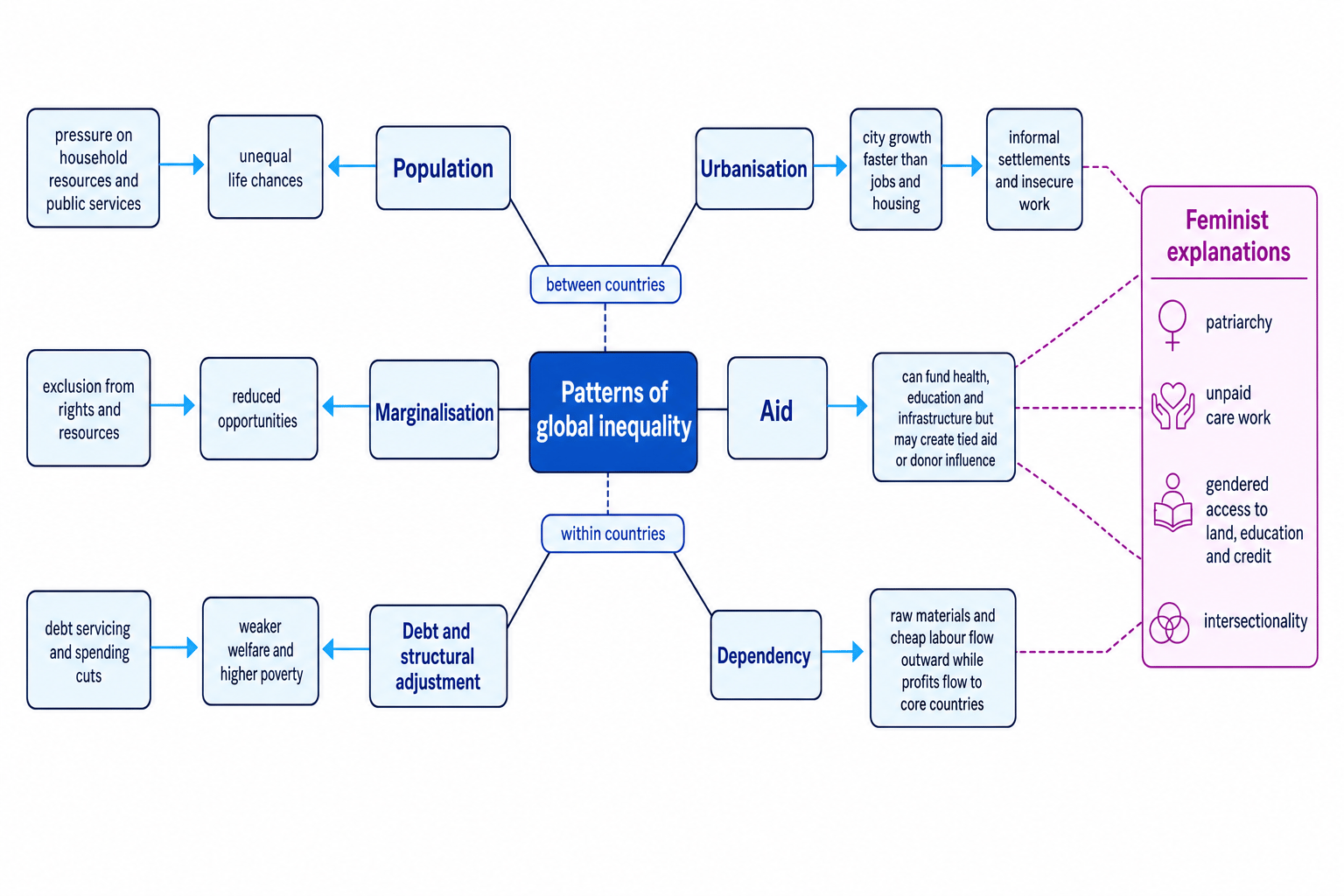
Use this map as a quick overview of the main explanation chains in this topic.
Think in chains, not labels
A strong answer does not just name “debt” or “population”. It explains the mechanism: how that factor produces unequal life chances, who benefits, who loses, and whether evidence supports the claim.
Population explanations
A population explanation argues that inequality is linked to the size, growth and structure of a population. This includes fertility — the average number of children born — and the age structure of a society.
Thomas Malthus argued that population could grow faster than food supply, creating poverty, famine and conflict. Modern neo-Malthusian arguments are less focused only on food and more on pressure on schools, hospitals, jobs, housing and the environment.
A common idea here is the dependency ratio: if there are many children or elderly people compared with working-age adults, families and governments may struggle to provide support.
Population policies can include contraception access, reproductive healthcare, girls’ education and public health campaigns. However, coercive policies such as China’s former one-child policy raise serious ethical concerns around rights, gender discrimination and state control.
Applying a population explanation
-
High fertility can mean household resources are spread across more children, so each child may receive less food, healthcare and schooling.
-
The state also faces higher demand for schools, clinics and housing; if the tax base is small, services may become overcrowded or underfunded.
-
Evaluation: this explanation is stronger when there is evidence of rapid population growth and weak infrastructure, but weaker if high fertility is itself caused by poverty, lack of contraception, gender inequality or child mortality.
AO3 matters here. Boserup challenged Malthus by arguing that population pressure can encourage innovation in farming and technology. Dependency and feminist theorists also argue that blaming “too many people” can ignore unequal land ownership, colonial histories and women’s lack of reproductive choice.
Urbanisation explanations
Urbanisation
Urbanisation means an increasing proportion of a population living in towns and cities. It often happens through rural-to-urban migration and natural population growth within cities.
Urbanisation can create inequality when city growth is faster than job creation, housing supply and public services. People may move because of push factors such as rural poverty, drought or conflict, and pull factors such as jobs, education and healthcare.
Mike Davis described the growth of large informal settlements in Planet of Slums (2006). In cities such as Lagos, Mumbai or Manila, some people gain access to work and education, while others experience insecure housing, informal labour, pollution and weak sanitation.
Policies include slum upgrading, affordable housing, public transport, sanitation schemes and UN Sustainable Development Goal 11, which focuses on inclusive and sustainable cities.
Treating urbanisation as automatically bad
Urbanisation can increase inequality, but it can also reduce poverty by creating jobs, education and healthcare access. Your evaluation should ask whether urban growth is planned, inclusive and linked to employment.
Marginalisation explanations
Marginalisation
Marginalisation means being pushed to the edge of society and excluded from resources, rights, decision-making or full social participation.
Marginalisation explains inequality by looking at how some groups are systematically excluded because of ethnicity, caste, religion, disability, gender, region, migration status or language. This links strongly to power and stratification, because dominant groups can protect their advantages.
Max Weber’s idea of social closure is useful here: privileged groups can restrict access to jobs, education, land or status. Sen’s capability approach also helps: inequality is not just about income, but about whether people have the real freedom to live the lives they value.
Examples include Dalits facing caste discrimination in India, indigenous communities losing land to mining, disabled people excluded from education, or refugees lacking legal work rights. In the UK, Gypsy, Roma and Traveller communities also show how marginalisation can operate through housing, schooling and stigma.
Linking urbanisation and marginalisation
-
A rural migrant may move to a city for work but end up in informal housing without secure tenure or official documents.
-
Without a formal address, the person may struggle to access banking, schooling, healthcare or legal employment, which turns poverty into longer-term exclusion.
-
Evaluation: the problem is not simply “too many migrants”; it is also how the state, employers and landlords organise access to rights and services.
Research methods matter. Official statistics may undercount informal workers, undocumented migrants or people in unregistered settlements. This can make inequality look smaller than it really is.
Aid explanations
Aid
Aid is the transfer of resources from governments, international organisations or charities to countries, communities or groups in need. It can be humanitarian aid, development aid, bilateral aid, multilateral aid or NGO aid.
Modernisation theorists such as Rostow see aid as a way to help poorer countries move through stages of development by providing capital, technology and expertise. Sachs argues for a “big push” to help countries escape poverty traps through investment in health, education and infrastructure.
AO2 examples include vaccination programmes, disaster relief, clean water projects and girls’ education initiatives. The UK has a long history of overseas aid through DFID, now part of the Foreign, Commonwealth and Development Office. The UK’s aid spending target was reduced from 0.7% to 0.5% of gross national income in 2021, which became a debate about national priorities and global responsibility.
But dependency theorists such as Hayter argue that aid can serve donor interests. Tied aid may require recipient countries to buy goods or services from the donor country. Aid can also strengthen corrupt elites, create dependency, or impose policies that reflect Western priorities.
Balanced AO3 on aid
Do not write “aid works” or “aid fails” as a blanket judgement. Distinguish between emergency aid, long-term development aid, tied aid, NGO aid and community-led projects.
Debt and structural adjustment
Many lower-income countries borrowed heavily after decolonisation or during economic crises. Debt servicing means paying interest and repayments on loans. If debt repayments take up a large share of government revenue, less money is available for schools, hospitals, housing and welfare.
Structural adjustment programmes
Structural adjustment programmes were policy conditions often attached to IMF and World Bank loans. They typically promoted cuts to public spending, privatisation, trade liberalisation and reduced state intervention.
These policies are linked to neoliberalism, the belief that free markets, private enterprise and reduced state spending are the best route to development. Critics argue that structural adjustment increased inequality by cutting subsidies, charging for healthcare or education, and weakening labour protections.
Relevant policies include IMF and World Bank loan conditions, the Heavily Indebted Poor Countries initiative, Jubilee 2000 debt cancellation campaigns, and Poverty Reduction Strategy Papers. Debt relief can free money for social spending, but critics argue that global financial institutions still hold too much power over poorer countries’ policy choices.
Tracing a debt-service chain
-
A government spends a large part of its budget repaying foreign debt, so it reduces spending on public services.
-
Reduced public spending can increase school fees, hospital charges or unemployment, which affects poorer groups most severely.
-
Evaluation: debt explains inequality well when repayments clearly crowd out welfare spending, but it should be combined with evidence about corruption, trade prices, interest rates and global financial rules.
Dependency explanations
Dependency theory
Dependency theory argues that poorer countries are kept underdeveloped because richer countries, transnational corporations and global institutions extract wealth from them.
Andre Gunder Frank argued that colonialism and capitalism produced the “development of underdevelopment”. In other words, poorer countries are not simply “behind”; they have been actively shaped into dependent positions.
Wallerstein’s world-systems theory divides the world economy into core, semi-periphery and periphery. Core countries control high-profit industries, finance and technology. Peripheral countries often supply raw materials, cheap labour and low-profit manufacturing.
AO2 examples include cocoa farmers receiving a small share of profits compared with chocolate companies, or workers mining minerals for global technology supply chains while transnational corporations capture higher profits. UK consumers can benefit from cheap goods, while workers elsewhere may face low wages and unsafe conditions.
AO3 evaluation is important. Dependency theory highlights power, colonial history and unequal trade, but it can be criticised for being too deterministic. Countries such as South Korea, Singapore and China show that some states have used global capitalism to industrialise rapidly, though not always without inequality or authoritarian control.
Applying dependency to a supply chain
-
A peripheral country exports raw materials, such as cocoa or minerals, at relatively low prices.
-
Core-based companies process, brand, finance and retail the final product, capturing a much larger share of profit.
-
Evaluation: this supports dependency theory if local producers remain poor despite global demand, but you should also consider state policy, trade agreements and whether producer countries can move into higher-value production.
Feminist explanations
Feminist explanations argue that global inequality is gendered. They focus on patriarchy, meaning social systems in which men as a group hold more power than women as a group.
Women and girls may face barriers to education, land ownership, inheritance, credit, contraception, safety and political representation. They also often do unpaid care work, such as cooking, childcare, collecting water and caring for elderly relatives. This work is essential to the economy but often invisible in official measures of development.
Boserup argued in Women’s Role in Economic Development (1970) that development projects often ignored women’s economic contribution. Moser highlighted women’s “triple role”: reproductive work, productive work and community management. Walby’s concept of patriarchy can also be applied to global inequality through paid work, household labour, violence, culture, sexuality and the state.
Intersectional feminists, influenced by Crenshaw, argue that “women” are not one single group. Gender intersects with class, caste, ethnicity, disability, religion and migration status. Postcolonial feminists also warn against portraying women in the Global South as passive victims needing rescue by the West.
Relevant policies include SDG 5 on gender equality, CEDAW, girls’ education programmes, reproductive healthcare, land rights reform and campaigns against gender-based violence. Microcredit schemes can help some women, but evidence is mixed: loans may increase women’s workload or be controlled by male relatives.
Applying a feminist explanation to garment work
-
Women may be recruited into low-paid garment work because employers assume they are more “docile”, skilled at sewing, or willing to accept insecure conditions.
-
Their low wages are connected to global consumer demand for cheap clothing and to patriarchal expectations that women’s earnings are secondary.
-
Evaluation: a feminist explanation is strong because it links gender norms, capitalism and global trade, but it should also consider women’s agency, unionisation and the possibility that paid work can increase independence.
Bringing the explanations together
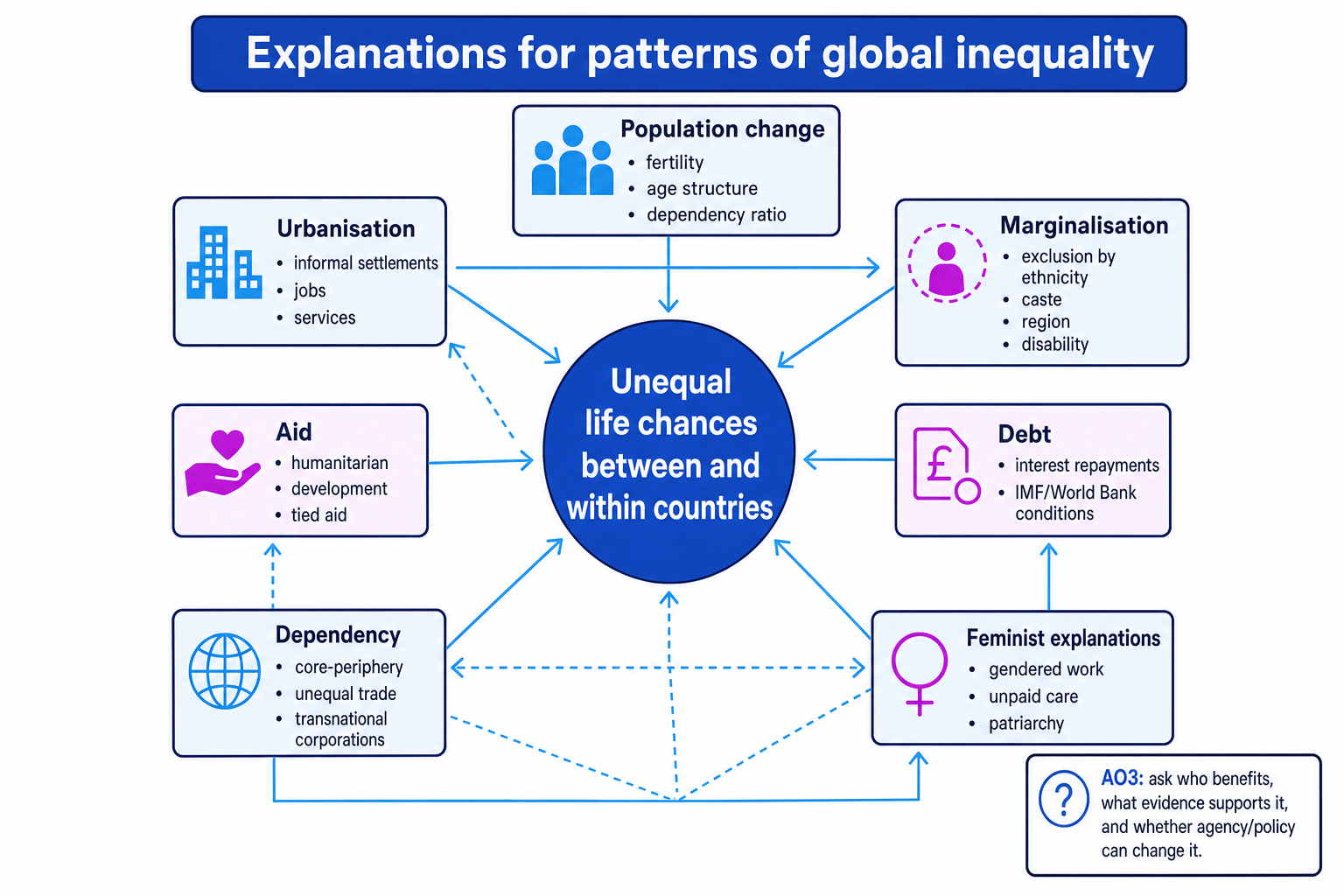
For essay answers, avoid treating these explanations as separate “shopping-list” points. They often overlap:
- Population growth may be shaped by poverty, patriarchy and lack of reproductive healthcare.
- Urbanisation can create opportunities, but marginalised groups may be excluded from the benefits.
- Aid can reduce suffering, but tied aid and debt conditions may reproduce dependency.
- Dependency theory explains global power relations, while feminist theory shows how those relations are gendered.
- Policies can reduce inequality, but only if they challenge the structures producing it.
The best essays are multi-causal
Global inequality is rarely caused by one factor. Strong analysis weighs explanations against each other: demographic pressure, urban change, social exclusion, aid relationships, debt, global capitalism and patriarchy.
For methods evaluation, use official statistics carefully. World Bank, UN and ONS-style data can be reliable and comparable, but may hide informal work, unpaid care, corruption, under-registration and local meanings of poverty. Qualitative research can reveal lived experience and identity, but may be less representative.
In the exam
-
Start each paragraph with a clear explanation, then show the mechanism: factor → process → inequality outcome.
-
Add AO2 by using a concrete example, such as IMF debt conditions, UK aid policy, informal settlements, cocoa supply chains, or girls’ education.
-
Evaluate by comparing perspectives: ask whether the explanation blames poorer countries, exposes global power, includes gender, and fits contemporary evidence.
Check yourself
- How would a dependency theorist criticise aid and debt policies?
- Why might population explanations be accused of “blaming the poor”?
- How do feminist explanations change the way we understand global inequality?