What you'll learn
- How globalisation affects development through trade, corporations, governments and NGOs.
- How sociologists such as Giddens, Frank, Wallerstein and Rostow explain global inequality.
- How to apply the topic to UK examples such as fast fashion, Fairtrade, aid policy and NGO campaigns.
- How to evaluate claims using theory, evidence and research-methods awareness.
Starting point: what is globalisation?
Before you evaluate globalisation, you need two basic ideas: globalisation and development.
Globalisation
Globalisation means the increasing interconnectedness of societies, economies, cultures and political systems across national borders. Giddens describes it as the intensification of worldwide social relations, where distant events shape local lives.
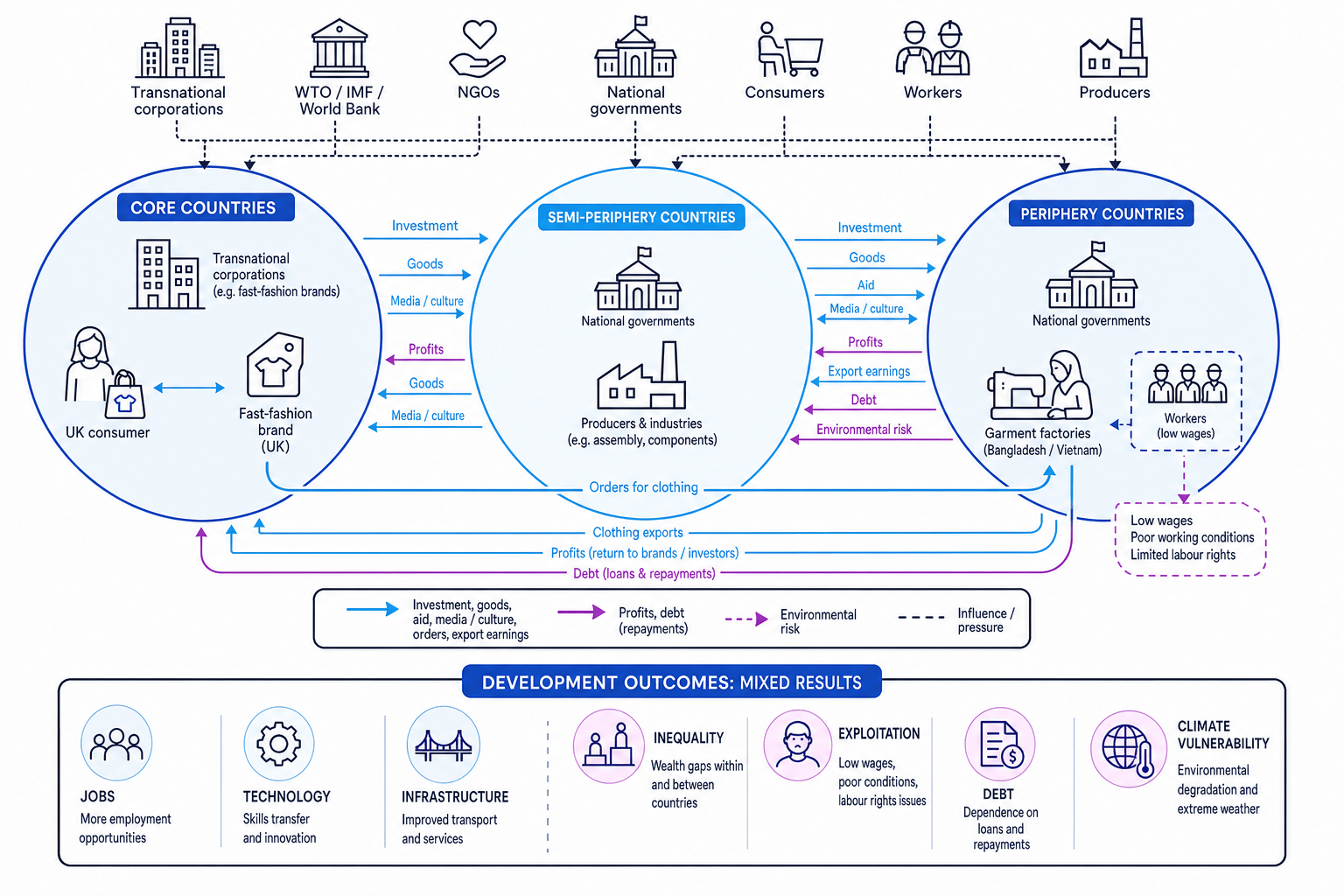
In everyday terms, globalisation means your phone, clothes, food, social media and job opportunities may depend on decisions made in several countries at once. A UK consumer buying a cheap T-shirt may be linked to cotton growers, factory workers, shipping firms, a transnational brand, trade rules and environmental costs.
Development
Development means social and economic change that improves people’s life chances. It can include income, health, education, gender equality, political rights, environmental security and freedom from poverty.
Sociologists often distinguish between the Global North — broadly richer and more powerful countries — and the Global South — broadly poorer countries with less global economic power. These terms are not purely geographical: Australia is in the south geographically but is usually treated as part of the Global North.
Why globalisation matters for development
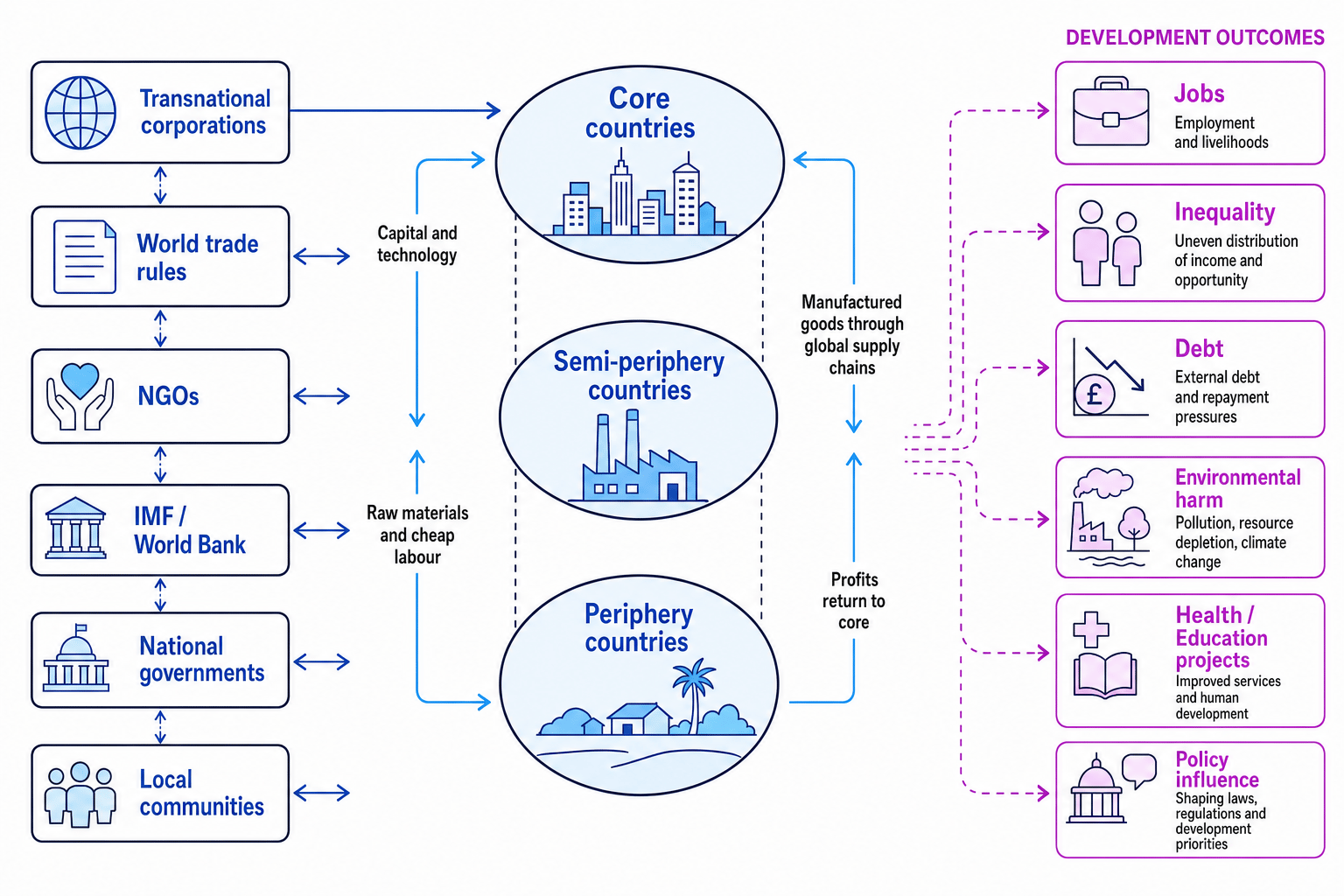
Globalisation changes development because it changes who has power. Development is no longer shaped only by national governments. It is also influenced by transnational corporations, world trade rules, international financial institutions, non-governmental organisations and global cultural flows.
World policy
World policy means decisions, rules and priorities made beyond a single nation-state, for example through the UN, WTO, IMF, World Bank, G7/G20 meetings, trade agreements, climate agreements and international NGO campaigns.
The diagram below shows the main actors and flows you can use in essays on globalisation and development.
The big sociological point
Globalisation does not affect everyone equally. It can create jobs, spread technology and fund services, but it can also deepen inequality, debt, exploitation and environmental harm.
Transnational corporations
Transnational corporations
Transnational corporations are companies that operate in more than one country, often with headquarters, production, supply chains and markets spread across the world.
Examples include Apple, Nike, Shell, BP, Unilever, Amazon and major fast-fashion brands. TNCs matter because they can bring foreign direct investment, jobs, infrastructure, new technology and tax revenue. Modernisation theorists see this as a possible route to development: poorer countries can industrialise by joining global markets.
However, dependency and world-systems theorists argue that TNCs often reproduce inequality. Frank argues that wealthy countries develop partly by exploiting poorer ones, creating the “development of underdevelopment”. Wallerstein’s world-systems theory divides the global economy into core, semi-periphery and periphery. Core countries control high-profit activities such as finance, branding and technology; periphery countries are often pushed into low-wage labour and raw-material extraction.
Frobel and others describe this as a new international division of labour, where production is moved to lower-wage countries while profits and decision-making remain concentrated in the Global North.
Applying globalisation to fast fashion
- A UK consumer buys a low-cost item from a retailer whose supply chain includes factories in countries such as Bangladesh, Vietnam or Cambodia.
- A modernisation view would stress development gains: factory work can provide wages, export earnings and new skills, especially for young women entering paid employment.
- A dependency or world-systems view would stress unequal power: the brand controls design, marketing and profit, while workers may experience low pay, insecurity and weak trade-union rights.
- A balanced judgement would say TNCs can support development, but the outcome depends on labour laws, corporate accountability, trade-union strength and whether profits stay locally or flow back to the core.
TNCs and world policy
TNCs influence policy because governments often compete to attract investment. This can lead to low corporation tax, weaker labour regulation, special economic zones and limited environmental controls. Sklair argues that a transnational capitalist class — corporate executives, politicians, professionals and consumerist elites — helps promote policies that favour global capitalism.
In the UK, the Modern Slavery Act 2015 requires some large companies to report on slavery and trafficking risks in supply chains. This shows how globalisation creates policy pressure: exploitation abroad becomes a concern for UK law, consumers and campaigners.
Treating TNCs as only exploitative
Do not write that TNCs are simply “bad”. Stronger answers show both sides: they may create employment and infrastructure, but the quality of development depends on wages, rights, taxation, environmental rules and who keeps the profits.
World trade and development
World trade
World trade means the buying and selling of goods and services across national borders. It is shaped by trade agreements, tariffs, subsidies, global supply chains and institutions such as the World Trade Organization.
Supporters of free trade argue that countries can specialise, sell to larger markets and grow faster. This links to neoliberalism, an approach associated with market freedom, privatisation, deregulation and reduced state intervention. The IMF and World Bank promoted these ideas through structural adjustment programmes, which often required poorer countries to cut public spending, privatise industries and open markets in return for loans.
Rostow’s modernisation theory suggests societies develop through stages, moving from traditional society to “take-off” and mass consumption. From this view, trade, investment and Western-style institutions can help poorer countries modernise.
Critical sociologists disagree. Stiglitz argues that globalisation has often been badly managed by powerful institutions. Chang argues that rich countries historically used protectionism themselves, then encouraged poorer countries to adopt free trade too early. This can trap poorer countries in low-value exports such as coffee, cocoa, minerals or cheap garments.
Evaluating trade liberalisation
- Imagine a low-income country is encouraged to reduce trade barriers and specialise in exporting coffee.
- A neoliberal argument would be that access to global markets creates export income, jobs and foreign currency, which can fund development.
- A dependency argument would question who controls prices and profits: farmers may receive low returns while global retailers, processors and brands capture more value.
- The evaluation depends on conditions: trade is more likely to support development if the country can diversify, protect workers, add value through processing and avoid excessive debt.
Trade, culture and identity
Global trade does not only move goods; it also spreads cultural meanings. Ritzer’s idea of McDonaldisation suggests global brands promote efficiency, predictability and standardisation. This can create cultural homogenisation, where places become more similar.
But globalisation can also create hybrid identities, where people combine global and local influences. For example, UK youth culture, music, food and fashion are shaped by migration, diaspora communities, social media and global brands. This links the World sociology topic to the broader theme of socialisation, culture and identity.
Non-governmental organisations
Non-governmental organisations
Non-governmental organisations, or NGOs, are organisations that are not run by the state and are not primarily profit-making. They may deliver aid, campaign, research, monitor rights or influence policy.
Examples include Oxfam, Save the Children, Amnesty International, Médecins Sans Frontières, Greenpeace and the Fairtrade Foundation. NGOs affect development by providing emergency relief, health projects, education, clean-water schemes and advocacy. They can also shape world policy through reports, media campaigns, lobbying and participation in UN consultations.
UK examples are useful for AO2. The Make Poverty History campaign in 2005 put pressure on G8 leaders at Gleneagles over debt relief, aid and trade justice. Oxfam campaigns on global inequality and tax avoidance. The Fairtrade Foundation influences consumer behaviour and supermarket supply chains by promoting minimum prices and community premiums for producers.
Assessing NGO influence on debt relief
- An NGO campaign frames debt as a development issue because repayments can reduce government spending on health, education and infrastructure.
- Public campaigning can pressure powerful states and institutions to support debt cancellation or fairer lending rules.
- The likely development impact is strongest when debt relief is linked to democratic accountability and investment in public services.
- A critical evaluation would add that NGOs may depend on donors, simplify complex issues for media campaigns, or speak for communities rather than enabling them to speak for themselves.
Post-development theorists such as Escobar criticise the idea that the Global North should define what “development” means for the Global South. From this view, some NGOs may unintentionally reproduce unequal power by presenting poorer communities as passive victims needing Western rescue.
A useful essay pattern
For each actor, use the sequence actor → mechanism → development impact → evaluation. For example: TNCs → investment and supply chains → jobs and inequality → depends on regulation and bargaining power.
Global policy: the bigger picture
Globalisation has produced global policy frameworks. The UN Sustainable Development Goals, agreed in 2015, set targets on poverty, education, gender equality, climate action and inequality. The Paris Agreement 2015 shows how development and environmental issues overlap: poorer countries often contribute least to climate change but face severe consequences.
The UK is part of these global policy debates through aid spending, trade policy, climate finance, NGOs and consumer markets. For example, the UK met the 0.7% aid target for several years but reduced aid spending to 0.5% of national income in 2021. This matters sociologically because aid policy reflects power, political priorities and ideas about moral responsibility.
Beck’s idea of a global risk society is useful here. Climate change, pandemics, debt crises and financial crashes are not contained within borders. Development issues are therefore global issues, not problems “over there”.
Evidence and methods: how do we know?
You can support essays with data from the UN, World Bank, IMF, NGOs and national governments. Indicators include income, life expectancy, literacy, school enrolment, infant mortality, gender inequality and the Human Development Index.
But be methodologically careful. Official statistics may be more reliable than anecdotes because they are collected regularly, but they may lack validity if they hide inequality within countries or ignore unpaid work and informal economies. NGO reports may provide rich qualitative evidence and access to marginalised groups, but they can be shaped by campaigning aims, donor priorities or selective case studies.
Ethically, research on global development must consider informed consent, confidentiality, safety, translation, researcher power and whether communities benefit from the research.
Pulling the debate together
A strong answer does not ask, “Is globalisation good or bad?” It asks, “Good or bad for whom, in what context, and under what power relations?”
Modernisation and neoliberal approaches stress growth, investment, trade and technology. Dependency, Marxist and world-systems approaches stress exploitation, unequal exchange and the power of global capitalism. Post-development approaches question whether Western definitions of progress are being imposed on other cultures.
For Eduqas essays, keep connecting theory to concrete examples: UK consumption and supply chains, TNCs, WTO rules, IMF/World Bank policies, NGO campaigns, Fairtrade, climate agreements and aid policy.
In the exam
- Start by defining globalisation and linking it directly to development, not just “countries becoming connected”.
- Use named actors: TNCs, world trade institutions, NGOs, national governments and global policy frameworks such as the SDGs.
- Evaluate throughout by comparing perspectives: modernisation/neoliberal optimism versus dependency/world-systems criticism, plus post-development concerns about culture and power.
- Add AO2 with concrete examples, especially UK links such as fast fashion, Fairtrade, Oxfam, aid spending, climate policy or supply-chain law.
Check yourself
- How might a TNC create development and inequality at the same time?
- Why do dependency theorists criticise free trade?
- In what ways can NGOs influence world policy, and what are their limitations?