What you'll learn
- What “social policy” means when applied to religion in contemporary UK society.
- The main policy areas: rights, equality, education, security, establishment and welfare.
- How sociologists evaluate these policies using theories of secularisation, pluralism, power and identity.
- How to build essay-style AO1, AO2 and AO3 points from concrete UK examples.
1. Starting point: what is social policy?
Religion here means organised systems of belief, worship, identity and practice, such as Christianity, Islam, Hinduism, Sikhism, Judaism and Buddhism, as well as non-religious worldviews where law treats “religion or belief” together.
Social policy
Social policy means laws, government decisions and public-sector practices that try to manage social issues, distribute rights and resources, or shape people’s behaviour.
So “social policy and religion” is not just about churches. It includes schools, workplaces, courts, prisons, hospitals, welfare services, hate crime, national ceremonies and counter-terrorism.
Two background concepts matter:
- Secularisation means the declining social significance of religion.
- Religious pluralism means the existence of many religious and non-religious beliefs within the same society.
The UK is a mixed case. It has become more secular in everyday life, but religion has not disappeared from public institutions. The Church of England remains established in England, while the 2021 Census for England and Wales showed both a large Christian category and a growing “no religion” category.
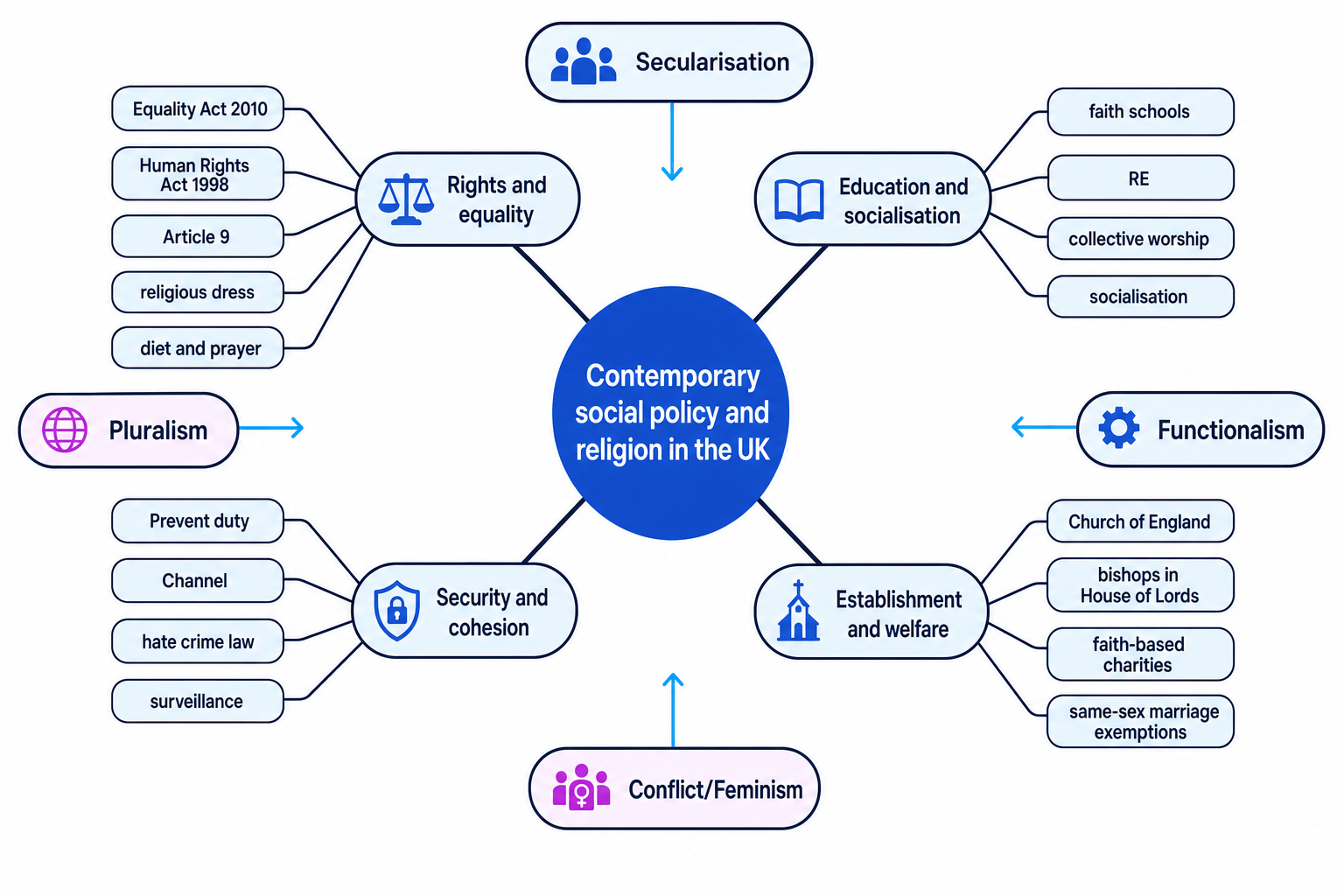
Here is the overall map of the policy field:
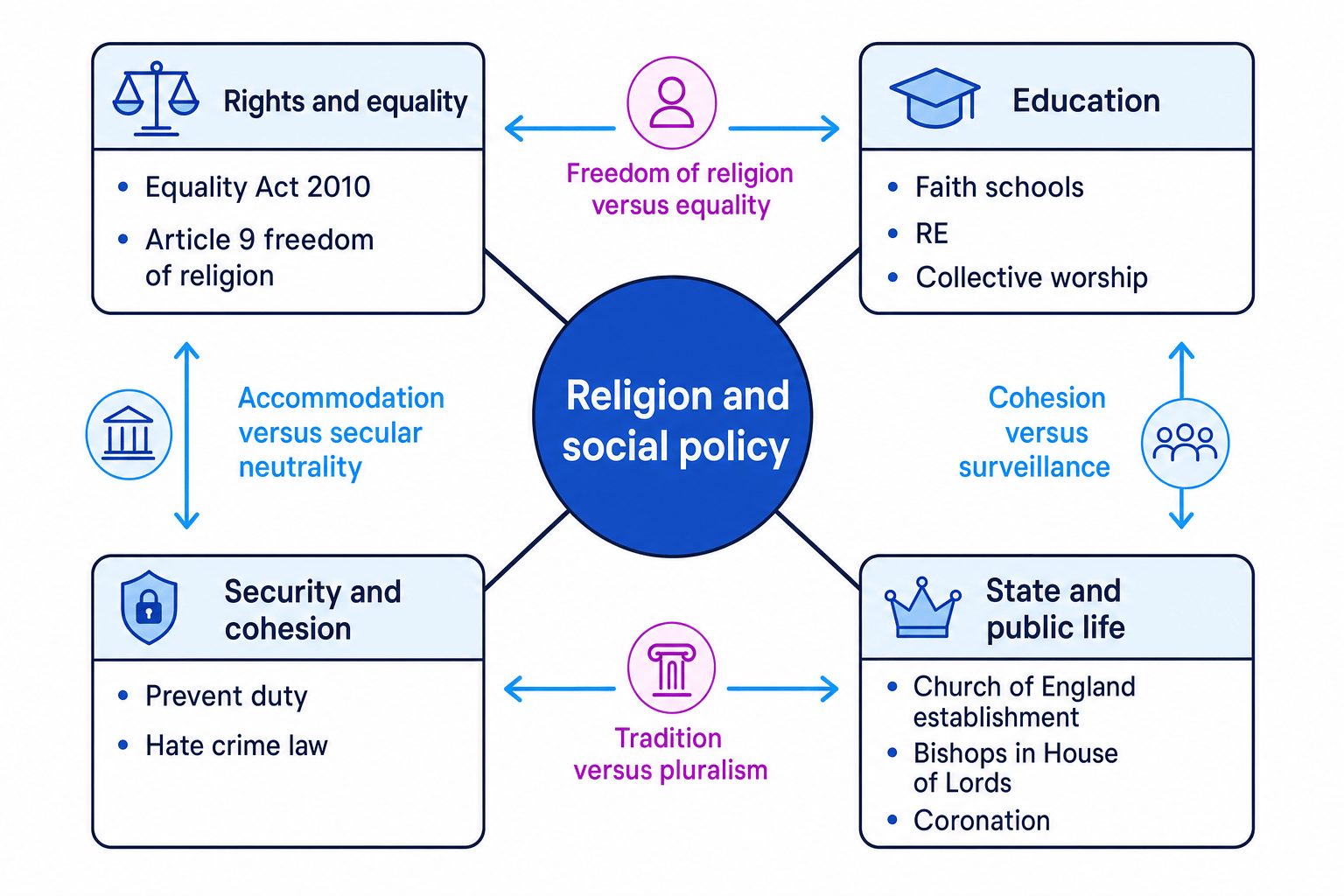
The core tension
Contemporary policy tries to protect freedom of religion while also protecting equality, social cohesion, security and the rights of others. Good essays show this balancing act rather than claiming policy is simply “pro-religion” or “anti-religion”.
2. Rights and equality
A protected characteristic is an aspect of identity covered by anti-discrimination law. Under the Equality Act 2010, religion or belief is a protected characteristic in areas such as employment, education and services.
The Human Rights Act 1998 brings the European Convention on Human Rights into UK law. Article 9 protects freedom of thought, conscience and religion. However, manifestation of religion is a qualified right, meaning it can be limited when necessary for public safety, order, health, morals, or the rights of others.
For AO2, you can apply this to:
- religious dress at work or school;
- prayer spaces;
- dietary requirements in prisons, hospitals or schools;
- conflicts between religious beliefs and LGBTQ+ equality;
- public services delivered by religious organisations.
The case of Eweida v United Kingdom (2013) is useful: the European Court of Human Rights found that British Airways had given too much weight to corporate image when restricting Nadia Eweida’s visible cross. But in other cases, courts have allowed limits on religious expression where equality or service delivery would be undermined.
Balancing religious freedom and equality
-
Identify the right being claimed: a worker or service user may argue that wearing a symbol, praying, or following a religious rule is part of manifesting religion under Article 9.
-
Identify the competing aim: an employer, school or public body may argue that a restriction protects safety, equality, neutrality, or the rights of other people.
-
Judge proportionality: a strong answer asks whether the restriction is more than necessary. A total ban is harder to justify than a narrow rule for a specific context.
-
Add evaluation: policy does not treat religious freedom as absolute. It protects belief strongly, but it may limit religious practice when it causes harm or discrimination.
3. Education, socialisation and faith schools
Socialisation is the process through which people learn norms, values, identities and expected behaviour. Religion and education are both major agencies of socialisation, so policy in schools is especially important.
A faith school is a school with a formal religious character or ethos. In England and Wales, religious education has long been part of schooling, though the exact rules differ by nation. In Wales, the Curriculum for Wales includes Religion, Values and Ethics. In England, religious education remains compulsory, and schools may also have collective worship requirements.
Check the jurisdiction
Education policy differs across England and Wales. For Eduqas, you can use examples from either, but label them accurately rather than treating “UK education policy” as one identical system.
Functionalists such as Durkheim argue that religion can create social solidarity: shared values that bind people together. Parsons would see schools as helping transmit society’s core values. From this view, religious education and school worship may support moral education and community cohesion.
However, secularisation theorists such as Bruce argue that compulsory Christian traditions look increasingly out of step with a diverse and less religious society. Davie complicates this by arguing that religion can remain culturally important even when attendance falls — “believing without belonging” and “vicarious religion”.
Faith schools are strongly debated:
- Supporters argue they provide ethos, community, parental choice and cultural identity.
- Critics argue they may increase segregation or reproduce inequality.
- Bourdieu helps here: middle-class families may use religious and cultural capital to access desirable schools.
- Modood argues that multicultural citizenship should recognise minority religious identities rather than forcing everyone into a supposedly neutral secular model.
Applying perspectives to faith schools
-
Start with AO1: faith schools are a policy example where the state funds or regulates education with a religious character.
-
Apply functionalism: they may transmit moral values and strengthen community identity, supporting social cohesion.
-
Apply a conflict view: if admissions or parental strategies advantage some groups, faith schooling can reproduce power and stratification.
-
Evaluate with pluralism: recognising faith identities may support inclusion, but separating children by religion may weaken shared socialisation across groups.
Assuming all faith schools work the same way
Do not write as if every faith school is socially selective, highly religious, or segregated. Their impact depends on admissions rules, local demographics, inspection, curriculum and the wider community.
4. Security, cohesion and hate crime
Social cohesion means the degree of trust, shared belonging and cooperation in a society. After concerns about terrorism and radicalisation, policy increasingly linked religion to security.
The Counter-Terrorism and Security Act 2015 created the Prevent duty, requiring schools, universities, NHS bodies, prisons and local authorities to have “due regard” to preventing people being drawn into terrorism. People considered at risk may be referred to Channel, a safeguarding programme.
Supporters argue Prevent protects vulnerable people and public safety. Critics argue it can construct Muslim identities as suspicious. This links to labelling theory: Becker argued that being labelled deviant can shape how others treat a person and how they see themselves. Foucault is also useful: his idea of surveillance suggests modern institutions govern people by monitoring risk and behaviour.
Policy also protects religious groups through hate crime law. A hate crime is an offence motivated by hostility towards a protected identity. Relevant policies include religiously aggravated offences under the Crime and Disorder Act 1998 and the Racial and Religious Hatred Act 2006, which criminalises stirring up religious hatred.
Methods link
Use official statistics carefully. Police-recorded religious hate crime depends on reporting rates, recording practices and public confidence. Census data measures identity, not necessarily belief, attendance or strength of commitment.
5. Establishment, welfare and moral policy
Establishment means a formal link between the state and a religious institution. The Church of England is established in England: the monarch is Supreme Governor, bishops sit in the House of Lords, and national ceremonies often use Anglican symbolism. In contrast, the Church in Wales was disestablished in 1920.
This raises a power question. Pluralists may see establishment as historical tradition with limited practical impact. Conflict theorists may see it as symbolic privilege for Christianity within the state.
Religious groups also influence welfare and moral debates. Faith-based charities help with food banks, homelessness, refugee support, chaplaincy and community care. Putnam’s idea of social capital — networks of trust and support — helps explain why faith communities can mobilise volunteers effectively. Dinham argues that governments often use faith groups in welfare while misunderstanding the complexity of religion.
Moral policy shows the balancing act clearly. The Marriage (Same Sex Couples) Act 2013 allowed same-sex marriage in England and Wales while protecting religious organisations from being forced to conduct ceremonies. Feminists and LGBTQ+ campaigners may criticise religious exemptions if they protect patriarchal or heteronormative power. Patriarchy means a social system in which men as a group hold power over women; Walby is useful for linking institutions to gender inequality.
6. Pulling the theories together
For essays, try to compare perspectives rather than listing policies.
- Functionalism: religion can support shared values, welfare and cohesion.
- Marxism: policy may protect dominant institutions and distract from class inequality; religion can legitimise power.
- Feminism: policy should be judged by whether it challenges or preserves gender and sexuality inequalities.
- Weberian/pluralist approaches: religious groups are status groups competing for recognition and influence.
- Secularisation theory: policy has to respond to declining religious authority.
- Multiculturalism: policy should recognise minority identities, but must still protect universal rights.
The best evaluation is balanced: contemporary policy is not simply secular. It is a set of compromises between tradition, diversity, equality, security and power.
In the exam
-
Anchor AO1 in named policy: Equality Act 2010, Human Rights Act 1998, Prevent duty, faith schools, hate crime law, Church establishment, or same-sex marriage law.
-
Add AO2 by applying the policy to a real setting: schools, workplaces, prisons, hospitals, universities, public services or national ceremonies.
-
Build AO3 by showing tension: religious freedom versus equality, multicultural recognition versus social cohesion, or security versus surveillance.
Check yourself
- Why is Article 9 described as a qualified right rather than an absolute right?
- How can faith schools be evaluated from both functionalist and conflict perspectives?
- What are the strengths and weaknesses of using official statistics to discuss religious hate crime?