What you'll learn
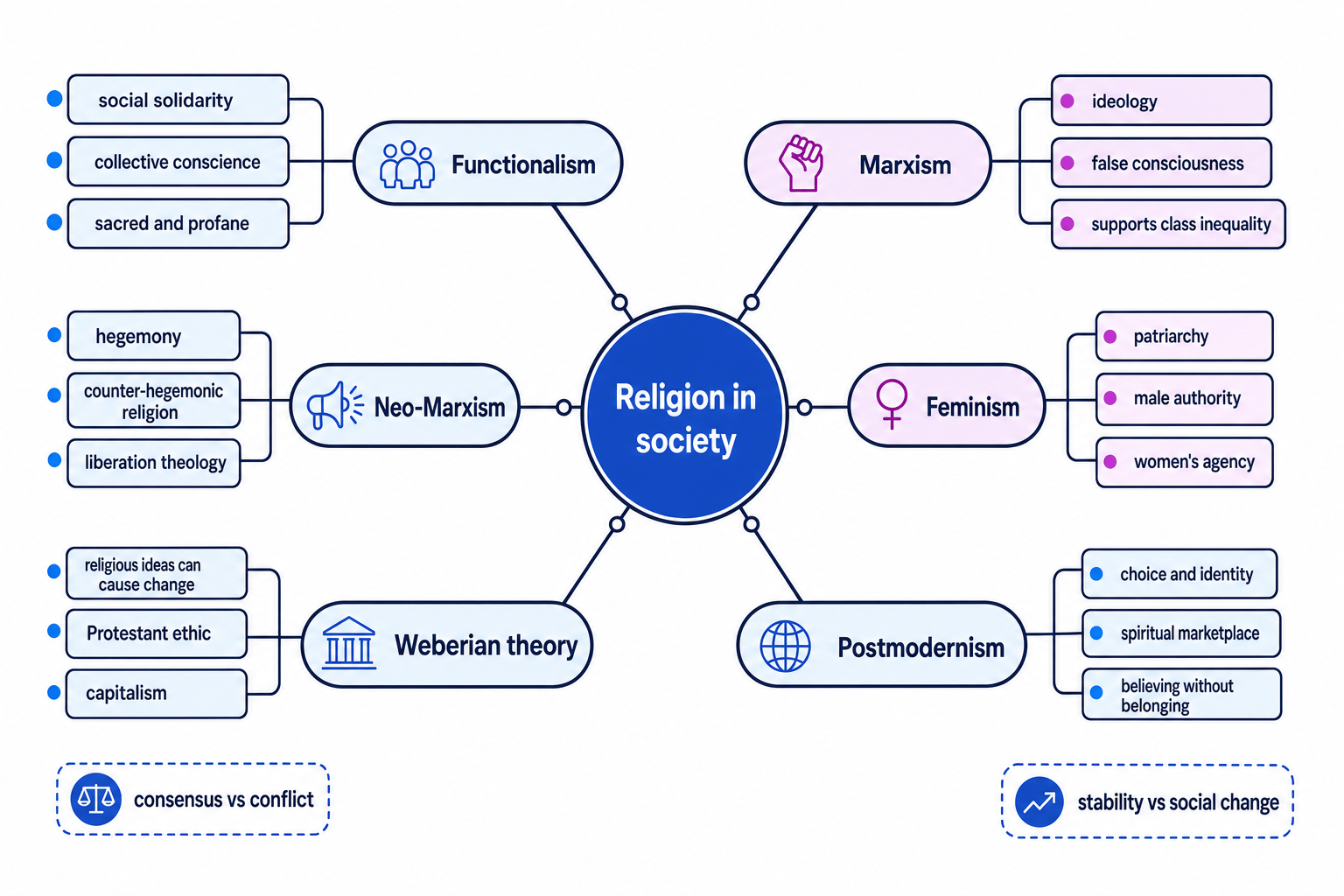
- How functionalist, Marxist, neo-Marxist, feminist, Weberian and postmodernist theories explain religion.
- How to apply each perspective to contemporary UK society, including secularisation, faith schools, gender and identity.
- How to build AO1 knowledge, AO2 application and AO3 evaluation into essay-style answers.
Starting points: what is a “perspective”?
A theoretical perspective is a broad way of seeing society. It acts like a lens: it highlights some things and pushes others into the background.
In this topic, religion means a set of beliefs, practices and organisations concerned with the sacred, the supernatural, ultimate meaning or moral order. Sociologists are less interested in whether religious beliefs are “true” and more interested in what religion does in society.
AO1, AO2 and AO3
AO1 means accurate knowledge of concepts, theories and studies. AO2 means applying them to examples, items or contemporary society. AO3 means analysing and evaluating: comparing perspectives, judging evidence and showing limitations.
A useful way to compare theories is to ask:
- Does religion create consensus — shared values and social order?
- Does religion reflect conflict — inequality, power and domination?
- Does religion mainly keep society stable, or can it drive social change?
- Does religion shape culture and identity, or is it shaped by class, gender and power?
Functionalism: religion creates social solidarity
Functionalism is a consensus theory. A consensus theory argues that society is held together by shared norms, values and institutions. Functionalists see religion as a social institution that helps people feel part of something bigger than themselves.
Durkheim argued that religion separates the sacred — things treated as special and set apart — from the profane — ordinary everyday life. In The Elementary Forms of Religious Life (1912), he used Australian Aboriginal totemism to argue that when people worship sacred symbols, they are really celebrating society itself.
He also argued that religion strengthens the collective conscience, meaning the shared moral beliefs of a community. Parsons added that religion gives meaning during suffering and death. Bellah’s idea of civil religion suggests that nations may have sacred symbols and rituals even when they are not formally religious, such as flags, remembrance ceremonies or royal rituals.
Functionalist takeaway
Religion helps socialisation by teaching shared values, strengthens culture and identity through rituals, and can make social order feel natural and meaningful.
Reading Remembrance Sunday functionally
- Identify the sacred symbols: the poppy, the silence and the Cenotaph are treated as set apart from ordinary life.
- Link the ritual to social solidarity: people gather around shared ideas of sacrifice, duty and national belonging.
- Evaluate the interpretation: it explains unity, but it may underplay conflict over war, empire, nationalism or pacifist beliefs.
AO3: Functionalism can overstate harmony. It struggles to explain religious conflict, gender inequality or why many people in the UK now identify as having “no religion”. It is also criticised for using evidence from small-scale societies and applying it too broadly.
Marxism: religion as ideology
Marxism is a conflict theory based on class inequality. Marxists argue that capitalism — an economic system based on private ownership and profit — divides society into a powerful ruling class and an exploited working class.
For Marx, religion is part of the superstructure, meaning the institutions and ideas built on top of the economic base. Religion can act as an ideology, a belief system that justifies inequality. Marx famously called religion “the opium of the people”: it comforts the oppressed but may stop them challenging their oppression.
False consciousness
False consciousness means a distorted view of reality where exploited groups accept inequality as normal, deserved or unavoidable.
For example, promises of reward in heaven may encourage people to tolerate suffering on earth. Religious teachings about obedience, sacrifice or hierarchy may also legitimate class power.
Applying Marxism to religious authority in Britain
- Start with power: the Church of England has historically been linked to the monarchy, elite education and the state.
- Apply ideology: religious rituals can present hierarchy as sacred, traditional or morally right rather than socially constructed.
- Add evaluation: this fits some examples, but it ignores religious groups that challenge poverty, racism or state power.
AO3: Marxism is strong on power and stratification, but it can be too deterministic. It assumes religion mainly supports capitalism, yet some religious movements support trade unions, anti-war campaigns, asylum seekers or food banks. Also, capitalism has continued in societies where religion has declined, which weakens a simple Marxist prediction.
Neo-Marxism: religion can challenge domination
Neo-Marxism updates Marxism by allowing more room for culture, ideas and human action. Gramsci argued that ruling groups maintain power through hegemony, meaning leadership through consent rather than just force. Religion can support hegemony, but it can also become counter-hegemonic by challenging dominant power.
Bloch argued that religion contains a “principle of hope”: visions of a better world can inspire resistance. Maduro and liberation theology show how Christianity has sometimes supported the poor against oppressive states, especially in Latin America.
In the UK, Quakers, Christian Aid, some Black churches, interfaith climate groups and churches supporting refugees show that religion is not always conservative.
Using neo-Marxism to explain religious protest
- Identify the unequal power relation: for example, refugees may face exclusion, poverty or hostile public attitudes.
- Show religion as counter-hegemonic: faith groups may provide support and frame hospitality as a moral duty.
- Compare with traditional Marxism: instead of simply dulling resistance, religion may help people organise against injustice.
AO3: Neo-Marxism is more flexible than traditional Marxism. However, it can be harder to test because concepts like “hope” and “hegemony” are abstract. Some examples, such as liberation theology, may not transfer neatly to contemporary Britain.
Feminism: religion and patriarchy
Feminism focuses on gender inequality. Patriarchy means a system of male power and female subordination. Feminists argue that many religions have reflected and reinforced patriarchy through male gods, male religious leaders, gendered rules about sexuality and expectations that women should be modest, obedient or family-centred.
Examples include restrictions on women becoming priests in Roman Catholicism, debates about women bishops in the Church of England, and religious campaigns around abortion, contraception or marriage. In the Church of England, women were first ordained as priests in 1994 and women bishops were approved in 2014, showing both change and continuing conflict.
Applying feminism to religious leadership
- Look at who holds authority: if senior roles are mainly male, this suggests gendered power within the institution.
- Connect authority to culture: male leadership can make patriarchal interpretations of scripture seem normal or sacred.
- Evaluate with agency: some women use religion as a source of identity, community, education and activism, so religion is not experienced only as oppression.
AO3: Feminism is powerful for analysing gender, power and identity. But it should avoid treating all women as the same. Class, ethnicity, sexuality and age shape women’s religious experiences. Some Muslim, Sikh, Hindu, Jewish and Christian women may see religious practice as empowering rather than simply restrictive.
Avoid one-dimensional feminism
Do not write “feminists think religion is bad for women” and stop there. Strong answers show patriarchy, but also consider women’s agency and differences between religious traditions.
Weberian theory: religion can drive social change
Weber’s approach is different from Marx’s because he argues that ideas can have independent power. His famous study The Protestant Ethic and the Spirit of Capitalism (1905) claimed that some forms of Protestantism helped capitalism develop.
Weber focused on Calvinism. Calvinists believed in predestination, the idea that God had already chosen who would be saved. This created anxiety. The idea of a calling encouraged disciplined work in everyday life, while asceticism meant self-denial and avoiding luxury. Weber argued that hard work, saving and reinvestment helped create a capitalist “spirit”.
Explaining capitalism with Weber
- Begin with belief: Calvinist ideas made everyday work feel like a religious duty.
- Link belief to behaviour: disciplined work and saving encouraged investment rather than consumption.
- Draw the sociological conclusion: religion did not just reflect economic change; it helped create a culture suited to capitalism.
AO3: Weber is useful because he challenges the Marxist idea that economics always comes first. However, critics argue capitalism also depended on trade, colonialism, law, technology and class power. Some capitalist development occurred in non-Protestant societies, so religion cannot be the only cause.
Postmodernism: religion, choice and identity
Postmodernism argues that contemporary society is fragmented, media-saturated and shaped by choice. A metanarrative is a big “one-size-fits-all” story about truth or meaning. Postmodernists argue that traditional religious metanarratives have weakened, but religion has not simply disappeared.
Instead, people may use religion and spirituality to construct identity. This is sometimes called a spiritual marketplace, where individuals choose beliefs, practices and communities. Davie described “believing without belonging”: people may hold religious or spiritual beliefs without regularly attending institutions. Heelas and Woodhead’s Kendal Project studied holistic spirituality and suggested a shift towards personal wellbeing and self-development.
AO2 examples include online worship, mindfulness, yoga, astrology on social media, mixed-faith families, naming ceremonies, and people identifying culturally as Christian, Muslim, Hindu, Sikh or Jewish even if they practise irregularly. Census 2021 for England and Wales found “Christian” was still the largest category, but “no religion” had risen sharply, supporting the idea of changing religious identity.
Applying postmodernism to online spirituality
- Identify choice: a person may combine meditation apps, astrology videos and occasional church attendance.
- Link to identity: religion becomes something personalised rather than controlled by one institution.
- Evaluate structure: this “choice” may still be shaped by class, ethnicity, family socialisation, gender and access to digital media.
AO3: Postmodernism captures diversity and identity well, especially in a more secular UK. But it may exaggerate individual freedom. Established religions still influence faith schools, politics, law, community life and global conflicts.
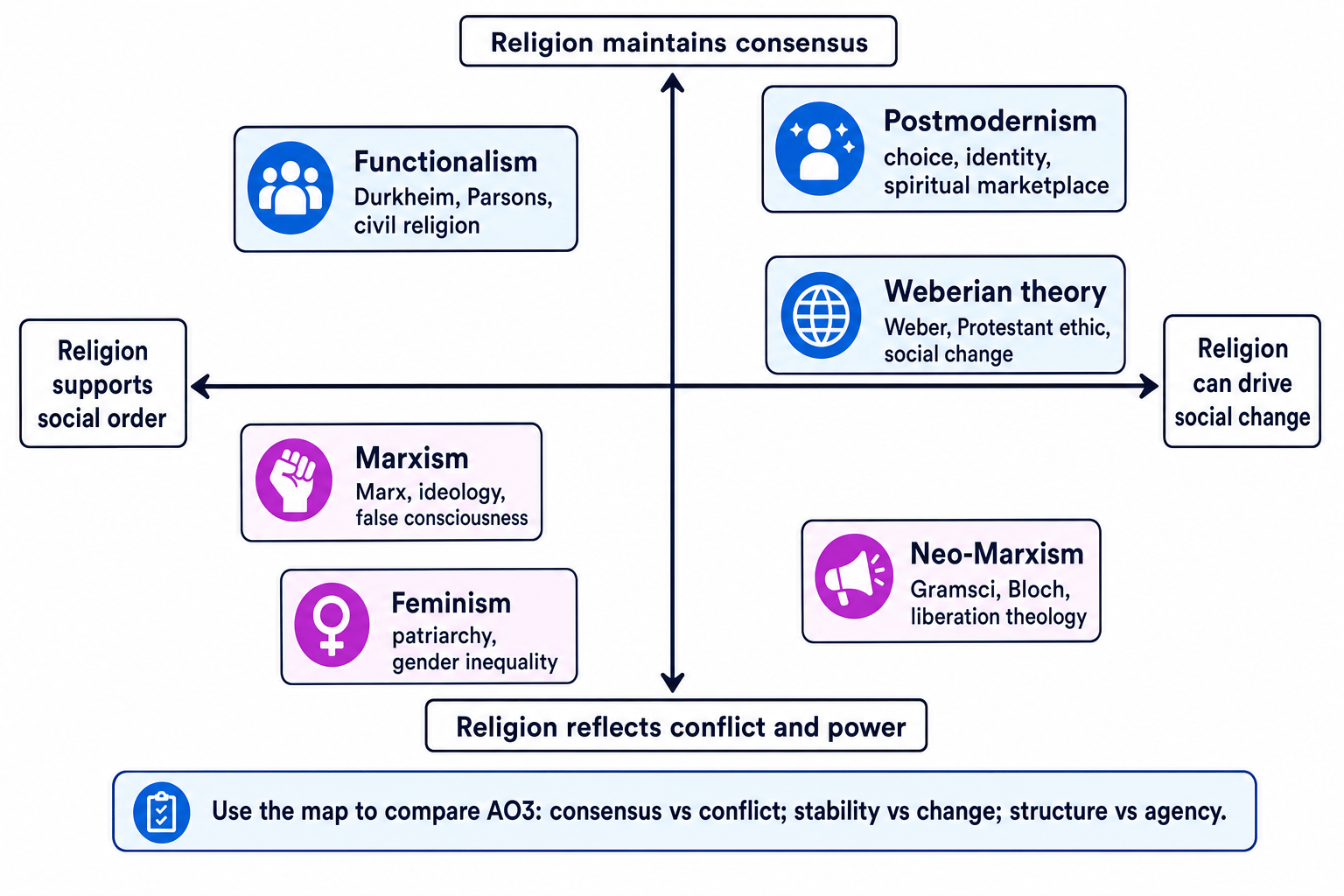
Comparing the perspectives
A strong essay does not just list theories. It compares them.
- Functionalism and Marxism are both structural theories, meaning they focus on large social forces. But functionalists see religion as creating order, while Marxists see it as supporting inequality.
- Weberian theory and neo-Marxism allow more room for religion to create change.
- Feminism shifts the focus from class to gender and patriarchy.
- Postmodernism focuses more on choice, identity and diversity in contemporary culture.
A simple comparison sentence
“Whereas functionalists see religion as promoting social solidarity, Marxists argue that the same rituals may legitimate inequality; this shows how the debate turns on whether religion is viewed as consensus-building or power-maintaining.”
A quick methods lens
You can evaluate theories using research-methods language.
Durkheim relied partly on secondary anthropological evidence, so there are questions about validity and whether small-scale societies represent modern Britain. Weber used historical comparison, which is rich and interpretive but cannot prove simple cause and effect. The Kendal Project gives detailed qualitative insight into spirituality, but one town may not be representative.
Official statistics such as the Census are useful for trends, but they measure self-identified religion. That may not validly measure belief, practice or commitment.
Using statistics too simply
Do not assume “no religion” means people have no beliefs or values. It may mean no institutional affiliation, weak practice, private spirituality or rejection of labels.
In the exam
- Build each paragraph with AO1 first: name the perspective, define the key concept and use a theorist such as Durkheim, Marx, Weber, Gramsci, Davie or Heelas.
- Add AO2 by applying the theory to a concrete example, such as faith schools, the monarchy, Census trends, women’s religious leadership, food banks or online spirituality.
- Secure AO3 by comparing perspectives: ask whether religion creates consensus, supports power, challenges inequality, drives change or expresses identity.
Check yourself
- How would a functionalist and a Marxist interpret the same religious ritual differently?
- Why is Weber’s view of religion and capitalism not simply Marxist?
- What evidence could you use to argue that religion in the UK is changing rather than disappearing?