What you'll learn
- How sociologists classify churches, denominations, sects, new religious movements and New Age movements.
- Why some religious groups become more mainstream while others remain separate from wider society.
- How secularisation and fundamentalism are linked to modern UK society.
- How to build AO1, AO2 and AO3 into essay answers on religion.
Why religious organisations matter
Religion is not only about private belief. Sociologists are interested in how belief becomes organised through buildings, leaders, rituals, rules, charities, schools, media networks and community groups.
Religious organisation
A religious organisation is a group or network that gives religious belief a social form: it creates roles, rules, rituals, leadership and boundaries between members and non-members.
A religious structure is the pattern behind the organisation. This includes hierarchy, membership rules, sources of authority, and the relationship between clergy — official religious specialists such as priests, imams, rabbis or ministers — and laity, meaning ordinary members.
The sociological focus
Sociologists do not ask whether a religion is “true”. They ask how religious organisations shape identity, distribute power, socialise members and respond to wider social change.
The classic typology of religious organisations
A typology is a classification system. Sociologists often use ideal types, meaning simplified models that highlight key features of real organisations. Real groups may not fit perfectly.
Troeltsch (1912) first distinguished between churches and sects. Later writers such as Niebuhr (1929) and Wallis (1984) developed the categories of denomination, cult and new religious movement.
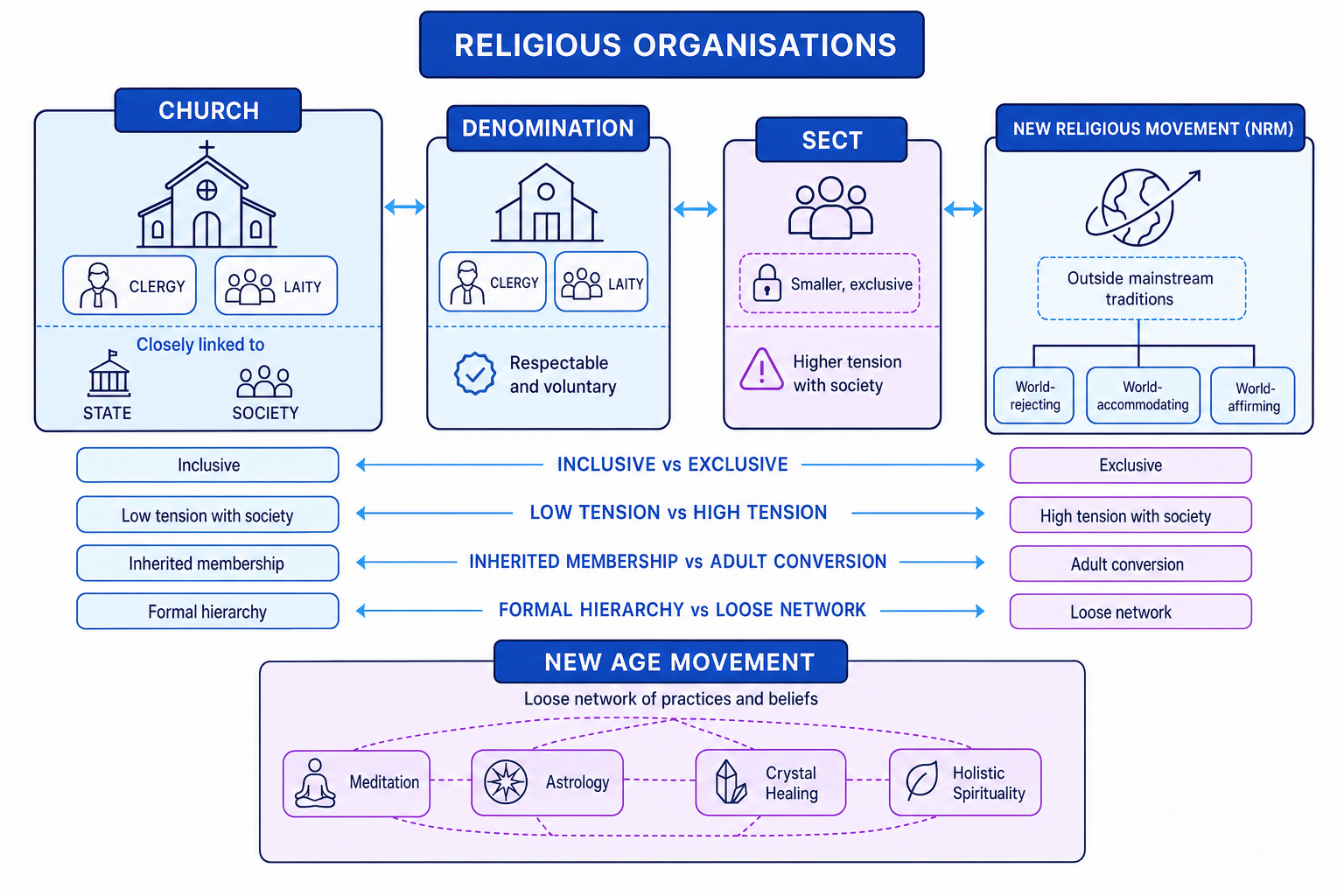
The diagram gives you the overview before we slow down each type.
Churches
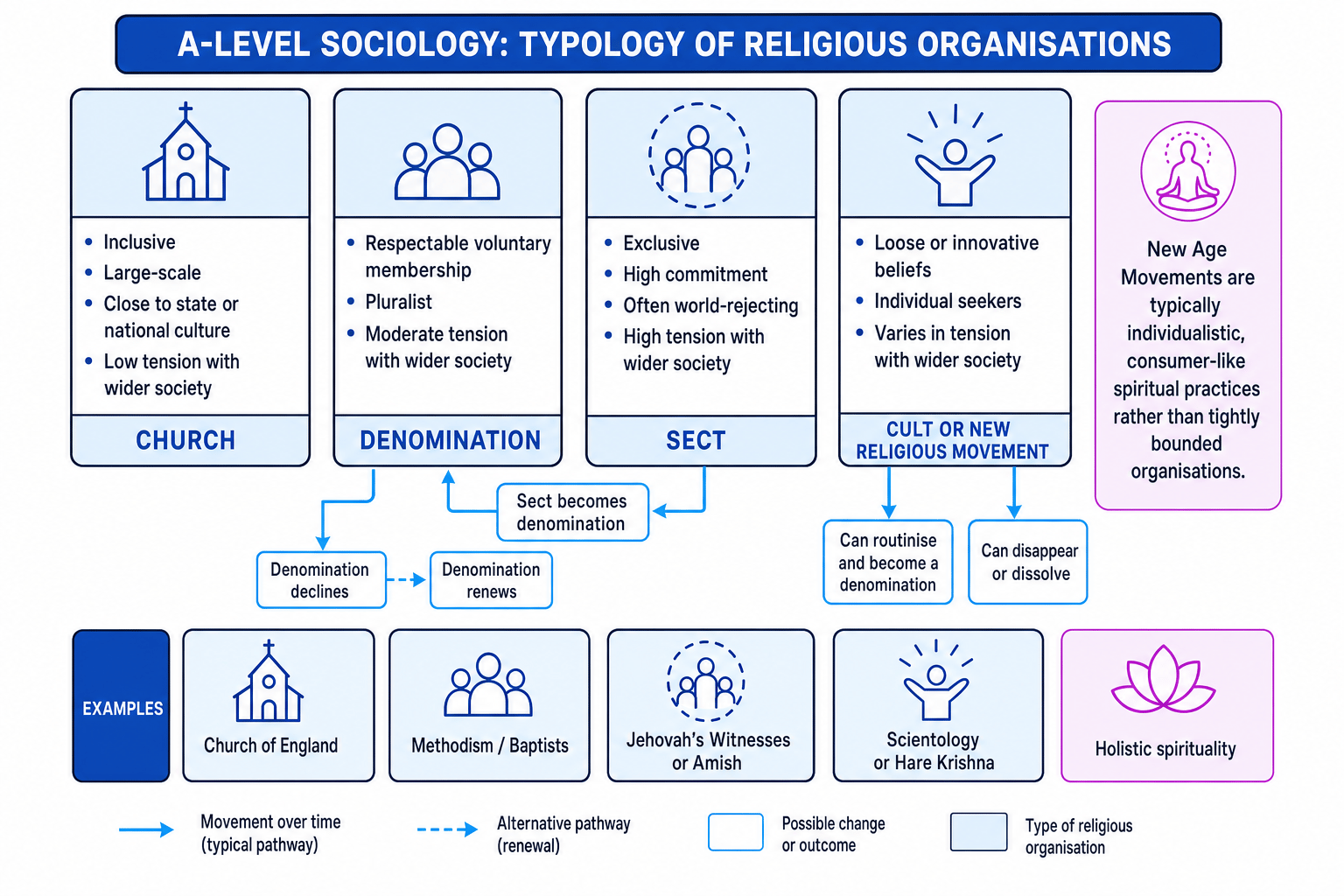
A church is a large, inclusive religious organisation that is often closely linked to the state, national culture or social establishment. Churches usually have trained clergy, formal doctrine, ritual traditions and a bureaucratic structure.
In the UK, the Church of England is the clearest example because it is an established church, meaning it has a formal legal relationship with the state. The monarch is Supreme Governor, some bishops sit in the House of Lords as Lords Spiritual, and Anglican rituals still appear in national events such as coronations and remembrance services.
AO3 point: Britain is now much more religiously diverse and less churchgoing, so the Church of England may be “church-like” institutionally but “denomination-like” in everyday participation.
Denominations
A denomination is a respectable, voluntary religious organisation that accepts it is one religion among others. Denominations normally have lower tension with wider society than sects. Examples include Methodists, Baptists and the United Reformed Church.
Niebuhr argued that some sects become denominations over time. This can happen when members become more socially established, children are born into the group, and the organisation develops formal leadership, buildings and committees.
Sects
A sect is usually smaller, more exclusive and higher commitment than a church or denomination. Sects often form through a schism, meaning a breakaway from an existing religious body.
Sects often have stricter rules about dress, diet, sexuality, worship or contact with non-members. They may reject parts of mainstream society, seeing it as morally corrupt. Examples often used in sociology include Jehovah’s Witnesses or some high-commitment evangelical groups.
This links to power and stratification because sects may attract people who feel excluded from mainstream society. For some members, the sect offers certainty, status and community that wider society does not provide.
Cults and new religious movements
In older sociology, a cult meant a loose or innovative religious organisation built around new ideas, practices or spiritual techniques. In everyday language, however, “cult” can sound insulting, so many sociologists prefer new religious movement, or NRM.
New religious movement
A new religious movement is a relatively recent religious or spiritual organisation that stands outside older mainstream religious traditions, or combines traditions in new ways.
Wallis (1984) classified NRMs into three types:
| Type of NRM | Meaning | Example often used |
|---|---|---|
| World-rejecting | Rejects mainstream society and demands major lifestyle change | Unification Church, Hare Krishna |
| World-accommodating | Focuses on spiritual renewal while members remain in everyday society | Some charismatic Christian movements |
| World-affirming | Accepts worldly success and offers techniques for self-improvement | Scientology, some meditation movements |
Barker’s (1984) study of the Unification Church challenged the idea that converts were simply “brainwashed”. She found recruitment was usually gradual and many people who attended events did not become long-term members.
New Age movements
A New Age movement is not usually one tight organisation. It is better understood as a loose spiritual network involving practices such as meditation, astrology, crystal healing, alternative therapies and holistic spirituality.
Holistic means treating the mind, body and spirit as connected. Heelas described New Age religion as self-spirituality, where authority comes from personal experience rather than a church, scripture or priest. Heelas and Woodhead’s Kendal Project (2005) found growth in the “holistic milieu”, but not enough to fully replace declining congregational religion.
Classifying a high-commitment group
A group requires adult conversion, discourages close friendships with outsiders, follows a charismatic leader and teaches that mainstream society is corrupt.
- Compare its relationship with wider society: the group is in high tension with mainstream norms because it discourages close outside contact and sees society as corrupt.
- Look at membership demands: adult conversion and strict commitment suggest it is not an inclusive church or moderate denomination.
- Apply the typology: the best classification is a sect, unless the beliefs are very new and loosely organised, in which case NRM might be more accurate.
Treating types as fixed boxes
Do not write as if every religious group fits perfectly into one category forever. Organisations can change: a sect may become a denomination, while a denomination may renew itself or decline.
Secularisation: are religious organisations losing power?
Secularisation
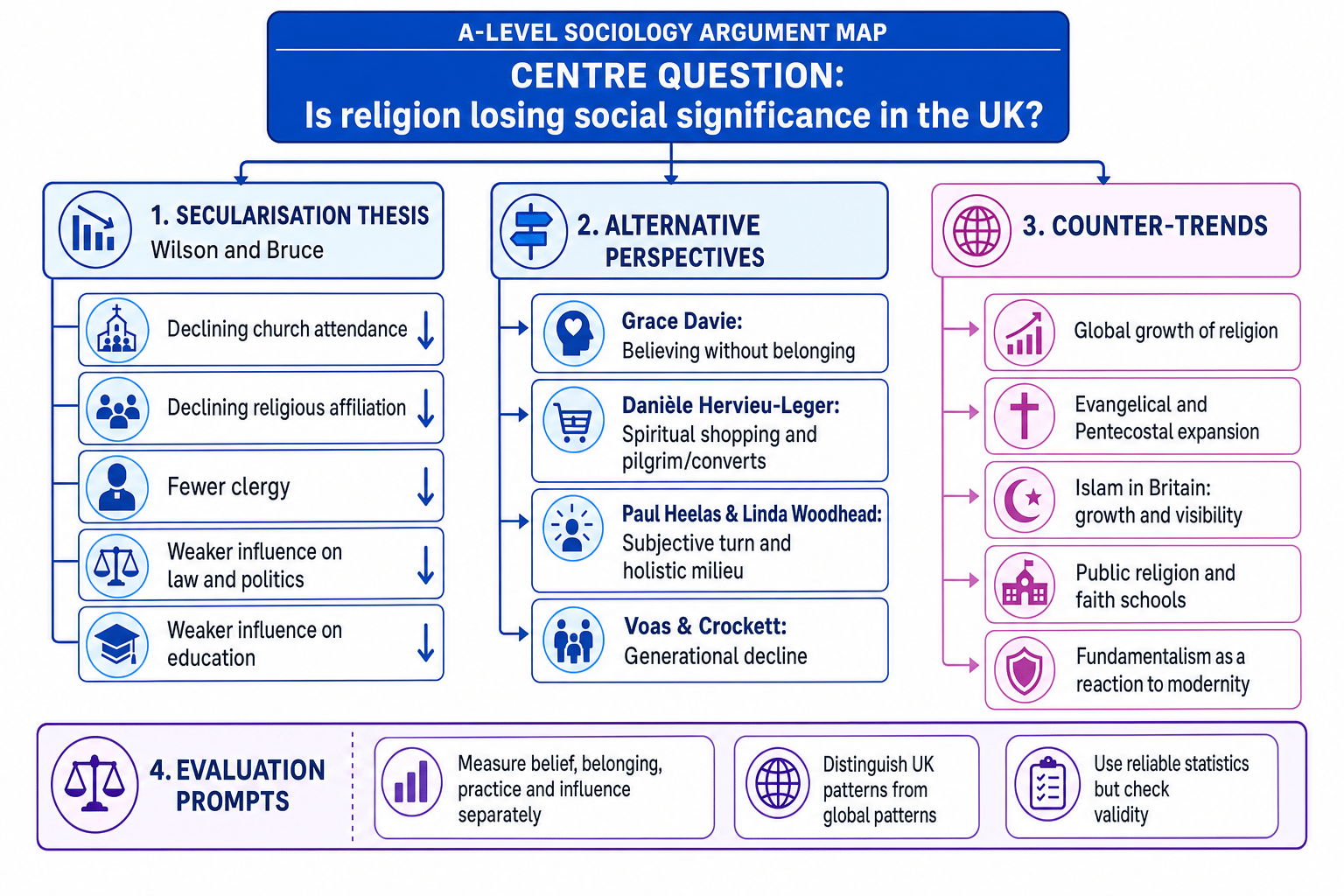
Secularisation is the process by which religion loses social significance. This can mean declining belief, declining worship, weaker religious organisations, or less influence over law, education, politics and everyday culture.
The central debate is whether religious organisations in the UK are declining, or whether religion is simply changing form.
The secularisation thesis
Wilson and Bruce argue that modern societies tend to become more secular. Three processes are especially important:
- Rationalisation: people increasingly explain the world through science, technology and bureaucracy rather than religion.
- Social differentiation: institutions such as education, law, health and welfare become separate from religious control.
- Pluralism: many competing beliefs exist side by side, making any single truth claim less dominant.
AO2 evidence includes Census 2021 data for England and Wales, where 46.2% identified as Christian and 37.2% as having no religion. British Social Attitudes surveys also show strong generational decline in religious affiliation.
However, religion has not disappeared. The UK still has faith schools, religious charities, public ceremonies, religious broadcasting, and legal protection for religion or belief under the Equality Act 2010.
Believing without belonging
Davie (1994) argued that many people continue to believe without regularly attending church. She called this believing without belonging. Later, she used the idea of vicarious religion, where a minority actively practises religion on behalf of a wider population, for example at weddings, funerals or national crises.
Hervieu-Léger (2000) argued that modern people may become spiritual “pilgrims” and “converts”, choosing beliefs rather than inheriting them. This fits New Age spirituality and “pick-and-mix” religion.
Voas and Crockett, however, argue that Britain may be moving towards neither believing nor belonging, especially through generational replacement: younger cohorts are less religious than older ones.
Measure religion in more than one way
Use four dimensions: belief, belonging, practice and social influence. A society may show decline in church attendance but still have religious identity, private spirituality or public religious debates.
Methods: how do we know?
Reliability means research gives consistent results. Validity means it measures what it claims to measure. Official statistics such as the Census are highly representative, but the word “religion” may measure cultural identity rather than active belief.
Attendance figures may measure practice more validly, but they can miss private prayer, online worship or informal spirituality. Interpretivists prefer interviews or ethnography because they explore meanings, but these methods can be time-consuming and harder to generalise.
Using Census data to assess secularisation
A paragraph uses Census 2021 data showing growth in “no religion” to support secularisation.
- Identify what the data measures: the Census mainly measures affiliation, meaning how people identify, not how often they worship or what they privately believe.
- Link it to theory: rising “no religion” supports Bruce’s argument that religious identity is weakening, especially if younger generations are less attached to churches.
- Evaluate the evidence: the data does not prove all belief has disappeared, because Davie would argue that some people may still believe without belonging.
Equating secularisation with atheism
Secularisation does not simply mean “everyone becomes atheist”. It means religion loses social power or public significance, even if some belief continues privately.
Fundamentalism
Fundamentalism
Fundamentalism is a form of religion that treats foundational texts or traditions as certain, non-negotiable authority and often seeks to defend a community from perceived moral or cultural threat.
Giddens argues that fundamentalism is “tradition defended in a traditional way” in a globalising world. In other words, modernity creates uncertainty, choice and rapid change; fundamentalist organisations respond by offering certainty, strict boundaries and clear moral rules.
Bruce argues that fundamentalism is strongest where religion still matters publicly and where traditional ways of life feel threatened. It can be a reaction to secularisation, but it can also show that religion remains politically powerful in some contexts.
AO2 examples include debates around sexuality, gender roles, abortion, faith schools, creationism, modest dress, or religious law. Be careful: fundamentalism exists in different religions, and it is not the same as violence.
Linking fundamentalism to modernity
A religious organisation campaigns against liberal sex education and sets up separate youth groups, media channels and schools.
- Identify the modern pressure: secular education and liberal sexual values challenge the organisation’s traditional moral authority.
- Explain the identity response: strict doctrine and separate institutions help members feel secure and distinct from wider society.
- Analyse the wider debate: this may support Giddens’ view that fundamentalism is a response to modern uncertainty, not simply a survival from the past.
Power, identity and stratification
Religious organisations socialise members into culture and identity through rituals, festivals, dress codes, food rules, stories and moral expectations. They can create strong belonging, especially for minority ethnic or migrant communities.
They also involve power. Feminists examine whether leadership is male-dominated and whether women are excluded from authority. The Church of England’s decision to allow women bishops from 2014 shows that religious structures can change, but often after long internal conflict.
Marxists argue that established religion can legitimate inequality by presenting social arrangements as natural or God-given. Weber, however, showed that religion can also drive social change, as in his argument about the Protestant ethic and capitalism.
Religious organisations may also build social capital, meaning networks of trust and support. UK examples include food banks, mosque and gurdwara community services, chaplaincy, and faith-based charities. So AO3 should avoid one-sided claims: religion can reproduce hierarchy, but it can also support resistance, welfare and identity.
In the exam
- Start with a clear definition and a named sociologist: for example, Troeltsch on church and sect, Wallis on NRMs, Bruce on secularisation, or Davie on believing without belonging.
- Apply the concept to a concrete example from UK society, such as the Church of England, Census 2021, faith schools, religious charities, or New Age spirituality.
- Evaluate by separating belief, belonging, practice and social influence; then compare perspectives and comment on the validity of the evidence.
Check yourself
- What is the difference between a church, a denomination and a sect?
- Why might New Age spirituality be used both to challenge and support the secularisation thesis?
- How could fundamentalism be interpreted as a response to modernity and globalisation?