What you'll learn
- How income, wealth and social mobility differ — and why that matters.
- The main patterns of inequality in the contemporary UK, including class, gender, ethnicity, age and region.
- How sociologists explain inequality using functionalist, Marxist, Weberian, feminist and cultural-capital ideas.
- How to evaluate evidence from official statistics and mobility studies for AO3.
The starting point: inequality and stratification
Social inequality
Social inequality means unequal access to valued resources such as money, housing, education, health, status and power.
Social stratification means society is organised into layers or groups, where some people have more rewards and life chances than others. In this topic, “changing patterns” means you are not just describing inequality — you are looking at how it has shifted over time and how it is distributed between groups.
For Eduqas, keep two threads running through your answer:
- Power and stratification: who controls resources, opportunities and decision-making?
- Socialisation, culture and identity: how class, gender, ethnicity, region and family background shape expectations, networks and chances.
Pattern, not just gap
A strong answer asks: who is unequal, in what way, compared with whom, and why has this changed?
Income and wealth: the essential distinction
Income
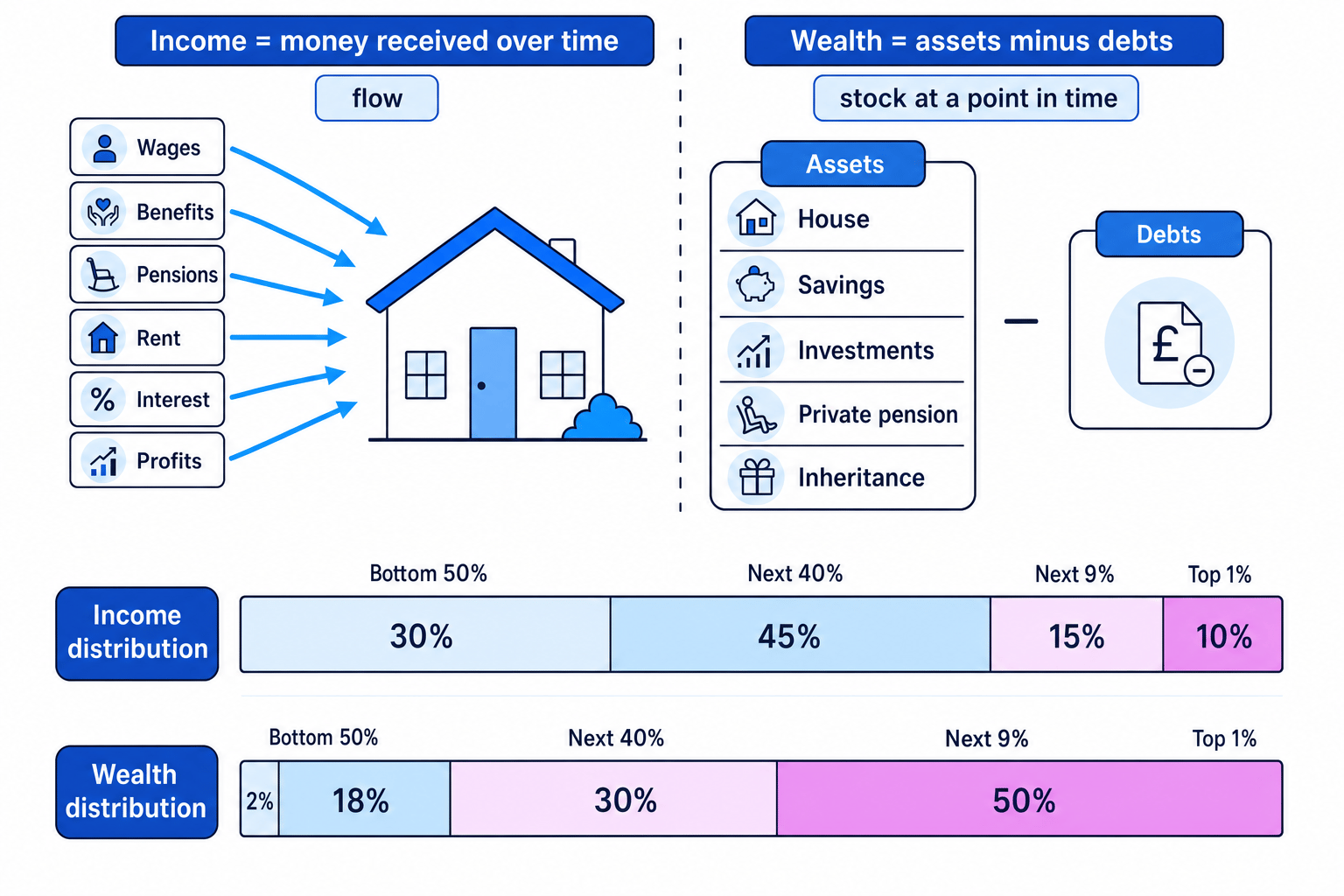
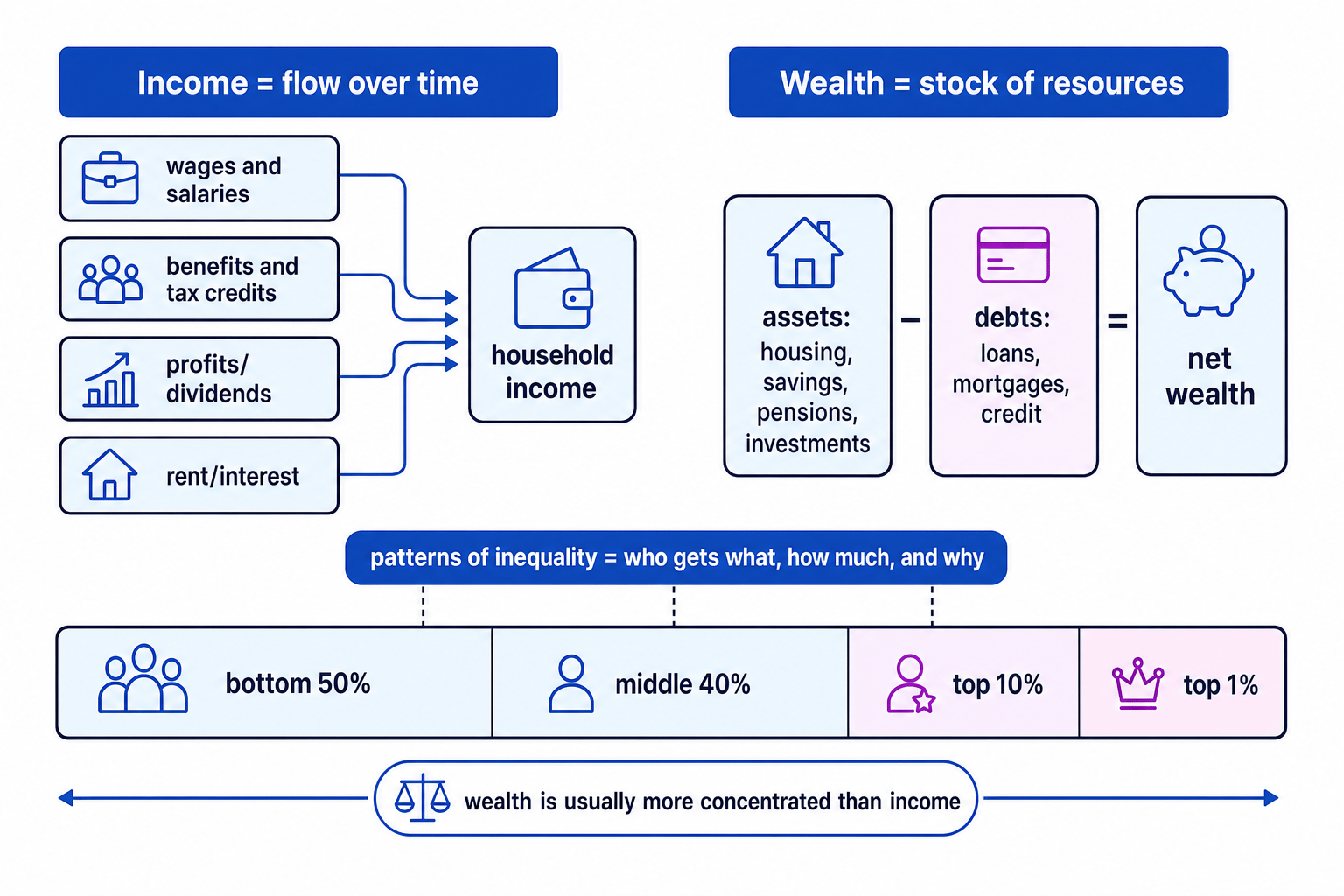
Income is money received over a period of time, such as wages, benefits, pensions, rent, interest, dividends or profits.
Wealth
Wealth is the total stock of assets someone owns, such as housing, savings, investments and pensions, minus debts.
Income is a flow; wealth is a stock. This is crucial because someone can have a high income but little wealth, or a low income but high wealth. Wealth often gives people security, choice and influence: it can fund private education, support unpaid internships, pay deposits for housing, and be passed on through inheritance.
Separating income from wealth
A graduate earns a good salary but rents privately and has no savings. A retired homeowner has a modest pension but owns a valuable house outright.
- Identify income first: the graduate has a higher regular flow of money from salary; the retired homeowner has a lower regular flow from pension income.
- Identify wealth next: the graduate may have little or negative net wealth because of debt and no property; the retired homeowner may have high net wealth because of housing assets.
- Compare life chances: the homeowner may have more security and can potentially help family members financially, while the graduate may be vulnerable to rent rises despite earning more.
- Link to inequality: this shows why wealth inequality can reproduce advantage across generations even when income looks less unequal.
Treating poverty and inequality as identical
Poverty is about lacking sufficient resources; inequality is about the gap between people or groups. A society can reduce poverty while still having large inequalities at the top.
The distribution of income in the contemporary UK
Distribution
Distribution means how resources are spread across a population. Sociologists often compare groups such as the top and bottom income groups, regions, genders, ethnic groups or social classes.
When measuring income, you may see several terms:
- Market income: income before taxes and benefits, such as wages and private pensions.
- Disposable income: income after taxes and benefits.
- Equivalised income: household income adjusted for household size and needs.
- Gini coefficient: a summary measure of income inequality, where a higher score means greater inequality.
- Quintiles or deciles: the population divided into five or ten equal-sized groups from poorest to richest.
Key UK patterns
Income inequality in the UK rose sharply during the 1980s. Sociologists link this to deindustrialisation, weaker trade unions, higher unemployment in former industrial areas, changes to taxation and welfare, and rapid growth in top salaries.
Since the 1990s, income inequality has fluctuated rather than simply rising every year, but the UK remains relatively unequal compared with many Western European countries. Taxes and benefits reduce inequality, but policies such as welfare cuts, the benefit cap, freezes to working-age benefits and austerity have increased hardship for some groups.
AO2 examples you could use include:
- Universal Credit and debates over whether it supports work or increases insecurity.
- The National Minimum Wage and National Living Wage, which protect some low-paid workers but do not remove problems such as insecure hours or high housing costs.
- The cost-of-living crisis, where food, energy and rent rises hit low-income households hardest because essentials take up more of their budget.
- Regional inequalities affecting parts of Wales, the North East, the Midlands and former industrial communities.
The distribution of wealth
Wealth is usually more unequal than income because assets accumulate over time. Housing, private pensions, savings and investments are especially important.
In the UK, wealth is strongly shaped by:
- Housing ownership: rising house prices benefit existing homeowners but make it harder for renters and younger people to buy.
- Inheritance: middle-class and wealthy families can pass on deposits, property or financial support.
- Age: older groups often hold more housing and pension wealth than younger adults.
- Region: London and the South East often have higher housing wealth, although this does not mean everyone there is wealthy.
- Ethnicity and gender: historic discrimination, labour-market inequality and caring responsibilities can reduce opportunities to build assets.
Policy matters here. Right to Buy increased home ownership for some council tenants but also reduced the stock of social housing. Pension auto-enrolment may help some workers build retirement wealth, but people in insecure or low-paid work may still accumulate little. Debates over inheritance tax, housing policy and social care also affect the distribution of wealth.
Social mobility: movement between social positions
Social mobility
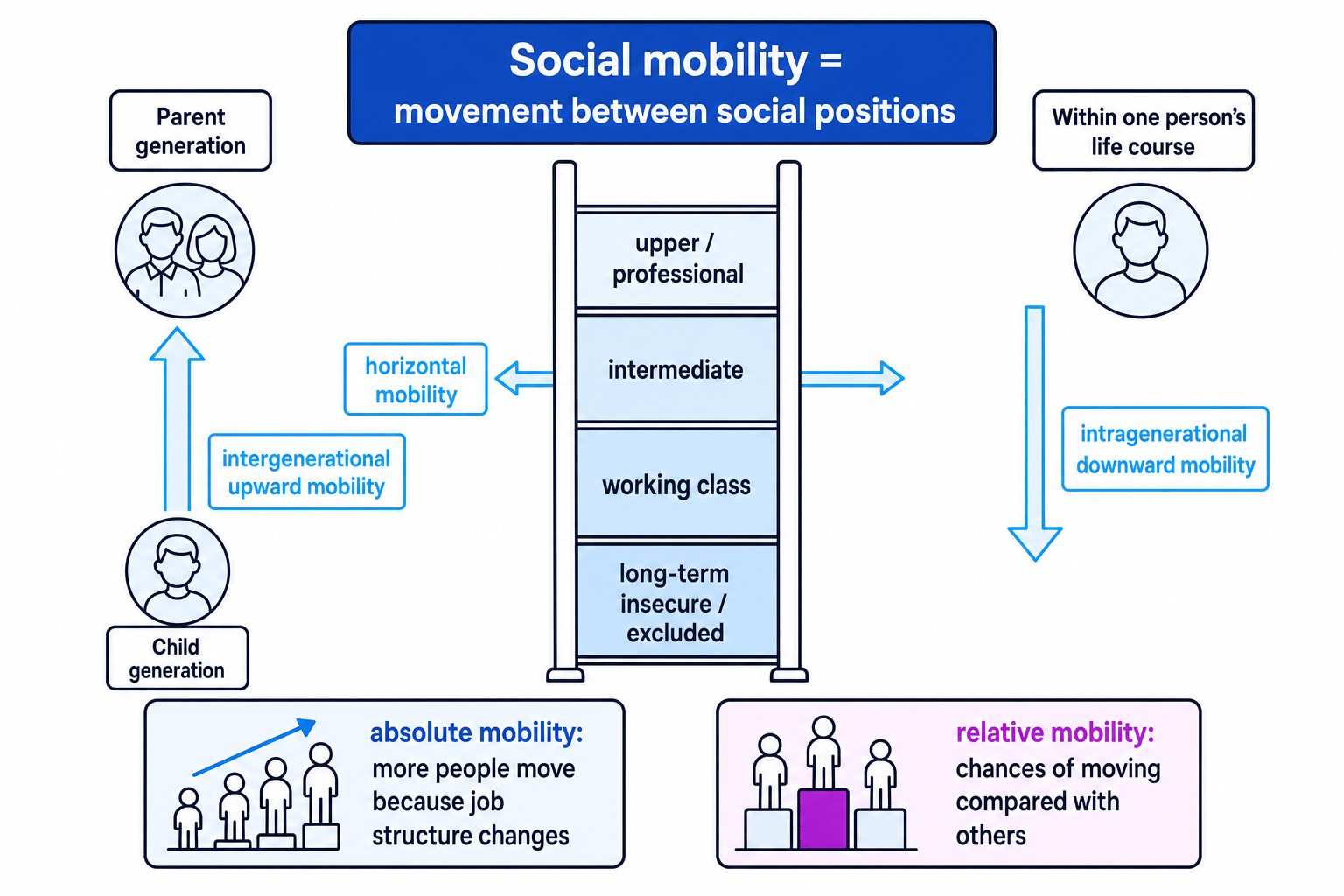
Social mobility means movement between social positions, usually measured by class, occupation, income or education.
There are several types:
- Intergenerational mobility: movement between parents’ and children’s social positions.
- Intragenerational mobility: movement within one person’s lifetime.
- Vertical mobility: movement up or down the hierarchy.
- Horizontal mobility: movement to a different position with similar status.
- Absolute mobility: the total amount of movement, often caused by changes in the job structure.
- Relative mobility: the chances of people from different backgrounds reaching certain positions compared with each other.
Is the UK meritocratic?
Meritocracy
A meritocracy is a society where people’s positions are based on talent, effort and achievement rather than inherited advantage.
Functionalists such as Davis and Moore (1945) argue that inequality can motivate people to train for important roles, so some unequal rewards are necessary. However, critics argue that the UK is not fully meritocratic because class background, wealth, education, ethnicity, gender and networks still shape opportunities.
Important studies include:
- Goldthorpe’s Oxford Mobility Study (1972): found significant absolute mobility, partly because the occupational structure changed, but class origins still mattered.
- Blanden et al. (2005): argued that intergenerational income mobility in the UK was relatively low compared with some other countries.
- Bukodi and Goldthorpe (2018): suggest that claims of sharply declining social mobility can be overstated, but relative class inequalities remain persistent.
- Friedman and Laurison (2019): identify a “class ceiling”, where people from working-class backgrounds who enter elite occupations often earn less and progress more slowly than colleagues from privileged backgrounds.
Analysing absolute and relative mobility
Imagine more working-class children enter professional jobs than in the past, but middle-class children are still much more likely to enter those jobs overall.
- Identify absolute mobility: more working-class children reaching professional jobs suggests upward movement has increased in total.
- Identify relative mobility: if middle-class children still have much better chances, the competition remains unequal.
- Apply to meritocracy: the society may look more open than before, but inherited advantage still shapes outcomes.
- Evaluate: occupational change can create “room at the top”, but wealth, schooling, networks and unpaid opportunities may still reproduce inequality.
Sociological explanations of changing inequality
Functionalism
Functionalists see inequality as potentially useful because unequal rewards encourage people to train for demanding roles. This links to role allocation, where education and work sort people into positions.
AO3: Tumin criticised Davis and Moore, arguing that inequality can waste talent because poorer groups may be blocked from developing their abilities. Functionalism can also underestimate inherited wealth and discrimination.
Marxism
For Marx, inequality is rooted in capitalism. The bourgeoisie own the means of production, while the proletariat sell their labour. Inequality persists because profit depends on exploitation.
In contemporary UK society, Marxists might point to low-paid service work, zero-hours contracts, shareholder power, private landlords and the growth of wealth through assets rather than wages.
AO3: Marxism is strong on power and class conflict, but it can underplay gender, ethnicity, status differences and the expansion of the middle class.
Weberian approaches
Weber argued that inequality is multidimensional. Class matters, but so do status and party. Status refers to social honour or prestige; party refers to organised power, including political influence.
This helps explain why a person’s life chances may depend on credentials, professional status, networks, ethnicity, gender and regional location — not only ownership of capital.
Feminism
Feminists argue that inequality is shaped by patriarchy, meaning male dominance within social structures. Walby highlights how paid work, unpaid care, family life and the state can reproduce gender inequality.
AO2 examples include the gender pay gap, the “motherhood penalty”, high childcare costs and women’s greater likelihood of doing unpaid caring work. The Equality Act 2010 provides legal protection against discrimination, but legal equality does not automatically produce equal outcomes.
Bourdieu and cultural capital
Bourdieu argued that advantage is reproduced through different forms of capital:
- Economic capital: money and assets.
- Cultural capital: knowledge, tastes, language and qualifications valued by institutions.
- Social capital: useful networks and connections.
This links inequality to socialisation and identity. Middle-class families may pass on confidence with schools, professional language, extracurricular activities and networks that help children succeed.
Strong AO3 comparison
A good essay does not just list theories. Compare them: Marxists emphasise ownership and exploitation, Weberians add status and power, feminists highlight patriarchy, and Bourdieu shows how advantage is reproduced culturally.
How sociologists measure inequality
Sociologists use evidence such as:
- ONS income, labour-market and wealth data.
- DWP Households Below Average Income statistics.
- The Wealth and Assets Survey.
- The Census.
- Longitudinal studies following people over time.
- Reports from the Social Mobility Commission, Joseph Rowntree Foundation or Resolution Foundation.
These sources are useful because they often use large samples and allow comparisons over time. This supports reliability, meaning findings can be checked or repeated.
However, there are limitations. Wealth can be hard to measure because very rich households may be less likely to respond, assets can be hidden or difficult to value, and household averages can hide inequalities within families. Class categories such as NS-SEC are useful but may not capture insecure work, unpaid care or cultural status.
Forgetting measurement issues
Do not treat statistics as neutral facts without evaluation. Ask how income, wealth, class and mobility were defined, who was included, and whether the data captures lived experience.
Pulling it together for essays
For an essay on changing patterns of inequality, aim to show three things:
- AO1 knowledge: define income, wealth and mobility; use theories and studies accurately.
- AO2 application: connect ideas to contemporary UK examples such as housing, welfare, wages, regional inequality and education.
- AO3 evaluation: compare perspectives, question measurement, and assess whether inequality is increasing, decreasing or changing form.
In the exam
- Start by separating income, wealth and social mobility so your answer does not become vague.
- Use at least one theory and one piece of evidence, then evaluate both rather than simply describing them.
- Keep returning to the question of change: what has shifted over time, what has stayed unequal, and which groups are most affected?
Check yourself
- Why is wealth usually more powerful than income in reproducing inequality?
- What is the difference between absolute and relative social mobility?
- How would a Marxist and a Weberian explain unequal life chances differently?