What you'll learn
- What subjectivity, objectivity and value freedom mean in sociology.
- Why positivists, interpretivists, Weberians, Marxists and feminists disagree about neutrality.
- How values can enter research at different stages, from topic choice to publication.
- How to use this debate in AO1, AO2 and AO3 essay answers.
Why this debate matters
Sociology studies people, meanings, institutions and power. That makes it harder to copy the natural sciences, where researchers usually study objects that do not answer back, resist, reinterpret questions or judge the researcher.
This topic asks a big Theory and Methods question: can sociology produce objective knowledge about society, or is all sociological knowledge shaped by values and viewpoints?
This links directly to both core themes:
- Socialisation, culture and identity: your values are shaped by family, education, media, religion, class, gender, ethnicity and culture.
- Social differentiation, power and stratification: powerful groups may have more influence over what counts as “official” knowledge, what gets researched, and which groups are labelled as a “social problem”.
Values: the starting point
Values
Values are beliefs about what is important, desirable, right or wrong. In sociology, values might include beliefs about equality, freedom, social order, individual responsibility, religion, gender roles or social justice.
Values matter because sociologists are not blank machines. They are people with social backgrounds, political views, moral concerns and personal experiences. A sociologist who researches poverty, policing, education or gender inequality may care deeply about the topic.
That does not automatically make their research “bad”. The key question is whether values are controlled, made explicit, or allowed to distort evidence.
The core tension
The debate is not simply “values bad, facts good”. It is about where values enter research, whether they can be removed, and how honestly sociologists deal with them.
Objectivity
Objectivity
Objectivity means trying to produce knowledge that is based on evidence rather than personal opinion, political belief or emotional preference. Objective research should be open to checking, criticism and replication by others.
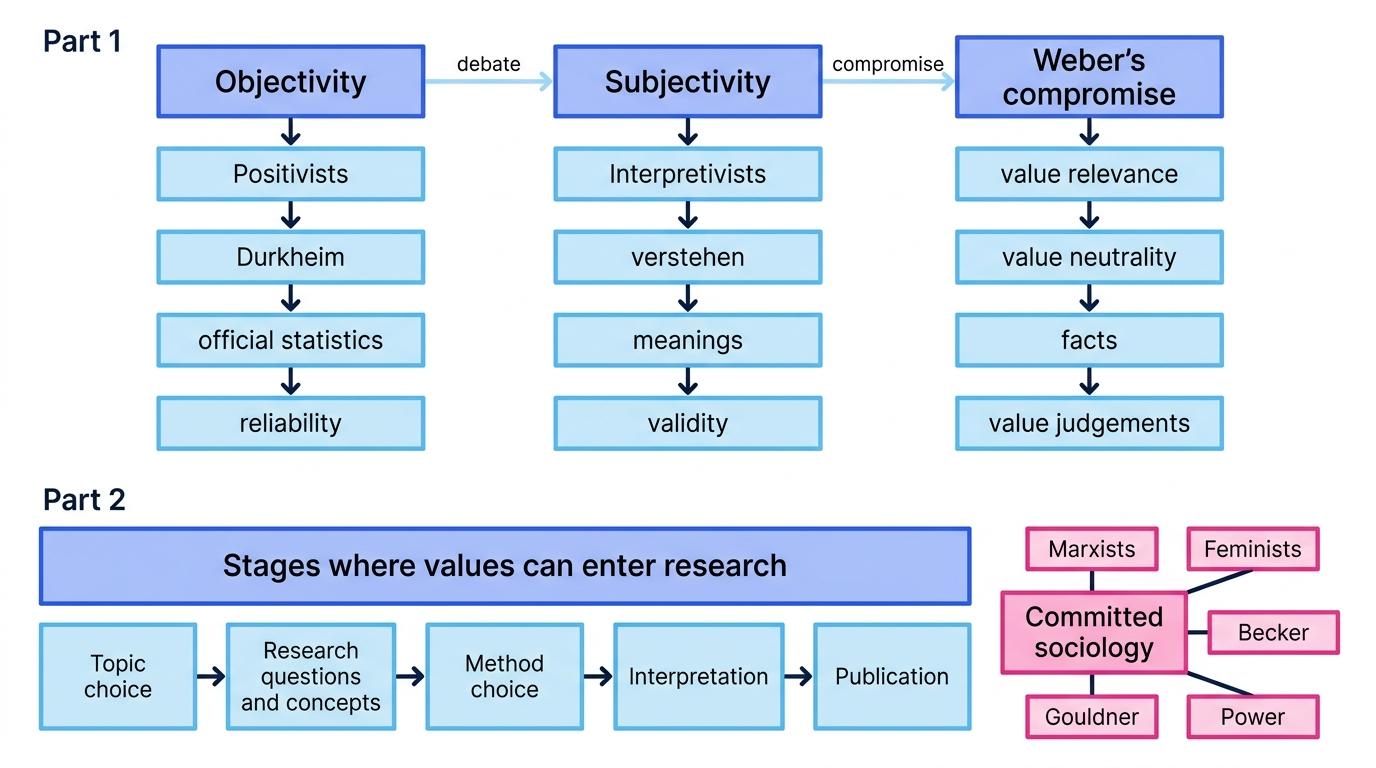
Objectivity is especially important to positivists. Positivism is the view that sociology should use methods similar to the natural sciences to discover patterns, causes and social facts.
Durkheim’s study of suicide is a classic example. He argued that suicide rates were shaped by social facts — social forces external to individuals, such as levels of integration and regulation. He used official statistics to look for patterns across groups.
In contemporary UK sociology, objectivity might involve using ONS Census data, Crime Survey for England and Wales data, or school achievement statistics to identify broad social patterns.
Separating evidence from value judgement
A researcher says: “Recorded knife crime has increased in some police force areas, and this shows young people today have no respect.”
-
Identify the empirical claim: “Recorded knife crime has increased in some police force areas” is a claim that can be checked against police-recorded crime data and the Crime Survey for England and Wales.
-
Identify the value judgement: “Young people today have no respect” makes a moral judgement about a whole group. It is not directly proven by the crime data.
-
Separate analysis from blame: A more objective sociological analysis would ask what factors may be involved, such as policing practices, deprivation, youth services, school exclusion, gang networks or media reporting.
Objectivity does not mean having no views
You do not need to claim that objective researchers have no opinions at all. The stronger point is that they try to stop personal values from deciding the evidence, method or conclusion.
Subjectivity
Subjectivity
Subjectivity means knowledge, experience or interpretation shaped by a person’s viewpoint, feelings, identity, social position or meanings.
In sociology, subjectivity appears in two main ways.
First, the people being studied have subjective meanings. For example, a student’s experience of school is shaped by their identity, friendships, teacher relationships and sense of belonging.
Second, the researcher also has subjectivity. Their gender, ethnicity, class, age, political views or personal history may affect what they notice, how participants respond to them, and how they interpret data.
Interpretivists argue that subjectivity is not just a problem to eliminate. It is often the very thing sociology needs to understand. Weber used the idea of verstehen, meaning empathetic understanding of social action from the actor’s point of view.
For example, to understand why some pupils resist school, an interpretivist would not only count exclusions. They might use interviews or participant observation to explore identity, labelling, peer-group status and feelings of injustice.
Value freedom
Value freedom
Value freedom is the idea that sociological research should be kept free from the researcher’s personal values, especially when collecting evidence, analysing data and reaching conclusions.
The strongest version says sociology should be neutral, factual and scientific. Sociologists should describe and explain society, not preach about what society ought to be like.
This is attractive because it protects sociology from becoming propaganda. If a researcher simply begins with “capitalism is evil” or “welfare claimants are lazy” and then only selects evidence that supports this view, the research loses credibility.
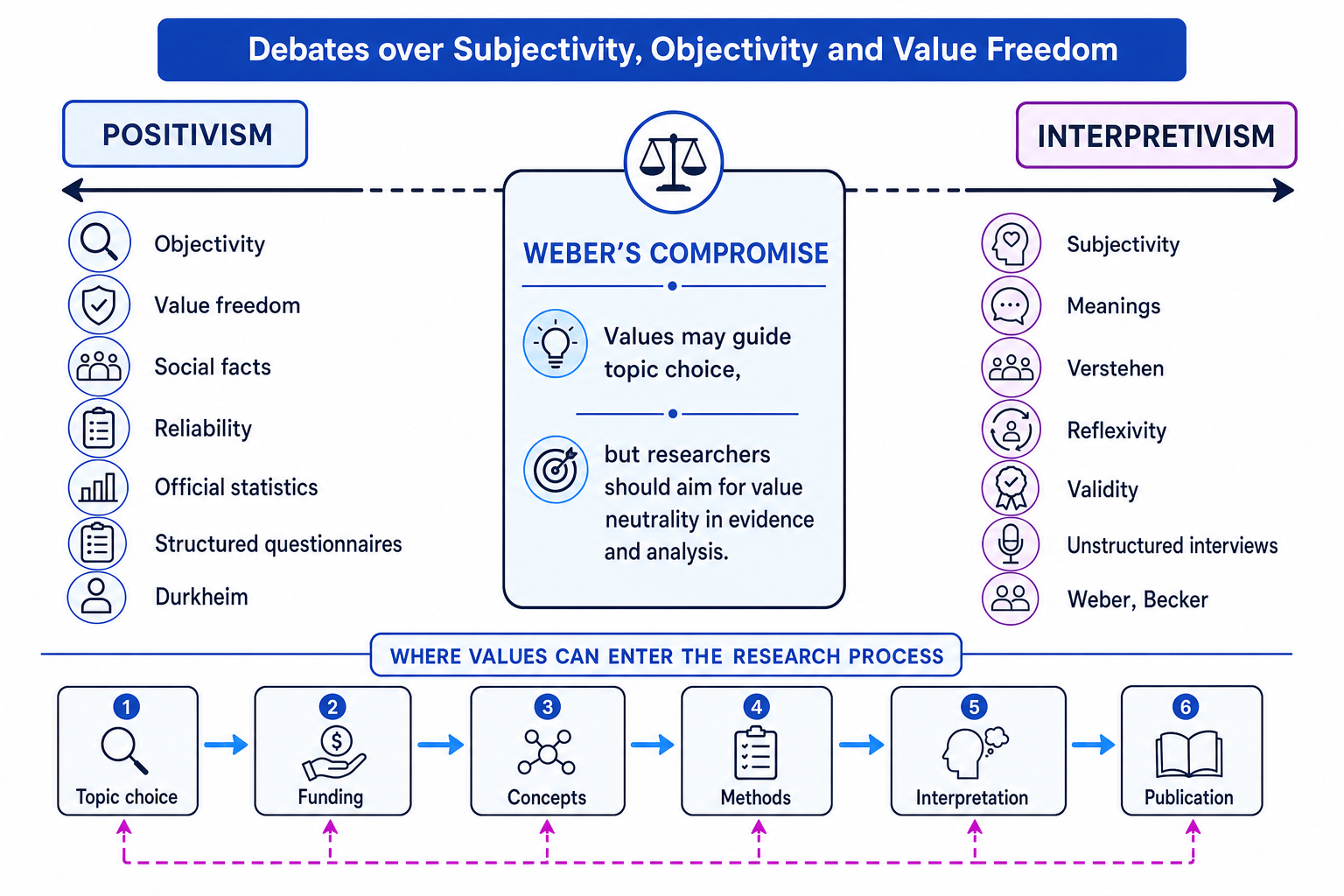
However, critics argue that complete value freedom is impossible. Values can shape:
- the topic chosen
- the research question asked
- the concepts used, such as “underachievement”, “deviance” or “family breakdown”
- the method selected
- the interpretation of findings
- the way findings are written up and publicised
Tracing values through a research project
Imagine a sociologist studies school exclusions among Black Caribbean boys in England.
-
Topic choice: Choosing this topic may reflect a value commitment to racial equality, educational justice or concern about institutional racism.
-
Concepts and questions: Asking “why are Black Caribbean boys excluded?” may lead to different research than asking “how do school policies and teacher expectations shape exclusion patterns?”
-
Methods: Official statistics may show patterns, but interviews with pupils, parents and teachers may reveal experiences of labelling, identity and school culture.
-
Interpretation: A value-free approach would avoid simply forcing the evidence into a preferred explanation. It would weigh competing factors, such as racism, class, masculinity, school discipline policies and local context.
Weber’s compromise: value relevance and value neutrality
Weber offers a useful middle position.
Value relevance
Value relevance means researchers’ values may influence which topics they see as important enough to study.
Value neutrality
Value neutrality means that once research has begun, sociologists should try to keep analysis disciplined, evidence-based and fair, even if their values shaped the original topic choice.
Weber did not think sociologists could be completely value-free in every sense. But he argued they should distinguish between facts and value judgements.
For example, a sociologist can investigate whether benefit sanctions increase poverty, mental distress or employment. But deciding whether sanctions are morally right is a political and ethical judgement, not something the data alone can settle.
Use Weber as your balanced evaluation
In essays, Weber is excellent for AO3 because he avoids both extremes: he accepts that values influence sociology, but still defends disciplined, evidence-based research.
Positivist view: sociology should aim for objectivity
Positivists argue that objective sociology is possible if researchers use systematic methods. They prefer methods such as structured questionnaires, experiments, official statistics and comparative studies because these can be standardised and repeated.
Their argument is that society has patterns that exist beyond individual opinions. For instance, class differences in health, gender differences in subject choice, or ethnic inequalities in stop and search rates can be measured and compared.
AO1 theorist link: Durkheim argued that social facts should be studied “as things”.
AO2 application: Census data can reveal patterns in household structure, ethnicity, occupation and religion across the UK.
AO3 evaluation: official categories are not neutral. Census categories for ethnicity, religion or family type are created by institutions and may not fully capture people’s lived identities.
Interpretivist view: sociology must understand meanings
Interpretivists argue that human beings are meaning-makers. You cannot fully understand action just by counting behaviour.
For example, two pupils may both be absent from school, but one absence may be due to illness, another to caring responsibilities, bullying, exclusion, anxiety or resistance to school authority. The same outward behaviour can have different meanings.
Interpretivists therefore favour methods such as unstructured interviews, participant observation and case studies. These may produce high validity, meaning they capture what social life is really like for participants.
AO1 theorist link: Weber’s verstehen focuses on understanding social action. Interactionists such as Becker explore labelling and the meanings attached to deviance.
AO2 application: research into gender identity, religious belonging or youth subcultures often needs qualitative methods to understand identity from the inside.
AO3 evaluation: interpretivist research may be less reliable because it is harder to repeat exactly, and the researcher’s presence may shape the data.
Committed sociology: values may be necessary
Some sociologists argue that value freedom is not only impossible but undesirable.
Becker asked, “Whose side are we on?” He argued that sociology often takes sides whether it admits it or not. Studying deviance from the viewpoint of police, courts or schools may support powerful institutions. Studying from the viewpoint of labelled groups may reveal hidden power.
Gouldner criticised the “myth of value-free sociology”. He argued that pretending to be neutral can hide the values already built into research, universities, funding and wider society.
Marxists argue that sociology should expose class exploitation and ideology. Feminists argue that supposedly objective research has often reflected male assumptions. Oakley, for example, criticised detached, hierarchical interviewing and argued for more open, reciprocal research relationships.
Power shapes knowledge
Debates about value freedom are also debates about power: whose problems are researched, whose categories are used, and whose voices are treated as credible.
Do not treat committed sociology as automatically biased
A feminist or Marxist researcher may have clear values but still use rigorous evidence. The AO3 issue is whether the values are made explicit and whether contradictory evidence is taken seriously.
Postmodern challenge: is there one objective truth?
Postmodernists are sceptical of claims to universal truth. They argue that knowledge is shaped by language, discourse, media and power. Foucault, often linked to post-structuralism, argued that knowledge and power are connected: institutions define categories such as “normal”, “deviant”, “mad” or “criminal”.
This is useful for analysing how official knowledge can label groups. For example, government language around “troubled families”, “illegal migrants” or “anti-social behaviour” may shape public attitudes and policy.
However, if all knowledge is treated as just one viewpoint among many, it becomes difficult to challenge racism, sexism, poverty or misinformation using evidence. Sociology still needs standards for judging claims.
Bringing the debate together
A strong answer does not simply say “positivists are objective and interpretivists are subjective”. The better argument is more layered:
- Positivists aim for objectivity through standardised methods and reliable data.
- Interpretivists argue that meanings and researcher involvement make complete objectivity unrealistic.
- Weber offers a compromise: values may shape topic choice, but analysis should be evidence-based.
- Marxists, feminists and interactionists argue that value commitment can expose inequality and give voice to less powerful groups.
- Postmodernists push the debate further by questioning whether any knowledge is independent of discourse and power.
In the exam
-
Define the key terms early: clearly separate values, subjectivity, objectivity, value freedom, value relevance and value neutrality.
-
Use theorists for AO1, not just labels: link Durkheim to positivism, Weber to value neutrality, Becker and Gouldner to the critique of value freedom, and feminists or Marxists to committed sociology.
-
Evaluate both extremes: avoid saying sociology is either totally objective or totally biased. The strongest answers discuss degrees of objectivity, reflexivity, evidence, power and method choice.
Check yourself
- How would Weber distinguish between value relevance and value neutrality?
- Why might Becker argue that sociology inevitably takes sides?
- Can official statistics be objective if the categories are created by powerful institutions?