What you'll learn
- How sociological theory influences the choice of research methods.
- Why positivists and interpretivists usually prefer different kinds of evidence.
- How methods can support, challenge or even shape sociological theory.
- How to evaluate this relationship using AO1, AO2 and AO3 in essays.
Start with the basic idea
You have already met theories and methods separately. This sub-topic asks you to connect them.
Sociologists do not choose methods randomly. Their view of what society is like, what counts as knowledge, and what humans are like will often affect how they research.
Core terms
- Theory means a set of ideas that tries to explain patterns in social life, such as why inequality exists or how identity is formed.
- Method means a practical tool for collecting or analysing data, such as a questionnaire, interview, observation or official statistic.
- Methodology means the reasoning behind method choice: why a particular method fits a researcher’s aims and assumptions.
- Operationalisation means turning an abstract concept, such as “class”, “religiosity” or “achievement”, into something that can be observed or measured.
A useful way to see the relationship is as a cycle: theory shapes the research question and method, but the findings can then support, challenge or refine the theory.
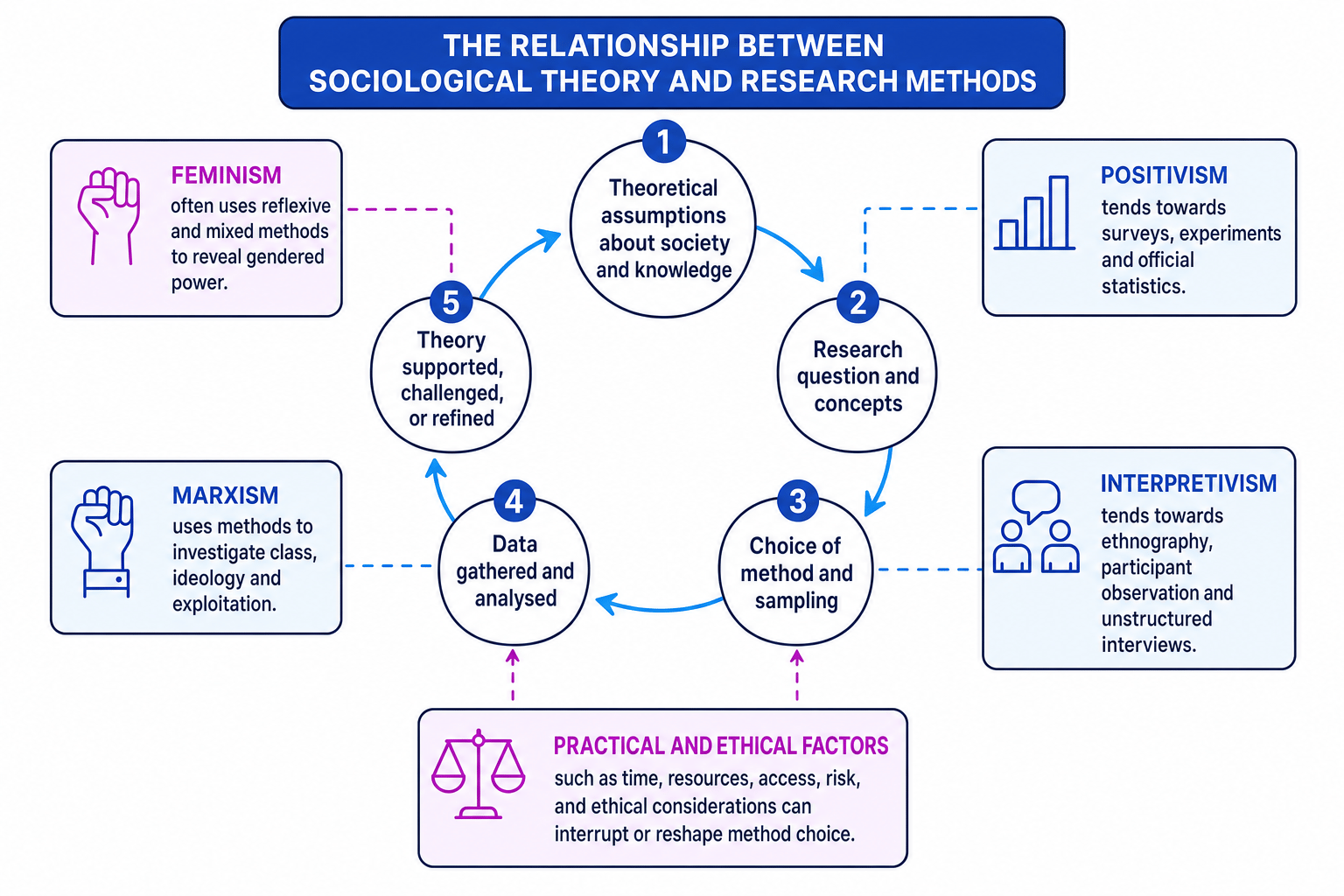
The relationship is two-way
Theory influences method choice, but methods also influence the kind of evidence produced. That evidence can then strengthen, weaken or reshape theory.
The deeper assumptions: ontology and epistemology
Two tricky words help explain why theories lead to different methods.
Ontology means assumptions about what social reality is like. For example, is society made up of external structures that shape us, or is it created through everyday interaction?
Epistemology means assumptions about what counts as valid knowledge. For example, should sociologists aim for objective measurement, or should they try to understand people’s meanings?
These assumptions matter because they push researchers towards different evidence.
| Theoretical assumption | Likely method choice | Reason |
|---|---|---|
| Society has measurable patterns | Surveys, official statistics, experiments | These produce numerical data and allow comparison |
| Social life is based on meanings | Unstructured interviews, participant observation, ethnography | These explore how people interpret their world |
| Power shapes knowledge | Feminist, Marxist or critical methods; often mixed methods | These reveal inequality and challenge dominant accounts |
Positivism: theory leading to quantitative methods
Positivism is the view that sociology should be scientific, objective and based on observable evidence. Positivists argue that society contains social facts: external patterns and forces that shape individuals, such as class, education, religion or family structure.
This is associated with Durkheim, especially his study of suicide in 1897. Durkheim used official statistics to argue that suicide rates varied according to levels of social integration and regulation.
Positivists usually prefer quantitative methods, which produce numerical data. Examples include social surveys, structured interviews, experiments and official statistics. They value reliability, meaning the method can be repeated and produce similar results, and representativeness, meaning the sample reflects the wider population.
AO2 examples in the UK include the Census, Crime Survey for England and Wales, school achievement data, ONS income statistics and deprivation indices. These allow sociologists to identify patterns in class, gender, ethnicity, age and region.
AO3 evaluation: positivist methods are strong for identifying large-scale trends, but they may lack validity, meaning they may not fully capture what they claim to measure. For example, exam statistics show achievement gaps, but not necessarily pupils’ experiences of labelling, racism, poverty or school culture.
Interpretivism: theory leading to qualitative methods
Interpretivism is the view that sociology should focus on meanings, motives and interpretations. Interpretivists argue that humans are not simply shaped by external forces; they actively create social reality through interaction.
This links to Weber’s idea of verstehen, meaning empathetic understanding of social action. It also connects to interactionist studies such as Becker’s work on labelling and Goffman’s work on institutions and identity.
Interpretivists usually prefer qualitative methods, which produce detailed, non-numerical data. Examples include unstructured interviews, participant observation, ethnography and personal documents. These methods aim for high validity because they get closer to how people understand their own lives.
AO2 examples include researching how pupils experience teacher labelling, how working-class young people construct identity, or how religious believers make sense of faith in a secular society.
AO3 evaluation: qualitative methods can reveal depth and meaning, but they are often time-consuming, based on small samples and harder to replicate. This can reduce reliability and generalisability.
Researching class identity
-
A sociologist influenced by Bourdieu might argue that class is not only about income; it also involves cultural capital, social networks, confidence, taste and habitus.
-
This theory suggests that official statistics on occupation or income would be useful but incomplete, because they show broad patterns without explaining how class feels in everyday life.
-
The researcher could combine ONS or UCAS data on educational inequality with interviews about whether working-class students feel “out of place” at elite universities.
-
This method choice fits the theory well because it captures both stratification patterns and lived identity, but it raises practical issues such as access to students and ethical issues around discussing sensitive experiences.
Conflict theories: methods and power
Conflict theories argue that society is structured around inequality and power. Marxism focuses on class conflict, capitalism and ideology. Feminism focuses on patriarchy, gender inequality and male power. These theories often ask: whose interests are served by knowledge?
Marxists may use statistics on wealth, wages, housing or education to show class inequality. They may also use historical research and qualitative interviews to explore exploitation, ideology and resistance.
Feminists have often criticised “malestream” sociology, meaning sociology that treats male experiences as normal or universal. Oakley argued that interviews should be less hierarchical and more reflexive. Reflexivity means researchers think critically about how their own identity, values and power affect the research process.
AO2 examples include using domestic abuse statistics to show gendered power, but also using interviews to understand why victims may not report abuse. Similarly, gender pay gap data can show inequality, while workplace interviews can reveal everyday sexism or motherhood penalties.
AO3 evaluation: critical theories are strong at exposing hidden power, but critics may argue that researchers risk selecting methods or interpretations that fit their political commitments. However, feminists and Marxists would reply that supposedly “neutral” methods can also reproduce existing power.
Treating theory as a method menu
Do not write as if “positivists always use questionnaires” or “feminists only use interviews”. Theory influences method choice, but practical access, ethics, funding, topic and the research population also matter.
Postmodernism and discourse
Postmodernism questions the idea that sociology can produce one objective truth about society. Postmodernists argue that contemporary society is fragmented, media-saturated and shaped by competing narratives.
This links to methods such as discourse analysis, media analysis and visual research. Discourse analysis studies how language constructs reality, for example how newspapers represent migrants, benefit claimants or young people.
Foucault is useful here because he argued that knowledge and power are linked. Categories such as “criminal”, “normal”, “deviant” or “mentally ill” are not neutral; they are produced through institutions and expert knowledge.
AO3 evaluation: postmodern approaches are useful for analysing culture, identity and media representation, but they can be criticised for relativism: if all knowledge is just a narrative, it becomes difficult to judge between better and worse explanations.
Methods can shape theory too
The relationship is not just “theory first, method second”. Sometimes methods produce evidence that changes theory.
For example, official crime statistics may appear to show the real amount of crime. A positivist might treat these statistics as objective social facts. But interactionists such as Cicourel argue that crime statistics are socially constructed through reporting, police decisions, recording practices and court processes.
This means the method itself shapes what sociologists think crime is.
Interpreting crime statistics
-
A positivist researcher might use police recorded crime to identify patterns by area, age or offence type, treating the data as evidence of real crime trends.
-
An interactionist would question how the statistics were created: some victims do not report crime, some groups are more heavily policed, and some incidents are not recorded in the same way.
-
The researcher could compare police data with the Crime Survey for England and Wales, which asks people about victimisation, including crimes not reported to police.
-
The comparison may refine theory: crime rates are not just about offending behaviour, but also about social control, labelling, trust in police and institutional power.
Practical, ethical and theoretical factors
In exam answers, do not reduce method choice to theory alone. A sociologist may prefer one method theoretically but choose another because of real-world constraints.
Practical factors include time, cost, funding, access, researcher skill and sample availability. For example, a large random sample may be ideal for representativeness but too expensive.
Ethical factors include informed consent, confidentiality, protection from harm and avoiding deception. For example, covert observation might produce valid data on deviant groups, but it raises serious ethical problems.
Theoretical factors include reliability, validity, representativeness, objectivity and whether the method fits positivist, interpretivist or critical assumptions.
Use the PET structure
When evaluating method choice, think Practical, Ethical, Theoretical. Then link each point back to the researcher’s theory and topic.
Mixed methods and triangulation
Mixed methods means using both quantitative and qualitative methods in the same study. Triangulation means using more than one source or method to check, deepen or balance findings.
For example, a study of educational inequality might use exam statistics to show patterns by class, gender and ethnicity, then interviews to explore teacher expectations, parental support and pupil identity.
This is often attractive because it avoids a simple positivist-versus-interpretivist divide. However, it can be expensive and time-consuming. There may also be theoretical tension: combining methods does not automatically combine the assumptions behind them.
The two AQA core themes
Socialisation, culture and identity
Theory affects how sociologists study identity. A functionalist might study how schools transmit shared norms and values. An interpretivist might study how pupils negotiate labels such as “boffin”, “troublemaker” or “failure”. A postmodernist might study how online identities are performed through social media.
Social differentiation, power and stratification
Theory also affects how sociologists study inequality. Marxists focus on class exploitation, feminists on patriarchy, and critical race theorists on racism and racialisation. Method choice can either expose or hide power. For example, broad official categories may show ethnic inequalities, but interviews may reveal discrimination that statistics alone cannot explain.
Turning this into essay material
For AO1, define the theory and method clearly. Use terms such as positivism, interpretivism, reliability, validity, social facts, verstehen, reflexivity and triangulation.
For AO2, apply the point to a concrete topic: crime statistics, educational achievement, domestic abuse, religion, class identity, Census categories or media representations.
For AO3, evaluate the link. Ask whether the method really fits the theory, whether other factors override theory, and whether the evidence produced is reliable, valid, representative or ethically gathered.
In the exam
-
Start each paragraph with a clear theory-method link, such as “Positivists prefer quantitative methods because they see society as patterned and measurable.”
-
Use a real example or study to apply the point, such as Durkheim on suicide, Oakley on feminist interviewing, or the Crime Survey for England and Wales.
-
Evaluate by showing limits: theory influences methods, but practical constraints, ethical issues, power relations and the research topic also shape the final choice.
Check yourself
- Why might a positivist prefer official statistics, and what would an interpretivist criticise about them?
- How can feminist methodology challenge the idea that research is neutral?
- Why is the relationship between theory and methods better seen as a cycle than a one-way process?
