What you'll learn
- What social policy is, and how it differs from a general “social problem”.
- How sociological research can influence UK policy on education, welfare, crime, families and health.
- How different sociological perspectives — functionalist, Marxist, feminist, New Right, interactionist and postmodernist — view policy.
- How to evaluate the relationship using AO1, AO2 and AO3 in essay-style answers.
Starting point: what is social policy?
Social policy
Social policy means the plans, laws, regulations and actions used by the state and other organisations to deal with social issues, allocate resources and influence people’s behaviour. Examples include welfare benefits, education reforms, housing policy, policing strategies, childcare provision and anti-discrimination law.
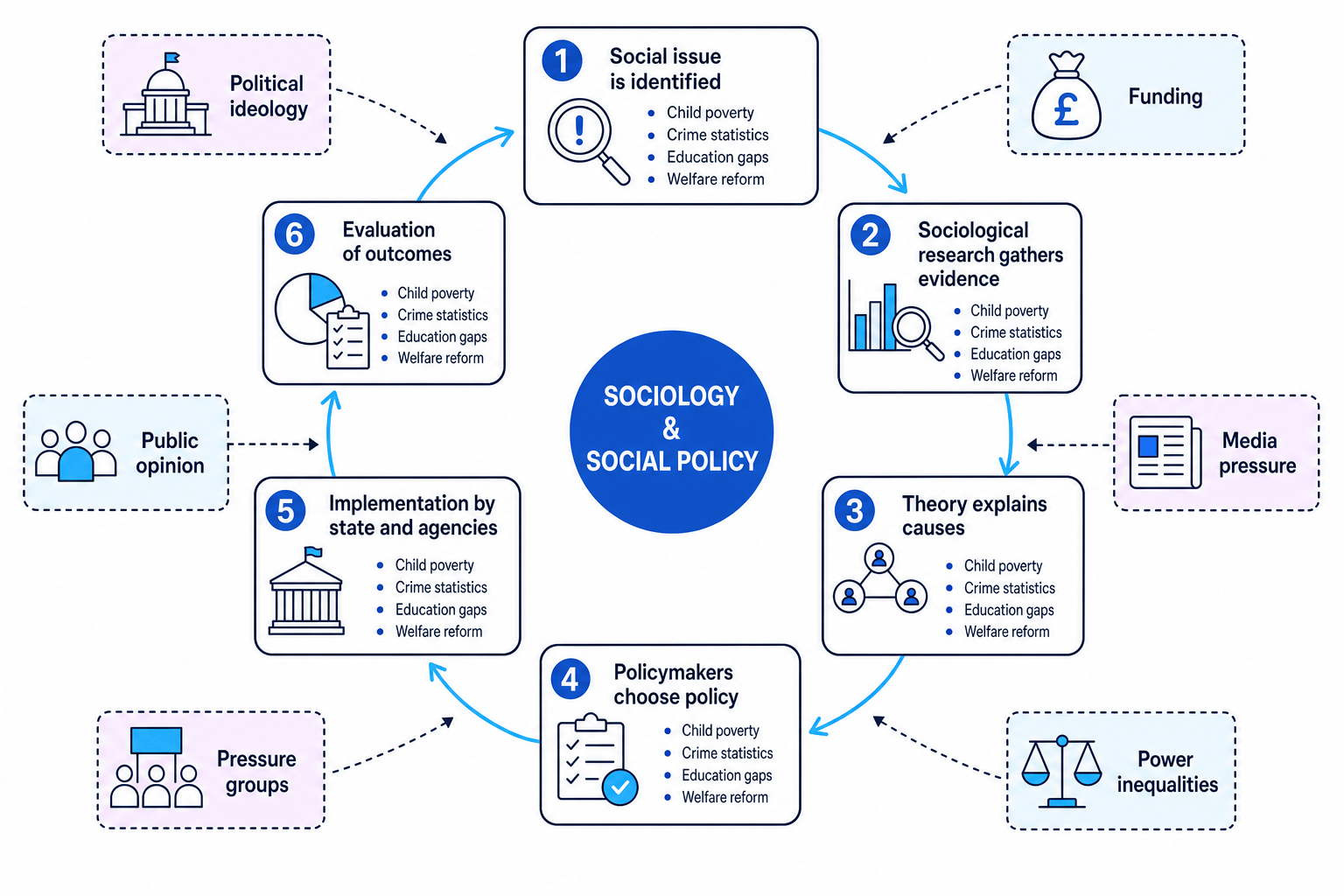
In A-Level Sociology, the key question is not simply “what policies exist?” It is: how does sociology relate to policy-making? Sociologists may identify problems, explain their causes, measure their effects and evaluate whether policies work.
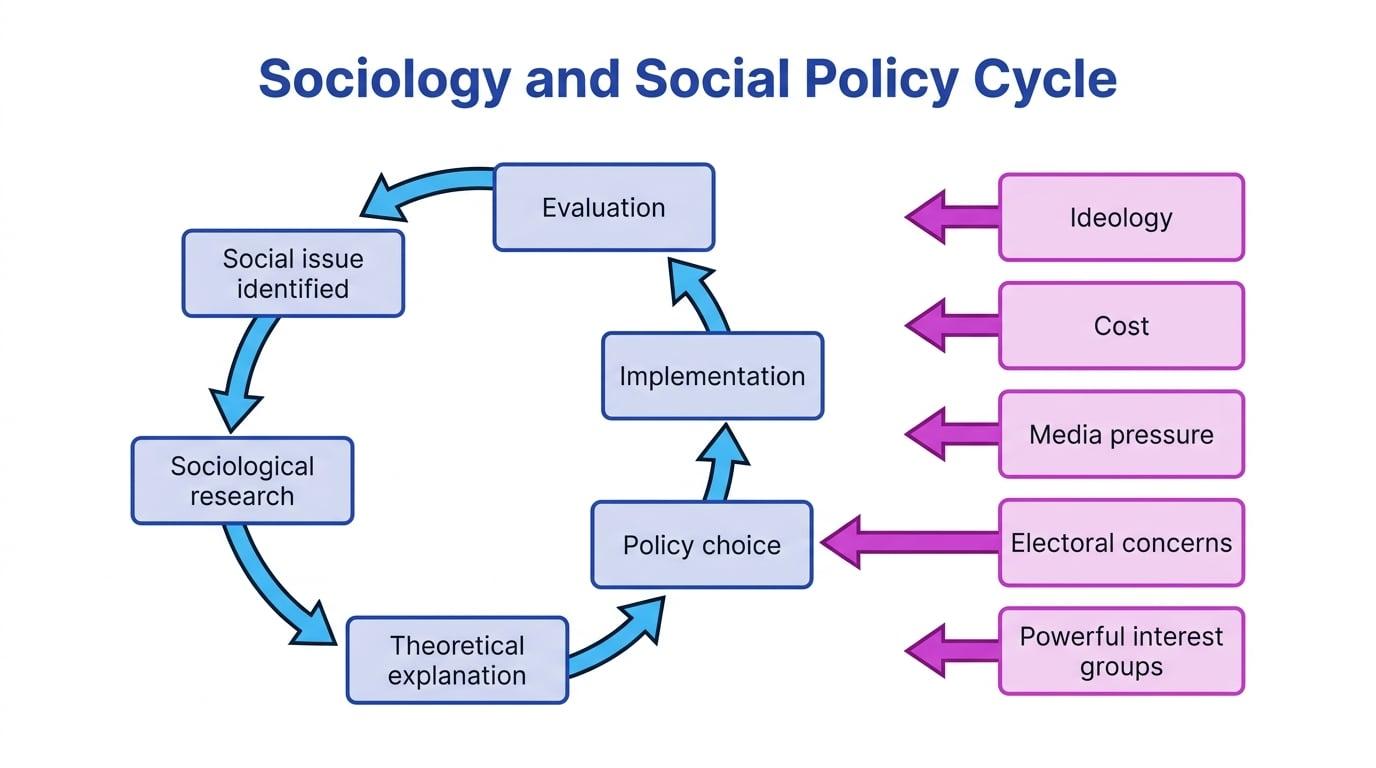
For example, sociological research on child poverty might influence benefit policy, early-years education, housing support or school funding. But this influence is never automatic. Governments also respond to ideology, budgets, public opinion, media pressure and powerful interest groups.
The big relationship
Sociology can provide evidence for policy, but policy is shaped by power, values and politics as well as by research.
Social problems and sociological problems
A social problem is an issue that a society, government or powerful group defines as harmful and in need of action. Examples might include knife crime, homelessness, school absence or poverty.
A sociological problem is broader: it is any social pattern that needs explanation. It may not be seen as urgent by politicians. For instance, sociologists might study why middle-class parents are better able to navigate school admissions, even if governments do not define this as a “crisis”.
This distinction matters because policy usually responds to socially constructed problems — issues that are publicly labelled as needing intervention. The media, pressure groups and politicians can all influence which issues become policy priorities.
Separating social and sociological problems
- Consider school exclusions. A government might define them as a social problem if they are linked to crime, truancy or poor exam results.
- A sociologist asks a wider question: why are some groups, such as working-class boys or some minority ethnic groups, excluded more often than others?
- This turns the issue into an analysis of social differentiation, power and stratification: exclusions may reflect class inequality, racialised labelling, school funding pressures or teacher expectations.
- A policy response might focus on behaviour units or stricter discipline, but sociological evaluation would ask whether this tackles the causes or simply manages the symptoms.
How sociology can influence policy
Sociology can contribute to policy in several ways.
Identifying patterns
Research can reveal inequalities that are not obvious from individual experience. For example, official statistics from the ONS, Census data or school performance data may show patterns in poverty, educational achievement, unemployment or health.
Explaining causes
Sociological theories help explain why problems occur. A functionalist may focus on social integration and shared values. A Marxist may focus on class exploitation. A feminist may focus on patriarchy. An interactionist may focus on labelling and meanings.
Evaluating outcomes
Sociologists can ask whether a policy achieves its stated aims, who benefits, who loses, and whether there are unintended consequences. For example, marketisation in education aimed to raise standards through parental choice, but sociologists such as Ball argue it can advantage middle-class families with more cultural and economic capital.
Unintended consequences
Unintended consequences are outcomes of a policy that were not planned by policymakers. These may be positive, negative or mixed.
Evidence-based policy: the optimistic view
Some sociologists and policymakers support evidence-based policy, meaning policy that is guided by reliable research rather than guesswork, tradition or ideology.
This view is linked to positivism, the approach that sociology should use systematic, scientific methods to discover social patterns. Positivists tend to favour quantitative data, such as surveys, official statistics and experiments, because these can produce generalisable evidence.
Functionalists are often relatively optimistic about policy. They see society as a system that needs order and integration. From this view, policy can help institutions such as the family, education system and welfare state perform their functions more effectively.
For example, education policies designed to improve literacy or reduce truancy could be seen as helping socialisation by transmitting shared norms and skills.
Assuming evidence simply becomes policy
Do not write as if sociological research automatically controls government decisions. Evidence is filtered through ideology, cost, electoral popularity, media framing and the interests of powerful groups.
Social democratic and Fabian approaches
Social democratic sociologists generally believe the state can reduce inequality through reform. They do not usually argue for revolution; instead, they support gradual change through welfare, education, taxation and public services.
This tradition is associated with Fabianism, a reformist socialist approach that sees research as a tool for improving society. Poverty studies by researchers such as Townsend helped shift debate towards seeing poverty as relative deprivation, not just absolute survival.
Relative deprivation
Relative deprivation means lacking the resources needed to participate in the normal life of society. It is about exclusion from ordinary living standards, not just physical survival.
AO2 examples include the welfare state, tax credits, Sure Start centres, the Pupil Premium and policies aimed at reducing health inequalities. These connect directly to the theme of social differentiation, power and stratification, because they try to reduce unequal life chances.
Analysing Sure Start through sociological perspectives
- Start with the policy: Sure Start, expanded under New Labour, aimed to support young children and families in disadvantaged areas through childcare, parenting support and early education.
- Apply a social democratic argument: early intervention can reduce class inequality by supporting children’s development before school.
- Link to socialisation: the policy assumes early childhood experiences shape identity, language, confidence and later educational achievement.
- Evaluate with another perspective: New Right thinkers may argue that state intervention weakens family responsibility, while Marxists may argue it treats symptoms of capitalism rather than the root cause of poverty.
- Add a real-world limitation: later funding cuts and uneven local provision make it harder to judge the policy as a simple success or failure.
Marxist views: policy serves capitalism
Marxists are much more critical. They argue that the state mainly serves the interests of the capitalist class, even when it appears neutral.
From a Marxist view, social policies often help reproduce capitalism. Education policy may produce a skilled and disciplined workforce. Welfare policy may keep workers healthy enough to work while preventing serious unrest. Crime policy may focus more on working-class street crime than on corporate harm.
This does not mean Marxists think every policy is useless. Rather, they argue that policies are limited because they do not challenge the ownership of wealth and power.
For AO2, you could apply this to welfare reform. Universal Credit may be presented as simplifying benefits and encouraging employment, but a Marxist could argue it disciplines the unemployed and pressures people into low-paid work, benefiting employers.
Feminist views: policy and patriarchy
Patriarchy
Patriarchy means a social system in which men hold disproportionate power over women in institutions such as the family, work, politics, law and culture.
Feminists examine whether social policies challenge or reinforce gender inequality. Some policies may support women’s independence, such as the Equal Pay Act 1970, Sex Discrimination Act 1975, Equality Act 2010, childcare funding and domestic abuse legislation.
However, feminists also criticise policies that assume women should be the main carers. For example, family policy may talk about “parents” but in practice place responsibility on mothers. Welfare systems can also monitor and judge women’s behaviour, especially working-class mothers and lone parents.
Thinkers such as Oakley are useful for discussing gender socialisation and domestic labour, while Walby is useful for analysing patriarchy across both public and private spheres.
A strong feminist evaluation move
Ask: does this policy redistribute power and resources, or does it simply expect women to manage inequality more efficiently?
New Right views: policy should encourage responsibility
The New Right favours limited state intervention, free markets, traditional family values and individual responsibility. New Right thinkers argue that generous welfare can create dependency and weaken the family.
Murray argued that welfare dependency contributed to an “underclass” with weak work norms and high rates of lone parenthood. This influenced debates about benefit conditionality, family policy and welfare reform.
AO2 examples include Universal Credit, benefit caps, tougher job-seeking requirements, academies, free schools and parental choice in education. These policies often assume that competition and responsibility improve outcomes.
AO3 evaluation is important: critics argue the New Right blames individuals for structural problems such as low wages, insecure work, unaffordable housing and regional inequality.
Interactionist views: labelling and policy
Interactionists focus on meanings, labels and everyday interactions. They ask how certain groups become defined as “problems”.
This is useful for analysing crime, education and welfare. Becker argued that deviance is not simply an act itself, but a result of social reaction and labelling. Cohen showed how media and official responses can create moral panics and deviancy amplification.
For policy, this means interventions can backfire. If young people are labelled as anti-social, deviant or “at risk”, this may affect their identity and how institutions treat them.
AO2 examples include stop and search, school behaviour policies, Prevent, anti-social behaviour orders and media-driven responses to youth crime.
Postmodern and late modern views
Postmodernists are sceptical of “one-size-fits-all” policy solutions. They argue society is increasingly diverse, fragmented and shaped by choice, identity and uncertainty.
This challenges traditional policy-making because different groups may have different needs. For example, family policy must respond to nuclear families, lone-parent families, reconstituted families, same-sex parents and chosen families.
Late modern thinkers such as Giddens and Beck also highlight risk, reflexivity and rapid social change. Policies around climate change, online harms, public health or surveillance must respond to new risks that older theories did not fully anticipate.
Why sociology may not influence policy
Even strong research may fail to shape policy. Reasons include:
- Political ideology: governments prefer evidence that fits their values.
- Cost: a policy may be sociologically convincing but too expensive for the government’s priorities.
- Electoral pressure: politicians may choose popular policies over complex evidence.
- Media framing: moral panics can push governments towards punitive responses.
- Powerful interests: businesses, professional groups and lobbying organisations may resist change.
- Practical problems: policies require staff, training, local capacity and administrative systems.
- Research limitations: studies may be small-scale, contested, outdated or difficult to translate into action.
This is where methods evaluation helps. You can discuss reliability, validity, representativeness, funding, access, ethics and whether the research is positivist or interpretivist.
Policy is also about power
The relationship between sociology and social policy is not just technical. It is about whose knowledge counts, whose problems matter, and whose interests are protected.
Using AO1, AO2 and AO3 together
For this topic, essays often become descriptive unless you deliberately build in application and evaluation.
AO1 is your knowledge: definitions, perspectives, theorists and concepts.
AO2 is your application: concrete UK examples such as Sure Start, Universal Credit, the Equality Act 2010, the smoking ban, Pupil Premium, academies, policing, welfare reform or domestic abuse policy.
AO3 is your analysis and evaluation: compare perspectives, assess evidence, identify limitations, and consider power, ideology and unintended consequences.
Building an evaluative paragraph on welfare policy
- Make the AO1 point: New Right sociologists argue welfare should avoid dependency and promote individual responsibility.
- Apply it to AO2: Universal Credit includes conditionality, meaning claimants may be required to search for work or face sanctions.
- Analyse the assumption: this treats unemployment partly as a problem of motivation and behaviour.
- Evaluate with a structural view: Marxists and social democrats argue unemployment and poverty are also shaped by low wages, insecure labour markets, housing costs and regional inequality.
- Reach a judgement: the policy may encourage some people into work, but it may also individualise poverty and overlook wider class inequalities.
In the exam
- Define social policy early, then show that sociology can identify, explain and evaluate social problems.
- Use at least two contrasting perspectives, such as New Right versus Marxist, or social democratic versus feminist.
- Always apply theory to a real UK policy example, then evaluate using ideology, power, cost, evidence or unintended consequences.
Check yourself
- What is the difference between a social problem and a sociological problem?
- Why might a government ignore strong sociological evidence?
- How would a Marxist, feminist and New Right sociologist each interpret welfare policy?