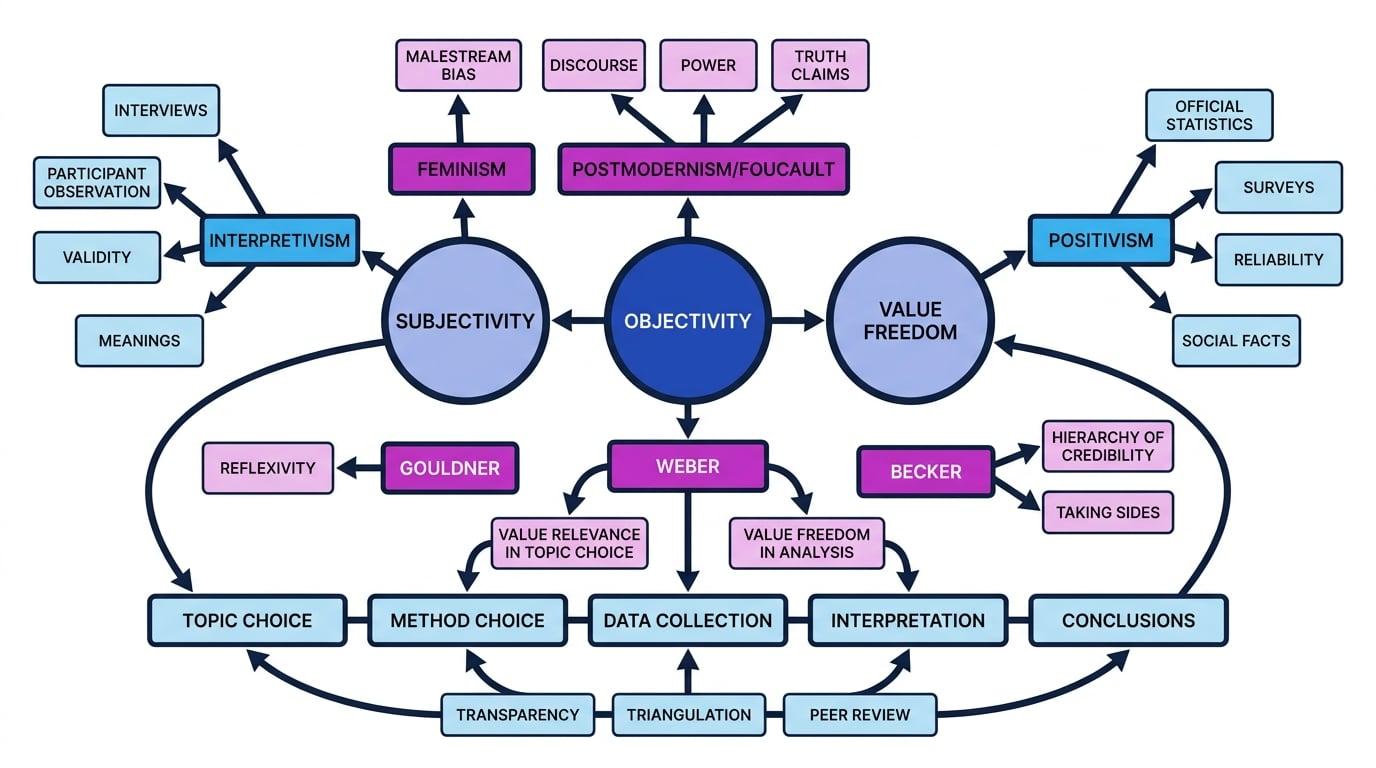
What you'll learn
- What subjectivity, objectivity and value freedom mean in sociological research.
- How positivists, interpretivists, Weber, Gouldner, Becker, feminists and postmodernists approach the debate.
- Why this matters for methods, especially reliability, validity, ethics and research funding.
- How to evaluate whether sociology can ever be fully “neutral”.
Why this debate matters
Sociology studies social life, but sociologists are themselves part of society. They have been socialised into particular cultures, identities, political assumptions and moral values. This creates a key Theory and Methods question: can sociologists study society objectively, or do their values always shape what they investigate and what they conclude?
This debate links directly to the two core AQA themes:
- Socialisation, culture and identity: researchers and participants interpret the world through learned meanings.
- Social differentiation, power and stratification: powerful groups may influence what counts as “truth”, what gets funded, and whose experiences are treated as important.
Values
Values are beliefs about what is important, desirable, right or wrong. In sociology, values may shape the choice of topic, the concepts used, the methods chosen, the interpretation of evidence and the recommendations made.
Subjectivity and objectivity
Subjectivity and objectivity
Subjectivity means being influenced by personal meanings, experiences, emotions, assumptions or values. Objectivity means trying to produce knowledge based on evidence, clear methods and logical analysis rather than personal opinion.
Subjectivity is not always “bad”. If you are studying identity, religion, crime, education or family life, people’s subjective meanings are often exactly what you need to understand. For example, a pupil’s experience of being labelled “troublemaker” cannot be captured fully by an exclusion statistic alone.
Objectivity, however, matters because sociology claims to produce knowledge rather than just opinion. Researchers try to improve objectivity through careful sampling, standardised questions, transparent coding, peer review, triangulation and separating evidence from moral judgement.
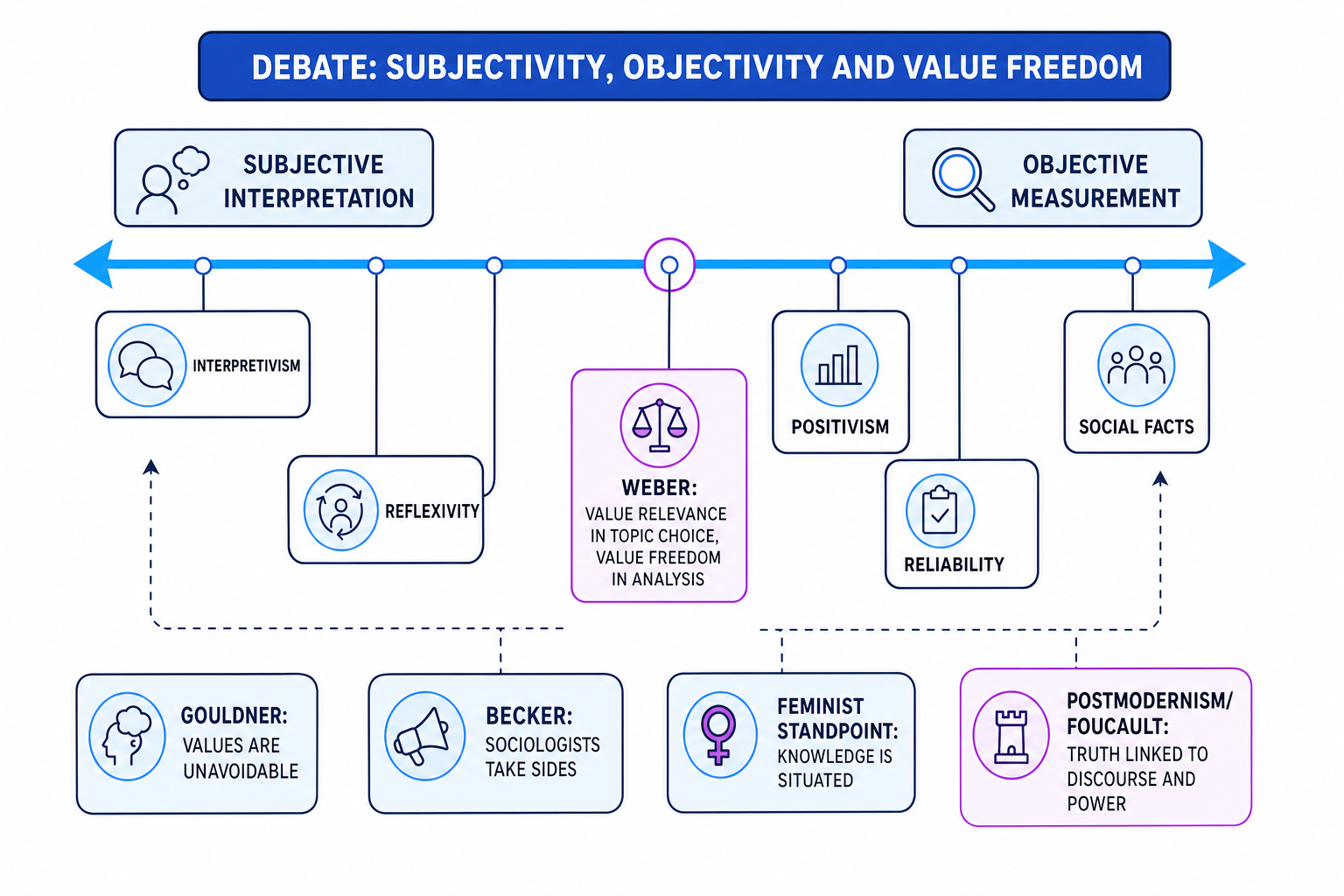
Spotting subjective and objective elements
-
A sociologist chooses to study whether Black Caribbean boys are disproportionately excluded from school. This topic choice is partly value-influenced because it treats racial inequality as a serious social issue.
-
The researcher then collects Department for Education statistics and uses the same coding rules for every school. This makes the evidence more objective and reliable than relying on personal impressions.
-
The researcher interviews pupils and teachers to understand experiences of labelling and discipline. This introduces interpretation, but it may increase validity because it explores the meanings behind the statistics.
Objectivity is not the same as being emotionless
A study can be motivated by moral concern, such as concern about poverty or racism, but still use systematic evidence. The key question is whether the researcher lets values replace evidence.
Positivism: sociology should aim for objectivity
Positivism
Positivism is the view that sociology should study society scientifically, using systematic methods to discover patterns, causes and social facts.
Positivists such as Comte and Durkheim argued that society can be studied in a similar way to the natural sciences. Durkheim’s study of suicide treated suicide rates as social facts: external social patterns that could be measured and explained through social integration and regulation.
For positivists, objectivity is possible if researchers use:
- Quantitative data, such as official statistics and surveys.
- Standardised methods, so another researcher could repeat the study.
- Clear definitions, so concepts like “crime”, “poverty” or “educational achievement” are measured consistently.
- Representative samples, so findings are not just based on unusual cases.
The positivist promise
Positivists do not claim researchers have no personal views. They claim good research methods can control those views enough to produce reliable, objective knowledge.
AO2 application: official statistics
In the UK, researchers might use ONS Census data, crime statistics or Department for Education attainment data to identify patterns by class, gender or ethnicity. This can reveal social differentiation and stratification, such as inequalities in income, school exclusions or life expectancy.
AO3 evaluation
The positivist approach is strong on reliability because standardised methods can be repeated. It can also reveal large-scale patterns that individuals may not notice.
However, official statistics are not perfectly objective. Crime statistics depend on reporting and recording practices. Ethnic categories in the Census are socially constructed. “Free school meals” is often used as a measure of disadvantage, but it does not capture every form of class inequality. So even apparently objective data involves human decisions.
Interpretivism: meanings make pure objectivity difficult
Interpretivism
Interpretivism is the view that sociology should understand the meanings people give to their actions, identities and social worlds.
Interpretivists argue that human beings are not like chemicals in a laboratory. People interpret situations, respond to labels, manage impressions and create shared meanings. Therefore, sociologists need methods such as unstructured interviews, participant observation and ethnography.
For interpretivists, subjectivity is not just a problem. It is also part of social reality. A person’s identity as “working-class”, “religious”, “deviant”, “masculine” or “successful” is shaped through meanings learned in culture and social interaction.
Meanings are data
Interpretivists argue that to understand social action, sociologists must study people’s subjective meanings, not just external behaviour.
Understanding truancy interpretively
-
A positivist might start with attendance statistics and identify which groups have higher truancy rates.
-
An interpretivist would ask what truancy means to pupils. For some, it may be resistance to school authority; for others, it may be linked to bullying, caring responsibilities or mental health.
-
The interpretivist explanation may be less reliable because interviews are harder to repeat exactly, but it may be more valid because it gets closer to pupils’ lived experiences.
AO3 evaluation
Interpretivism is strong on validity, especially for topics involving identity, labelling, stigma or subcultures. For example, Willis’s study of “the lads” showed how working-class boys actively created anti-school identities.
However, interpretive research can be criticised for researcher bias, small samples and difficulty in generalising. If a sociologist becomes too close to participants, they may “go native” and lose analytical distance.
Weber: value relevance and value freedom
Max Weber offers a balanced position. He accepted that values influence sociology, but he still believed researchers should try to separate evidence from personal judgement.
Weber's distinction
Value relevance means values influence the choice of research topic. Value freedom means researchers should avoid letting their values distort data collection, analysis and conclusions.
For Weber, it is unrealistic to pretend that sociologists choose topics randomly. A sociologist may study poverty because they care about inequality, or religion because they think meaning and identity matter. But once the topic is chosen, the researcher should use evidence honestly and avoid presenting moral beliefs as facts.
Using Weber's distinction
-
A researcher chooses to study food bank use because they believe poverty is a serious issue. This is value relevance: values shape the topic choice.
-
The researcher then defines key concepts carefully, such as “food insecurity”, “household income” and “benefit delay”, so the study is not just based on emotional language.
-
When writing conclusions, the researcher distinguishes evidence from judgement: “benefit delays were reported by many participants” is an evidence-based claim; “the benefits system is immoral” is a value judgement.
Weber in one sentence
Weber’s position is: values may guide what sociologists study, but evidence should guide what sociologists conclude.
Challenges to value freedom
Many sociologists argue that value freedom is either impossible, undesirable, or both.
Gouldner: value freedom is a myth
Alvin Gouldner argued that sociology cannot be value-free because sociologists bring assumptions from their own social backgrounds, political beliefs and academic traditions. He supported reflexive sociology, where researchers openly examine how their values affect their work.
Reflexivity
Reflexivity means critically reflecting on how the researcher’s identity, values, role and relationship with participants may shape the research process.
Reflexivity is especially important in research on gender, ethnicity, sexuality, class and disability, because power relations may affect what participants feel able to say.
Becker: sociologists inevitably take sides
Howard Becker argued in “Whose Side Are We On?” that sociologists cannot avoid taking sides. In stratified societies, powerful groups often have a hierarchy of credibility, meaning their version of reality is more likely to be believed.
For example, in research on crime, police, courts and media may be treated as more credible than young people labelled as “deviant”. Becker argues that studying marginalised groups can challenge the official view.
Feminist sociology: “malestream” objectivity
Feminist sociologists argue that supposedly objective sociology has often reflected male assumptions. Oakley criticised detached, hierarchical interviewing and argued that feminist research should be more equal and open. Stanley and Wise argued that women’s experiences should be taken seriously as a basis for knowledge.
This links to power and stratification: if research ignores women’s unpaid labour, domestic abuse or workplace discrimination, it may appear neutral while actually reproducing patriarchy.
Postmodernism and Foucault: truth and power
Postmodernists are sceptical of any claim to a single objective truth. Foucault argued that knowledge and power are connected through discourses, which are ways of talking and thinking that define what counts as normal, deviant, healthy or criminal.
For example, debates about “anti-social behaviour”, “radicalisation” or “benefit dependency” are not just neutral descriptions. They can shape how groups are controlled, labelled or governed.
Applying reflexivity to gender research
-
A sociologist researching women’s experiences of workplace harassment reflects on how their own gender, age and professional status may affect what participants disclose.
-
They design the research ethically by ensuring informed consent, confidentiality and support information, because value freedom does not mean ignoring harm.
-
In the write-up, they explain how interview dynamics may have shaped the data, allowing readers to judge the credibility of the findings.
So, can sociology be value-free?
A strong answer is usually balanced: complete value freedom is unlikely, but disciplined objectivity is still possible and necessary.
Values can enter sociology through:
- Topic choice: why study poverty rather than elite wealth?
- Concepts: “underclass”, “deprivation” and “social exclusion” carry different assumptions.
- Funding: government or corporate funders may prefer certain questions.
- Access: schools, prisons or companies may restrict what researchers can observe.
- Interpretation: the same data may be explained differently by Marxists, feminists, functionalists or New Right theorists.
But this does not mean “anything goes”. Sociology can still improve objectivity through transparent methods, evidence, peer criticism, triangulation, ethical review and reflexivity.
Best conclusion
Sociology may never be completely value-free, but it can be value-aware. The aim is not to have no values at all, but to prevent hidden values from distorting evidence.
Quick perspective comparison
| Perspective | View of objectivity and value freedom | Evaluation |
|---|---|---|
| Positivism | Objectivity is possible through scientific methods, measurement and reliability. | Strong for patterns, but may ignore meanings and the social construction of data. |
| Interpretivism | Full objectivity is difficult because sociology studies meanings. | Strong for validity, but may be less reliable and harder to generalise. |
| Weber | Topic choice is value-relevant, but analysis should be value-free. | Balanced and exam-friendly, but critics say values still shape interpretation. |
| Gouldner | Value freedom is impossible; sociologists should be reflexive. | Useful critique, but may weaken claims to scientific objectivity. |
| Becker | Sociologists inevitably take sides, often against powerful official viewpoints. | Reveals power, but may risk appearing politically biased. |
| Feminism | Traditional objectivity may hide male power; research should expose inequality. | Highlights patriarchy, but critics may question whether committed research can be neutral. |
| Postmodernism | Truth claims are linked to discourse and power. | Challenges certainty, but can slide into relativism. |
In the exam
-
Define the terms early: distinguish subjectivity, objectivity and value freedom rather than using them as synonyms.
-
Use named theorists for AO1: Weber, Durkheim, Gouldner, Becker, feminists and Foucault are especially useful for this debate.
-
Evaluate both extremes: avoid saying sociology is either completely scientific or completely biased. A strong conclusion usually argues for “value-aware” research.
-
Apply to real methods: mention official statistics, interviews, funding, ethics, reliability, validity and reflexivity to show Theory and Methods understanding.
Check yourself
- What is the difference between Weber’s value relevance and value freedom?
- Why might official statistics look objective but still contain social assumptions?
- How would Becker or a feminist sociologist criticise the idea of neutral research?